
pyRadMC








Fast photon Monte Carlo dose engine for radiotherapy treatment planning.
Status: pre-1.0 research software. The physics, both backends and the influence-matrix pipeline are complete and test-pinned, but the software is young, and the validation it has passed is stated precisely on the validation status page rather than claimed broadly. Do not use it for anything clinical, now or later, without independent validation.
The primary product is a beamlet-resolved dose influence matrix (Dij) for photon IMRT/VMAT planning: sparse CSC columns with a per-entry statistical uncertainty, computed on CPU and CUDA from a single physics source by tagging every history's whole secondary family with its beamlet of origin. Scheduling — grouping, chunking, batch merging, which GPU gets which column — cannot change the matrix by one bit (test-pinned). Measured end to end on a laptop RTX 4070 at planning statistics: ~1.1e7 histories/s, i.e. a 100-beamlet 6 MeV field at 2–3 % per-beamlet sigma in single-digit seconds.
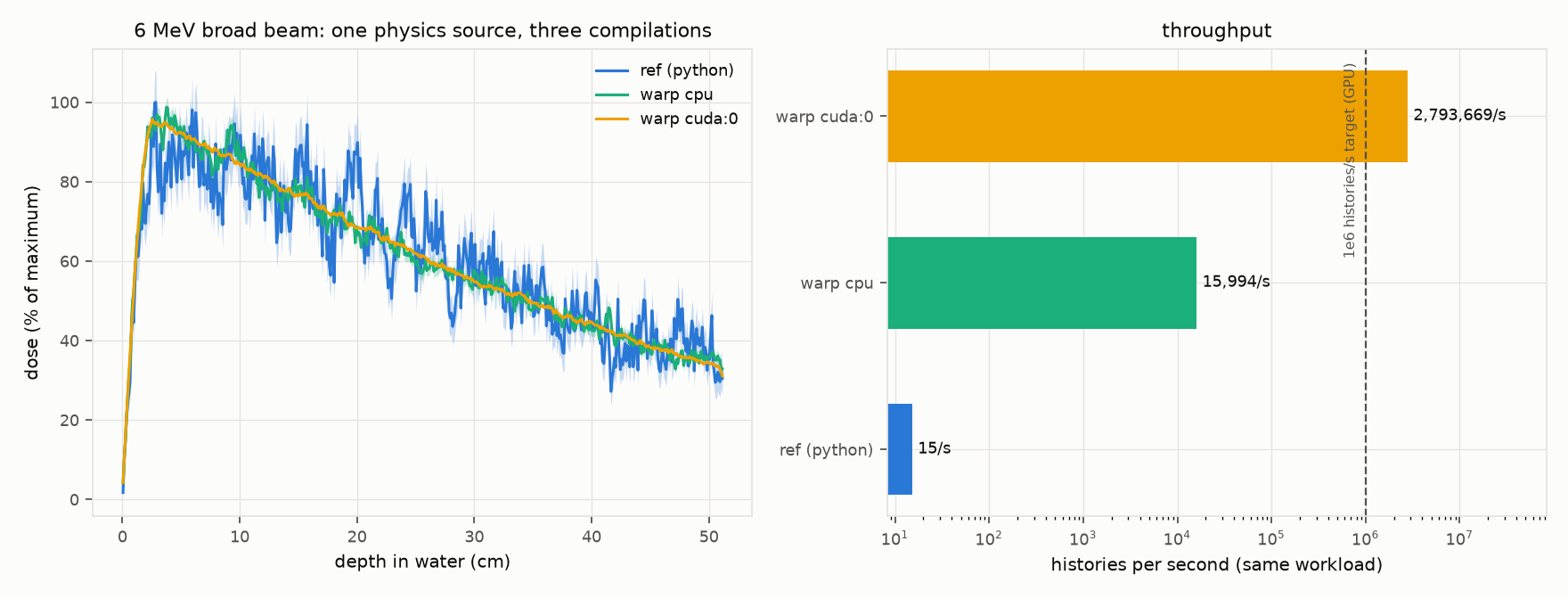
The same 6 MeV beam computed with the reference interpreter and with the Warp compilation of
the identical physics source on CPU and CUDA (examples/warp_backend_demo.py). The
depth-dose curves agree within their error bands; the bars show why the backend exists.
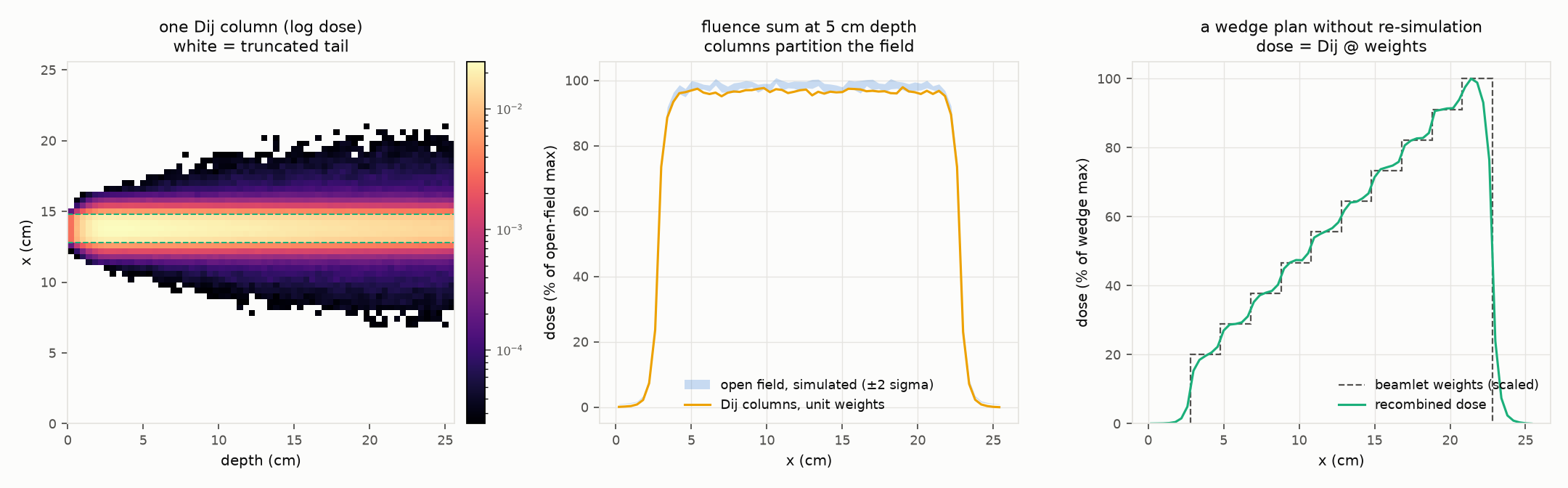
The point of the whole exercise (examples/dij_demo.py): one beamlet's dose column with the
truncated tail visible (left); the open field recombined from the columns at unit weights
against an independently simulated open field (middle — columns partition the field exactly);
and a wedge plan as Dij @ weights, no re-simulation (right), which is the loop a
treatment-plan optimizer runs thousands of times.
Install
pip install pyRadMC              # reference backend; NumPy and SciPy only
pip install "pyRadMC[warp]"      # production backend, CPU and CUDA
pip install "pyRadMC[ct]"        # CT image reading (SimpleITK)
Until the first tagged release reaches PyPI, install from a clone instead:
pip install -e ".[warp]".
| Backend | Role | Devices |
|---|---|---|
ref |
correctness oracle; never optimized | CPU (NumPy) |
warp |
production | CPU, CUDA |
Warp needs no CUDA toolkit to install and runs on the CPU without a GPU; CUDA is used when a device is present. The two backends are validated against each other statistically — CPU and GPU results are never bit-identical, but each is bit-reproducible on its own device for a given seed.
Both backends reuse deterministic Goudsmit-Saunderson tables from
~/.cache/pyradmc/gs-grid. The reference sampler loads existing nodes and grows
the stored window on demand, so fresh processes reuse previous table builds.
Quick start
from pyradmc import AnalyticCrossSections, HostRNG, PencilBeamSource, ReferenceEngine, VoxelGrid

grid = VoxelGrid.uniform_water(shape=(16, 16, 16), spacing=(1.0, 1.0, 1.0))
xs = AnalyticCrossSections(geometry_densities=grid.max_density_by_material())
source = PencilBeamSource(energy=6.0, position=(8.0, 8.0, -1.0), direction=(0.0, 0.0, 1.0))

result = ReferenceEngine(grid=grid, cross_sections=xs, rng=HostRNG()).run(
    source, n_histories=80_000, n_batches=10, seed=20260726
)
result.dose          # MeV/g per emitted history, on the scoring grid
result.dose_sigma    # batched 1-sigma
result.provenance    # version, seed, cutoffs, backend, device, cross-sections
Swap in WarpEngine(grid=..., cross_sections=..., device="cuda:0") for the production backend —
the run signatures are identical. Everything importable from the top-level pyradmc
namespace is public API.
From here, the documentation carries the rest:
getting started (GPU runs, the
influence matrix, pencil-beam kernels, a tour of the examples/),
validation status — read it before
trusting a number — and
cross-section data (the engine ships no
libraries; the tabulated backend compiles from the IAEA EPICS evaluations, digest-verified).
Contributing
Read AGENTS.md before contributing — it is the governing document, written for
human and agentic contributors alike; CONTRIBUTING.md is the short version
of the mechanics. Work lands on develop through squash-merged pull requests; main carries
releases only.
License
Apache-2.0. See LICENSE.
1 maintainer

Release files for pyRadMC 0.2.1
For a detailed explanation of source distributions (sdists) and built distributions (wheels), please see the package formats documentation.
Source distribution (sdist)
| File | Size | Uploaded | |
|---|---|---|---|
| pyradmc-0.2.1.tar.gz | 1.7 MB | Details |
Built distribution (wheel)
| File | Interpreter | ABI | Platform | Reset |
|---|---|---|---|---|
| pyradmc-0.2.1-py3-none-any.whl | Python 3 | none | any | Details |
Total release size: 2.0 MB
Release files / pyradmc-0.2.1.tar.gz
| Download URL | pyradmc-0.2.1.tar.gz |
|---|---|
| Size | 1.7 MB |
| Tags | Source |
|
SHA-256 checksum How to use checksums |
e18c12c95a1d1eb2e1011f37fd17f4326851dfa37e32d02ab27669a434508b94
|
|
BLAKE2b-256 checksum How to use checksums |
e6af98a28d813421ee31fb670ff7287f20dca0f90e099ef8ed2425ff187f712d
|
| Upload date | |
|
Uploaded using Trusted Publishing? What is trusted publishing? |
Yes |
| Uploaded via |
twine/7.0.0 CPython/3.13.14
|
Provenance
Provenance describes where a file came from. On PyPI, provenance is shared via attestations, which provide a verifiable record of the build or publishing details. View details, limitations and caveats.


PyPI Publish Attestation
PyPI verified that this artifact, at this checksum, originated from the publisher listed below.
Signed by GitHub Actions, verified by PyPI on Sep 6, 2026.
Transparency logRelease files / pyradmc-0.2.1-py3-none-any.whl
| Download URL | pyradmc-0.2.1-py3-none-any.whl |
|---|---|
| Size | 294.5 kB |
| Tags | Python 3 |
|
SHA-256 checksum How to use checksums |
c92af30ba6ef6f3fd402af88ffef4113e3c9b43d3bf4b50e2efe0e088a2106ac
|
|
BLAKE2b-256 checksum How to use checksums |
35a04a72194e8327f71262067974ed5574feaafacd9e68821b3f7fb22bec18a0
|
| Upload date | |
|
Uploaded using Trusted Publishing? What is trusted publishing? |
Yes |
| Uploaded via |
twine/7.0.0 CPython/3.13.14
|
Provenance
Provenance describes where a file came from. On PyPI, provenance is shared via attestations, which provide a verifiable record of the build or publishing details. View details, limitations and caveats.
PyPI Publish Attestation
PyPI verified that this artifact, at this checksum, originated from the publisher listed below.
Signed by GitHub Actions, verified by PyPI on Sep 6, 2026.
Transparency log













