
This release is a pre-release and may not be stable for production use.
A5 - Global, equal-area, millimeter-accurate geospatial index
Website: A5Geo.org
Introduction
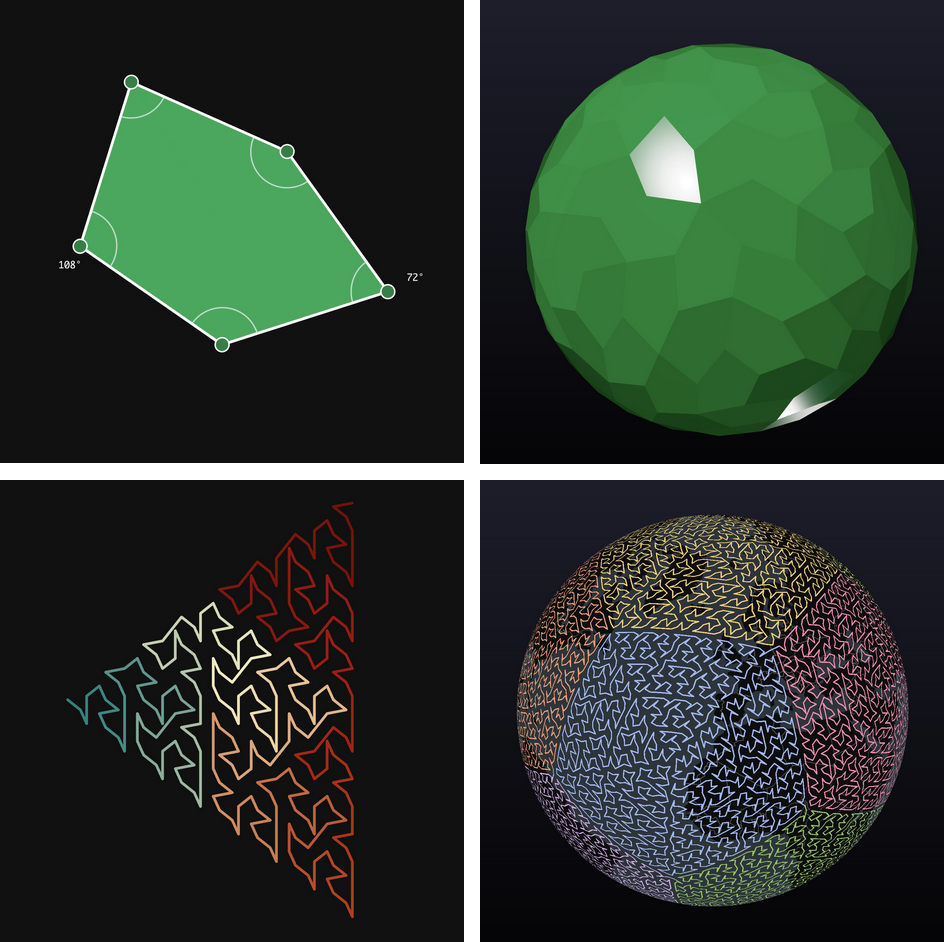
A5 is a geospatial index that partitions the world into pentagonal cells. The cells are available at 31 different resolution levels, with the largest cell covering the whole world, and the smallest less than 30mm². Within each resolution level the cells have equal area, as per the OGC definition.
A5 cells provide simple way to represent spatial data as a collection of cells, which together represent regions on the globe. These can be anything, from city districts to parcels of land. Once data is in a cell-based format, it becomes much simpler to perform analysis such as calculating the correlation between different variables - for example elevation and crop yield.
Cells can also be used to group (aggregate) point data, to understand how it spatially distributed. For example, the density of holiday rentals across a city.
To understand how it works, take a look at the Examples.
A5 is implemented in TypeScript and is available as a library, with API documentation here. It is open source and licensed under the Apache 2.0 License.
Benefits over alternative systems
Like other DGGSs, A5 can be used for indexing, spatial joins, and other spatial operations. The appropriate choice of DGGS will depend on the use case, the key strengths of A5 over other similar indexing systems are:
- Equal area cells group spatial features without introducing bias.
- Very high resolution of 30mm² at final resolution level, encoded as a 64-bit integer.
- Single cell topology type, with minimal shape distortion across the globe.
Geometric Construction
DGGSs are generally based on a planar cell tiling which is applied to the sides of a platonic solid, before being projected onto a sphere.
A5 is unique in that it uses a pentagonal tiling of a dodecahedron. The pentagon chosen for the tiling is equilateral, but not regular - unlike other common DGGSs which use regular polygons, for example HTM uses triangles, S2 uses squares, and H3 uses hexagons.
The benefit of choosing a dodecahedron is that it is the platonic solid with the lowest vertex curvature, and by this measure it is the most spherical of all the platonic solids. This is key for minimizing cell distortion as the process of projecting a platonic solid onto a sphere involves warping the cell geometry to force the vertex curvature to approach zero. Thus, the lower the original vertex curvature, the less distortion will be introduced by the projection.
1 maintainer

Metadata
1 maintainer
Release files for pya5 1.0.0b1
For a detailed explanation of source distributions (sdists) and built distributions (wheels), please see the package formats documentation.
Source distribution (sdist)
| File | Size | Uploaded | |
|---|---|---|---|
| pya5-1.0.0b1.tar.gz | 513.7 kB | Details |
Built distribution (wheel)
| File | Interpreter | ABI | Platform | Reset |
|---|---|---|---|---|
| pya5-1.0.0b1-py3-none-any.whl | Python 3 | none | any | Details |
Total release size: 642.7 kB
Release files / pya5-1.0.0b1.tar.gz
| Download URL | pya5-1.0.0b1.tar.gz |
|---|---|
| Size | 513.7 kB |
| Tags | Source |
|
SHA-256 checksum How to use checksums |
15ff6e35563206d05942f2105c04d2ff915a8df59f820ccee5545696f4a5d8ac
|
|
BLAKE2b-256 checksum How to use checksums |
af849233572e150884fdc61b5c740e025d97b2d4102483667e65da37e8a1ce14
|
| Upload date | |
|
Uploaded using Trusted Publishing? What is trusted publishing? |
Yes |
| Uploaded via |
twine/7.0.0 CPython/3.13.14
|
Provenance
Provenance describes where a file came from. On PyPI, provenance is shared via attestations, which provide a verifiable record of the build or publishing details. View details, limitations and caveats.


PyPI Publish Attestation
PyPI verified that this artifact, at this checksum, originated from the publisher listed below.
Signed by GitHub Actions, verified by PyPI on Oct 9, 2026.
Transparency logRelease files / pya5-1.0.0b1-py3-none-any.whl
| Download URL | pya5-1.0.0b1-py3-none-any.whl |
|---|---|
| Size | 129.0 kB |
| Tags | Python 3 |
|
SHA-256 checksum How to use checksums |
a686eaadd8de915b6cf5b00bbc290ad40371a16a8e97b4beeacb21a82f770503
|
|
BLAKE2b-256 checksum How to use checksums |
07ffaa4246166d456f393e57999fd78e5bc88de6d90cf13ca38d7f3babae4975
|
| Upload date | |
|
Uploaded using Trusted Publishing? What is trusted publishing? |
Yes |
| Uploaded via |
twine/7.0.0 CPython/3.13.14
|
Provenance
Provenance describes where a file came from. On PyPI, provenance is shared via attestations, which provide a verifiable record of the build or publishing details. View details, limitations and caveats.
PyPI Publish Attestation
PyPI verified that this artifact, at this checksum, originated from the publisher listed below.
Signed by GitHub Actions, verified by PyPI on Oct 9, 2026.
Transparency log













