
A python package for time series anomaly detection

Project description
Anomaly Detection for Time-series (PyADTS)







PyADTS is aimed at accelerating the workflow of time series anomaly detection for researchers. It contains various utilities for data loading, pre-processing, detector construction, detector ensemble, evaluation and etc. PyADTS can help you to write less boilerplate on following parts:
- Preparing dataset & pre-processing
- Feature extraction (Optional)
- Model training
- Ensemble (Optional)
- Evaluation
You can find the complete documentation here.
Table of Contents:
Installation
To install the package locally, run:
>> cd <pyadts_dir>
>> pip install .
To install the package from PyPi, run:
>> pip install pyadts
Quick Start
Fetch the dataset
PyADTS contains various built-in datasets. To utilize them:
from pyadts.data import get_nab_nyc_taxi

data = get_nab_nyc_taxi(root_path='<the_path_of_nab_dataset>')
All components of the dataset are organized as a dict:
{'value': value, 'label': label, 'timestamp': timestamp, 'datetime': datetime}
Pre-processing
It's important to pre-process the time series before training. PyADTS offered three types of pre-processing methods including:
- Rearrangement: Sort the values along with the timestamp and reconstruct the timestamp to discover missing values. (return a dict and append an attribute
missing) - Normalization: Normalize the time series
- Imputation: Impute the time series.
from pyadts.data import series_impute, series_normalize, series_rearrange

data_processed = series_rearrange(**data)

data_processed['value'] = series_normalize(data_processed['value'], mask=data_processed['missing'], method='zscore')

data_processed['value'] = series_impute(data_processed['value'], missing=data_processed['missing'], method='linear')
Feature extraction
Extracting manual features is essential for some anomaly detection approaches. PyADT offered various options for extracting features including:
- Simple features: logarithm, difference, second-order difference, ...
- Window-based features: window mean value, window std value, ...
- Decomposition features: STL decomposition, ...
- Frequency domain features: wavelet features, spectral residual, ...
- Regression features: SARIMA regression residual, Exponential Smoothing residual, ...
from pyadts.data import FeatureExtractor

feature_extractor = FeatureExtractor()
Train the model
Different anomaly detection algorithms should be utilized to tackle different scenarios. PyADT contains various algorithms including supervised-, unsupervised-, nonparametric-methods (you can refer the full list of implemented algorithms).
from pyadts import ThresholdDetector

train_x = data['value']
detector = ThresholdDetector()
pred_y = detector.fit_predict(train_x)
Ensemble
TODO
Evaluation
It's easy to evaluate your algorithms using PyADT's built-in metrics:
from pyadts import roc_auc

train_y = data['label']
roc = roc_auc(pred_y, train_y, delay=7)
In real-world applications, the delay of anomaly alerts is acceptable. So PyADT offered the delay argument for all metrics.
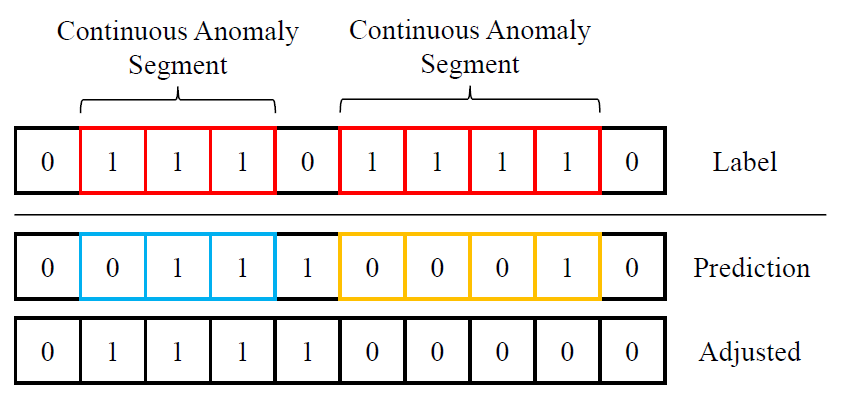
The pipeline
TODO
Other Utilities
Visualization
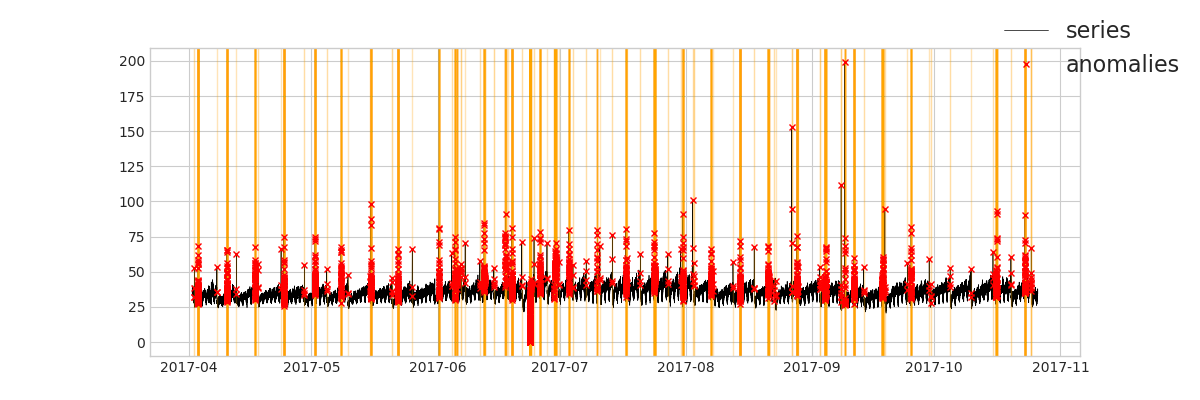
You can visualize your data with a single line of code:
from pyadts.data import plot_series

fig = plot_series(value=data['value'], label=data['label'], datetime=data['datetime'], plot_vline=True)
fig.show()
The example visualization:
Generate synthetic data
TODO
Implemented Algorithms
Supervised Approaches
- Random Forest
- SVM
- Deep Neural Network
Unsupervised Approaches
Non-parametric
- SR
- Threshold
- Quantile
- K-Sigma
Statistic-based
- SPOT
- DSPOT
- Autoregression
- ESD
- S-ESD
- S-H-ESD
Machine learning-based
- LOF
- Isolation Forest
- OCSVM
Deep-based
- Autoencoder
- RNN Autoencoder
- Donut
TODO
- Fix bugs and reformat code
- Multi-variate time series support
- Complete the models
- Incorporating Numba
- Implement the pipeline
- Synthetic data generator
- Allow both inplace and non-inplace operations
- Add streaming support
Release history Release notifications | RSS feed


Download files
Download the file for your platform. If you're not sure which to choose, learn more about installing packages.
Source Distribution
Built Distribution
Filter files by name, interpreter, ABI, and platform.
If you're not sure about the file name format, learn more about wheel file names.
Copy a direct link to the current filters
File details
Details for the file pyadts-0.0.2a0.tar.gz.
File metadata
- Download URL: pyadts-0.0.2a0.tar.gz
- Upload date:
- Size: 4.3 kB
- Tags: Source
- Uploaded using Trusted Publishing? No
- Uploaded via: twine/3.2.0 pkginfo/1.5.0.1 requests/2.24.0 setuptools/49.2.0.post20200714 requests-toolbelt/0.9.1 tqdm/4.47.0 CPython/3.8.3
File hashes
| Algorithm | Hash digest | |
|---|---|---|
| SHA256 |
d107496c1362344c51737dc5297d483d591222216dd8bdf161b8433c949496ed
|
|
| MD5 |
309ba67e12d461165f20b6ff5d44ca36
|
|
| BLAKE2b-256 |
81f7f451729ce4c75051b9905bdcb63fbf22dc082667b31fc06dc00db18fe310
|
File details
Details for the file pyadts-0.0.2a0-py3-none-any.whl.
File metadata
- Download URL: pyadts-0.0.2a0-py3-none-any.whl
- Upload date:
- Size: 15.6 kB
- Tags: Python 3
- Uploaded using Trusted Publishing? No
- Uploaded via: twine/3.2.0 pkginfo/1.5.0.1 requests/2.24.0 setuptools/49.2.0.post20200714 requests-toolbelt/0.9.1 tqdm/4.47.0 CPython/3.8.3
File hashes
| Algorithm | Hash digest | |
|---|---|---|
| SHA256 |
8ddd2fbbba2f4e003ec3d682b740a0fc8f93b3bbbd9982430b50e05c3ed457fe
|
|
| MD5 |
96f11e9240e2153ee51c3e1d945aaaf9
|
|
| BLAKE2b-256 |
f7120eebd2ff373272148133c2af37c15754e0d7d97bdb91b2655add428e79ad
|






