
pyaesa is a Python package for absolute environmental sustainability assessment (AESA), covering data download and processing, deterministic and uncertainty assessment, and figure generation.
Verified details
These details have been verified by PyPIProject links
GitHub Statistics
Maintainers

Project description

Documentation: pyaesa.readthedocs.io reproduces the documentation of this GitHub repository.
Beta status: pyaesa is currently in beta testing. Please report bugs,
unexpected behavior, documentation gaps, and installation or workflow issues on
the GitHub Issues page.
pyaesa is a Python package for absolute environmental sustainability
assessment (AESA) workflows. It supports data download, data
processing, deterministic calculations, figure rendering, Monte Carlo
uncertainty and Sobol variance.
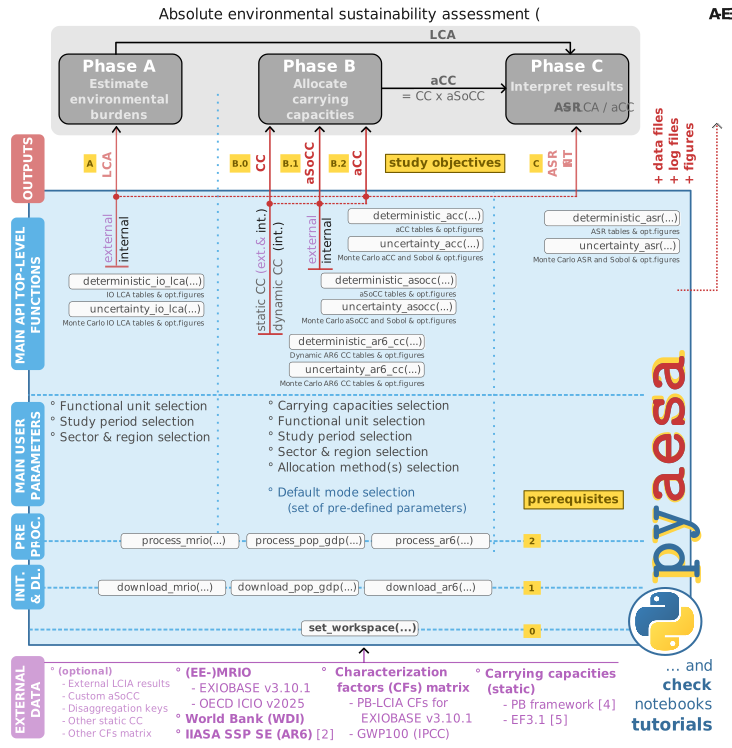
The package follows the three AESA phases described in the JRC guidance. The calculation chain is:
- Phase A builds life cycle assessment (LCA) results.
- Phase B builds allocated carrying capacity (aCC) results:
aCC = aSoCC * CC. - Phase C builds absolute sustainability ratio (ASR) results:
ASR = LCA / aCC.
aSoCC means allocated share of carrying capacity. CC means carrying
capacity. CC can be static, for example with LCIA methods PB-LCIA or EF3.1,
or dynamic through AR6 climate change pathways.
License
pyaesa
source code is distributed under the GPL 3.0 license. Downloaded datasets
remain governed by their original providers' terms and conditions documented in
the Data Source Licenses And Terms section.
Community
Contributing to pyaesa
pyaesa uses the GitHub Discussions Ideas category to collect feature ideas and development priorities from users.
Use Ideas to propose new features, request additional allocation methods, upvote existing proposals, and comment with your use case, data source, expected workflow, or implementation constraints.
To propose direct code modifications, for example implementing new allocation
methods or other features, see CONTRIBUTING.md.
Sharing Reproducible Case Studies
Users are encouraged to share AESA case studies developed with
pyaesa
in the AESA_case_studies
repository. This supports the AESA community by making case studies easier to
understand, inspect, reproduce, compare, and extend.
Installation
Install the package from PyPI:
python -m pip install pyaesa
For local development from a repository clone, install in editable mode:
python -m pip install -e .
pyaesa requires at least 4 GB of available RAM to run.
High-level overview of the package
The figure below provides a high-level overview of the package, including main data sources, high-level public functions and study objectives supported by the package. More details are provided in the next sections.
Example Output Figures
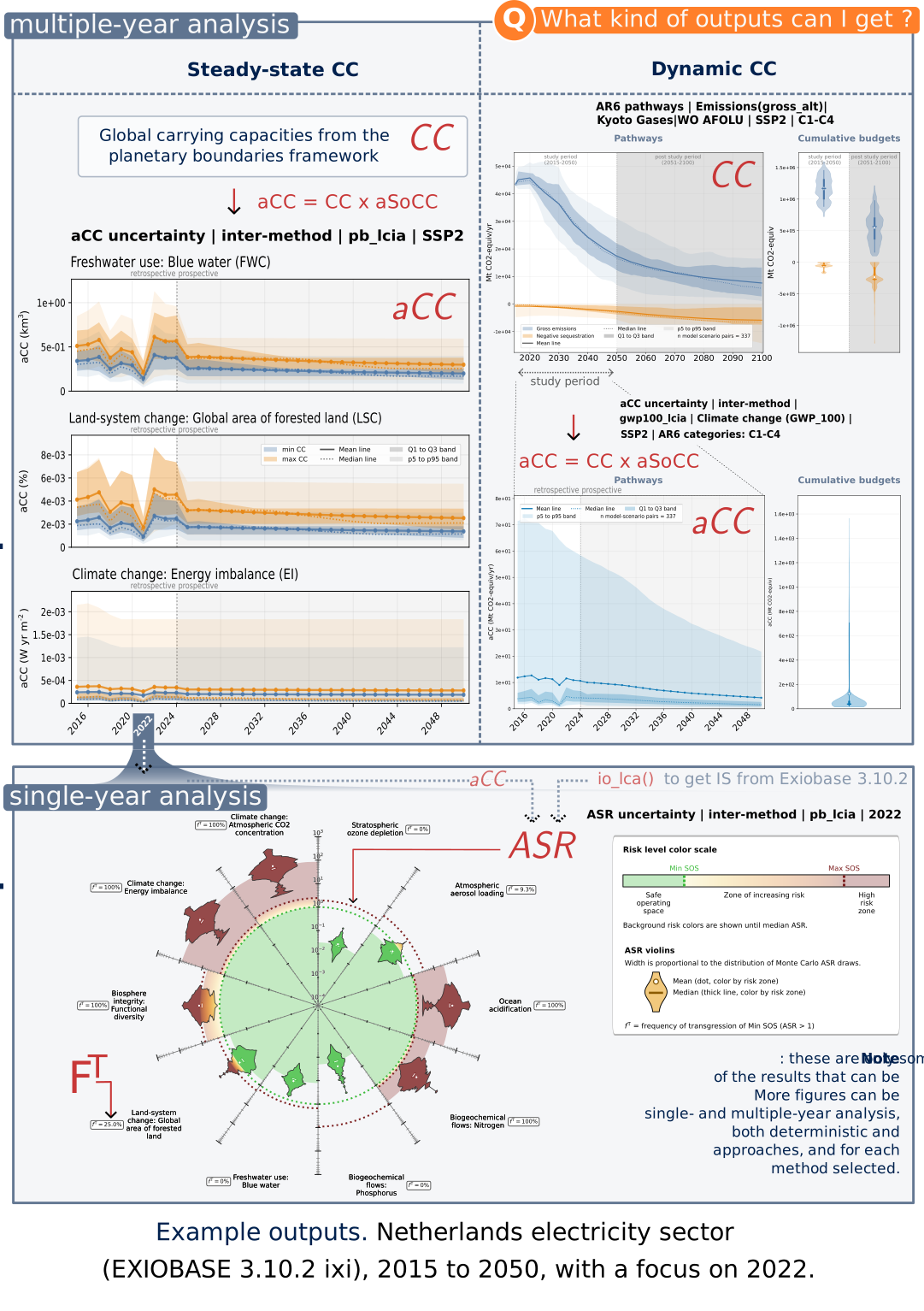
pyaesa produces result tables and figures. The example below illustrates
some of the 83 figure families available with pyaesa. For steady-state
carrying capacities, it shows allocated carrying capacity (aCC) trajectories
and a single-year ASR polar figure. For dynamic climate change carrying
capacities based on AR6 pathways, it shows global carrying capacity (CC) and
allocated carrying capacity (aCC) trajectories and cumulative budgets.
Data Sources By AESA Phase
| AESA phase or route | Data source | Used for |
|---|---|---|
| Phase A IO-LCA | EXIOBASE 3.10.2 MRIO | pyaesa owned IO-LCA results and ASR numerators. |
| Phase B aSoCC allocation | EXIOBASE 3.10.2 or OECD ICIO v2025 MRIO | Allocation enacting metrics, final demand, production, value added, and environmental extensions after LCIA characterization when available. |
| Phase B aSoCC retrospective scope | World Bank population/GDP | Historical population and GDP allocation inputs. |
| Phase B aSoCC prospective scope | SSP population/GDP | Future population and GDP allocation inputs. |
| Phase B dynamic climate change CC | AR6 climate pathways | Dynamic climate change carrying capacity pathways. |
EXIOBASE is supported for ixi and pxp source variants. The
examples use EXIOBASE 3.10.2 but EXIOBASE 3.9.6 is also supported.
Current EXIOBASE LCIA coverage is gwp100_lcia and pb_lcia. Therefore in pyaesa EF3.1 is
available for non-LCIA based allocation routes, but it is not currently
available for pyaesa owned IO-LCA or LCIA based allocation methods.
tutorials/core_prerequisites/2_process_data.ipynb explains the detailed
process for adding LCIA methods with EXIOBASE characterization matrices and
matching carrying capacity thresholds, either for private project use or for
public package submission.
Data Source Licenses And Terms
The GPL 3.0 license applies to pyaesa
source code only. Downloaded datasets remain governed by their original
providers' terms and conditions.
For all data sources, cite the original provider following the
recommended citation guide.
| Data source | Used in pyaesa |
Terms and conditions | Link |
|---|---|---|---|
| EXIOBASE 3 | EXIOBASE 3.10.2 and 3.9.6 MRIO downloads for IO-LCA and allocation inputs. |
|
EXIOBASE terms and conditions and Zenodo EXIOBASE record |
| OECD ICIO v2025 | OECD ICIO MRIO downloads for allocation inputs. |
|
OECD ICIO page and OECD terms and conditions |
| World Bank population/GDP | Historical population and GDP allocation inputs. |
|
World Bank terms and conditions |
| IIASA SSP population/GDP | Prospective population and GDP allocation inputs. |
|
IIASA SSP terms and conditions |
| IIASA AR6 climate pathways | Dynamic climate change carrying capacity pathways. |
|
IIASA AR6 license terms and conditions |
Public Workflow Function Map
Core Prerequisites To Run Once
Run set_workspace(...) once at the beginning of each Python session.
Run the download and processing functions needed before the selected study endpoint: MRIO processing for aSoCC and pyaesa owned IO-LCA, and population/GDP processing for allocation methods that use those inputs (once run they are kept on disk and can be reused across studies). For dynamic AR6 CC and downstream routes that use it, download AR6 raw inputs; the matching processed AR6 scope can be
created by the downstream dynamic route when it is missing so it does not need to be run separately.
| Function | What it computes or prepares and writes | Disk space | Runtime |
|---|---|---|---|
set_workspace(...) |
Creates the workspace, output root, and packaged prerequisite files. | 2 MB | <1 min |
download_mrio(...) |
Downloads raw MRIO files for the selected source and years. | See table below. | See table below. |
download_pop_gdp(...) |
Downloads raw World Bank and SSP population/GDP files. | 1 MB | 1 min |
download_ar6(...) |
Downloads raw AR6 climate pathway and historical baseline files. | 210 MB | 1 min |
process_mrio(...) |
Builds processed MRIO matrices, optional region or sector aggregation and disaggregation scopes, metadata, economic enacting metrics such as final demand and value added, and environmental enacting metrics after LCIA characterization. These outputs are reused by aSoCC allocation methods and `pyaesa` owned IO-LCA. | See table below. | See table below. |
process_pop_gdp(...) |
Builds harmonized historical and SSP population/GDP tables, aligns country coverage to the supported MRIO scopes, records missing value treatment, and harmonizes GDP PPP units. These outputs are reused by retrospective and prospective aSoCC allocation methods. | 2 MB | <1 min |
process_ar6(...) |
Builds retained and optionally harmonized AR6 pathway workbooks for dynamic climate change CC, including Kyoto gases and CO2 variables with and without AFOLU, category and SSP budget summaries, logs, and optional diagnostic figures. | 14 MB without figures; 63 MB with figures. | 1 min without figures; figures add about 2 min. |
MRIO Storage And Runtime
MRIO raw download storage and runtime by source:
| Source | Disk space | Runtime |
|---|---|---|
| EXIOBASE 3.10.2 ixi | 260 MB for one year; 7.5 GB for 1995 to 2024 | 20 s for one year; 10 min for all years |
| EXIOBASE 3.10.2 pxp | 230 MB for one year; 6.7 GB for 1995 to 2024 | 20 s for one year; 10 min for all years |
| OECD ICIO v2025 | 470 MB for one bundle, for example 1995 to 2000; 2.2 GB for 1995 to 2022 | 1 min for one bundle, for example 1995 to 2000; 4 min for all years |
MRIO processed output storage and runtime by source:
| Source | Disk space | Runtime |
|---|---|---|
| EXIOBASE 3.10.2 ixi | 230 MB for one year; 6.7 GB for 1995 to 2024 | 1 min for one year; 25 min for all years |
| EXIOBASE 3.10.2 pxp | 280 MB for one year; 8.2 GB for 1995 to 2024 | 1 min for one year; 36 min for all years |
| OECD ICIO v2025 | 210 MB for one year; 5.8 GB for 1995 to 2022 | <1 min for one year; 5 min for all years |
The measurements were taken on Windows 11 with Python 3.14, an 11th Gen Intel Core i7 1165G7 CPU, 32 GB RAM.
AESA Functions
| Phase | Mode | Function | What it computes and writes |
|---|---|---|---|
| A | deterministic | deterministic_io_lca(...) |
Computes pyaesa owned IO-LCA result tables from processed EXIOBASE assets and figures. |
| A | uncertainty | uncertainty_io_lca(...) |
Computes Monte Carlo IO-LCA run tables, summaries, source logs, and figures. |
| B | deterministic | deterministic_asocc(...) |
Computes allocated shares of carrying capacity (aSoCC) tables and figures. |
| B | uncertainty | uncertainty_asocc(...) |
Computes aSoCC Monte Carlo run tables, summaries, source logs, figures by default, and Sobol outputs when requested. |
| B | deterministic | deterministic_ar6_cc(...) |
Computes dynamic AR6 climate change carrying capacity (CC) pathway tables and figures. |
| B | uncertainty | uncertainty_ar6_cc(...) |
Computes AR6 CC Monte Carlo trajectory run tables, summaries, source logs, and figures. |
| B | deterministic | deterministic_acc(...) |
Computes allocated carrying capacity (aCC) tables as aSoCC * CC and figures. |
| B | uncertainty | uncertainty_acc(...) |
Computes aCC Monte Carlo run tables, summaries, source logs, figures by default, and Sobol outputs when requested. |
| C | deterministic | deterministic_asr(...) |
Computes absolute sustainability ratio (ASR) tables as LCA / aCC and figures. |
| C | uncertainty | uncertainty_asr(...) |
Computes ASR Monte Carlo run tables, summaries, source logs, figures by default, and Sobol outputs when requested. |
Support Functions
| Support function | What it prepares or writes |
|---|---|
disaggregate_asocc(...) |
Published disaggregated aSoCC source outputs and optional figures for matching sector resolution between MRIO sources. Use the dedicated disaggregation notebook for the required deterministic prerequisite chain. |
prepare_external_inputs(...) |
Project scoped external aSoCC and external LCA folders, README files, and templates for user provided data. |
write_asocc_weight_template(...) |
Editable inter-method weights tree, guide, and preview figure for the aSoCC inter-method uncertainty source. |
preview_asocc_weight_tree(...) |
Validated inter-method tree and preview figure for proposed custom weights. |
Study objectives and recommended routes
-
Run
set_workspace(...)once for the workspace. -
Download the raw data families needed by the study endpoint.
-
Run
process_mrio(...)andprocess_pop_gdp(...)when the endpoint needs processed MRIO or population/GDP assets. Directprocess_ar6(...)runs are optional for dynamic AR6 CC, aCC, and ASR endpoints because those routes can provision the matching processed AR6 scope when it is missing. -
Choose a study objective that fit your application. Study objectives are study endpoints from the user perspective. A study objective corresponds to an expected output for the user. In
pyaesa, five study objectives are currently available:
| Study objective | Corresponding output |
|---|---|
A |
Life-cycle assessment (LCA/IO-LCA) |
B.0 |
Dynamic carrying capacity (CC) |
B.1 |
Assigned share of carrying capacities (aSoCC) |
B.2 |
Assigned carrying capacities (aCC) |
C |
Absolute sustainability ratio (ASR) |
- Once your have chosen the study objective (i.e., the endpoint), call the corresponding deterministic or uncertainty function directly.
It is very important for the user to understand that to reach a desired study objective,
pyaesaautomatically runs upstream computations needed to produce the desired endpoint, i.e., to ensure that all previous outputs are available before running the downstream function providing the endpoint. This is illustrated via the green arrows (automatic nesting) in the figure above. Consequently, the user must focus solely on the desired study objective, and run the single relevant function.
Check out tutorials/study_objectives/0_study_objectives.md to understand how to select and reach study objectives in pyaesa.
Set of tutorials
The README is the tutorial navigator. The tutorial notebooks are split into reusable prerequisite data preparation notebooks, study endpoint notebooks, and optional workflow notebooks.
Core prerequisites tutorials:
| Key | Notebook |
|---|---|
| Workspace | tutorials/core_prerequisites/0_set_workspace.ipynb |
| Download | tutorials/core_prerequisites/1_download_data.ipynb |
| Process | tutorials/core_prerequisites/2_process_data.ipynb |
Study objectives tutorials:
Optional tutorials:
| Main use | Notebook |
|---|---|
| disaggregation | tutorials/optional_workflows/disaggregate_asocc_mrio_sectors.ipynb |
| inter-method weights | tutorials/optional_workflows/custom_asocc_method_weights.ipynb |
| external aSoCC and external LCA input staging | tutorials/optional_workflows/external_asocc_lca_input_staging.ipynb |
Methodological references:
| Location | Notes |
|---|---|
methodological_notes/methodological_note_asocc_fus_allocation_methods.pdf |
Functional units and allocation methods. |
methodological_notes/methodological_note_acc_prospective.pdf |
Prospective allocation. |
methodological_notes/methodological_note_acc_uncertainty_sources.pdf |
Uncertainty sources. |
methodological_notes/methodological_note_steady_state_dynamic_cc.pdf |
Definition of steady state and dynamic carrying capacities. |
set_workspace(...) copies these methodological references into the active
workspace under data_raw/methodological_notes/.
Use the API reference in docs/api.rst for exact signatures and parameter contracts. Use docs/tutorial.rst for the notebook index.
Use of generative AI
Generative AI tools were used during the development of pyaesa. As the development of the package took several months from the initial ideation to the first release, several tools were used including OpenAI Codex models 5.3 to 5.5, Codex Spark 5.3, Anthropic Claude Opus 4.6 and Sonnet 4.6, and GitHub Copilot.
These tools were used to support implementation tasks, including code generation, refactoring, debugging, test design, documentation drafting, code review, computing time optimization, memory use reduction, and figure rendering workflows.
The development of AESA methodology and workflow, mathematical expressions, software architecture and the figures conception were defined by the authors. Generative AI outputs were used as implementation drafts, checked and modified where needed, and retained only after review and testing by human intelligence.
Project details
Verified details
These details have been verified by PyPIProject links
GitHub Statistics
Maintainers
Release history Release notifications | RSS feed


Download files
Download the file for your platform. If you're not sure which to choose, learn more about installing packages.
Source Distribution
Built Distribution
Filter files by name, interpreter, ABI, and platform.
If you're not sure about the file name format, learn more about wheel file names.
Copy a direct link to the current filters
File details
Details for the file pyaesa-1.2.4.tar.gz.
File metadata
- Download URL: pyaesa-1.2.4.tar.gz
- Upload date:
- Size: 2.6 MB
- Tags: Source
- Uploaded using Trusted Publishing? Yes
- Uploaded via: twine/6.1.0 CPython/3.13.12
File hashes
| Algorithm | Hash digest | |
|---|---|---|
| SHA256 |
04ab95869adaf6c58cc4540aefbc6728e4554748ad6d99ec5bfe577a8d814733
|
|
| MD5 |
eefd7f9f26e0cdb7cf85b24f2d4d2a9a
|
|
| BLAKE2b-256 |
3361733e11b635b6ddd6a77e16f3df8d8997b7ab0fd9c8e48d5dd8edfe755dc8
|
Provenance
The following attestation bundles were made for pyaesa-1.2.4.tar.gz:
Publisher:
publish_pypi.yml on AESAtoolkit/pyaesa
-
Statement:
-
Statement type:
https://in-toto.io/Statement/v1 -
Predicate type:
https://docs.pypi.org/attestations/publish/v1 -
Subject name:
pyaesa-1.2.4.tar.gz -
Subject digest:
04ab95869adaf6c58cc4540aefbc6728e4554748ad6d99ec5bfe577a8d814733 - Sigstore transparency entry: 1854292123
- Sigstore integration time:
-
Permalink:
AESAtoolkit/pyaesa@36333620b21838557df32a261470deed5f206236 -
Branch / Tag:
refs/heads/main - Owner: https://github.com/AESAtoolkit
-
Access:
public
-
Token Issuer:
https://token.actions.githubusercontent.com -
Runner Environment:
github-hosted -
Publication workflow:
publish_pypi.yml@36333620b21838557df32a261470deed5f206236 -
Trigger Event:
workflow_dispatch
-
Statement type:
File details
Details for the file pyaesa-1.2.4-py3-none-any.whl.
File metadata
- Download URL: pyaesa-1.2.4-py3-none-any.whl
- Upload date:
- Size: 3.1 MB
- Tags: Python 3
- Uploaded using Trusted Publishing? Yes
- Uploaded via: twine/6.1.0 CPython/3.13.12
File hashes
| Algorithm | Hash digest | |
|---|---|---|
| SHA256 |
b110d2af7f7a124cdf5374ff6cc93e42185674ca611be6c3299b66c24d6b20ad
|
|
| MD5 |
2b4d9faa9877424a86ba47a45de05e1b
|
|
| BLAKE2b-256 |
e9220be13f482067db5270895d7db70fab3d26d92faf810fa45fecd2c24a1564
|
Provenance
The following attestation bundles were made for pyaesa-1.2.4-py3-none-any.whl:
Publisher:
publish_pypi.yml on AESAtoolkit/pyaesa
-
Statement:
-
Statement type:
https://in-toto.io/Statement/v1 -
Predicate type:
https://docs.pypi.org/attestations/publish/v1 -
Subject name:
pyaesa-1.2.4-py3-none-any.whl -
Subject digest:
b110d2af7f7a124cdf5374ff6cc93e42185674ca611be6c3299b66c24d6b20ad - Sigstore transparency entry: 1854292194
- Sigstore integration time:
-
Permalink:
AESAtoolkit/pyaesa@36333620b21838557df32a261470deed5f206236 -
Branch / Tag:
refs/heads/main - Owner: https://github.com/AESAtoolkit
-
Access:
public
-
Token Issuer:
https://token.actions.githubusercontent.com -
Runner Environment:
github-hosted -
Publication workflow:
publish_pypi.yml@36333620b21838557df32a261470deed5f206236 -
Trigger Event:
workflow_dispatch
-
Statement type:






