
pyaescbc
AES-256-CBC + HMAC-SHA256 encryption of bytearray data, built on the
cryptography package.
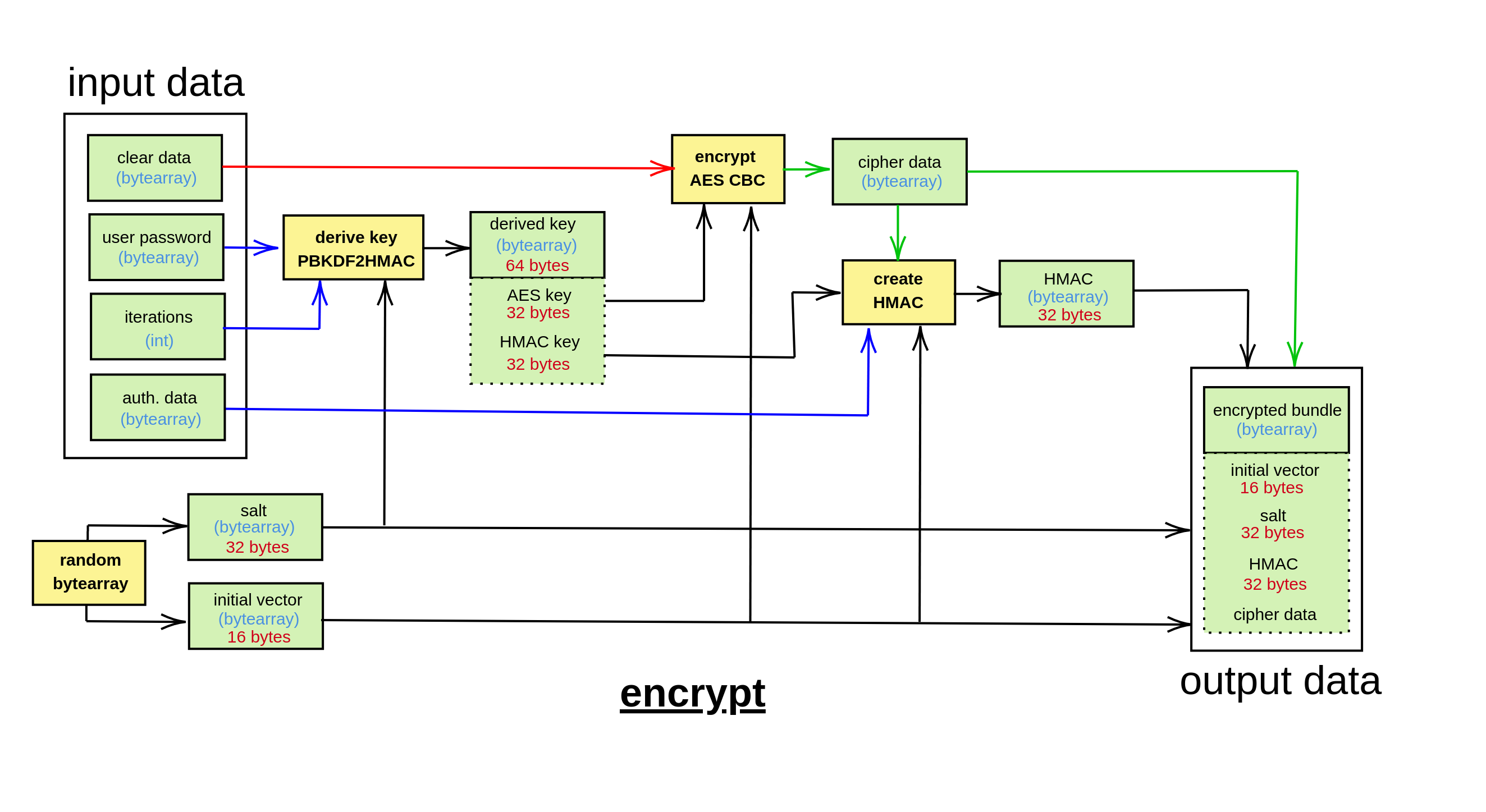
pyaescbc encrypts and authenticates data (Encrypt-then-MAC) behind a small API, in two modes:
- Password mode (
encrypt/decrypt): the key is derived from a password with PBKDF2-HMAC-SHA256. Slow on purpose, to resist brute-force attacks. - Key mode (
encrypt_with_key/decrypt_with_key): the data is encrypted with a random 32-byte key, without key derivation. It takes microseconds, which makes it suited to encrypting many small secrets (see envelope encryption).
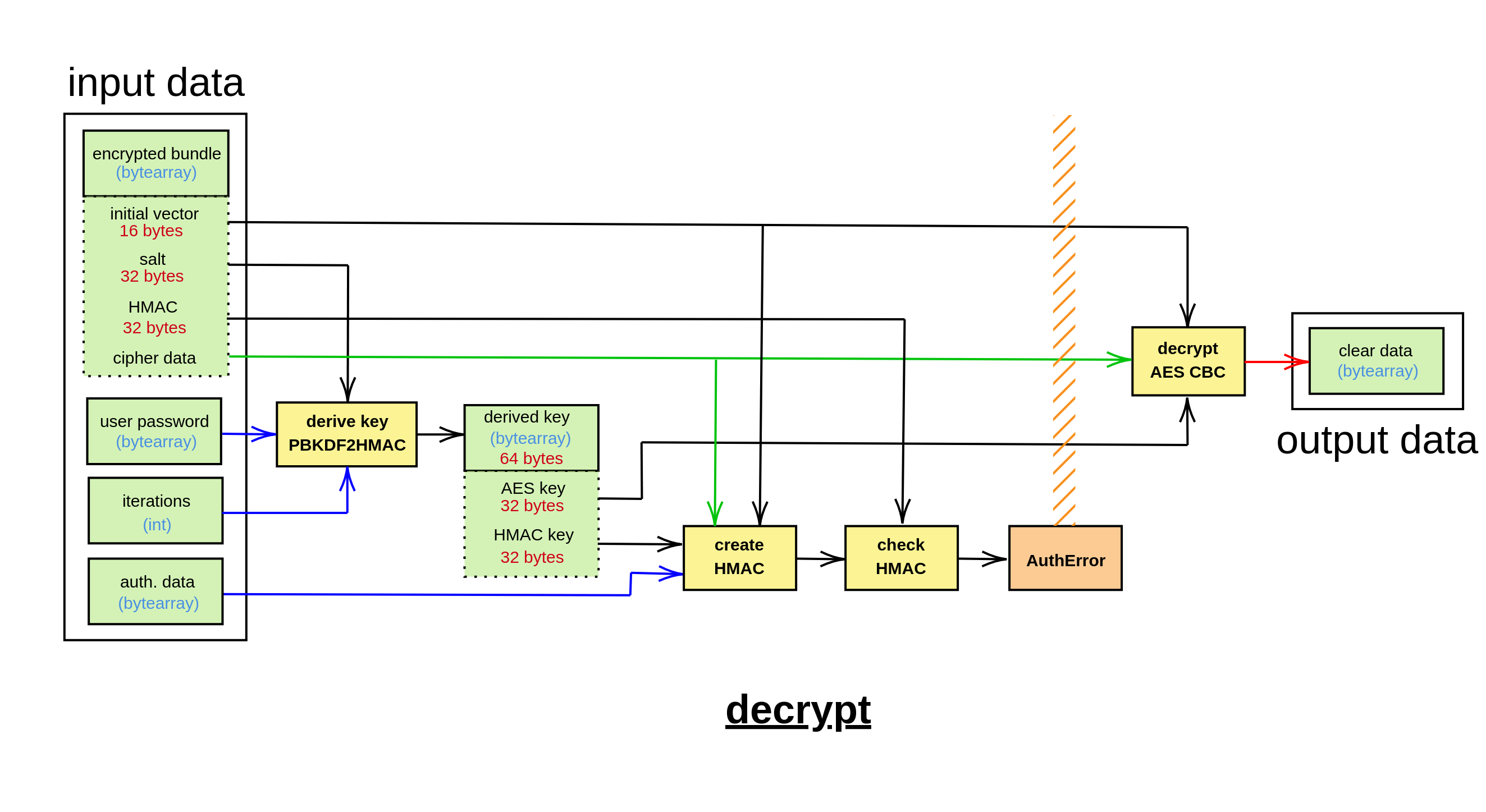
Both modes authenticate the data: a wrong password or key, wrong additional data, or any modification of the encrypted bundle is detected before anything is decrypted.
Security considerations
Installation
Requires Python 3.11 or later.
pip install pyaescbc
Or the development version:
pip install git+https://github.com/Artezaru/pyaescbc.git
Usage
All data, passwords and keys are bytearray objects, so that they can be wiped from memory
after use.
Password mode
import pyaescbc

# Encryption
cleardata = bytearray("Hello, World!", "utf-8")
password = bytearray("password", "utf-8")
authdata = bytearray("user=toto", "utf-8")  # optional additional authenticated data
encrypted_bundle = pyaescbc.encrypt(cleardata, password, authdata=authdata, iterations=2_000_000)

# Decryption (the number of iterations is read from the bundle)
password = bytearray("password", "utf-8")
authdata = bytearray("user=toto", "utf-8")  # same value as for encryption
decrypted_data = pyaescbc.decrypt(encrypted_bundle, password, authdata=authdata)

print(decrypted_data)  # bytearray(b'Hello, World!')
iterationssets the cost of the PBKDF2 derivation: 600 000 by default (pyaescbc.DEFAULT_ITERATIONS), betweenMIN_ITERATIONS(100 000) andMAX_ITERATIONS(100 000 000). It is stored in the bundle.authdatais authenticated but neither encrypted nor stored: the same value must be given to decrypt. It is useful to bind the data to a context (a user, a record, a field).- By default,
encryptwipescleardataandpasswordonce the encryption succeeded, anddecryptwipespassword. Usedelete_data=False/delete_keys=Falseto keep them.
Key mode (envelope encryption)
The password mode runs a slow key derivation on every call. To encrypt many secrets, use a random data key with the key mode, and protect that key once with the password:
import pyaescbc

# Creation: a random data key, wrapped with the password (slow, once)
data_key = pyaescbc.generate_key()
wrapped_key = pyaescbc.encrypt(data_key.copy(), bytearray("password", "utf-8"))

# Each secret is encrypted with the data key (fast, no key derivation)
secret = pyaescbc.encrypt_with_key(
    bytearray("my secret", "utf-8"),
    data_key,
    authdata=bytearray("entry=42", "utf-8"),  # optional
)
pyaescbc.delete_bytearray(data_key)

# Next session: unwrap the data key once, then decrypt any secret quickly
data_key = pyaescbc.decrypt(wrapped_key, bytearray("password", "utf-8"))
print(pyaescbc.decrypt_with_key(secret, data_key, authdata=bytearray("entry=42", "utf-8")))

# Changing the password only re-wraps the data key: the secrets are not re-encrypted
wrapped_key = pyaescbc.encrypt(data_key.copy(), bytearray("new password", "utf-8"))

pyaescbc.delete_bytearray(data_key)  # end of the session
- The key must come from
pyaescbc.generate_key(). Never use a password as key: it would get no brute-force protection. - The key is kept by default (
delete_keys=False), since it is reused for many messages. - To make an old password useless even against old copies of the data, generate a new data key and re-encrypt the secrets with it: this is fast in key mode.
Errors
try:
    cleardata = pyaescbc.decrypt(encrypted_bundle, password)
except pyaescbc.AuthError:
    ...  # wrong password or authdata, or the bundle has been tampered with
except ValueError:
    ...  # not a valid bundle (wrong size, unknown format or version, bundle of the other mode)
A bundle of one mode passed to the other mode is rejected with an explicit ValueError
(for example: "this is a key-mode bundle, use decrypt_with_key()").
Storing a bundle
An encrypted bundle is binary data. Store it as bytes in a file or a database, or convert it to text with base64:
import base64

text = base64.b64encode(encrypted_bundle).decode("ascii")
encrypted_bundle = bytearray(base64.b64decode(text))
Public API
| Name | Description |
|---|---|
encrypt, decrypt |
Password mode |
encrypt_with_key, decrypt_with_key |
Key mode |
generate_key, KEY_SIZE |
Random 32-byte key for the key mode |
DEFAULT_ITERATIONS, MIN_ITERATIONS, MAX_ITERATIONS |
PBKDF2 settings of the password mode |
AuthError |
Raised when the authentication fails |
delete_bytearray |
Wipes a bytearray (best-effort) |
Only these names are public. The building blocks that were public in pyaescbc 2.1 and earlier
(derive_key, create_hmac, random_iv, ...) are now internal: they still work but emit a
DeprecationWarning, and will be removed in the next major version.
Bundle formats
Both formats share the layout header | HMAC-SHA256 (32 bytes) | AES-256-CBC cipherdata; the
header is authenticated by the HMAC.
| Mode | Magic | Header |
|---|---|---|
| Password | PACB |
magic (4) · version 2 (1) · iterations (4) · salt (32) · IV (16) = 57 bytes |
| Key | PACK |
magic (4) · version 1 (1) · IV (16) = 21 bytes |
Bundles created by previous versions of pyaescbc (format version 2) can still be decrypted.
The complete specification is in the online documentation.
Authors
-
Artezaru artezaru.github@proton.me
-
Git Platform: https://github.com/Artezaru/pyaescbc.git
-
Online Documentation: https://Artezaru.github.io/pyaescbc
License
Copyright 2025 Artezaru
Licensed under the Apache License, Version 2.0 (the "License"); you may not use this file except in compliance with the License. You may obtain a copy of the License at
http://www.apache.org/licenses/LICENSE-2.0
Unless required by applicable law or agreed to in writing, software distributed under the License is distributed on an "AS IS" BASIS, WITHOUT WARRANTIES OR CONDITIONS OF ANY KIND, either express or implied. See the License for the specific language governing permissions and limitations under the License.
1 maintainer

Metadata
1 maintainer
Release files for pyaescbc 3.0.0
For a detailed explanation of source distributions (sdists) and built distributions (wheels), please see the package formats documentation.
Source distribution (sdist)
| File | Size | Uploaded | Provenance | Actions |
|---|---|---|---|---|
| pyaescbc-3.0.0.tar.gz | 529.2 kB | Without provenance | Details for pyaescbc-3.0.0.tar.gz |
Built distribution (wheel)
| File | Interpreter | ABI | Platform | Actions Reset |
|---|---|---|---|---|
| pyaescbc-3.0.0-py3-none-any.whl | Python 3 | none | any | Details for pyaescbc-3.0.0-py3-none-any.whl |
Total release size: 1.1 MB
Release files / pyaescbc-3.0.0.tar.gz
| Download URL | pyaescbc-3.0.0.tar.gz |
|---|---|
| Size | 529.2 kB |
| Tags | Source |
|
SHA-256 checksum How to use checksums |
f028e2913801355777ad8e6c066fdf85a49d5224c69efb0c9ac244fbce8553ac
|
|
BLAKE2b-256 checksum How to use checksums |
bc016d98cb318226c2ebad1b4a5794dd6cbade554d834bf785969ef5d96a5e97
|
| Upload date | |
|
Uploaded using Trusted Publishing? What is trusted publishing? |
No |
| Uploaded via |
twine/7.0.0 CPython/3.11.18
|
Release files / pyaescbc-3.0.0-py3-none-any.whl
| Download URL | pyaescbc-3.0.0-py3-none-any.whl |
|---|---|
| Size | 531.5 kB |
| Tags | Python 3 |
|
SHA-256 checksum How to use checksums |
54732e0128274522be608701e2dcc5eff1b91f5cf6379ea0816c355e7bb551a7
|
|
BLAKE2b-256 checksum How to use checksums |
5afe8666e9c466b94a0feaad5cad9f56f3af0293980acb7393941e3a4759dc0c
|
| Upload date | |
|
Uploaded using Trusted Publishing? What is trusted publishing? |
No |
| Uploaded via |
twine/7.0.0 CPython/3.11.18
|
Security for pyaescbc 3.0.0
Provenance
Provenance describes where a file came from. On PyPI, provenance is shared via attestations, which provide a verifiable record of the build or publishing details. View details, limitations and caveats.
No provenance found
None of the files in this release were uploaded with provenance metadata.
A note on package security
PyPI is a repository for distributing packages, not a service for auditing them. While third-party security researchers and our staff do their best to detect and remove malicious packages, PyPI cannot guarantee the quality, security or suitability of any given package.
To learn more about protecting yourself from malicious actors, visit our package security documentation.














