
Fast and Versatile Alignments for Python

Project description
pyalign
Try it out and learn the details:

Alignments have been a staple algorithm in bioinformatics for decades now, but most packages implementing tend to be either easy to use and slow, or fast but very difficult to use and highly domain specific.
pyalign is a small and hopefully rather versatile Python package that aims to be fast and easy to use. At its core, it is an optimizer for finding "optimum correspondences between sequences" (Kruskal, 1983) - the main proponents of which are alignments and dynamic time warping.
General Features:
- easy to install and easy to use
- robust and efficient implementation of standard algorithms
- very fast for smaller problem sizes (see below for details)
- built-in visualization functionality for teaching purposes
In terms of alignment algorithms:
- computes local, global and semiglobal alignments on pairs of sequences
- supports different gap costs (commonly used ones as well as custom ones)
- automatically selects best suitable algorithm (e.g. Gotoh)
- no assumptions on matched items, i.e. not limited to characters
- supports any given similarity or distance function (i.e. can maximize or minimize)
- can return one as well as all optimal alignments and scores
The implementation should be rather fast due to highly optimized code paths for every special case. While it does not support GPUs, here are some facts:
- optimized C++ core employing xtensor
- supports SIMD via batching (i.e. simple SIMD parallelism as first suggested by Alpern et al. and more recently by Rudnicki et al.)
- carefully designed to avoid dynamic memory allocation
- extensive metaprogramming to provide different optimized code paths for different usage patterns - for example, computing "only single score" won't write tracebacks, whereas computing "all alignments" will track multiple traceback edges
Installation
pip install pyalign
Example
Running
import pyalign.problems
import pyalign.solve
import pyalign.gaps

pf = pyalign.problems.ProblemFactory(
    pyalign.problems.Binary(eq=1, ne=-1),
    direction="maximize")
solver = pyalign.solve.GlobalSolver(
    gap_cost=pyalign.gaps.LinearGapCost(0.2))
problem = pf.new_problem("INDUSTRY", "INTEREST")
alignment = solver.solve(problem)
alignment
in Jupyter gives
INDU    STRY
||      ||
IN  TEREST
Of course you can also extract the actual score:
alignment.score
as
2.4
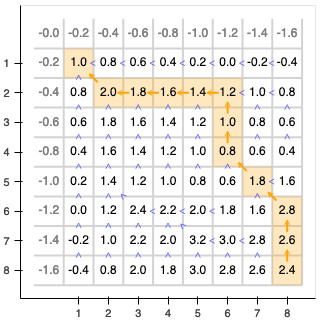
It's also possible to extract the traceback matrix and path and generate visuals (and thus a detailed rationale for the obtained score and solution):
solver_sol = pyalign.solve.GlobalSolver(
    gap_cost=pyalign.gaps.LinearGapCost(0.2),
    generate="solution")
solver_sol.solve(problem)
As a final example, here is how to generate an iterator over all optimal solutions of a problem:
solver_sol_all = pyalign.solve.GlobalSolver(
    gap_cost=pyalign.gaps.LinearGapCost(0.2),
    generate="solution[all, optimal]")
solver_sol_all.solve(problem)
Performance
Here are a few benchmarks. The "pure python" implementation seen in this benchmark is found at https://github.com/eseraygun/python-alignment.
The y axis is logarithmic. 1000 μs = 1 / 1000 s.
+alphabet means using pyalign.problem.AlphabetProblemFactory instead of
the simpler pyalign.problem.ProblemFactory.
+AVX2 means feeding groups of equally-structured aligment problems into
one solve call by using pyalign.problem.ProblemBatch - doing this will
internally make use of AVX2 SIMD operations if available.


Other Alignment Libraries
Here is a short overview of other libraries.
similar to pyalign
- https://edist.readthedocs.io/en/latest/
- https://pypi.org/project/textdistance/
- https://github.com/mbreese/swalign/
- https://github.com/seqan/seqan3
- https://github.com/wannesm/dtaidistance
for large scale problems
What you will not find in pyalign:
- SIMD acceleration for single pairs of sequences as in e.g. (Farrar 2007)
- GPU acceleration, see e.g. (Barnes, 2020)
- approximate or randomized algorithms
- advanced preprocessing or indexing
If you need any of the above, you might want to take a look at:
References
Original Works
Altschul, S. (1998). Generalized affine gap costs for protein sequence alignment. Proteins: Structure, 32.
Gotoh, O. (1982). An improved algorithm for matching biological sequences. Journal of Molecular Biology, 162(3), 705–708. https://doi.org/10.1016/0022-2836(82)90398-9
Sankoff, D. (1972). Matching Sequences under Deletion/Insertion Constraints. Proceedings of the National Academy of Sciences, 69(1), 4–6. https://doi.org/10.1073/pnas.69.1.4
Smith, T. F., & Waterman, M. S. (1981). Identification of common molecular subsequences. Journal of Molecular Biology, 147(1), 195–197. https://doi.org/10.1016/0022-2836(81)90087-5
Miller, W., & Myers, E. W. (1988). Sequence comparison with concave weighting functions. Bulletin of Mathematical Biology, 50(2), 97–120. https://doi.org/10.1007/BF02459948
Needleman, S. B., & Wunsch, C. D. (1970). A general method applicable to the search for similarities in the amino acid sequence of two proteins. Journal of Molecular Biology, 48(3), 443–453. https://doi.org/10.1016/0022-2836(70)90057-4
Waterman, M. S., Smith, T. F., & Beyer, W. A. (1976). Some biological sequence metrics. Advances in Mathematics, 20(3), 367–387. https://doi.org/10.1016/0001-8708(76)90202-4
Waterman, M. S. (1984). Efficient sequence alignment algorithms. Journal of Theoretical Biology, 108(3), 333–337. https://doi.org/10.1016/S0022-5193(84)80037-5
Other Algorithms
Chakraborty, A., & Bandyopadhyay, S. (2013). FOGSAA: Fast Optimal Global Sequence Alignment Algorithm. Scientific Reports, 3(1), 1746. https://doi.org/10.1038/srep01746
Surveys
Aluru, S. (Ed.). (2005). Handbook of Computational Molecular Biology. Chapman and Hall/CRC. https://doi.org/10.1201/9781420036275
Stojmirović, A., & Yu, Y.-K. (2009). Geometric Aspects of Biological Sequence Comparison. Journal of Computational Biology, 16(4), 579–610. https://doi.org/10.1089/cmb.2008.0100
Kruskal, J. B. (1983). An Overview of Sequence Comparison: Time Warps, String Edits, and Macromolecules. SIAM Review, 25(2), 201–237. https://doi.org/10.1137/1025045
Müller, M. (2007). Information Retrieval for Music and Motion. Springer Berlin Heidelberg. https://doi.org/10.1007/978-3-540-74048-3
Implementations
Alpern, B., Carter, L., & Su Gatlin, K. (1995). Microparallelism and high-performance protein matching. Proceedings of the 1995 ACM/IEEE Conference on Supercomputing (CDROM) - Supercomputing ’95, 24-es. https://doi.org/10.1145/224170.224222
Barnes, R. (2020). A Review of the Smith-Waterman GPU Landscape. https://www2.eecs.berkeley.edu/Pubs/TechRpts/2020/EECS-2020-152.html
Farrar, M. (2007). Striped Smith-Waterman speeds database searches six times over other SIMD implementations. Bioinformatics, 23(2), 156–161. https://doi.org/10.1093/bioinformatics/btl582
Flouri, T., Kobert, K., Rognes, T., & Stamatakis, A. (2015). Are all global alignment algorithms and implementations correct? [Preprint]. Bioinformatics. https://doi.org/10.1101/031500
Rognes, T. (2011). Faster Smith-Waterman database searches with inter-sequence SIMD parallelisation. BMC Bioinformatics, 12(1), 221. https://doi.org/10.1186/1471-2105-12-221
Rudnicki, W. R., Jankowski, A., Modzelewski, A., Piotrowski, A., & Zadrożny, A. (2009). The new SIMD Implementation of the Smith-Waterman Algorithm on Cell Microprocessor. Fundamenta Informaticae, 96(1–2), 181–194. https://doi.org/10.3233/FI-2009-173
Tran, T. T., Liu, Y., & Schmidt, B. (2016). Bit-parallel approximate pattern matching: Kepler GPU versus Xeon Phi. 26th International Symposium on Computer Architecture and High Performance Computing, 54, 128–138. https://doi.org/10.1016/j.parco.2015.11.001
Release history Release notifications | RSS feed


Download files
Download the file for your platform. If you're not sure which to choose, learn more about installing packages.
Source Distribution
Built Distributions
Filter files by name, interpreter, ABI, and platform.
If you're not sure about the file name format, learn more about wheel file names.
Copy a direct link to the current filters
File details
Details for the file pyalign-0.3.9.tar.gz.
File metadata
- Download URL: pyalign-0.3.9.tar.gz
- Upload date:
- Size: 45.6 kB
- Tags: Source
- Uploaded using Trusted Publishing? No
- Uploaded via: twine/3.7.1 importlib_metadata/4.8.2 pkginfo/1.8.2 requests/2.26.0 requests-toolbelt/0.9.1 tqdm/4.62.3 CPython/3.9.9
File hashes
| Algorithm | Hash digest | |
|---|---|---|
| SHA256 |
6068ac92f2a29545775c86080e0db6906d46a32251baba7501dcd44f61bd1f35
|
|
| MD5 |
2ae7b7931d2fd39024f4c68fe035daca
|
|
| BLAKE2b-256 |
00e407245beadbc017f1a2f5d90101c4b23db8db0934b294e03d56107e4d78d5
|
File details
Details for the file pyalign-0.3.9-cp39-cp39-manylinux2014_x86_64.whl.
File metadata
- Download URL: pyalign-0.3.9-cp39-cp39-manylinux2014_x86_64.whl
- Upload date:
- Size: 2.4 MB
- Tags: CPython 3.9
- Uploaded using Trusted Publishing? No
- Uploaded via: twine/3.7.1 importlib_metadata/4.8.2 pkginfo/1.8.2 requests/2.26.0 requests-toolbelt/0.9.1 tqdm/4.62.3 CPython/3.9.9
File hashes
| Algorithm | Hash digest | |
|---|---|---|
| SHA256 |
c2bd1aaa0867e8fdcef09c4b441cddab0d192acae82cfb5f1a400e895ad8d7d0
|
|
| MD5 |
d41e76120e8aba4be6fed709287f7aa2
|
|
| BLAKE2b-256 |
667c583efcc77d449f8d02bd3ba4923401f144b24d62ee47f8b371e4df06856c
|
File details
Details for the file pyalign-0.3.9-cp38-cp38-manylinux2014_x86_64.whl.
File metadata
- Download URL: pyalign-0.3.9-cp38-cp38-manylinux2014_x86_64.whl
- Upload date:
- Size: 2.4 MB
- Tags: CPython 3.8
- Uploaded using Trusted Publishing? No
- Uploaded via: twine/3.7.1 importlib_metadata/4.8.2 pkginfo/1.8.2 requests/2.26.0 requests-toolbelt/0.9.1 tqdm/4.62.3 CPython/3.9.9
File hashes
| Algorithm | Hash digest | |
|---|---|---|
| SHA256 |
db55dcf04c4087290cc5b296c67555256e9ad62e06a731c3d34134c6bc079bc5
|
|
| MD5 |
edcdcf83511cfcc69f948558d8f69a3f
|
|
| BLAKE2b-256 |
eb6fc5d7e49b8098b992a5d81898f4874a738654a696b0cdc3e131c80c76a055
|






