
BIGUE hyperbolic embedder
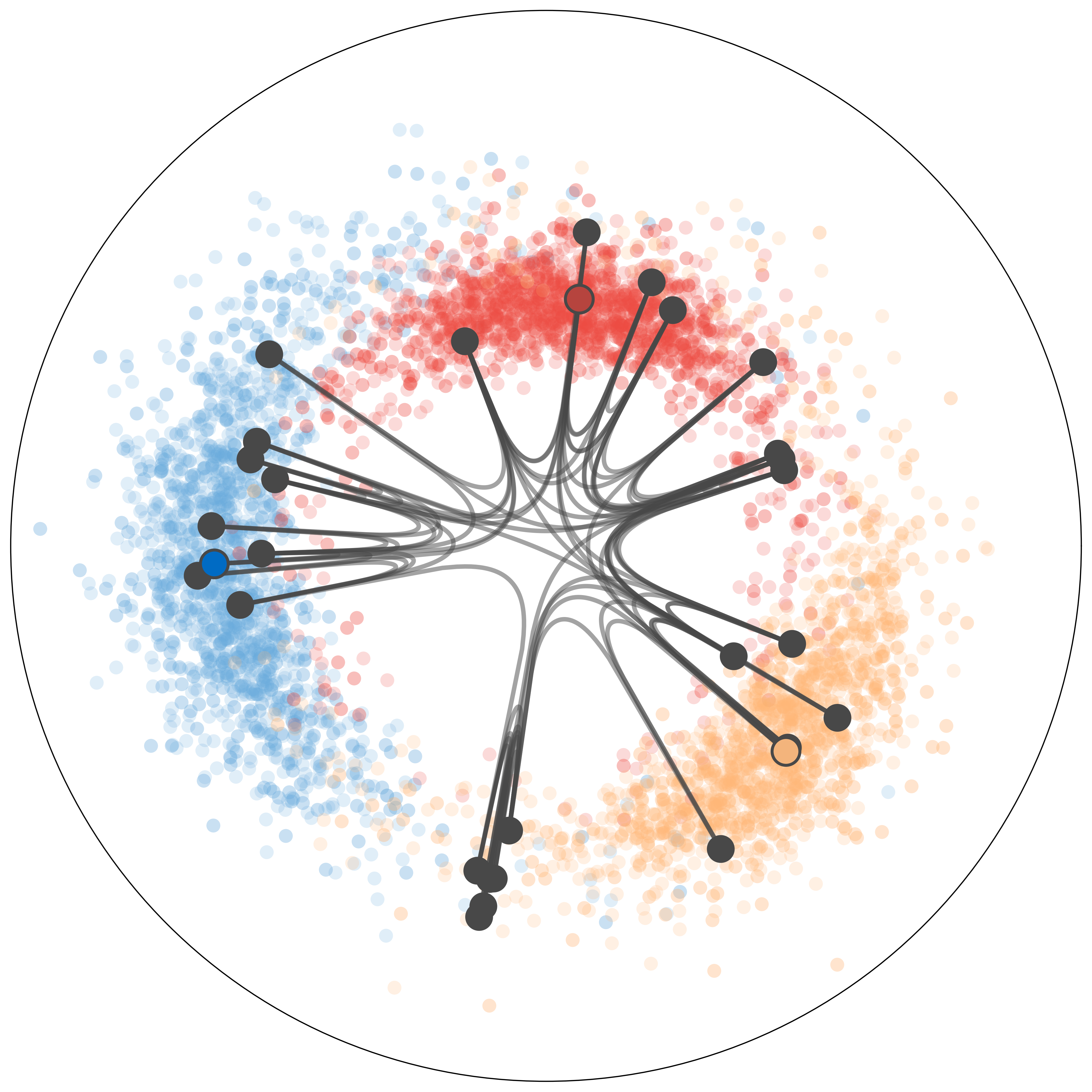
Bayesian Inference of a Graph's Unkown Embedding (BIGUE) is a Markov Chain Monte Carlo algorithm that samples the best hyperbolic embeddings of a given network according to a Bayesian $\mathbb{S}^1$ model.
The code used to generate the Figures in the paper is in the bigue-analysis repository. If you use this algorithm, please cite:
Ariane Lizotte, Jean-Gabriel Young and Antoine Allard "Symmetry-driven embedding of networks in hyperbolic space". Commun. Phys. 8, 199 (2025). https://doi.org/10.1038/s42005-025-02122-0
Ariane Lizotte. "bigue". Zenodo (2025). https://doi.org/10.5281/zenodo.15189657.
Installation
Dependencies
The pybigue library requires:
- Python (>= 3.10)
- NumPy
- SciPy
- CmdStanPy
- Numba
pybigue can be installed directly from PyPi
pip install pybigue
Usage
To use the default BIGUE sampler,
from pybigue.sampling import sample_bigue, read_sample

# ... code that obtains an numpy adjacency matrix

sample_directory = "./sample/"
sample_bigue(adjacency_matrix, sample_directory) # Writes samples to disk
samples = read_sample(sample_directory) # Reads samples
Two complete examples are presented in the examples. The file embed_synthetic_graph.py uses the default BIGUE algorithm (requires also matplotlib) and the file manual_sampling.py shows how one can tweak the sampler (hyperparameter values, prior distributions, subkernel selection probabilities, combining with Stan HMC, etc.).
Note that the samples are not aligned automatically. This Python library doesn't provide a tool to compute automorphisms. This can be found in the bigue-analysis repository. Nevertheless, the samples can be aligned given a list of automorphisms
from pybigue.models import S1Model

# Each automorphism is an array of the new label of each vertex.
automorphisms = [np.arange(adjacency_matrix.shape[0])] # Trivial automorphism
aligned_samples = {
    chain: S1Model.align_sample(sample, reference_thetas=some_thetas, automorphisms=automorphisms)
        for chain, sample in samples.items()
}
Source code
The lastest version can be fetched with
git clone https://github.com/DynamicaLab/bigue.git
Testing
After downloding the code, the test suite can be ran using (requires installing pytest)
pytest pybigue
1 maintainer

Metadata
1 maintainer
Release files for pybigue 1.0.1
For a detailed explanation of source distributions (sdists) and built distributions (wheels), please see the package formats documentation.
Source distribution (sdist)
| File | Size | Uploaded | Provenance | |
|---|---|---|---|---|
| pybigue-1.0.1.tar.gz | 37.4 kB | Without provenance | Details |
Built distribution (wheel)
| File | Interpreter | ABI | Platform | Reset |
|---|---|---|---|---|
| pybigue-1.0.1-py3-none-any.whl | Python 3 | none | any | Details |
Total release size: 75.9 kB
Release files / pybigue-1.0.1.tar.gz
| Download URL | pybigue-1.0.1.tar.gz |
|---|---|
| Size | 37.4 kB |
| Tags | Source |
|
SHA-256 checksum How to use checksums |
1595db011ba91234d0f87c61248da49f0ce91c4cf6c149b01767b74484f233b0
|
|
BLAKE2b-256 checksum How to use checksums |
41fdc4e345160ebcab3baaa2e2e9592cefc63abeaf3875041ce6b8b57ae6cf2b
|
| Upload date | |
|
Uploaded using Trusted Publishing? What is trusted publishing? |
No |
| Uploaded via |
twine/7.0.0 CPython/3.13.13
|
Release files / pybigue-1.0.1-py3-none-any.whl
| Download URL | pybigue-1.0.1-py3-none-any.whl |
|---|---|
| Size | 38.5 kB |
| Tags | Python 3 |
|
SHA-256 checksum How to use checksums |
79b66c0ff4425722471f72b0c7126a8bd04da412c448a6a6cec7a71dc9f3d707
|
|
BLAKE2b-256 checksum How to use checksums |
ef6400ba7903b3a3a8397af848096e9fd9ce54e0fc59213add2b509ae433810e
|
| Upload date | |
|
Uploaded using Trusted Publishing? What is trusted publishing? |
No |
| Uploaded via |
twine/7.0.0 CPython/3.13.13
|
Security for pybigue 1.0.1
Provenance
Provenance describes where a file came from. On PyPI, provenance is shared via attestations, which provide a verifiable record of the build or publishing details. View details, limitations and caveats.
No provenance found
None of the files in this release were uploaded with provenance metadata.
A note on package security
PyPI is a repository for distributing packages, not a service for auditing them. While third-party security researchers and our staff do their best to detect and remove malicious packages, PyPI cannot guarantee the quality, security or suitability of any given package.
To learn more about protecting yourself from malicious actors, visit our package security documentation.














