
Cavity Detection Tool

Project description
Cavity Detection Tool (CADET)
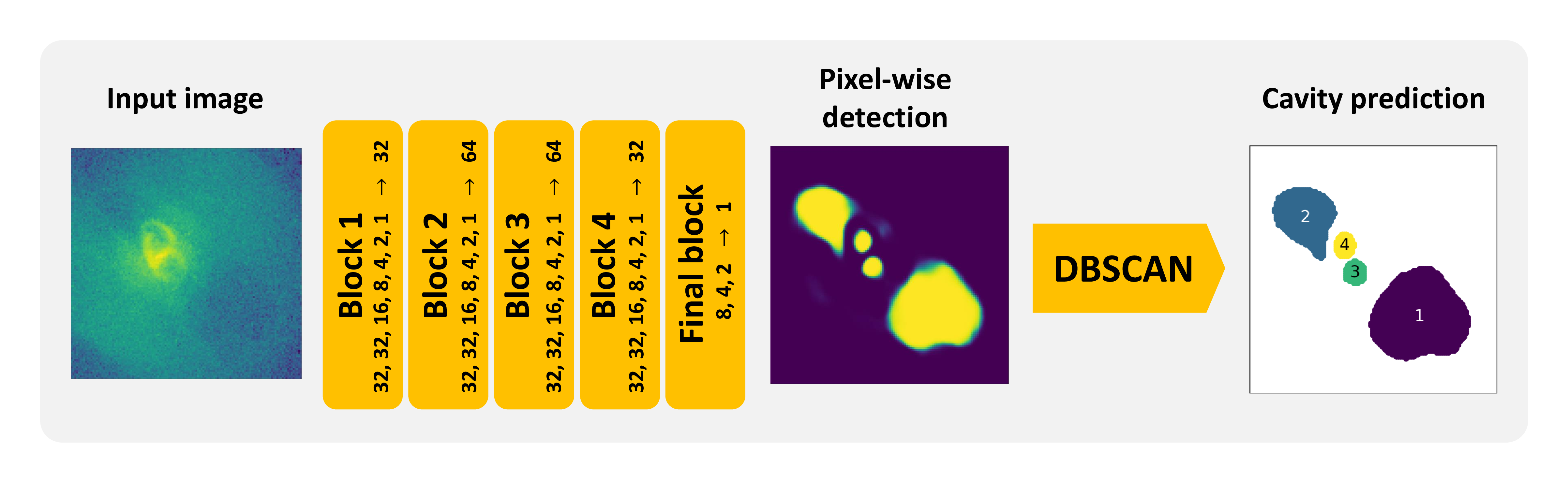
CADET is a machine learning pipeline trained to identify surface brightness depressions (X-ray cavities) in noisy Chandra images of early-type galaxies and galaxy clusters. The pipeline consists of a convolutional neural network trained to produce pixel-wise cavity predictions and a DBSCAN clustering algorithm that decomposes the predictions into individual cavities. The pipeline is described in detail in Plšek et al. 2023.
The architecture of the convolutional network consists of 5 convolutional blocks, each resembling an Inception layer, it was implemented using the Keras library and its development was inspired by Fort et al. 2017 and Secká 2019. For the clustering, we used is the Scikit-learn implementation of the Density-Based Spatial Clustering of Applications with Noise (DBSCAN).
Python package
The CADET pipeline has been released as a standalone Python3 package pycadet, which can be installed using pip:
$ pip3 install pycadet
or from source:
$ pip3 install git+https://github.com/tomasplsek/CADET.git
The pycadet package requires the following libraries:
keras
tensorflow / pytorch / jax # depending on which Keras backend you want to use
scikit-learn
numpy
scipy
astropy
matplotlib
pyds9
Since pycadet v0.3.0, the package is compatible with Keras3 which supports multiple backends (tensorflow, pytorch or jax). By default, the tensorflow backend is used, but any other backend can be selected by setting the KERAS_BACKEND environment variable or by editing the ~/keras/keras.json file (note: pytorch need to be defined as torch).
The automatic installation of pycadet will only install the keras package, and the installation of the backend is left to the user. For machines with dedicated NVIDIA graphical cards, the -gpu versions of backend libraries (tensorflow-gpu, pytorch-gpu, jax-gpu) can be installed to allow the CADET model to leverage the GPU for faster inference. For Anaconda environments, it is recommended to install the dependencies beforehand as some of the packages can be tricky to install in an existing environment and on some machines (e.g. new Macs).
An exemplary notebook on how to use the pycadet package can be found here:

DS9 Plugin
The CADET pipeline can also be used as a SAOImageDS9 plugin which is installed together with the pycadet Python package. The CADET plugin requires that SAOImageDS9 is already installed on the system.
After the installation, the CADET plugin should be available in the Analysis menu of DS9. After clicking on the CADET option, a new window will appear, where the user can set several options: whether the prediction should be averaged over multiple input images by shifting by +/- 1 pixel (Shift); and whether the prediction should be decomposed into individual cavities (Decompose). When decomposing into individual cavities, the user can also set a pair of discrimination thresholds, where the first one (Threshold1) is used for volume calibration and the second one (Threshold2) for false positive rate calibration (for more info see Plšek et al. 2023).
If the CADET plugin does not appear in the Analysis menu, it can be added manually by opening Edit > Preferences > Analysis and adding a path to the following file DS9CADET.ds9.ans (after the installation it should be located in ~/.ds9/). This plugin is inspired by the pyds9plugin library.

Online CADET interface
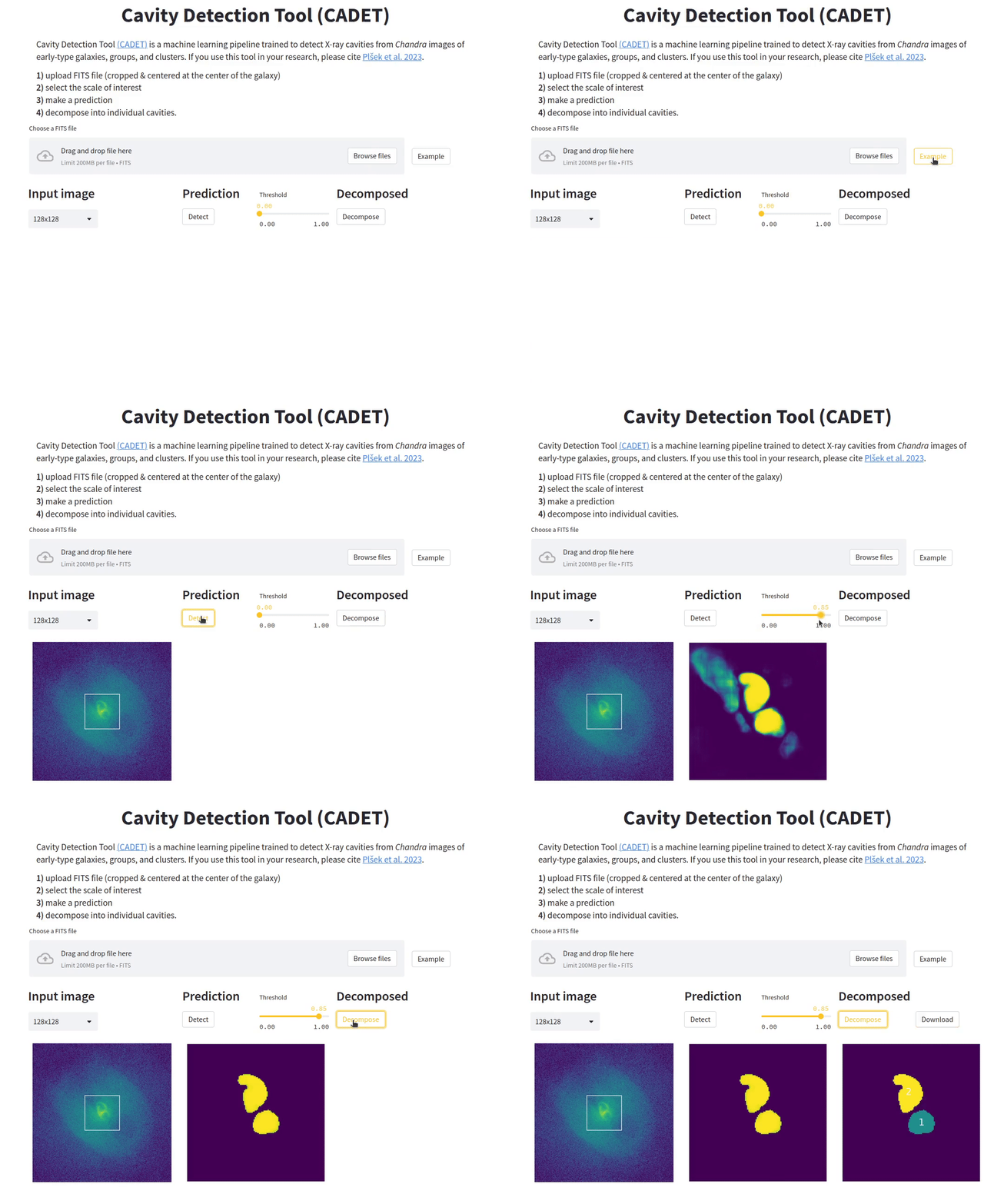
A simplified version of the CADET pipeline is available via a web interface hosted on HuggingFace Spaces. The input image should be centred on the galaxy centre and cropped to a square shape. It is also recommended to remove point sources from the image and fill them with the surrounding background level using Poisson statistics (dmfilth within CIAO). Furthermore, compared to the pycadet package, the web interface performs only a single thresholding of the raw pixel-wise prediction, which is easily adjustable using a slider.
Convolutional part
The convolutional part of the pipeline can be used separately to produce raw pixel-wise predictions. Since the convolutional network was implemented using the functional Keras API, the architecture could have been stored together with the trained weights in the HDF5 format (CADET.hdf5). The trained model can then simply be loaded using the load_model Keras function (requires Keras v2.15 or lower):
from keras.models import load_model

model = load_model("CADET.hdf5")

y_pred = model.predict(X)
The raw CADET model only inputs 128x128 images. Furthermore, to maintain the compatibility with Keras, the input needs to be reshaped as X.reshape(1, 128, 128, 1) for single image or as X.reshape(-1, 128, 128, 1) for multiple images.
Alternatively, the CADET model can be imported from HuggingFace's model hub:
from huggingface_hub import from_pretrained_keras

model = from_pretrained_keras("Plsek/CADET-v1")

y_pred = model.predict(X)
How to cite
If you use the CADET pipeline in your research, please cite the following paper Plšek et al. 2023 (arXiv):
@ARTICLE{2023MNRAS.tmp.3233P,
       author = {{Pl{\v{s}}ek}, T. and {Werner}, N. and {Topinka}, M. and {Simionescu}, A.},
        title = "{CAvity DEtection Tool (CADET): Pipeline for detection of X-ray cavities in hot galactic and cluster atmospheres}",
      journal = {\mnras},
         year = 2023,
        month = nov,
          doi = {10.1093/mnras/stad3371},
}
Todo
The following improvements to the data generation and training process are currently planned:
- add other features to supress FP rate (cold fronts, complex sloshing, point sources, jets)
- use more complex cavity shapes (e.g. Guo et al. 2015)
- train on multiband images simulated using PyXsim/SOXS
- replace DBSCAN by using instance segmentation
- restrict the cavity number and shape using regularization?
- systematic cavity size uncertainty estimation using MC Dropout
Release history Release notifications | RSS feed


Download files
Download the file for your platform. If you're not sure which to choose, learn more about installing packages.
Source Distribution
File details
Details for the file pycadet-0.3.2.tar.gz.
File metadata
- Download URL: pycadet-0.3.2.tar.gz
- Upload date:
- Size: 6.3 MB
- Tags: Source
- Uploaded using Trusted Publishing? No
- Uploaded via: twine/3.8.0 colorama/0.4.4 importlib-metadata/4.6.4 keyring/23.5.0 pkginfo/1.8.2 readme-renderer/34.0 requests-toolbelt/0.9.1 requests/2.25.1 rfc3986/1.5.0 tqdm/4.57.0 urllib3/1.26.5 CPython/3.10.12
File hashes
| Algorithm | Hash digest | |
|---|---|---|
| SHA256 |
4970d0656ae599391531fde4bb080a4e6981a433e469c31811d0387face79817
|
|
| MD5 |
b0052eea69291f46ce60a556f460dd12
|
|
| BLAKE2b-256 |
1b17cfb1f76f7f91888a947da2526e470af34f892908dabfff1268880be30a24
|






