
A Python tool to edit videos and automatically add CSS-styled subtitles to videos.

Project description
pycaps




pycaps is a Python tool for adding CSS styled subtitles to videos. It's designed as both a programmable library and a command-line interface (CLI), making it perfect for automating the creation of dynamic content for platforms like TikTok, YouTube Shorts, and Instagram Reels.
Note: This is a community fork published on PyPI as
pycaps-ai. The original project is francozanardi/pycaps.

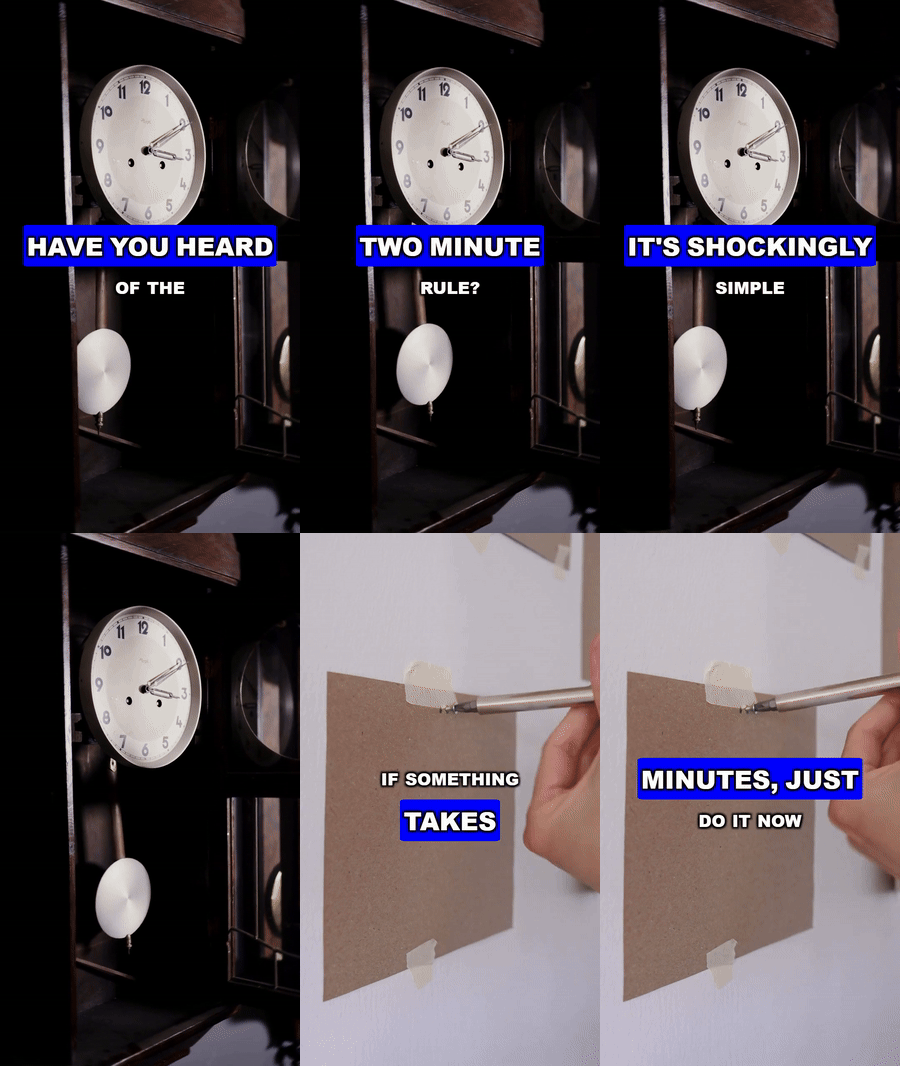
See more examples on pycaps.com
Try It Online (no installation needed!)
You have two options to test pycaps directly in your browser (hosted by the original project). Choose the one that best fits your needs.
1. Interactive Web Demo (on Hugging Face)
Ideal for a quick preview, testing built-in templates, and editing captions with a user-friendly interface.

Keep in mind:
- This demo runs on a shared, CPU-only environment, so it's best for short videos (< 60 seconds).
- For a private, faster experience, you can duplicate the Space for free.
2. Full-Power Notebook (on Google Colab)
The best choice for processing longer videos with maximum transcription quality, using a free GPU provided by Google.

Keep in mind:
- The interface is a step-by-step code notebook, not a graphical UI.
- You will be guided to enable the GPU for the best performance.
Key Features
- Template System: Get started quickly with predefined templates. Create and share your own templates, packaging styles, animations, and configurations.
- CSS Styling: Style subtitles using standard CSS. Target specific states like
.word-being-narratedfor dynamic effects, cleanly separating style from logic. - Word Tagging: Tag words or phrases using regular expressions, word lists, or AI. These tags act as powerful selectors for applying custom CSS, effects, or animations.
- Advanced Animations & Effects: Bring words to life with a library of built-in animations (fades, pops, slides) and effects (typewriting, emoji insertion, sound effects).
- Whisper-based Transcription: Automatically generate accurate, word-level timestamps for your videos using OpenAI's Whisper.
- Dual Interface: Use it as a simple CLI for quick renders or as a comprehensive Python library for programmatic video creation.
- Offline-First: The core transcription, styling, and rendering engine runs entirely on your local machine. An internet connection is only needed for optional AI-powered features that require contextual understanding of your script.
Prerequisites
Before installing, please ensure your environment meets the following requirements:
-
Python Version:
pycapswas tested on Python 3.10, 3.11, and 3.12. Other versions may present issues. -
FFmpeg: You need to have FFmpeg installed on your system and accessible from your command line's
PATH. This is essential for all audio and video processing tasks.- You can download it from ffmpeg.org and follow a guide to add it to your system's
PATH.
- You can download it from ffmpeg.org and follow a guide to add it to your system's
Installation
-
Install FFmpeg: Ensure you have completed the prerequisite step above.
-
Install from PyPI:
Full installation (recommended):
pip install "pycaps-ai[all]"
Custom installation with specific features:
# Whisper + Playwright + transcription editor (default setup)
pip install "pycaps-ai[base]"

# Lighter rendering: Google Speech + html2pic (no browser)
pip install "pycaps-ai[fast]"
Install from GitHub (latest dev):
pip install "git+https://github.com/AleefBilal/pycaps.git#egg=pycaps-ai[all]"
-
Install Browser Dependencies for Rendering:
pycapscurrently has two different options to render the subtitle images:CssSubtitleRenderer, which is the original and default one. It uses Playwright to render CSS styles. So, you need to install its browser dependency to use it:playwright install chromium
PictexSubtitleRenderer, which is a light-weight option. It doesn't use a browser, but it only support a subset of CSS, and it may present some visual differences in the result (specially in the shadows, you should modify the CSS from the templates to get the same results). To use it, you must callwith_custom_subtitle_renderer(PictexSubtitleRenderer())whenCapsPipelineBuilder()is created.
⚠️ Note: The first time you use
pycaps, it will also download a Whisper AI model for transcription. This may take a few minutes and only happens once.
Quick Start
There are two primary ways to use pycaps: via the command line with a template or programmatically in a Python script.
1. Using the Command-Line (CLI)
The fastest way to get started is to use a built-in template.
pycaps render --input my_video.mp4 --template minimalist
This command will:
- Load the
minimalisttemplate. - Transcribe the audio from
my_video.mp4. - Apply the template's styles and animations.
- Save the result in a new file.
If you already have a transcript from another tool, you can skip built-in transcription:
pycaps render --input my_video.mp4 --template minimalist --transcript transcript.json
Supported transcript formats: whisper_json, pycaps_json, srt, vtt (--transcript-format is optional and defaults to auto).
2. Using the Python Library
For full control, use the CapsPipelineBuilder in your Python code.
from pycaps import CapsPipelineBuilder

# The pipeline contains multiples stages to render the final video
pipeline = (
    CapsPipelineBuilder()
    .with_input_video("input.mp4")
    .add_css("css_file.css")
    .build()
)
pipeline.run() # When this is executed, it starts to render the video
You can also preload the builder using a Template.
from pycaps import *

# Load a template and configure it
builder = TemplateLoader("default").with_input_video("my_video.mp4").load(False)

# Programmatically add an animation
builder.add_animation(
    animation=FadeIn(),
    when=EventType.ON_NARRATION_STARTS,
    what=ElementType.SEGMENT
)

# Build and run the pipeline
pipeline = builder.build()
pipeline.run()
What's Next?
- 🚀 For Command-Line Users: Check the CLI Usage Guide for a quick and easy start.
- 🧠 For Developers: Understand the core concepts in the Structure Guide.
- 🏷️ Styling & Logic: Learn about the powerful Tagging System.
- 🎨 Reusable Styles: See how Templates work and how to create your own.
- 💡 Inspiration: Dive into Code & JSON Examples.
- 🔧 Advanced Config: See all options in the JSON Configuration Reference.
- 🤖 AI Features: Learn about AI-powered features in the API Usage Guide.
Contributing
This project is in active development. Contributions, bug reports, and feature requests are welcome! Please open an issue or pull request on our GitHub repository.
License
pycaps is licensed under the MIT License. Originally created by Franco Zanardi.
Release history Release notifications | RSS feed


Download files
Download the file for your platform. If you're not sure which to choose, learn more about installing packages.
Source Distribution
Built Distribution
Filter files by name, interpreter, ABI, and platform.
If you're not sure about the file name format, learn more about wheel file names.
Copy a direct link to the current filters
File details
Details for the file pycaps_ai-0.2.1.tar.gz.
File metadata
- Download URL: pycaps_ai-0.2.1.tar.gz
- Upload date:
- Size: 599.4 kB
- Tags: Source
- Uploaded using Trusted Publishing? No
- Uploaded via: twine/6.2.0 CPython/3.13.13
File hashes
| Algorithm | Hash digest | |
|---|---|---|
| SHA256 |
ca3111de1d29e8bd70bb6725d9ed43c3e7f5af5cac22d84d42c72bf8030b314a
|
|
| MD5 |
ab858923d3a9572857fb1ba330078af4
|
|
| BLAKE2b-256 |
b6ef6ead457fd1db20497c1c543840b9c1bc42ad5ceb35190657594cc0b80c93
|
File details
Details for the file pycaps_ai-0.2.1-py3-none-any.whl.
File metadata
- Download URL: pycaps_ai-0.2.1-py3-none-any.whl
- Upload date:
- Size: 635.7 kB
- Tags: Python 3
- Uploaded using Trusted Publishing? No
- Uploaded via: twine/6.2.0 CPython/3.13.13
File hashes
| Algorithm | Hash digest | |
|---|---|---|
| SHA256 |
9fcb1359ac8e09e04a65d17e019f0ba3083ec28e969089eb93c72e175b191cea
|
|
| MD5 |
d25dbfa35f1ed4a5b2644d64bf4c29ae
|
|
| BLAKE2b-256 |
18102eb10af31a350d217a26f8d9480b5c3f54a0c670b42f945333da94e113c9
|






