
PyCForge




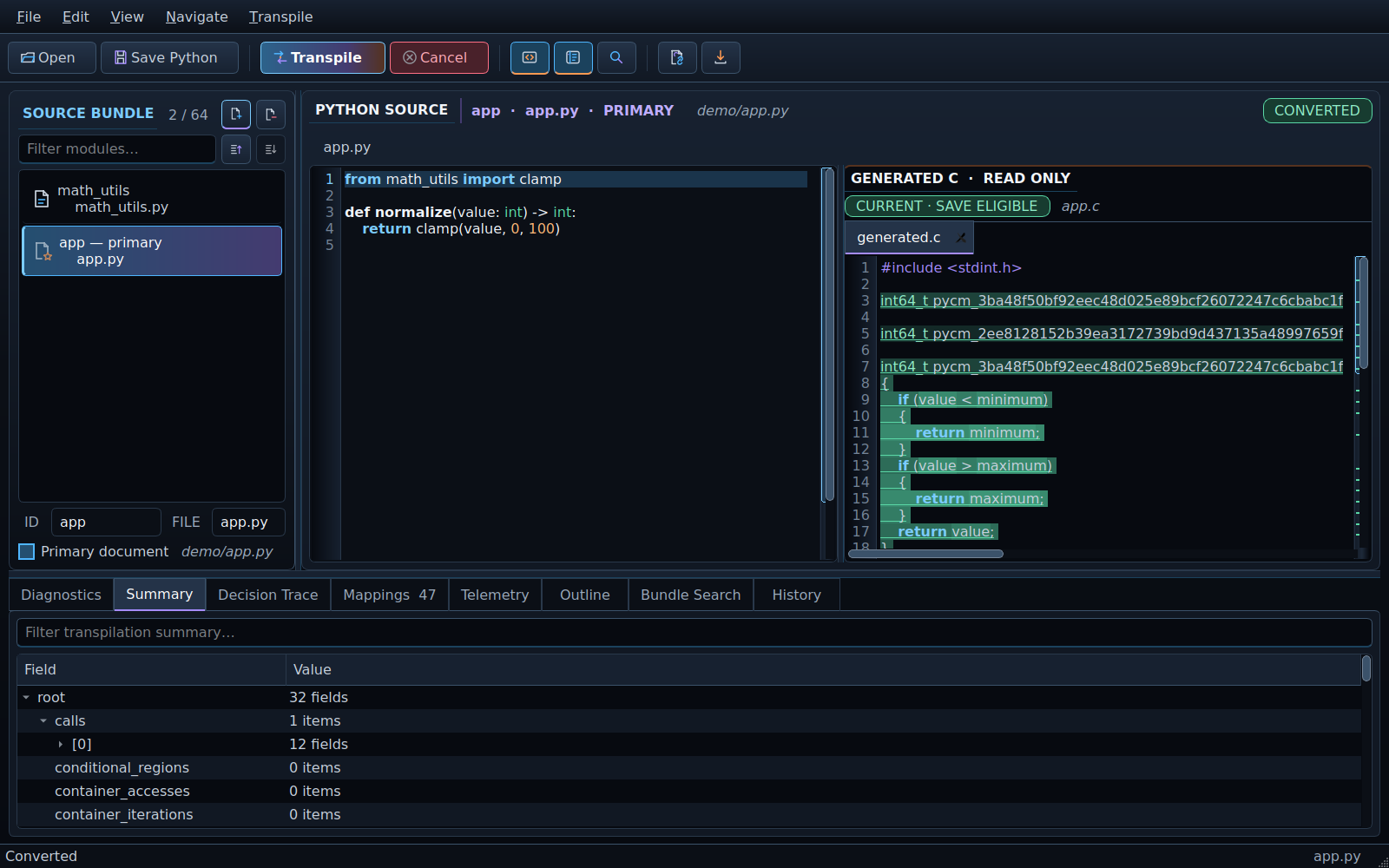
PyCForge is a deterministic Python-to-C source transpiler with a full PySide6 (Qt 6) desktop workspace, a command-line interface, and a Python API. It converts a documented, deliberately bounded Python subset into readable C11 source while producing diagnostics, source mappings, decision traces, and reproducible fingerprints.
This source tree defines the PyCForge 0.16.0 release contract. Tagged builds
are published only after the complete release workflow revalidates the source,
distributions, required PySide6 desktop application, and immutable assets.
Open the 35-page PyCForge 0.16.0 Programmer's Conversion Guide (PDF)
Quick start
PyCForge requires Python 3.11 or newer. Install it from PyPI:
python -m pip install pycforge
That one command installs PySide6 and the desktop application as required
dependencies. There is no GUI extra and no separate desktop package.
Minimal Debian/Ubuntu installations must also provide the system EGL runtime
(sudo apt-get install libegl1); the pinned Linux CI and release runners
install it explicitly before exercising real Qt widgets.
Launch the desktop workspace:
pycforge-workspace
The equivalent module command is:
python -m pycforge.ide
A 60-second conversion
Save this as example.py:
def add(left: int, right: int) -> int:
    return left + right
Convert it:
pycforge convert example.py --output example.c
PyCForge produces:
#include <stdint.h>

int64_t add(int64_t left, int64_t right);

int64_t add(int64_t left, int64_t right)
{
    return left + right;
}
The generated C is deterministic for the same authenticated source bundle and converter configuration.
What PyCForge provides
- A Python-first PySide6/Qt 6 workspace with document tabs, source splitting, navigation, search, outline, command palette, and conversion history.
- Persisted 8–48 pt Python-editor text sizing from Edit → Editor Settings… and undoable Python-aware auto-indentation on Enter.
- Explicit source bundles containing 1 to 64 Python documents, including bounded cross-module function imports.
- Read-only generated C with clean text presentation plus source mappings, overview-rail navigation, diagnostics, conversion summary, decision trace, and telemetry inspectors.
- Isolated, cancellable desktop conversion so the converter does not run on the GUI thread.
- A headless CLI for scripts and build pipelines.
- A Python API for applications that need structured conversion results.
- Stable diagnostics and fail-closed rejection of unsupported Python.
- Phase 16 proofs for selected branch-defined scalar locals, Python loop
completion (
while/for ... else), overflow-safe signed-64rangeupdates, and one closed bounded UTF-8 file read/write profile.
Command-line interface
Write generated C to a file:
pycforge convert input.py --output generated.c
Emit the structured result as JSON:
pycforge --format json convert input.py
See all commands and options:
pycforge --help
Python API
from pycforge import ConversionRequest, PythonToCConverter

source = """\
def add(left: int, right: int) -> int:
    return left + right
"""

result = PythonToCConverter().convert(
    ConversionRequest.from_source(source)
)

if result.generated_c is not None:
    print(result.generated_c)
else:
    for diagnostic in result.diagnostics:
        print(diagnostic)
The desktop workspace, CLI, and Python API use the same converter and result contracts.
Supported Python
PyCForge is intentionally not a general Python runtime. Its current subset
includes strictly annotated top-level functions using selected scalar values,
arithmetic and comparisons, if/elif/else, bounded while and range
loops including proved loop else, direct eligible function calls, fixed
homogeneous containers, a bounded static-record profile, selective scalar
scope hoisting, and exact bounded UTF-8 file sessions.
Anything outside the documented subset is unsupported by default and is rejected with diagnostics rather than silently approximated. Read the exact supported-Python specification before adopting PyCForge for production input.
Phase 16 in brief
-
A scalar local first assigned below an exhaustive
ifcan be declared once at C function entry when every reachable use is definitely preceded by a compatibleint,float,bool, orstrstore. This is selective proof, not general Python scope or closure support. -
elseis supported on admittedwhile, positionalrange, and fixed list/tuple/dictionary loops. Natural termination—including zero iterations—runs the else suite; only abreakowned by that exact loop suppresses it. Nested breaks,continue, and returns retain Python control ownership. Phase 16 also guards a signed-64rangeupdate before adding its step, avoiding C signed overflow at the exhaustion boundary. -
File I/O is limited to a direct one-item
with open(path, 'r' or 'w', encoding='utf-8', newline='') as handleinside a top-level function, with one directread()transfer or onewrite(text)statement whose text is an already-proved string name or string literal. Effectful write expressions are rejected because helper-internal open cannot preserve context-entry ordering. An assigned read result must declare a fresh direct local rather than rebind a parameter or earlier local. Reads are bounded (1 MiB by default, 16 MiB hard maximum), validate UTF-8 and reject embedded NUL, and transfer one unique buffer only after close succeeds. Writes use borrowed UTF-8 text, require an exact byte count, and propagate close failure. Aliasing, rebinding, explicit close, arbitrary modes, multiple context items, and general file-object behavior fail closed.At the generated-C ABI, the external caller must supply non-null, NUL-terminated valid UTF-8 path strings. Borrowed write text has the same preconditions and must contain no embedded NUL. The helpers cannot independently validate pointer validity, path UTF-8/NUL properties, or an embedded NUL beyond the first terminator in write text. Source path literals containing NUL reject with
PYC3903; write literals containing NUL reject withPYC3905. Runtime codes 5 and 6 describe read file content only.
Safety boundary
PyCForge parses supplied source as data. Conversion never imports or executes the input Python, scans the host environment for modules, resolves undeclared files, or opens a path selected by the source program. It stops after C source generation. PyCForge never compiles, assembles, links, loads, runs, or executes the generated C.
Generated C for an admitted Phase 16 file-effect function performs file I/O
only if someone separately builds and runs that C outside PyCForge. Its public
C entry point has one generated final int64_t * status parameter; the
external caller owns that writable status storage and must pass a non-null
pointer. Each file-effect entry initializes it to success immediately after
the null guard and before source-controlled work; helpers overwrite it on
failure. A successful read returns a unique malloc-owned char *; the
external caller owns it and must release it with free. Failures return null
for reads or the function's failure value for writes and publish the stable
status code. Source-defined calls to file-effect functions are rejected in the
initial profile so this ABI cannot be bypassed inside transpiled Python.
Python int values map to the documented signed 64-bit representation domain;
other supported Python values likewise follow explicit target-C contracts.
Review the
product boundary
and the Programmer's Conversion Guide for the complete limitations.
Documentation
- Programmer's Conversion Guide - 0.16.0 Reference Edition (PDF)
- Supported Python
- Workspace specification
- Current state
- Release notes
- Changelog
- Security policy
Development
git clone https://github.com/lastforkbender/pycforge.git
cd pycforge
python -m venv .venv
python -m pip install --upgrade pip
python -m pip install -e .
python -m pip install pytest reportlab==4.4.9 pypdf==6.10.0
QT_QPA_PLATFORM=offscreen python -m pytest -q -rs
The normal editable installation includes PySide6, matching the package users receive from PyPI. Automated release checks cover Python 3.11 and 3.12 on Linux with real PySide6 widgets using Qt's offscreen platform.
License
PyCForge is free software released under the GNU General Public License v3.0 only.
1 maintainer

Release files for pycforge 0.16.0
For a detailed explanation of source distributions (sdists) and built distributions (wheels), please see the package formats documentation.
Source distribution (sdist)
| File | Size | Uploaded | |
|---|---|---|---|
| pycforge-0.16.0.tar.gz | 513.9 kB | Details |
Built distribution (wheel)
| File | Interpreter | ABI | Platform | Reset |
|---|---|---|---|---|
| pycforge-0.16.0-py3-none-any.whl | Python 3 | none | any | Details |
Total release size: 1.1 MB
Release files / pycforge-0.16.0.tar.gz
| Download URL | pycforge-0.16.0.tar.gz |
|---|---|
| Size | 513.9 kB |
| Tags | Source |
|
SHA-256 checksum How to use checksums |
301811379977756192c296d87458e47fd4d9581f0316c2161cf625ad45193504
|
|
BLAKE2b-256 checksum How to use checksums |
091d8cbb51352d080cc9b76969a2bca863d4e1756152916a32216a4719b256ed
|
| Upload date | |
|
Uploaded using Trusted Publishing? What is trusted publishing? |
Yes |
| Uploaded via |
twine/7.0.0 CPython/3.13.14
|
Provenance
Provenance describes where a file came from. On PyPI, provenance is shared via attestations, which provide a verifiable record of the build or publishing details. View details, limitations and caveats.


PyPI Publish Attestation
PyPI verified that this artifact, at this checksum, originated from the publisher listed below.
Signed by GitHub Actions, verified by PyPI on Aug 25, 2026.
Transparency logRelease files / pycforge-0.16.0-py3-none-any.whl
| Download URL | pycforge-0.16.0-py3-none-any.whl |
|---|---|
| Size | 599.0 kB |
| Tags | Python 3 |
|
SHA-256 checksum How to use checksums |
6112d6445e7ecff158557c90b589ce332cc16b599a4a8a502a305930705f6c60
|
|
BLAKE2b-256 checksum How to use checksums |
fe0eb90ce1c606f622c7e8d6323b7a55a7c43f6edb69fe5485890fa968e949c4
|
| Upload date | |
|
Uploaded using Trusted Publishing? What is trusted publishing? |
Yes |
| Uploaded via |
twine/7.0.0 CPython/3.13.14
|
Provenance
Provenance describes where a file came from. On PyPI, provenance is shared via attestations, which provide a verifiable record of the build or publishing details. View details, limitations and caveats.
PyPI Publish Attestation
PyPI verified that this artifact, at this checksum, originated from the publisher listed below.
Signed by GitHub Actions, verified by PyPI on Aug 25, 2026.
Transparency log













