
PyClassParser
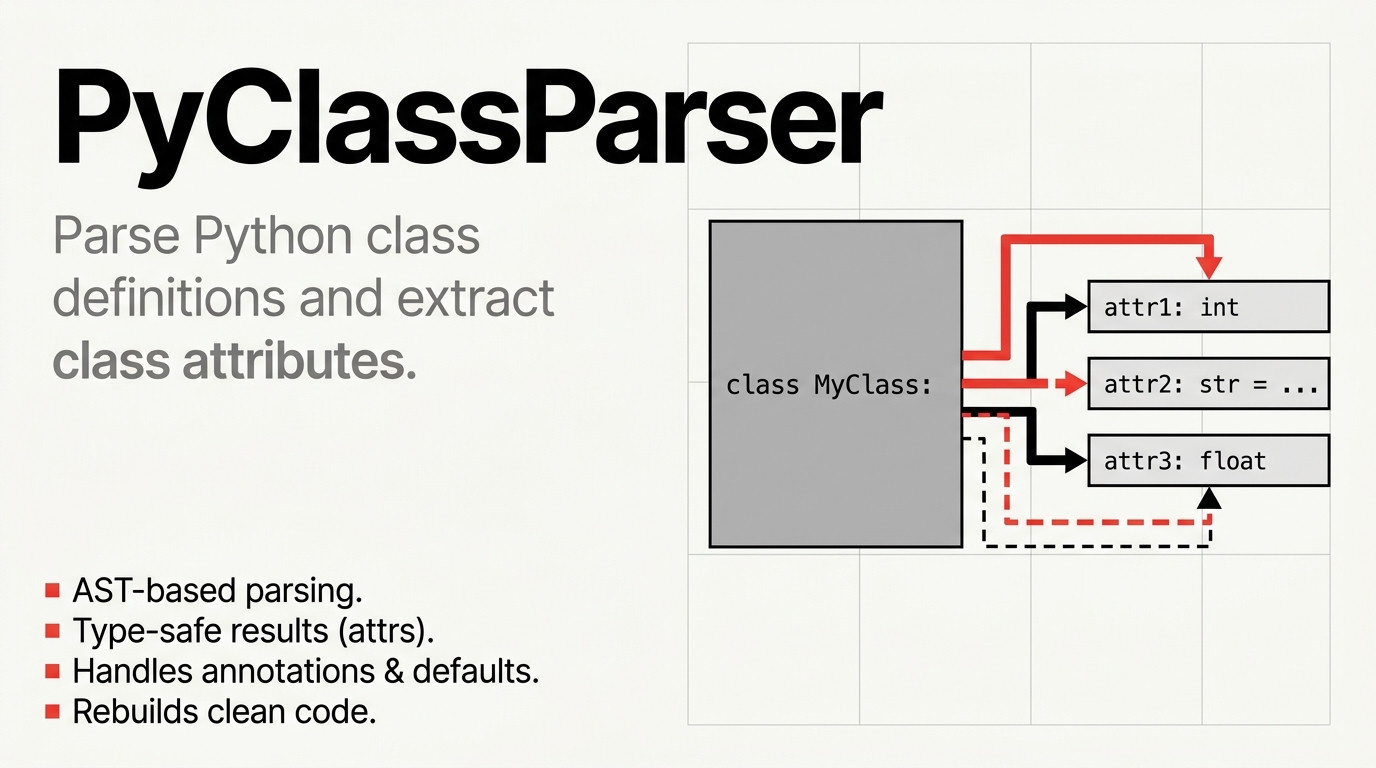





PyClassParser is a Python library designed to parse Python class definitions and extract class attributes. Parsing is backed by the standard-library ast module, so it is robust against blank lines, comments, docstrings, methods, nested classes and default values that contain colons. It uses the attrs library for defining the result objects and ensures type safety with attrs-strict.
Features
- Parses Python class definitions to extract class names and their attributes.
- Uses the standard-library
astmodule, so the input must be syntactically valid Python (aSyntaxErroris raised otherwise). - Uses
attrsfor the result objects andattrs-strictfor type validation. - Captures each attribute's name (
attr_value), annotation (attr_type) and default value (default_value) when present. - Rebuilds a clean, always-valid reconstruction of the imports and class stubs.
Installation with UV:
uv add pyclassparser
Usage
Here's how you can use PyClassParser to parse Python class definitions:
Example Code
Create a Python script, for example example.py:
from pyclassparser import ClassParser

code = """
class MyClass:
    attr1: int
    attr2: str = "default"

class AnotherClass:
    attr3: float
"""
parser = ClassParser(code=code)
print(parser.output)
print(parser.class_data_dict)
Example Output
Running the above script should give you the parsed output of class definitions:
class MyClass:
    attr1: int
    attr2: str = 'default'

class AnotherClass:
    attr3: float

{'MyClass': [ClassATTR(attr_value='attr1', attr_type='int', default_value=None),
             ClassATTR(attr_value='attr2', attr_type='str', default_value="'default'")],
 'AnotherClass': [ClassATTR(attr_value='attr3', attr_type='float', default_value=None)]}
Note:
parser.parsed_codeis an alias ofparser.output. Because the code is re-emitted from the AST, string literals are normalized (e.g."default"becomes'default').
What gets parsed
- Only top-level classes are reported; nested classes are ignored.
- An attribute is either an annotated assignment (
attr: type), whereattr_typeis the annotation, or a plain assignment (attr = value), whereattr_typeisNone.default_valueholds the default as it appears in the source, orNonewhen there is no default. - Docstrings, comments, methods and nested classes are ignored.
- Class-level decorators and PEP 695 type parameters (
class Box[T]:) are kept inparsed_code. - A duplicate top-level class name raises
ValueError.
Running the tests
uv sync
uv run pytest
uv run mypy pyclassparser
Contributing
Contributions are welcome! Please submit a pull request or open an issue to discuss your ideas.
1 maintainer

Metadata
1 maintainer
Release files for pyclassparser 0.8.4
For a detailed explanation of source distributions (sdists) and built distributions (wheels), please see the package formats documentation.
Source distribution (sdist)
| File | Size | Uploaded | Provenance | |
|---|---|---|---|---|
| pyclassparser-0.8.4.tar.gz | 7.8 kB | With provenance | Details |
Built distribution (wheel)
| File | Interpreter | ABI | Platform | Reset |
|---|---|---|---|---|
| pyclassparser-0.8.4-py3-none-any.whl | Python 3 | none | any | Details |
Total release size: 13.6 kB
Release files / pyclassparser-0.8.4.tar.gz
| Download URL | pyclassparser-0.8.4.tar.gz |
|---|---|
| Size | 7.8 kB |
| Tags | Source |
|
SHA-256 checksum How to use checksums |
2a4a46ab32eb4b5d189e4376363d502912f794da027c8f15358a09d7ea0f4e96
|
|
BLAKE2b-256 checksum How to use checksums |
2486f25772b137f3f6e202734897dacc4fe2497a19b1729e02a034df898c470b
|
| Upload date | |
|
Uploaded using Trusted Publishing? What is trusted publishing? |
Yes |
| Uploaded via |
twine/6.1.0 CPython/3.13.13
|
Provenance
Provenance describes where a file came from. On PyPI, provenance is shared via attestations, which provide a verifiable record of the build or publishing details. View details, limitations and caveats.


PyPI Publish Attestation
PyPI verified that this artifact, at this checksum, originated from the publisher listed below.
Signed by GitHub Actions, verified by PyPI on Jul 4, 2026.
Transparency logRelease files / pyclassparser-0.8.4-py3-none-any.whl
| Download URL | pyclassparser-0.8.4-py3-none-any.whl |
|---|---|
| Size | 5.8 kB |
| Tags | Python 3 |
|
SHA-256 checksum How to use checksums |
ce9a92bb3d98c5cc81eaa3b6bf8338eb8da2ddbfb7a93502dbf42803dfd67ef1
|
|
BLAKE2b-256 checksum How to use checksums |
8c8d07554ec72a01c257d8d291f352c2fef96ae07deff989881652b9b15e2c2b
|
| Upload date | |
|
Uploaded using Trusted Publishing? What is trusted publishing? |
Yes |
| Uploaded via |
twine/6.1.0 CPython/3.13.13
|
Provenance
Provenance describes where a file came from. On PyPI, provenance is shared via attestations, which provide a verifiable record of the build or publishing details. View details, limitations and caveats.
PyPI Publish Attestation
PyPI verified that this artifact, at this checksum, originated from the publisher listed below.
Signed by GitHub Actions, verified by PyPI on Jul 4, 2026.
Transparency logSecurity for pyclassparser 0.8.4
Provenance
Provenance describes where a file came from. On PyPI, provenance is shared via attestations, which provide a verifiable record of the build or publishing details. View details, limitations and caveats.
Full provenance
All 2 files in this release have been uploaded with provenance metadata.
Attestation for pyclassparser-0.8.4.tar.gz
PyPI Publish Attestation
PyPI verified that this artifact, at this checksum, originated from the publisher listed below.
Signed by GitHub Actions, verified by PyPI on Jul 4, 2026.
Transparency logA note on package security
PyPI is a repository for distributing packages, not a service for auditing them. While third-party security researchers and our staff do their best to detect and remove malicious packages, PyPI cannot guarantee the quality, security or suitability of any given package.














