
Deep Agent framework built on Pydantic-ai with planning, filesystem, and subagent capabilities
Verified details
These details have been verified by PyPIProject links
GitHub Statistics
Maintainers

Project description

Pydantic Deep Agents
From framework to terminal -- autonomous AI agents that plan, code, and ship
Docs · PyPI · CLI · DeepResearch · Examples





Unlimited Context • Subagent Delegation • Persistent Memory • Lifecycle Hooks
Same Architecture as the Best
pydantic-deep implements the deep agent pattern -- the same architecture powering:
| Product | What They Built | |
|---|---|---|
| Claude Code | Anthropic's AI coding assistant | |
| Manus AI | Autonomous task execution | |
| Devin | AI software engineer |
Now you can build the same thing -- or just use the CLI.
Inspired by: LangChain's Deep Agents research on autonomous agent architectures.
pydantic-deep is three things:
- A Python framework for building Claude Code-style agents with planning, filesystem access, subagents, memory, and unlimited context
- A CLI that gives you a terminal AI assistant out of the box
- DeepResearch -- a full-featured research agent with web UI, web search, diagrams, and sandboxed code execution
CLI -- Terminal AI Assistant

pip install pydantic-deep[cli]
pydantic-deep chat
That's it. You get an interactive AI agent in your terminal with:
- File read/write/edit, shell execution, glob, grep
- Task planning and subagent delegation
- Persistent memory across sessions
- Context compression for unlimited conversations
- Git-aware project context
- Built-in commands:
/commit,/pr,/review,/test,/fix,/explain - Customizable skills, hooks, and output styles
# Interactive mode
pydantic-deep chat

# Run a single task
pydantic-deep run "Fix the failing tests in src/"

# Docker sandbox for isolated execution
pydantic-deep run "Build a web scraper" --sandbox

# Pick a model
pydantic-deep chat --model anthropic:claude-sonnet-4-20250514

# Manage config
pydantic-deep config set model openai:gpt-4.1
See CLI docs for the full reference.
Framework -- Build Your Own Agent
pip install pydantic-deep
Requires pydantic-ai >= 1.71.0.
from pydantic_ai_backends import StateBackend
from pydantic_deep import create_deep_agent, create_default_deps

agent = create_deep_agent()
deps = create_default_deps(StateBackend())

result = await agent.run("Create a todo list for building a REST API", deps=deps)
One function call gives you an agent with planning, filesystem tools, subagents, skills, context management, and cost tracking. Everything is toggleable:
agent = create_deep_agent(
    model="openai:gpt-4.1",
    include_todo=True,          # Task planning
    include_filesystem=True,    # File read/write/edit/execute
    include_subagents=True,     # Delegate to subagents
    include_skills=True,        # Domain-specific skills from SKILL.md files
    include_memory=True,        # Persistent MEMORY.md across sessions
    include_plan=True,          # Structured planning before execution
    include_teams=True,         # Multi-agent teams with shared TODOs
    include_web=True,           # Built-in WebSearch() and WebFetch() capabilities
    context_manager=True,       # Auto-summarization for unlimited context
    cost_tracking=True,         # Token/USD budget enforcement
    include_checkpoints=True,   # Save, rewind, and fork conversations
)
Structured Output
from pydantic import BaseModel

class CodeReview(BaseModel):
    summary: str
    issues: list[str]
    score: int

agent = create_deep_agent(output_type=CodeReview)
result = await agent.run("Review the auth module", deps=deps)
print(result.output.score)  # Type-safe!
Context Management
from pydantic_deep import create_summarization_processor

processor = create_summarization_processor(
    trigger=("tokens", 100000),
    keep=("messages", 20),
)
agent = create_deep_agent(history_processors=[processor])
Hooks (Claude Code-Style)
from pydantic_deep import Hook, HookEvent

agent = create_deep_agent(
    hooks=[
        Hook(
            event=HookEvent.PRE_TOOL_USE,
            command="echo 'Tool called: $TOOL_NAME' >> /tmp/audit.log",
        ),
    ],
)
Cost Tracking
agent = create_deep_agent(
    cost_tracking=True,
    cost_budget_usd=5.0,
    on_cost_update=lambda info: print(f"Cost: ${info.total_usd:.4f}"),
)
Custom Subagents
agent = create_deep_agent(
    subagents=[
        {
            "name": "code-reviewer",
            "description": "Reviews code for quality issues",
            "instructions": "You are a senior code reviewer...",
            "preferred_mode": "sync",
        },
    ],
)
See the full API reference for all options.
DeepResearch -- Reference App
A full-featured research agent with web UI, built entirely on pydantic-deep.

Plan Mode -- planner asks clarifying questions |

Parallel Subagents -- 5 agents researching simultaneously |

Excalidraw Canvas -- live diagrams synced with agent |

File Browser -- workspace files with inline preview |
Web search (Tavily, Brave, Jina), sandboxed code execution, Excalidraw diagrams, subagents, plan mode, report export, and more.
cd apps/deepresearch
uv sync
cp .env.example .env  # Add your API keys
uv run deepresearch    # Open http://localhost:8080
See apps/deepresearch/README.md for full setup.
Architecture
pydantic-deep v0.3.0 uses pydantic-ai's native Capabilities API (Agent(capabilities=[...])) for all cross-cutting concerns. This replaces the previous middleware wrapping approach and provides a cleaner, more composable architecture.
Capabilities
All lifecycle features are implemented as capabilities that extend AbstractCapability from pydantic-ai:
| Capability | Package | What It Does |
|---|---|---|
| CostTracking | pydantic-ai-shields | Token/USD budget enforcement and real-time cost callbacks |
| ContextManagerCapability | summarization-pydantic-ai | Auto-compression when approaching token budget |
| HooksCapability | pydantic-deep | Claude Code-style lifecycle hooks on tool events |
| CheckpointMiddleware | pydantic-deep | Save, rewind, and fork conversation state |
| WebSearch / WebFetch | pydantic-ai (built-in) | Web search and URL fetching |
pydantic-deep also provides 5 internal capabilities that are automatically wired up when their corresponding include_* flags are set:
| Internal Capability | Activated By | What It Does |
|---|---|---|
| SkillsCapability | include_skills=True |
Domain-specific skills from SKILL.md files |
| ContextFilesCapability | context_files / context_discovery |
Auto-discover and inject DEEP.md, AGENTS.md, CLAUDE.md |
| MemoryCapability | include_memory=True |
Persistent MEMORY.md across sessions |
| TeamCapability | include_teams=True |
Multi-agent teams with shared TODOs and message bus |
| PlanCapability | include_plan=True |
Structured planning before execution |
Component Packages
Every component is modular and works standalone:
| Component | Package | What It Does |
|---|---|---|
| Backends | pydantic-ai-backend | File storage, Docker/Daytona sandbox |
| Planning | pydantic-ai-todo | Task tracking with dependencies |
| Subagents | subagents-pydantic-ai | Sync/async delegation, cancellation |
| Summarization | summarization-pydantic-ai | LLM summaries or sliding window |
| Shields | pydantic-ai-shields | Cost tracking, input/output/tool blocking |
                              pydantic-deep
+---------------------------------------------------------------------+
|                                                                     |
|   +----------+ +----------+ +----------+ +----------+ +---------+   |
|   | Planning | |Filesystem| | Subagents| |  Skills  | |  Teams  |   |
|   +----+-----+ +----+-----+ +----+-----+ +----+-----+ +----+----+   |
|        |            |            |            |            |        |
|        +------------+-----+------+------------+------------+        |
|                           |                                         |
|                           v                                         |
|  Summarization --> +------------------+ <-- Capabilities            |
|  Checkpointing --> |    Deep Agent    | <-- Hooks                   |
|  Cost Tracking --> |   (pydantic-ai)  | <-- Memory                  |
|                    +--------+---------+                             |
|                             |                                       |
|           +-----------------+-----------------+                     |
|           v                 v                 v                     |
|    +------------+    +------------+    +------------+               |
|    |   State    |    |   Local    |    |   Docker   |               |
|    |  Backend   |    |  Backend   |    |  Sandbox   |               |
|    +------------+    +------------+    +------------+               |
|                                                                     |
+---------------------------------------------------------------------+
All Features
Click to expand full feature list
Core Toolsets
- Planning -- Task tracking with subtasks, dependencies, cycle detection. PostgreSQL storage. Event system.
- Filesystem --
ls,read_file,write_file,edit_file,glob,grep,execute. Docker sandbox. Permission system. - Subagents -- Sync/async delegation. Background task management. Soft/hard cancellation.
- Summarization -- LLM-based summaries or zero-cost sliding window. Trigger on tokens, messages, or fraction.
Capabilities
- CostTracking -- Token/USD budgets with automatic enforcement and real-time callbacks (from
pydantic-ai-shields). - ContextManagerCapability -- Auto-compression when approaching token budget (from
summarization-pydantic-ai). - HooksCapability -- Claude Code-style lifecycle hooks. Shell commands on tool events. Audit logging, safety gates.
- CheckpointMiddleware -- Save state at intervals. Rewind or fork sessions. In-memory and file-based stores. Extends
AbstractCapability. - WebSearch / WebFetch -- Built-in pydantic-ai capabilities for web search and URL fetching.
- SkillsCapability -- Domain-specific skills loaded from SKILL.md files.
- ContextFilesCapability -- Auto-discover and inject DEEP.md, AGENTS.md, CLAUDE.md, SOUL.md into the system prompt.
- MemoryCapability -- Persistent MEMORY.md across sessions, auto-injected into system prompt.
- TeamCapability -- Multi-agent teams with shared TODO lists, claiming, dependency tracking, and peer-to-peer message bus.
- PlanCapability -- Dedicated planner subagent for structured planning before execution.
Advanced
- Agent Teams -- Shared TODO lists with claiming and dependency tracking. Peer-to-peer message bus.
- Persistent Memory --
MEMORY.mdthat persists across sessions. Auto-injected into system prompt. - Context Files -- Auto-discover and inject
AGENT.mdinto the system prompt. - Output Styles -- Built-in (concise, explanatory, formal, conversational) or custom from files.
- Plan Mode -- Dedicated planner subagent for structured planning before execution.
- Eviction Processor -- Evict large tool outputs to files. Keep context lean while preserving data.
- Patch Tool Calls -- On resume, patch stale tool call results for clean history.
- Custom Tool Descriptions -- Override any tool's description via
descriptionsparameter. - Custom Commands --
/commit,/pr,/review,/test,/fix,/explain. Three-scope discovery: built-in, user, project. - Structured Output -- Type-safe responses with Pydantic models via
output_type. - Human-in-the-Loop -- Confirmation workflows for sensitive operations.
- Streaming -- Full streaming support for real-time responses.
- Image Support -- Multi-modal analysis with image inputs.
Contributing
git clone https://github.com/vstorm-co/pydantic-deepagents.git
cd pydantic-deepagents
make install
make test  # 100% coverage required
make all   # lint + typecheck + test
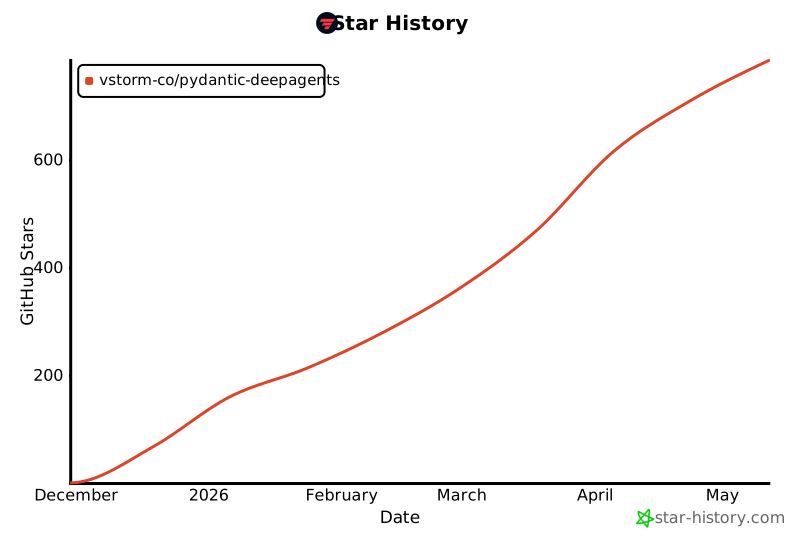
Star History
License
MIT -- see LICENSE

Project details
Verified details
These details have been verified by PyPIProject links
GitHub Statistics
Maintainers
Release history Release notifications | RSS feed


Download files
Download the file for your platform. If you're not sure which to choose, learn more about installing packages.
Source Distribution
Built Distribution
Filter files by name, interpreter, ABI, and platform.
If you're not sure about the file name format, learn more about wheel file names.
Copy a direct link to the current filters
File details
Details for the file pydantic_deep-0.3.1.tar.gz.
File metadata
- Download URL: pydantic_deep-0.3.1.tar.gz
- Upload date:
- Size: 12.5 MB
- Tags: Source
- Uploaded using Trusted Publishing? Yes
- Uploaded via: twine/6.1.0 CPython/3.13.7
File hashes
| Algorithm | Hash digest | |
|---|---|---|
| SHA256 |
3b8199e62bb977848b3881eb7e31862fb77235da8658de7a9a8cb413c9351c2d
|
|
| MD5 |
4fcb80ff08cb49ef8413e4513b2d0f8e
|
|
| BLAKE2b-256 |
2c3639e71a6020e024ae8e537ecbc96250e305b5eda18030313b56a07d3fb03d
|
Provenance
The following attestation bundles were made for pydantic_deep-0.3.1.tar.gz:
Publisher:
publish.yml on vstorm-co/pydantic-deepagents
-
Statement:
-
Statement type:
https://in-toto.io/Statement/v1 -
Predicate type:
https://docs.pypi.org/attestations/publish/v1 -
Subject name:
pydantic_deep-0.3.1.tar.gz -
Subject digest:
3b8199e62bb977848b3881eb7e31862fb77235da8658de7a9a8cb413c9351c2d - Sigstore transparency entry: 1203521461
- Sigstore integration time:
-
Permalink:
vstorm-co/pydantic-deepagents@a53f03d7dfca75ae521881bb6055575b627a474e -
Branch / Tag:
refs/tags/0.3.1 - Owner: https://github.com/vstorm-co
-
Access:
public
-
Token Issuer:
https://token.actions.githubusercontent.com -
Runner Environment:
github-hosted -
Publication workflow:
publish.yml@a53f03d7dfca75ae521881bb6055575b627a474e -
Trigger Event:
release
-
Statement type:
File details
Details for the file pydantic_deep-0.3.1-py3-none-any.whl.
File metadata
- Download URL: pydantic_deep-0.3.1-py3-none-any.whl
- Upload date:
- Size: 2.0 MB
- Tags: Python 3
- Uploaded using Trusted Publishing? Yes
- Uploaded via: twine/6.1.0 CPython/3.13.7
File hashes
| Algorithm | Hash digest | |
|---|---|---|
| SHA256 |
9736e6f21b561dcb1fe1b173d83a554558e55b3ef0c4471b4f8f5a92d88d1e0e
|
|
| MD5 |
5b67d34b6ea531c316563bba352578b2
|
|
| BLAKE2b-256 |
4043fc0d188cbce787bb30f98c2c8b823e592f3de5e72c1e21435e62159f87f1
|
Provenance
The following attestation bundles were made for pydantic_deep-0.3.1-py3-none-any.whl:
Publisher:
publish.yml on vstorm-co/pydantic-deepagents
-
Statement:
-
Statement type:
https://in-toto.io/Statement/v1 -
Predicate type:
https://docs.pypi.org/attestations/publish/v1 -
Subject name:
pydantic_deep-0.3.1-py3-none-any.whl -
Subject digest:
9736e6f21b561dcb1fe1b173d83a554558e55b3ef0c4471b4f8f5a92d88d1e0e - Sigstore transparency entry: 1203521463
- Sigstore integration time:
-
Permalink:
vstorm-co/pydantic-deepagents@a53f03d7dfca75ae521881bb6055575b627a474e -
Branch / Tag:
refs/tags/0.3.1 - Owner: https://github.com/vstorm-co
-
Access:
public
-
Token Issuer:
https://token.actions.githubusercontent.com -
Runner Environment:
github-hosted -
Publication workflow:
publish.yml@a53f03d7dfca75ae521881bb6055575b627a474e -
Trigger Event:
release
-
Statement type:






