
Pydantic SchemaForms





Support Python Versions





CI/CD Pipeline:


SonarCloud:





Requires Python 3.14+ — this library uses Python 3.14 language features and will not import on older versions.
Overview
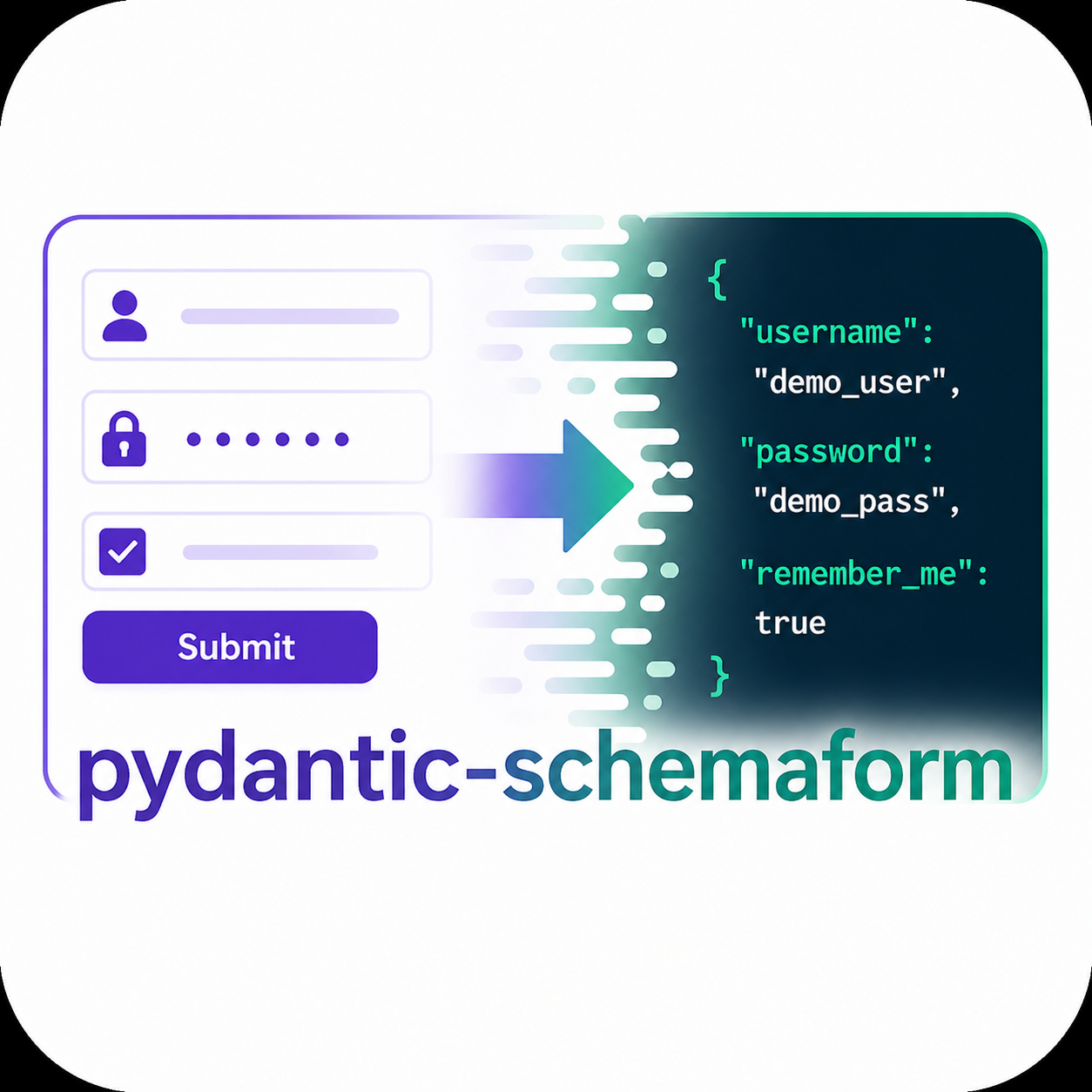
pydantic-schemaforms turns a Pydantic model into a server-rendered HTML form, and validates what comes back with the same model.
from fastapi import FastAPI, Request
from fastapi.responses import HTMLResponse

from pydantic_schemaforms import Field, FormModel, html, render_form_html_async


class SignupForm(FormModel):
    name: str = Field(title='Full name', min_length=2)
    email: str = Field(title='Email', ui_element='email')


app = FastAPI()
RENDER_OPTIONS = {'include_framework_assets': True, 'asset_mode': 'cdn'}


@app.get('/signup', response_class=HTMLResponse)
async def show_signup():
    return await render_form_html_async(SignupForm, submit_url='/signup', **RENDER_OPTIONS)


@app.post('/signup', response_class=HTMLResponse)
async def submit_signup(request: Request):
    result = SignupForm.validate(await request.form(), submit_url='/signup', **RENDER_OPTIONS)
    if not result.is_valid:
        return await result.render_with_errors_async()

    name = result.data['name']
    return html(t'<p>Thanks for signing up, {name}!</p>')
That's a complete FastAPI app: a styled signup form, browser and server
validation, errors shown next to each field with the user's input kept, and
the validated data as a plain dictionary. A Flask version is the same model
with render_form_html() and request.form.
Features
- One model for everything. The form, its validation, the validated data
and, with
as_api_model(), a typed JSON API all come from one Pydantic class. - Inputs from types.
str,int,date,bool,Enum,Literal,EmailStrand more pick their input;Field(ui_element=...)chooses any of 40+ others (currency, tags, rating, code editor, file upload, ...). - Complex forms by nesting. Sub-forms, optional sub-forms and repeating
lists, shown as sections, tabs, columns, an accordion or a step wizard with
one
layout=argument. Data and errors come back nested like the model. - Bootstrap, Material or plain HTML, with assets inlined, linked from a CDN or left to your page.
- Escaped by construction. All HTML is built with Python 3.14 t-strings and an escaping processor.
- Accessibility-tested. Every input, layout and error state is checked with axe-core against WCAG 2.0–2.2 A and AA rules on every pull request.
- More when you need it: live validation over HTMX, CSV import into an editable table, CSRF protection, rule-based validators and plugin hooks for your own inputs.
Install
uv add "pydantic-schemaforms[fastapi]"     # or [flask]
pip install "pydantic-schemaforms[fastapi]"
Requires Python 3.14+ (the library uses t-strings) and Pydantic 2.13+;
tested on 3.14 and 3.15. Add the email extra if your forms use EmailStr.
Documentation
The docs at https://devsetgo.github.io/pydantic-schemaforms/ have:
- Tutorial: from a first form to nested forms, layouts, styling and CSRF protection, with FastAPI and Flask versions of every example.
- Advanced User Guide: live validation, data tables, JSON APIs, forms built at runtime, assets and plugin hooks.
- Recipes: complete apps for contact forms, login and registration, edit forms, line items, file uploads, wizards and more.
- Reference: every input, layout, field option and function.
The live demo shows every input, layout and kind of validation.
Using an AI coding assistant?
The package ships Agent Skills that match the installed version, so assistants don't suggest removed APIs. Install them into your project with library-skills:
uvx library-skills --claude
You get pydantic-schemaforms (build and fix forms), schemaforms-create ("create a login
form"), schemaforms-convert (from Pydantic, WTForms, Django or JSON Schema),
schemaforms-upgrade (from removed APIs) and schemaforms-document (document your forms).
For assistants without skills support, python -m pydantic_schemaforms.ai_instructions claude --write writes the same guidance to CLAUDE.md; see the
AI Assistants and Agent Skills page.
Accessibility
axe-core 4.14 runs against every example page, under Bootstrap and Material and in the error state after a failed submit, and any serious or critical violation fails CI. This is testing, not a compliance claim: conformance depends on your whole application. See the Accessibility reference.
Contributing
Contributions are welcome; see the Contributing Guide and the Roadmap.
git clone https://github.com/devsetgo/pydantic-schemaforms.git
cd pydantic-schemaforms
pip install -e .
python -m pytest tests/
Links
- Documentation: pydantic-schemaforms Docs
- Live demo: https://pydantic-schemaforms.devsetgo.com
- Repository: GitHub
- PyPI: pydantic-schemaforms
- Issues: Bug Reports & Feature Requests
License
This project is licensed under the MIT License - see the LICENSE file for details: https://github.com/devsetgo/pydantic-schemaforms/blob/main/LICENSE
1 maintainer

Metadata
1 maintainer
Release files for pydantic-schemaforms 26.4.3
For a detailed explanation of source distributions (sdists) and built distributions (wheels), please see the package formats documentation.
Source distribution (sdist)
| File | Size | Uploaded | Provenance | Actions |
|---|---|---|---|---|
| pydantic_schemaforms-26.4.3.tar.gz | 725.2 kB | With provenance | Details for pydantic_schemaforms-26.4.3.tar.gz |
Built distribution (wheel)
| File | Interpreter | ABI | Platform | Actions Reset |
|---|---|---|---|---|
| pydantic_schemaforms-26.4.3-py3-none-any.whl | Python 3 | none | any | Details for pydantic_schemaforms-26.4.3-py3-none-any.whl |
Total release size: 1.5 MB
Release files / pydantic_schemaforms-26.4.3.tar.gz
| Download URL | pydantic_schemaforms-26.4.3.tar.gz |
|---|---|
| Size | 725.2 kB |
| Tags | Source |
|
SHA-256 checksum How to use checksums |
e99136697b3fdb3471f5e1313fbc0b50a68b2165c6aaaff6b42a72ef7c16f239
|
|
BLAKE2b-256 checksum How to use checksums |
e0f943ec16e44c6e58ff30e9800555196329f22030bf3942aa9677bc4e6c344a
|
| Upload date | |
|
Uploaded using Trusted Publishing? What is trusted publishing? |
Yes |
| Uploaded via |
twine/7.0.0 CPython/3.13.16
|
Provenance
Provenance describes where a file came from. On PyPI, provenance is shared via attestations, which provide a verifiable record of the build or publishing details. View details, limitations and caveats.


PyPI Publish Attestation
PyPI verified that this artifact, at this checksum, originated from the publisher listed below.
Signed by GitHub Actions, verified by PyPI on Oct 29, 2026.
Transparency logRelease files / pydantic_schemaforms-26.4.3-py3-none-any.whl
| Download URL | pydantic_schemaforms-26.4.3-py3-none-any.whl |
|---|---|
| Size | 765.7 kB |
| Tags | Python 3 |
|
SHA-256 checksum How to use checksums |
16aa3050fc50a03f50557edf944dffb29190184bef2e943318e7fc618e2e6c11
|
|
BLAKE2b-256 checksum How to use checksums |
0c28dae466d66da56247494c8d899fb4c6b534b66cb6c867554257607aadb4b2
|
| Upload date | |
|
Uploaded using Trusted Publishing? What is trusted publishing? |
Yes |
| Uploaded via |
twine/7.0.0 CPython/3.13.16
|
Provenance
Provenance describes where a file came from. On PyPI, provenance is shared via attestations, which provide a verifiable record of the build or publishing details. View details, limitations and caveats.
PyPI Publish Attestation
PyPI verified that this artifact, at this checksum, originated from the publisher listed below.
Signed by GitHub Actions, verified by PyPI on Oct 29, 2026.
Transparency logSecurity for pydantic-schemaforms 26.4.3
Provenance
Provenance describes where a file came from. On PyPI, provenance is shared via attestations, which provide a verifiable record of the build or publishing details. View details, limitations and caveats.
Full provenance
Both files in this release have been uploaded with provenance metadata.
Attestation for pydantic_schemaforms-26.4.3.tar.gz
PyPI Publish Attestation
PyPI verified that this artifact, at this checksum, originated from the publisher listed below.
Signed by GitHub Actions, verified by PyPI on Oct 29, 2026.
Transparency logA note on package security
PyPI is a repository for distributing packages, not a service for auditing them. While third-party security researchers and our staff do their best to detect and remove malicious packages, PyPI cannot guarantee the quality, security or suitability of any given package.
To learn more about protecting yourself from malicious actors, visit our package security documentation.














