
pydecide
One Python client for typed decisions, with a confidence gate between the cheap model and the good one.





Routing, triage and guardrail calls do not need a chat model. A decision model
takes a state and typed questions (pick one of these, score this, yes or no)
and answers with probabilities, in milliseconds. pydecide speaks to all of
them through one API: TypeSafe's hosted Jev, OpenRouter, OpenAI's Decisions
endpoint, the open-weight laya family on PyTorch and MLX, any
sentence-transformers CrossEncoder, and a JSON-prompted LLM as a last resort.
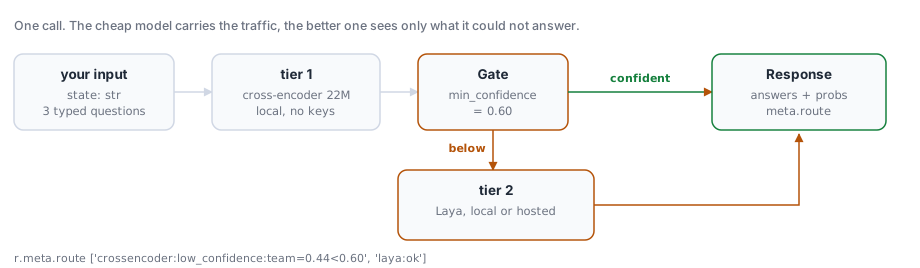
The reason to use it over any single backend's SDK is the chain. A Client
takes an ordered list of backends and a confidence policy. A backend that
errors, or that answers below its threshold, hands the question to the next
one, so a local model carries the traffic and a hosted model sees only what
the local one could not answer. Every response records the route it took.
| One API, seven backends | Local and hosted behind the same Choice, Score and Noul types. |
| Confidence gate | Per call, per question, or per question type. Score answers are never gated, and Gating says why. |
| Local only on request | DECIDE_LOCAL_ONLY=1 refuses every backend that would send the state to a server, whatever keys are set. Gating. |
| Threshold from data | Record decisions, attach outcomes, decide fit prints what each threshold would have accepted and how often it was right. |
| Readable routes | r.meta.route is ['crossencoder:low_confidence:team=0.44<0.60', 'laya:ok'], not a boolean. |
| Drop-in for typesafe-sdk | Swap one import and keep your questions, calls and response objects. Limits. |
| A server and a CLI | decide serve speaks TypeSafe's wire format; decide ask answers from the shell. |
| 20.9 ms | Median for one Choice question on an M4 with laya-mlx, in process. Measured, method in Latency. |
Install
uv tool install pydecide   # the decide CLI on your PATH, from any directory
uv add pydecide            # inside a project
With pip: pip install pydecide / pipx install pydecide. That is the CLI,
the hosted backends and one dependency, httpx. decide serve additionally
needs the server extra.
Local model backends need an extra:
uv tool install "pydecide[all]"
With pip: pip install "pydecide[all]". Quote the brackets in zsh, since it
otherwise tries to glob them. This pulls in PyTorch and MLX, about 2 GB.
| Extra | Adds |
|---|---|
server |
FastAPI and uvicorn, for decide serve. The client alone needs neither. |
laya |
laya backend (PyTorch) |
mlx |
laya_mlx backend (Apple Silicon; needs Python 3.11+) |
st |
crossencoder backend (sentence-transformers) |
all |
laya + mlx + st |
The mlx extra depends on laya-mlx, which requires Python 3.11 or newer;
on 3.10 the extra installs nothing and the laya_mlx backend is
unavailable.
Quickstart: zero configuration
Install a local backend and decide ask works right away, with no
environment variables at all:
uv tool install "pydecide[mlx]"    # Apple Silicon
# or
uv tool install "pydecide[laya]"   # any platform (PyTorch)
decide ask "I had a rough day, everything broke" --noul "Is the writer doing well?" --choice good,bad
NAME    TYPE    ANSWER  PROBABILITIES
choice  choice  bad     good=0.01 bad=0.99
noul    noul    false   0.01
backend=laya_mlx route=laya_mlx:ok latency=56.5ms
This is the real output of that command, run with laya_mlx installed and
none of DECIDE_LOCAL_MODEL, TYPESAFE_API_KEY, OPENROUTER_API_KEY,
OPENAI_API_KEY, DECIDE_LLM_BASE_URL or DECIDE_BACKENDS set.
The Python client works the same way. Client.from_env() builds a backend
chain from whatever is installed and configured in the process environment;
with a local backend installed, it needs no variables either. Pass an
explicit env= mapping instead (e.g. in tests) to configure from something
other than os.environ:
from decide import Client, Choice, Score, Noul

client = Client.from_env()

r = client.decide(
    state={"ticket": "I was charged twice, please refund."},
    questions={
        "team": Choice(
            "Which team handles this?",
            {
                "billing": "charges, refunds",
                "engineering": "bugs and outages",
                "sales": "pricing and upgrades",
            },
        ),
        "severity": Score("How severe is this?", ["minor", "degraded", "blocked"]),
        "refund": Noul("Does the customer ask for money back?"),
    },
)

r.choices["team"].choice  # "billing"
r.choices["team"].probabilities  # {"billing": 0.9763, "engineering": 0.0107, "sales": 0.013}
r.scores["severity"].score  # 1.6284  (expected level index, 0..len(levels)-1)
r.scores["severity"].probabilities  # [0.0802, 0.2112, 0.7086]
r.nouls["refund"].noul  # 0.8919
r.meta.backend  # "laya_mlx"
r.meta.latency_ms  # 50.0
r.meta.route  # ["laya_mlx:ok"]
This was run against the laya_mlx backend with no environment variables
set at all, using its own default checkpoint; every value above is the real
output of that run, not illustrative.
from_env picks the chain in this order, using whatever is installed and/or
configured: laya_mlx or laya, whichever is importable, with its own
default model unless DECIDE_LOCAL_MODEL overrides it; typesafe (if
TYPESAFE_API_KEY is set); openrouter (if OPENROUTER_API_KEY is set);
openai_decisions (if OPENAI_API_KEY is set and DECIDE_OPENAI_DECISIONS is not 0);
llm (if DECIDE_LLM_BASE_URL or OPENAI_API_KEY is set). A local backend,
when installed, is tried first, with the hosted backends as fallback. Set
DECIDE_BACKENDS="laya,typesafe" to override the order explicitly, or
DECIDE_LOCAL_ONLY=1 to drop every hosted backend whatever keys are in the
environment, which also makes Client([...]) refuse one. If
nothing is importable or configured, from_env raises ConfigError telling
you to install a local backend or set a hosted one's API key.
AsyncClient has the same surface, awaited: await client.decide(...),
await client.decide_batch(...), AsyncClient.from_env(...).
Documentation
| Backends | The seven backends, the environment variables that pick them, and running the typesafe backend against any other /v1/systemone server. |
| Gating and fallback | How the chain escalates, choosing a threshold, and the entropy, margin, conformal and calibrated policies. |
| Server | decide serve, which speaks TypeSafe's wire format so a non-Python service can call a local chain. |
| CLI | decide ask and the rest of the command line. |
| Recording and fitting | Record decisions in production, attach what happened, and fit a threshold off the result instead of guessing one. |
| Already using typesafe-sdk? | The compatibility client, and what it does not support. |
Latency
Measured on an Apple M4 (32 GB) with the laya_mlx backend (laya-mlx 0.4.0)
on its default checkpoint, aac6fef/laya-mlx, in process, after three warm-up
requests. One Client.decide call, timed by meta.latency_ms, 20 samples:
| Request | Median | Range |
|---|---|---|
| One Choice question | 20.9 ms | 19.4 to 24.0 ms |
| Choice, Noul and Score in one call | 38.1 ms | 37.3 to 41.0 ms |
Loading the model and answering the first request took 1,304 ms, once. A
decide CLI invocation on the same machine takes 0.7 to 1.3 s of wall clock,
most of it interpreter startup and loading the model again, while the decision
inside it measures 56 to 144 ms. Measure in process if you are comparing
against a hosted API.
Your numbers will differ with the machine, the checkpoint and the length of
the state, so measure before you rely on any of this. --verbose prints the
backend, the route and the latency of the call:
decide ask "I was charged twice" --choice billing,engineering --verbose
NAME    TYPE    ANSWER   PROBABILITIES
choice  choice  billing  billing=0.99 engineering=0.01
backend=laya_mlx route=laya_mlx:ok latency=45.4ms
That one is a cold call with no warm-up, which is why it is slower than the table above.
What the probabilities mean
Every probability in a ChoiceAnswer, ScoreAnswer or NoulAnswer is
whatever the backend reported; decide does not calibrate, smooth or
verify it. What that means differs by backend: typesafe, openrouter, openai_decisions and
laya/laya_mlx are purpose-built decision models, but their outputs are
still self-reported by the model and not audited by this library. The
crossencoder backend turns a relevance reranker's raw logits into a
softmax or sigmoid, so the result is a normalized score forced to distribute
mass over the supplied candidates, not a calibrated probability; a Choice
will still pick a winner even when every candidate is a bad fit, and a
Noul of 0.9 does not mean the condition holds 90% of the time. The llm
backend is the least trustworthy of all: it prompts a general chat model to
estimate its own confidence in JSON, with no guarantee the model attends to
every candidate or keeps its numbers well calibrated. Treat all of this
accordingly, as a signal to gate and fall back on, not as ground truth.
Status
The public API may still change before a 1.0 release. The current version is the one in the PyPI badge above, and the changelog says what changed.
License
MIT, see LICENSE.
1 maintainer

Metadata
1 maintainer
Release files for pydecide 0.2.18
For a detailed explanation of source distributions (sdists) and built distributions (wheels), please see the package formats documentation.
Source distribution (sdist)
| File | Size | Uploaded | Provenance | Actions |
|---|---|---|---|---|
| pydecide-0.2.18.tar.gz | 304.6 kB | With provenance | Details for pydecide-0.2.18.tar.gz |
Built distribution (wheel)
| File | Interpreter | ABI | Platform | Actions Reset |
|---|---|---|---|---|
| pydecide-0.2.18-py3-none-any.whl | Python 3 | none | any | Details for pydecide-0.2.18-py3-none-any.whl |
Total release size: 369.0 kB
Release files / pydecide-0.2.18.tar.gz
| Download URL | pydecide-0.2.18.tar.gz |
|---|---|
| Size | 304.6 kB |
| Tags | Source |
|
SHA-256 checksum How to use checksums |
d6701c8488c9369c3e535671a0feb8e6753bb9b3da03b8e5b40471d7bbb6c8b2
|
|
BLAKE2b-256 checksum How to use checksums |
e0c3ddd39897a39c80c4370663c35b125dc5ade81db59d965334eea525d69379
|
| Upload date | |
|
Uploaded using Trusted Publishing? What is trusted publishing? |
Yes |
| Uploaded via |
twine/7.0.0 CPython/3.13.16
|
Provenance
Provenance describes where a file came from. On PyPI, provenance is shared via attestations, which provide a verifiable record of the build or publishing details. View details, limitations and caveats.


PyPI Publish Attestation
PyPI verified that this artifact, at this checksum, originated from the publisher listed below.
Signed by GitHub Actions, verified by PyPI on Oct 20, 2026.
Transparency logRelease files / pydecide-0.2.18-py3-none-any.whl
| Download URL | pydecide-0.2.18-py3-none-any.whl |
|---|---|
| Size | 64.4 kB |
| Tags | Python 3 |
|
SHA-256 checksum How to use checksums |
21c18d0bdd409aea300896d80fc34c67713eab3ee284e80392a895dd3ed43c7c
|
|
BLAKE2b-256 checksum How to use checksums |
110746bfbcd6301fcbe8ffe366ed13e5ed2f3c25d8a7441df45eed38228e1b20
|
| Upload date | |
|
Uploaded using Trusted Publishing? What is trusted publishing? |
Yes |
| Uploaded via |
twine/7.0.0 CPython/3.13.16
|
Provenance
Provenance describes where a file came from. On PyPI, provenance is shared via attestations, which provide a verifiable record of the build or publishing details. View details, limitations and caveats.
PyPI Publish Attestation
PyPI verified that this artifact, at this checksum, originated from the publisher listed below.
Signed by GitHub Actions, verified by PyPI on Oct 20, 2026.
Transparency logSecurity for pydecide 0.2.18
Provenance
Provenance describes where a file came from. On PyPI, provenance is shared via attestations, which provide a verifiable record of the build or publishing details. View details, limitations and caveats.
Full provenance
All 2 files in this release have been uploaded with provenance metadata.
Attestation for pydecide-0.2.18.tar.gz
PyPI Publish Attestation
PyPI verified that this artifact, at this checksum, originated from the publisher listed below.
Signed by GitHub Actions, verified by PyPI on Oct 20, 2026.
Transparency logA note on package security
PyPI is a repository for distributing packages, not a service for auditing them. While third-party security researchers and our staff do their best to detect and remove malicious packages, PyPI cannot guarantee the quality, security or suitability of any given package.
To learn more about protecting yourself from malicious actors, visit our package security documentation.














