
A zero dependency lightweight static analyzer designed for adversarial-shape code in python to detect supply chain attacks before they reach your interpreter.
Verified details
These details have been verified by PyPIProject links
Owner
GitHub Statistics
Maintainers

Project description
pydepgate







A zero dependency lightweight static analyzer designed for adversarial-shape code in python to detect supply chain attacks before they reach your interpreter.
pydepgate inspects Python packages and environments for code that executes silently at interpreter startup. This was the attack class used by the March 2026 LiteLLM supply-chain compromise and catalogued as MITRE ATT&CK T1546.018.
Available on PyPI as pydepgate.
The problem
Python's interpreter runs several kinds of code automatically at startup, before any user script executes:
.pthfiles insite-packages/. Any line beginning withimportis passed toexec()bysite.pyduring interpreter initialization.sitecustomize.pyandusercustomize.py. Imported automatically if present.__init__.pytop-level code in any imported package.setup.py. Executed duringpip installfor source distributions.- Console-script entry points. Generated and executed by
pip install.
Each of these is a legitimate Python feature. Each has been used in
real-world supply-chain attacks. Existing Python security tooling
(pip-audit, safety, bandit) does not inspect these startup vectors.
The .pth vector in particular has been acknowledged as a security gap
in CPython issue #113659
but has no patch.
Installation
pip install pydepgate
Requires Python 3.11 or later. No third-party runtime dependencies.
Docker Usage
docker pull ghcr.io/nuclear-treestump/pydepgate:0.4.5
See Docker README.md for usage details and suggested workflows
Quickstart
# Scan a wheel
pydepgate scan some-package-1.0.0-py3-none-any.whl

# Scan an installed package by name
pydepgate scan litellm

# Scan a single file
pydepgate scan --single suspicious_module.py

# Look up what a signal means
pydepgate explain DENS010
Exit code 0 is clean, 2 means at least one HIGH or CRITICAL finding.
The full exit code contract is in
docs/reference/exit-codes.md.
Usage
Scan an artifact
Wheels, source distributions, and installed packages all use the same
positional scan invocation:
pydepgate scan some-package-1.0.0-py3-none-any.whl
pydepgate scan some-package-1.0.0.tar.gz
pydepgate scan litellm
The wheel and sdist paths read directly from disk. The installed-package
form is resolved via importlib.metadata against the active environment.
Scan a single file
--single bypasses wheel/sdist/installed-package dispatch and analyzes
the file directly. Useful for iterating on test fixtures, ad-hoc
inspection of a suspicious file, or reproducing a finding without
restructuring the file into a package:
pydepgate scan --single suspicious_module.py
pydepgate scan --single fixture.pth
pydepgate scan --single garbage.py --as init_py
The file kind is auto-detected from the filename. .pth files are
treated as pth; files named setup.py, __init__.py,
sitecustomize.py, or usercustomize.py are classified as their natural
kind; anything else defaults to setup_py (the most permissive context).
Override with --as: setup_py / init_py / pth / sitecustomize /
usercustomize / library_py.
Scan with payload peek
The peek enricher attempts safe partial decoding of large encoded literals so you can see what's actually inside a flagged blob without ever executing it:
pydepgate scan some-package.whl --peek
pydepgate scan some-package.whl --peek --peek-chain
Peek handles base64, hex, zlib, gzip, bzip2, and lzma chains up to a configurable depth, classifies the terminal payload, and emits ENC002 when the unwrap chain is nested. Pickle data is detected but never deserialized; decompression bombs are bounded by an in-flight byte budget.
Full peek flag reference: docs/cli/index.md.
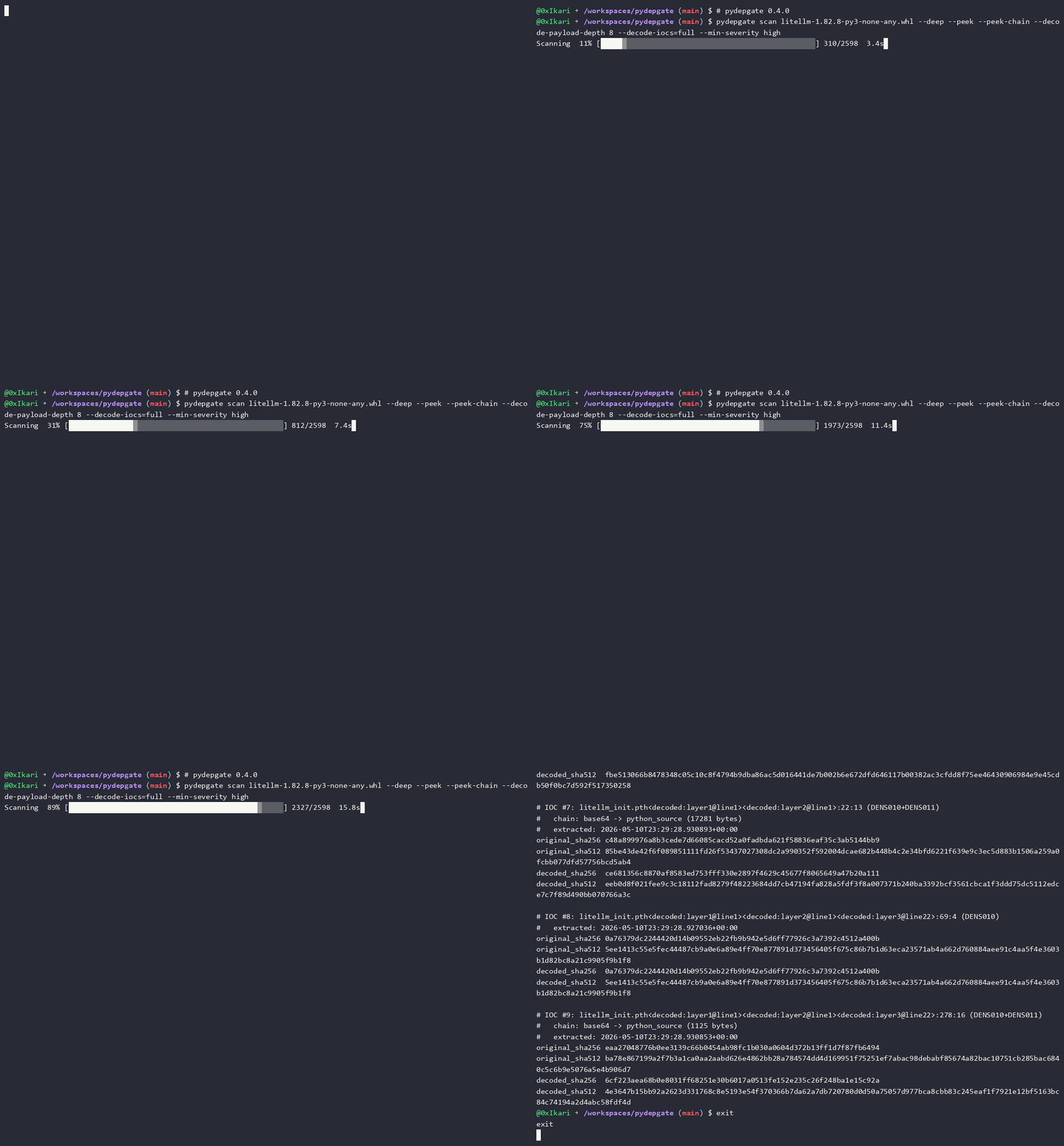
Scan with recursive decode
--decode-payload-depth=N runs a recursive re-scan over decoded
payloads, catching the multi-layer attack shape used by LiteLLM 1.82.8
(a base64 outer payload whose decoded source contains a second base64
payload).
pydepgate scan --deep some-package.whl --peek \
    --decode-payload-depth=3 \
    --decode-iocs=full \
    --decode-location ./forensics
Output goes to a directory chosen with --decode-location (default
./decoded/). With --decode-iocs=full, the run produces an encrypted
ZIP archive (default password infected, the malware-research
convention) plus a plaintext IOC sidecar for grep-friendly hash
extraction.
Full decode pipeline reference, including the IOC mode matrix and end-to-end forensic example: docs/guides/decode-payloads.md.
Scan in CI
--ci forces machine-readable JSON output and disables ANSI color. It
does not change --min-severity; combine the two when CI should block
only on HIGH and CRITICAL findings:
pydepgate scan --ci --min-severity high some-package.whl
Full CI guide (GitHub Actions, GitLab CI, Docker, pre-commit hooks): docs/guides/ci-integration.md.
Scan with custom rules
pydepgate scan some-package.whl --rules-file company-rules.gate
Auto-discovery checks ./pydepgate.gate then <venv>/pydepgate.gate
when the flag is not set. The rule file format is TOML or JSON,
auto-detected. Full format spec:
docs/reference/rules-file.md.
Look up a signal or rule
pydepgate explain STDLIB001
pydepgate explain DENS010
pydepgate explain --rule default_stdlib001_in_pth
pydepgate explain --list
Scan an entire library archive
pydepgate scan --deep some-package.whl --min-severity high
--deep runs the density analyzer over ordinary library .py files in
addition to startup vectors. The density layer produces enough
informational signals at library scope that the --min-severity high
filter is strongly recommended.
SARIF output
pydepgate scan some-package.whl --format sarif > findings.sarif
Emits a SARIF 2.1.0 document with codeFlows on decoded-payload findings, 24-character partial fingerprints for cross-run deduplication, and content-blind message text (no payload bytes leak into the document). For GitHub Code Scanning integration: docs/guides/sarif-integration.md.
What pydepgate detects
The current analyzer set covers five major classes of suspicious behavior in startup vectors. Each analyzer emits raw signals; the rules engine maps signals to severity-rated findings based on file kind and context.
Encoding abuse (ENC001, ENC002). Patterns where encoded content is
decoded and executed in a single chain, for example
exec(base64.b64decode(payload)). Catches base64, hex, codec-based,
zlib, bz2, lzma, and gzip variants. With --peek enabled, ENC002 fires
when the partial-decoder unwrap loop reaches 2+ chain layers or
exhausts its configured depth, strong evidence that a literal is
intentionally obfuscated rather than a benign encoded blob.
Dynamic execution (DYN001-007). Direct calls to exec, eval,
compile, or __import__; access to exec primitives via getattr,
globals(), locals(), vars(), or __builtins__ subscripts;
compile-then-exec across the file; and aliased call shapes that catch
e = exec; e(...) evasions.
String obfuscation (STR001-004). Obfuscated string expressions
that resolve to the names of exec primitives or dangerous stdlib
functions, computed by a safe partial evaluator that never executes
user code. Catches concatenation ('ev' + 'al'), character codes
(chr(101) + chr(118) + chr(97) + chr(108)), slicing ('lave'[::-1]),
str.join of literal pieces, bytes.fromhex(...).decode(), f-string
assembly, and single-assignment variables containing obfuscated values.
The "harder they hide it the stronger the signal" model is realized
through operation counting.
Suspicious stdlib usage (STDLIB001-003). Calls to stdlib functions
that are highly unusual in startup vectors: process spawn
(STDLIB001: os.system, subprocess.Popen, subprocess.run,
os.exec*), network operations (STDLIB002: urllib.request.urlopen,
socket.socket, http.client), and native code loading (STDLIB003:
ctypes.CDLL, ctypes.WinDLL). The rules engine promotes these to
CRITICAL when they appear in setup.py or .pth files.
Code density (DENS001-051). A broad layer covering the things
obfuscated code looks like even when no single primitive call is
suspicious on its own: high-entropy string literals, base64-alphabet
strings, machine-generated identifiers, confusable single-character
names, invisible Unicode characters, Unicode homoglyphs in identifiers,
disproportionate AST depth, deeply nested lambdas, byte-range integer
arrays, high-entropy docstrings, and dynamic __doc__ references
passed to a callable. Calibrated so the same content scans differently
depending on file kind: a high-entropy base64 literal in .pth is
CRITICAL, in __init__.py is MEDIUM, anywhere else is LOW.
Complete signal reference with severity tables per file kind: docs/reference/signals.md.
Layered detection in practice
The LiteLLM 1.82.8 .pth payload is a single line:
import base64; exec(base64.b64decode('cHJpbnQoMSkK'))
A scanner that grepped for exec would catch it. A scanner that
grepped for base64.b64decode would catch it. But an attacker who
knew about either of those evasions could trivially defeat both.
pydepgate fires five separate findings on this line from four
independent analyzers:
- ENC001 (encoding_abuse): decode-then-execute pattern
- DYN002 (dynamic_execution):
exec()with non-literal argument at module scope - DENS001 (code_density): token-dense single line
- DENS010 (code_density): high-entropy string literal
- DENS011 (code_density): base64-alphabet string literal
Plus the rule layer promotes all of them to CRITICAL because the
file is a .pth. To evade pydepgate, an attacker has to defeat every
analyzer simultaneously while still producing a working .pth
payload. Each evasion narrows what's possible; the intersection of all
evasions is the empty set for any shape that could realistically
execute on Python startup.
The rules engine
Analyzers emit raw signals. The rules engine maps signals to
severity-rated findings using a data-driven rule set. Default rules
are built into pydepgate; users can override or augment them with a
pydepgate.gate file (TOML or JSON, auto-detected) in the project
root, the venv root, or specified via --rules-file.
A rule has three parts: identity, match conditions, and an effect:
[[rule]]
id = "litellm-pth-stdlib"
signal_id = "STDLIB001"
file_kind = "pth"
action = "set_severity"
severity = "critical"
explain = "subprocess calls in .pth files have no legitimate use case."
Three actions are supported: set_severity, suppress, and
set_description. User rules always take precedence over default
rules, regardless of specificity. Suppressed findings are tracked
separately so users can see what would have fired and why it didn't.
Run pydepgate explain --list to see all default rules and signals
with descriptions. Complete rules file specification:
docs/reference/rules-file.md. Worked
walkthroughs of common rule-writing tasks:
docs/guides/custom-rules.md.
Status
Static analysis is functional end-to-end. pydepgate can statically analyze wheels, sdists, installed packages, and single loose files for the patterns used in real-world Python supply-chain attacks.
Stable today:
- Static analysis of
.whlfiles, sdists, installed packages by name, and individual loose files via--single. - Five production analyzers (
encoding_abuse,dynamic_execution,string_ops,suspicious_stdlib,code_density). - A rules engine with file-kind-aware severity promotion, fully
data-driven via TOML or JSON
pydepgate.gatefiles. The default rule set includes 32 rules dedicated to density-layer signals alone. - A safe partial evaluator that resolves obfuscated string expressions without executing user code.
- An optional payload-peek enricher (
--peek) with bounded multi-layer decode, content classification, decompression-bomb budgets, and pickle detection without deserialization. - A recursive decode pipeline (
--decode-payload-depth=N) that re-scans decoded payloads and produces a tree-shaped attack-chain report, with optional encrypted-archive IOC output. - An SSH-randomart-style finding-distribution map rendered inline with human-readable scan output.
- Three output formats: human-readable terminal, JSON (schema v2), and SARIF 2.1.0 with codeFlow encoding, GitHub-compatible severity mapping, partial fingerprints, and content-blind message text. Validated in CI against the Microsoft SARIF Multitool.
- Pre-commit hook integration via
pydepgateandpydepgate-pthhook IDs. - Official Docker image at
ghcr.io/nuclear-treestump/pydepgate. Multi-stage Alpine build under 50 MB, runs as non-root (uid 1000), published forlinux/amd64andlinux/arm64. - Shell tab completion for bash, zsh, and fish.
In active development:
- The
comment_analysisanalyzer. - Runtime interdiction (
execmode). - Environment auditing (
preflightmode). - Aliased import resolution (
from subprocess import Popen as P). - A pip-wrapper / transitive-dependency
auditsubcommand.
Documentation
| Section | Contents |
|---|---|
| Getting Started | First scan, reading output, using explain |
| CLI Reference | All subcommands, all flags, environment variables |
| Signals Reference | Every signal ID with severity tables per file kind |
| Rules File | pydepgate.gate format specification |
| Exit Codes | Exit code contract and CI implications |
| Output Formats | Human, JSON, SARIF schemas |
| Guide: CI Integration | GitHub Actions, GitLab CI, pre-commit, Docker |
| Guide: Custom Rules | Suppressing false positives, scoping rules |
| Guide: Decode Payloads | Recursive decode, IOC sidecars, encrypted archives |
| Guide: SARIF Integration | GitHub Code Scanning ingestion |
Design constraints
- Zero runtime dependencies. Standard library only. This is a load-bearing design constraint, not a stylistic preference: every additional dependency is a supply-chain attack surface for a tool whose job is to defend against supply-chain attacks.
- Safe by construction. Parsers and the partial evaluator never execute, compile, or import input content. Every operation modeled by the resolver is reimplemented from scratch using only Python builtins on values the resolver itself produced.
- Self-integrity at bootstrap. Critical stdlib references are captured into locals before any untrusted code runs (relevant when the runtime engine ships in v0.4).
- Lightweight. The full test suite runs in roughly twenty seconds on the lowest available options in Codespaces, including subprocess-based CLI tests against installed packages.
Relationship to PyDepGuard
pydepgate is a narrow, single-purpose tool focused on startup-vector interdiction. PyDepGuard is a broader Python security framework covering runtime sandboxing and dependency management. The startup-vector engine developed in pydepgate is intended to eventually integrate with PyDepGuard as a subsystem; until then, the two projects are developed independently.
Users who need only startup-vector protection should use pydepgate. Users who need the full runtime security model should use PyDepGuard directly.
Architecture
The codebase is organized as a layered pipeline:
parsers/           bytes -> structured representations (pth, pysource, wheel, sdist)
introspection/     installed package enumeration via importlib.metadata
traffic_control/   path-based triage; decides what to analyze
analyzers/         structured representations -> raw signals
  _resolver.py        safe partial evaluator (shared infrastructure)
  _visitor.py         scope tracking and AST utilities (shared)
  encoding_abuse      ENC001
  dynamic_execution   DYN001-007
  string_ops          STR001-004
  suspicious_stdlib   STDLIB001-003
  density_analyzer    DENS001-051
enrichers/         signal hints -> enriched signal context
  payload_peek        ENC002 emission and decoded context block
rules/             signals + context -> severity-rated findings
engines/           orchestration (currently: static)
visualizers/       inline rendering helpers for the human reporter
cli/               argparse, dispatch, reporters, explain subcommand
Analyzers do not see raw bytes. They walk parsed representations and
emit Signal objects. The rules engine wraps signals with severity to
produce Finding objects, applying user and default rules in priority
order. The CLI renders findings in human, JSON, or SARIF format.
The _resolver.py module is reusable infrastructure for any analyzer
that needs to know what an expression evaluates to. It returns
structured ResolutionResult objects with success/failure status,
operation counts, partial values, and resolved fragment lists.
The static engine exposes three entry points for single-file analysis.
scan_file(path) reads bytes and routes through triage by filename.
scan_bytes(content, internal_path, ...) is the per-file workhorse
that artifact enumerators (wheel, sdist, installed) call once per
in-scope file. scan_loose_file_as(path, file_kind) bypasses triage
entirely and forces a file kind, preserving the real path through to
finding contexts; this is the entry point used by
pydepgate scan --single.
Development
git clone https://github.com/nuclear-treestump/pydepgate
cd pydepgate
pip install -e .
python -m unittest discover tests -v
The test suite has grown to approximately 500 tests as the analyzer set has expanded. Tests are organized by module and include happy-path coverage, evasion batteries, false-positive batteries, robustness checks against adversarial inputs, integration tests against synthetic wheels and sdists, and CLI tests via subprocess.
To regenerate the binary .pth test fixtures after editing them:
python scripts/generate_fixtures.py
Contributors: see CONTRIBUTING.md for the issue process, sign-off requirements, and contribution scope.
Safety notes
This project builds tooling to defend against Python supply-chain
attacks. The test fixtures in tests/fixtures/ and the synthetic
samples used in integration tests model the structural shape of
known attacks (LiteLLM 1.82.8, Trojan Source CVE-2021-42574, others
catalogued under T1546.018) but contain only inert payloads. No
actual malicious code is present in this repository.
For regression testing against real malicious samples, use the OSSF malicious-packages, Datadog malicious-software-packages-dataset, or lxyeternal/pypi_malregistry datasets. Do so in disposable VMs or containers, and do not commit samples to this repository.
Known limitations
pydepgate's static analysis is honest about what it can and cannot catch. Documented gaps include:
Analysis gaps:
- Function return tracking.
code = make_payload()wheremake_payload()internally callscompile(...)is not flagged. __builtins__as a Name subscript (rather than via a function call).- Tuple unpacking, augmented assignment, and conditional assignments in the resolver's variable tracking.
- Lambda scope precision (lambdas count as their enclosing scope).
- Aliased stdlib imports such as
from subprocess import Popen as P.
Density-layer caveats:
DENS020(low-vowel-ratio identifiers) andDENS040(AST depth) both produce false positives on legitimate machine-generated code (Cython output, parser tables, generated configuration). They ship atLOWseverity outside startup vectors so they surface as contributing signals rather than standalone alerts.DENS031(homoglyphs) can fire on legitimate non-English variable names in non-Latin codebases. The default rule keeps it atHIGHrather thanCRITICALoutside startup vectors so users with intentional non-Latin naming can suppress with a single user rule.
Promise
Supply-chain security is too important to be a function of corporate goodwill. This project exists because the current state of Python supply-chain defense is not acceptable, and it will continue to exist on those terms.
This project will not be sold, transferred to a corporation, or made part of any employment or work agreement that could capture or stifle it. If a time comes when development by the current maintainer is no longer possible, the maintainer commits to finding a successor who will be held to the same conditions. If no such successor can be found, the project will be archived rather than placed under corporate control.
Funding
pydepgate is built by a single individual whose day job is assembling industrial machines. If this tool saved you time or added legitimate security to your CI/CD pipeline, sponsorship makes continued development sustainable.
This project is also available on Tidelift. See the Sponsors button for all available options.
Development continues regardless of funding level.
Funds are used for:
- Living expenses (rent, food, internet).
- Infrastructure costs for planned tools and services, including the Threat Feed and Burn Notice subsystems on the roadmap.
- Compensation for any additional maintainers brought onto the project in the future.
Author
Built by Ikari (@0xIkari) - Python and security engineering. Available for security engineering roles; pydepgate remains independent under the terms of the Promise above.
- LinkedIn: zmillersecengineer
- Email: ikari@nuclear-treestump.com
License
Apache 2.0. See LICENSE.
Project details
Verified details
These details have been verified by PyPIProject links
Owner
GitHub Statistics
Maintainers
Release history Release notifications | RSS feed


Download files
Download the file for your platform. If you're not sure which to choose, learn more about installing packages.
Source Distribution
Built Distribution
Filter files by name, interpreter, ABI, and platform.
If you're not sure about the file name format, learn more about wheel file names.
Copy a direct link to the current filters
File details
Details for the file pydepgate-0.5.0.tar.gz.
File metadata
- Download URL: pydepgate-0.5.0.tar.gz
- Upload date:
- Size: 321.6 kB
- Tags: Source
- Uploaded using Trusted Publishing? Yes
- Uploaded via: twine/6.1.0 CPython/3.13.12
File hashes
| Algorithm | Hash digest | |
|---|---|---|
| SHA256 |
4d58b78f856a4c2abd0a15ea0917e5cf28e05f7738ab714e5c1fd3a30b569385
|
|
| MD5 |
a56f91d110ba09ba0b0876715b9327b4
|
|
| BLAKE2b-256 |
beb97e541a25a87ccc7e617467f8674eef9c8f8c7cd6c97458dd9b68616516c9
|
Provenance
The following attestation bundles were made for pydepgate-0.5.0.tar.gz:
Publisher:
python-publish.yml on nuclear-treestump/pydepgate
-
Statement:
-
Statement type:
https://in-toto.io/Statement/v1 -
Predicate type:
https://docs.pypi.org/attestations/publish/v1 -
Subject name:
pydepgate-0.5.0.tar.gz -
Subject digest:
4d58b78f856a4c2abd0a15ea0917e5cf28e05f7738ab714e5c1fd3a30b569385 - Sigstore transparency entry: 1674211892
- Sigstore integration time:
-
Permalink:
nuclear-treestump/pydepgate@2bd1f4b5eb175e6188e7ac0b6b899dcc1d1fa71a -
Branch / Tag:
refs/tags/v0.5.0 - Owner: https://github.com/nuclear-treestump
-
Access:
public
-
Token Issuer:
https://token.actions.githubusercontent.com -
Runner Environment:
github-hosted -
Publication workflow:
python-publish.yml@2bd1f4b5eb175e6188e7ac0b6b899dcc1d1fa71a -
Trigger Event:
release
-
Statement type:
File details
Details for the file pydepgate-0.5.0-py3-none-any.whl.
File metadata
- Download URL: pydepgate-0.5.0-py3-none-any.whl
- Upload date:
- Size: 366.0 kB
- Tags: Python 3
- Uploaded using Trusted Publishing? Yes
- Uploaded via: twine/6.1.0 CPython/3.13.12
File hashes
| Algorithm | Hash digest | |
|---|---|---|
| SHA256 |
465a04ecbe635273f2a16ecefba36675a45cf7c7feabe5052ce1366b8aff77fe
|
|
| MD5 |
99840da45caeee5194af66ef63bb1d2e
|
|
| BLAKE2b-256 |
eb4a17fb580e22266edf040114a7f47ab253f55880e2b2f734e8602ecb646c43
|
Provenance
The following attestation bundles were made for pydepgate-0.5.0-py3-none-any.whl:
Publisher:
python-publish.yml on nuclear-treestump/pydepgate
-
Statement:
-
Statement type:
https://in-toto.io/Statement/v1 -
Predicate type:
https://docs.pypi.org/attestations/publish/v1 -
Subject name:
pydepgate-0.5.0-py3-none-any.whl -
Subject digest:
465a04ecbe635273f2a16ecefba36675a45cf7c7feabe5052ce1366b8aff77fe - Sigstore transparency entry: 1674211900
- Sigstore integration time:
-
Permalink:
nuclear-treestump/pydepgate@2bd1f4b5eb175e6188e7ac0b6b899dcc1d1fa71a -
Branch / Tag:
refs/tags/v0.5.0 - Owner: https://github.com/nuclear-treestump
-
Access:
public
-
Token Issuer:
https://token.actions.githubusercontent.com -
Runner Environment:
github-hosted -
Publication workflow:
python-publish.yml@2bd1f4b5eb175e6188e7ac0b6b899dcc1d1fa71a -
Trigger Event:
release
-
Statement type:






