
pydialign: Measures of Verbal Alignment in Dyadic Dialogue

pydialign is a Python port of dialign, a software that provides automatic and generic measures of verbal alignment and self-repetitions in dyadic dialogue based on sequential pattern mining at the level of surface of text utterances. It is built on pygstlib for generalized suffix-tree pattern mining.
The measures implemented by pydialign are described in the reference journal article (Lang Resources & Evaluation, 2021).
Table of contents:
- Framework
- Installation
- Input format
- Usage
- Analysis in notebooks (pandas)
- Caveats
- Development
- Contributors
- Citing pydialign
- License
Framework
pydialign is based on the observation that the behaviours of dialogue participants tend to converge and automatically align at several levels (such as the lexical, syntactic and semantic ones). One consequence of successful alignment at several levels between dialogue participants is a certain repetitiveness in dialogue leading to the development of a lexicon of fixed expressions. As a matter of fact, dialogue participants tend to automatically establish and use fixed expressions that become dialogue routines.
More concretely, here follows an excerpt of a dialogue between a human and an agent operated by a Woz where instances of shared lexical patterns are coloured (from the journal article):
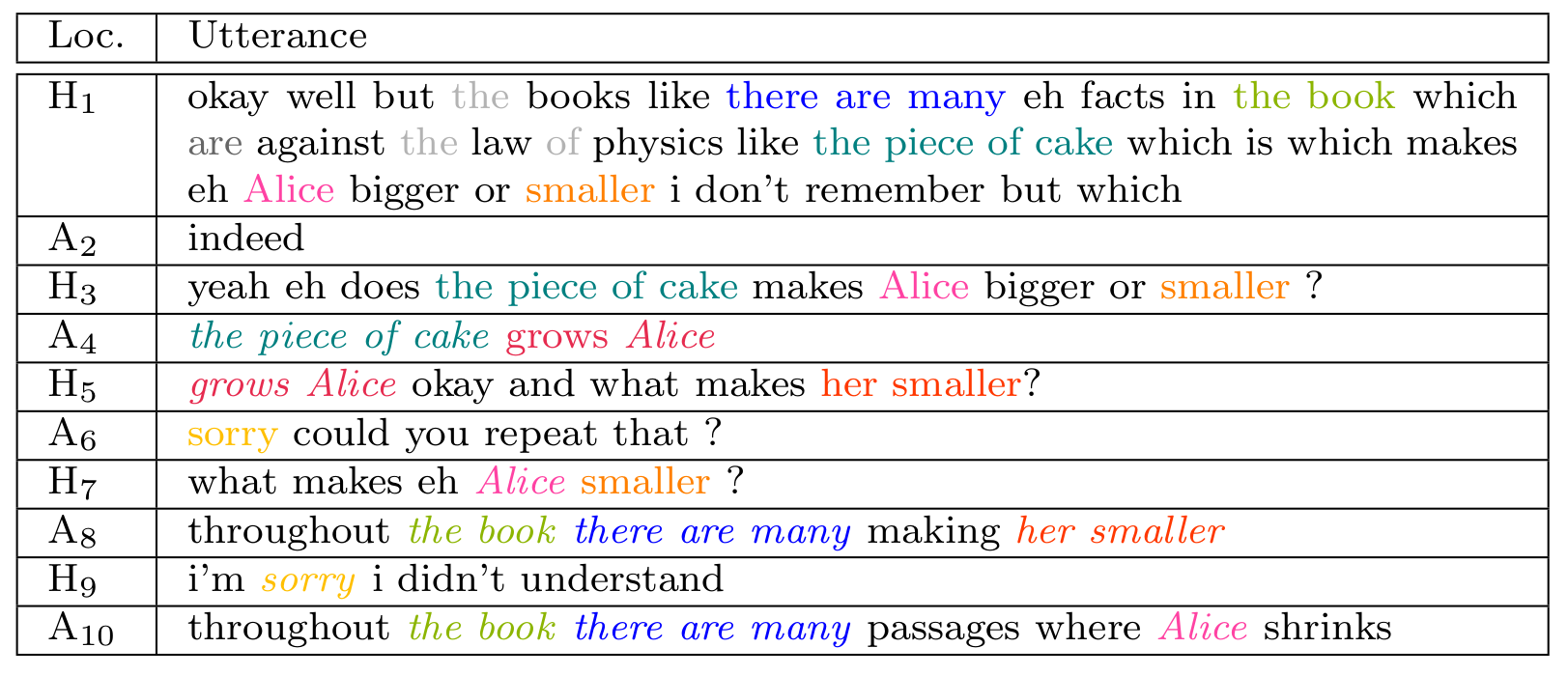
pydialign provides a framework to quantify the interactive lexical alignment process and the self-repetition behaviour of dialogue participants (DPs) in dyadic textual dialogues. This framework focuses on lexical patterns occurring in dialogue utterances. It distinguishes two main types of such patterns. The first type is shared lexical patterns between DPs, i.e., patterns that are initiated (or primed) by a DP, subsequently adopted by the other DP and possibly reused during the dialogue by any DP. These patterns are directly related to the interactive verbal alignment process, a particular type of on-the-fly linguistic adaptation. They can be seen as shared dialogue routines at the lexical level. They are a way to verbally align and ultimately share a common language to improve understanding, collaboration and social connection to a conversational partner. The second type is lexical self-repetition. Contrary to the previous type which considers patterns that are shared between DPs, self-repetition considers each DP in isolation. Self-repetitions are lexical patterns appearing at least twice in the dialogue utterances of a given DP, independently of the other DP's utterances. Self-repetitions are directly related to the self-consistency of the linguistic production of a given DP.
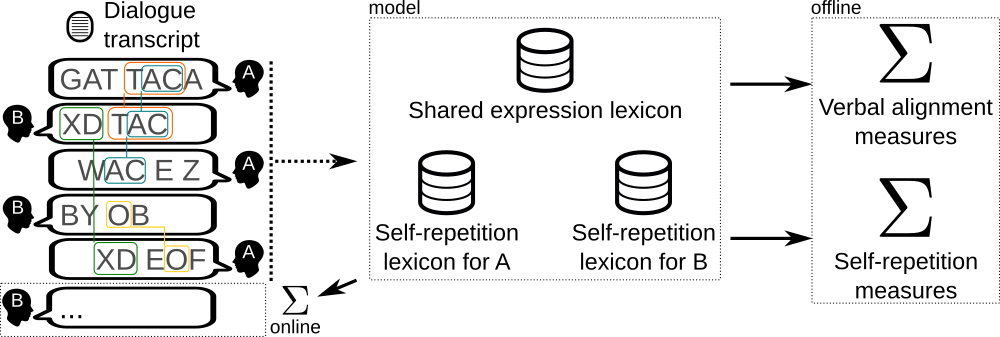
The main concept behind this model is the automatically built lexicon. For each dialogue transcript, three lexicons are automatically computed:
- the shared expression lexicon: keeps track of shared expressions and valuable features about these expressions (e.g., who first produced this expression, its frequency);
- one self-repetition lexicon per DP: keeps track of self-repetitions and valuable features about these patterns (e.g., its frequency).
Lexicons and the dialogue transcript are leveraged by deriving offline and online measures to quantify aspects of the verbal alignment process and the self-repetition behaviour of DPs. Offline measures are intended to be used for past dialogue interactions (e.g., corpus studies) while online measures are intended for use in a dialogue system.
Measures Provided by pydialign
pydialign provides a set of measures to characterise both:
- the interactive verbal alignment process between dialogue participants, and
- the self-repetition behaviour of each participant.
These measures allow the characterisation of the nature of these processes by addressing various informative aspects such as their variety, strength, complexity, stability, and orientation. In a nutshell:
- variety: the variety of shared expressions or self-repetitions emerging during a dialogue relative to its length. It is directly related to the number of unique expressions in a lexicon.
- strength: the strength of repetition of the (shared) lexical patterns, i.e., how much the patterns are reused.
- complexity: the complexity indicates the variety of the types of lexical patterns. It is here featured by Shannon entropy measures. High entropy indicates the presence of a wide range of lexical patterns relative to their lengths in number of tokens (e.g., ranging from a single word to a full sentence). On the contrary, low entropy indicates the predominance of one type of lexical pattern.
- extension and stability: the extension and stability of the (shared) lexical patterns are related to the size of the lexical patterns. The extension indicates the size of the lexical patterns. The longer it is, the more extended the lexical pattern is. Extension is directly linked to the stability of the processes since the more extended the patterns are, the more stable the processes are.
- orientation: the orientation of the interactive alignment process, i.e., it indicates either a symmetry (both dialogue participants initiate and reuse the same number of shared lexical patterns), or an asymmetry (a dialogue participant initiates and/or reuses more shared lexical patterns).
Measures Characterising the Interactive Verbal Alignment Process
Speaker-independent
| Measure | Description | Aspects |
|---|---|---|
| EV | Expression Variety (EV). The shared expression lexicon size normalized by the length of the dialogue (which is its total number of tokens in the dialogue). | Variety |
| ER | Expression Repetition (ER). The proportion of tokens which DPs dedicate to the repetition of a shared expression. | Strength |
| ENTR | Shannon entropy of the lengths in token of the shared expression instances. | Complexity |
| L | Average length in token of the shared expression instances. | Stability |
| LMAX | Maximum length in token of the shared expression instances. | Stability |
Speaker-dependent
| Measure | Description | Aspects |
|---|---|---|
| IE_S | Initiated Expression (IE) for locutor S. Ratio of shared expressions initiated by locutor S. | Orientation |
| ER_S | Expression Repetition (ER) for locutor S. Ratio of tokens produced by S belonging to an instance of a shared expression. | Strength |
Measures Characterising Self-Repetition Behaviour of each Dialogue Participant
| Measure | Description | Aspects |
|---|---|---|
| SEV_S | Self-Expression Variety (SEV) for locutor S. For locutor S, the self-repetition lexicon size normalized by the total number of tokens produced by S in the dialogue. | Variety |
| SER_S | Self-Expression Repetition (SER) for locutor S. The proportion of tokens which locutor S dedicates to self-repetition. | Strength |
| SENTR_S | Shannon entropy of the length in token of the self-repetitions from S. | Complexity |
| SL_S | Average length in tokens of the self-repetitions from S. | Stability |
| SLMAX_S | Maximum length in token of the self-repetitions from S. | Stability |
Synthetic Presentation of the Provided Measures
| Aspect | Speaker-independent Measures (*) | Speaker-dependent Measures (**) |
|---|---|---|
| Variety | EV | SEV_S |
| Strength | ER | ER_S, SER_S |
| Complexity | ENTR | SENTR_S |
| Stability | L, LMAX | SL_S, SLMAX_S |
| Orientation | -- | IE_S |
(*) all related to interactive verbal alignment
(**) measures starting with 'S' relate to self-repetition behaviour, the others to interactive verbal alignment
Installation
uv add pydialign            # or: pip install pydialign
uv add 'pydialign[analysis]'  # with the pandas analysis layer
Requires Python ≥ 3.10. The only required runtime dependency is pygstlib.
Input format
One dialogue per file, one utterance per line, tab-separated, UTF-8:
LOCUTOR<TAB>TOKENIZED UTTERANCE
At most 2 distinct locutors per dialogue. Utterances should be pre-tokenized
(tokens separated by spaces); -n/--normalisation lowercases for you.
Usage
dialign for corpus studies
dialign -i corpus/ -o output-dialign/
produces, per dialogue <name> (file name with . → _):
<name>-lexicon.tsv— the shared expression lexicon;<name>-lexicon-self-rep-A.tsv,<name>-lexicon-self-rep-B.tsv— the self-repetition lexicons (speaker A is the alphabetically-first locutor);<name>-dialogue.txt— the transcript tagged with expressions ([established],_not yet established_) plus per-turn details;
and, per corpus: metrics-speaker-independent.tsv and
metrics-speaker-dependent.tsv (one row per dialogue).
To restrict which files of the input directory are processed:
dialign -i corpus/ -o output-dialign/ \
    -p "dialogue-" \  # required filename prefix
    -s "-cleaned" \   # required filename suffix
    -e "tsv"          # required extension (without the '.')
➡ Follow the corpus-study tutorial.
dialign-online for interactive purposes
dialign-online -f history.tsv              # interactive REPL
dialign-online -f history.tsv -o out.tsv   # batch export
The REPL scores candidate utterances against the running dialogue history
(commands: h help, s score, a add, p print, e export, q quit),
reporting DER (dynamic shared-expression repetition) and DSER
(dynamic self-repetition). Batch mode replays a transcript, scoring each
utterance incrementally.
➡ Follow the dialign-online tutorial.
dialign-online-metrics — per-utterance SER/ER/Activation
dialign-online-metrics -i dialogues.tsv -a 2.0 -b 2.0 -l 0.5
The input file may hold several dialogues separated by blank lines. Prints a
CSV block per dialogue to stdout with per-utterance SER, ER and a cognitive
activation score (-a alpha: temporary activation, -b beta: permanent
activation, -l lambda ∈ [0,1]: their relative weight).
dialign-rstp / dialign-sr — corpus lexicon exporters
dialign-rstp -i corpus/ -e tsv -r inter -o lexicon.csv
dialign-sr   -i corpus/ -e tsv -o corpus-lexicon-self-repetition
dialign-rstp aggregates per-dialogue lexicons into one corpus inventory
(-r all|intra|inter pattern filter, -d delexicalisation of
negotiation-domain nouns, -m begin/end markers). dialign-sr writes two
corpus self-repetition inventories, <prefix>-A.csv and <prefix>-B.csv.
Library usage
from pydialign import (
    DialogueHistory, Utterance, build_lexicon, read_dialogue,
    tokenize_without_markers,
)
from pydialign.metrics.offline import DialogueLexiconMeasures

# Offline: measures for one dialogue file
dialogue = read_dialogue("examples/offline/corpus/excerpt-alice.tsv",
                         tokenize_without_markers)
lexicon = build_lexicon(
    dialogue.utterances, dialogue.get_speaker, dialogue.get_raw_speaker
)
measures = DialogueLexiconMeasures(lexicon)
print(measures.expression_repetition, measures.expression_variety)
# Output: 0.2 0.10476190476190476

# Online: score the next utterance of a running dialogue
history = DialogueHistory([Utterance("Alice", "what's up ?")])
scoring = history.score(Utterance("Bob", "so what's up my dear ?"))
print(round(scoring.der, 4), [e.surface for e in scoring.shared_expressions])
# Output: 0.3333 ["what's up"]
Analysis in notebooks (pandas)
The optional pydialign.analysis module turns
corpora, lexicons and online scores into pandas DataFrames
(pip install 'pydialign[analysis]'):
from pydialign.analysis import corpus_measures_frame

df = corpus_measures_frame("examples/offline/corpus/")
print(df[["num_tokens", "els", "ev", "er", "entr", "l", "lmax"]])
# Output:
#                    num_tokens  els        ev   er      entr     l  lmax
# dialogue
# excerpt-alice_tsv         105   11  0.104762  0.2  1.756624  1.88     4
Also available: lexicon_frame (one row per expression), turns_frame
(per-turn token coverage and the cumulative ER trajectory),
online_scoring_frame (per-utterance DER/DSER), and analyze_corpus (one
call loading everything). ➡ See the
analysis notebook.
Caveats
- Dyadic dialogues only: at most 2 distinct locutors per transcript.
- Surface-level: pydialign works on the surface form of what you give it — utterances should be pre-tokenized and consistently cased/normalized.
- Parity with the Scala dialign: lexicon inventories and tagged
transcripts are byte-identical to the original's; metric values are
numerically identical (number formatting follows Java's
Double.toString, and integer-valued columns print as integers). The one intentional deviation: where the Scala code printsSetcontents in arbitrary order (turn details, exported expression lists), pydialign renders a deterministic sorted order. - pandas is optional: the core install never imports pandas;
pydialign.analysisraises a helpfulImportErrorif the[analysis]extra is missing.
Development
uv venv && uv pip install -e '.[dev]'
uv run pytest          # unit, Scala-oracle, golden, property and naive-reference tests
uv run ruff check .
The project is managed BMAD-style: see docs/prd.md,
docs/architecture.md, the story backlog in
docs/stories/ and the QA reviews in
docs/qa/.
Contributors
- Guillaume Dubuisson Duplessis (2017, 2020, 2021, 2022; Python port 2026)
Citing pydialign
If you use pydialign or dialign in research, please cite the reference journal article:
Dubuisson Duplessis, G., Langlet, C., Clavel, C., Landragin, F.: Towards alignment strategies in human-agent interactions based on measures of lexical repetitions, Lang Resources & Evaluation 55, 353–388 (2021). HAL | DOI
See also:
Dubuisson Duplessis, G., Clavel, C., Landragin, F.: Automatic Measures to Characterise Verbal Alignment in Human-Agent Interaction, 18th Annual Meeting of the Special Interest Group on Discourse and Dialogue (SIGDIAL), 2017, pp. 71–81. Paper
Contact
License
MIT — see the LICENSE.txt file.
pydialign is a port of dialign (licensed under CECILL-B), published under MIT by the original author.
1 maintainer

Metadata
1 maintainer
Release files for pydialign 0.1.0
For a detailed explanation of source distributions (sdists) and built distributions (wheels), please see the package formats documentation.
Source distribution (sdist)
| File | Size | Uploaded | |
|---|---|---|---|
| pydialign-0.1.0.tar.gz | 59.5 kB | Details |
Built distribution (wheel)
| File | Interpreter | ABI | Platform | Reset |
|---|---|---|---|---|
| pydialign-0.1.0-py3-none-any.whl | Python 3 | none | any | Details |
Total release size: 104.2 kB
Release files / pydialign-0.1.0.tar.gz
| Download URL | pydialign-0.1.0.tar.gz |
|---|---|
| Size | 59.5 kB |
| Tags | Source |
|
SHA-256 checksum How to use checksums |
8caf368f26b3a35d6b08a87e81af1d4218a10145d397dee43687df9597dc6da9
|
|
BLAKE2b-256 checksum How to use checksums |
0fc5e9a5965d31e2f25fed728fca289f4086cacfe4f219d49df0ad9152f65f9d
|
| Upload date | |
|
Uploaded using Trusted Publishing? What is trusted publishing? |
Yes |
| Uploaded via |
twine/6.1.0 CPython/3.13.12
|
Provenance
Provenance describes where a file came from. On PyPI, provenance is shared via attestations, which provide a verifiable record of the build or publishing details. View details, limitations and caveats.


PyPI Publish Attestation
PyPI verified that this artifact, at this checksum, originated from the publisher listed below.
Signed by GitHub Actions, verified by PyPI on Jul 12, 2026.
Transparency logRelease files / pydialign-0.1.0-py3-none-any.whl
| Download URL | pydialign-0.1.0-py3-none-any.whl |
|---|---|
| Size | 44.7 kB |
| Tags | Python 3 |
|
SHA-256 checksum How to use checksums |
0382da23df2a7dc4728697f16cbb5bc3f60d635c37c59bc13cc4f97816635809
|
|
BLAKE2b-256 checksum How to use checksums |
1b9b4387400732be222c154e265c4822835275d561ca0080ae0c92d2c51ed957
|
| Upload date | |
|
Uploaded using Trusted Publishing? What is trusted publishing? |
Yes |
| Uploaded via |
twine/6.1.0 CPython/3.13.12
|
Provenance
Provenance describes where a file came from. On PyPI, provenance is shared via attestations, which provide a verifiable record of the build or publishing details. View details, limitations and caveats.
PyPI Publish Attestation
PyPI verified that this artifact, at this checksum, originated from the publisher listed below.
Signed by GitHub Actions, verified by PyPI on Jul 12, 2026.
Transparency log












