
A high-performance DNS scanner with GitHub dark-themed TUI, parallel Slipstream proxy testing, real-time ISP/EDNS0/DNSSEC/Resolved-IP checks, smart multi-key sorting, and Iran CIDR bundle

Project description
PYDNS Scanner
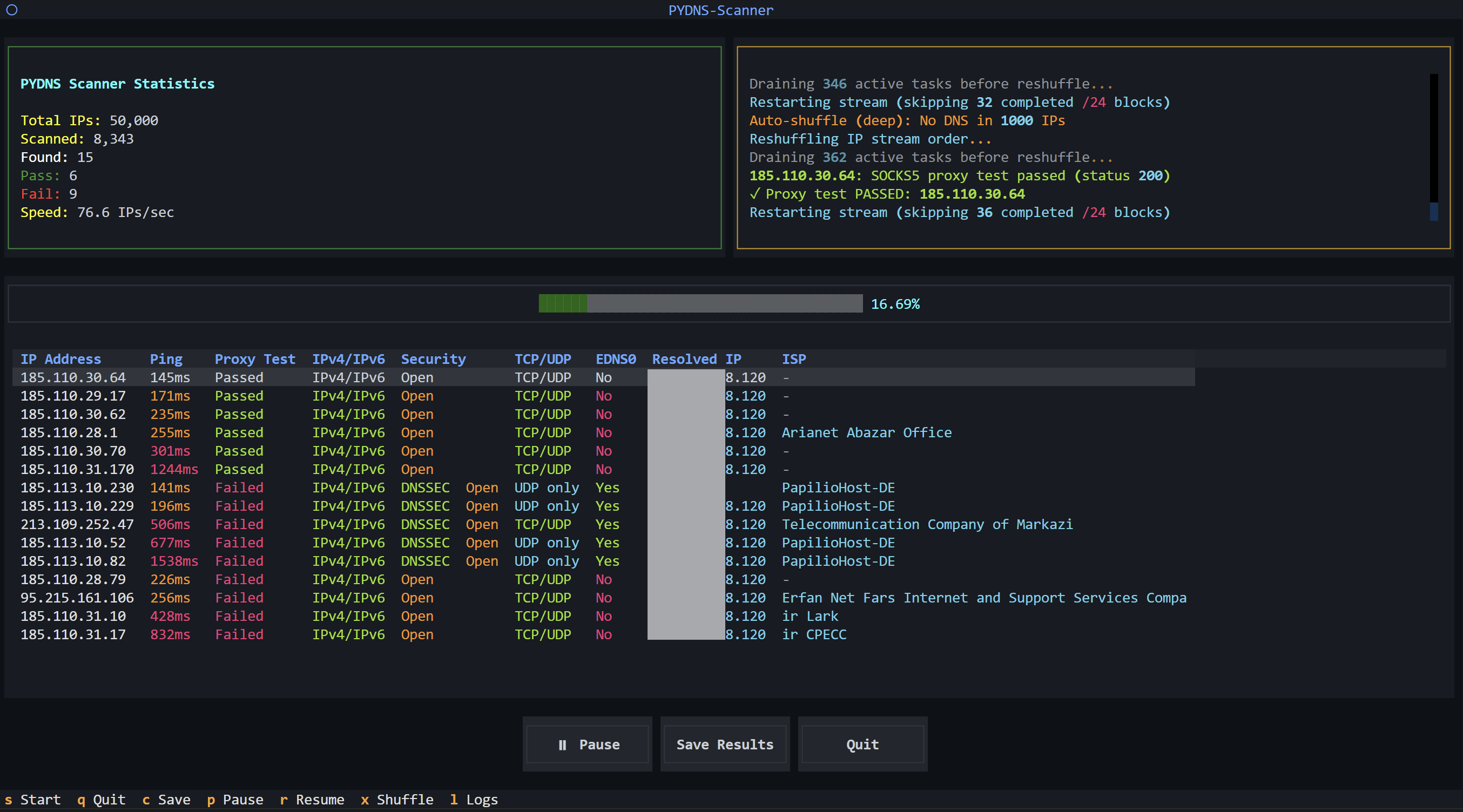




This tool can scan millions of IP addresses to find working DNS servers with optional Slipstream proxy testing and automatic multi-platform client download.
🆕 v1.4.0: Resolved IP column, smart multi-key sorting, proxy HTTPS-CONNECT fix, performance improvements!
🎉 What's New in v1.4.0
🎨 Redesigned Start Menu
- Better UI - Completely redesigned configuration screen with cleaner layout and improved visual hierarchy
- Optional log panel - Log output is hidden by default; press
Lat any time during a scan to toggle it on or off
🗂️ Three Scan Modes
All three modes use identical scan logic. They differ only in how many IPs are read from the CIDR file and the shuffle step — if no working DNS is found within that many consecutive IPs, the remaining range is automatically reshuffled to avoid missing servers hidden deep in a subnet.
- Quick Scan — up to 25,000 IPs, shuffle step every 500 IPs
- Deep Scan — up to 50,000 IPs, shuffle step every 1,000 IPs
- Full Scan — unlimited IPs (entire file), shuffle step every 3,000 IPs
🔐 Security Testing
- Hijack detection - Detects if the DNS server is intercepting or redirecting queries
- Filtered detection - Identifies servers that silently block certain domains
- Open resolver check - Flags servers that resolve arbitrary external queries
- DNSSEC validation - Reports whether the server returns signed (DNSSEC) responses
🌐 Network Analysis Columns
- Resolved IP - Each candidate DNS server is used to resolve
google.com; the resulting IP is shown in the results table - ISP detection - Displays AS number and organisation name for each DNS server via ip-api.com (rate-limited, async)
- IPv4 / IPv6 detection - Shows whether the server responds on IPv4, IPv6, or both
- EDNS0 detection - Tests and displays EDNS0 extension support
- TCP / UDP column - Tests and shows which transports the server supports
🔌 Slipstream Rust Plus — Improved Proxy Testing
- Upgraded to Slipstream Rust Plus client (Fox-Fig/slipstream-rust-plus-deploy) — significantly faster binaries across all platforms
- HTTPS CONNECT tunnel - Proxy test now targets
https://www.google.comvia HTTP CONNECT; the previous plain-HTTP probe always returned "Failed" - Independent SOCKS5 test - SOCKS5 is tested on its own, not just as a fallback
- False-positive elimination - Improved result validation removes incorrect pass/fail determinations
- Smart multi-key sort - Results ordered by: Proxy pass → DNSSEC → fastest ping
🗃️ Results Table Overhaul
- New column layout - Port column removed; column order: Ping → [Proxy] → IPv4/IPv6 → Security → TCP/UDP → EDNS0 → Resolved IP → ISP
- Live pass/fail counters - Statistics bar updates correctly throughout the scan
🐛 Bug Fixes
- Custom CIDR selection - Fixed a bug where selecting a custom IP range file in the scan menu was not applied correctly
- /31 and /32 subnet fix - IPs from these subnets were previously skipped silently
- ISP lock hang - Rate-limit lock is now released before sleeping, eliminating pipeline stalls
⚡ Performance & Module Improvements
google-re2- Replaced Python's stdlibrewith Google's RE2 engine for faster, safer regex- Per-test aiodns resolver - Each DNS test creates its own resolver, preventing C-ares concurrency hangs
- Range-based IP shuffle - Integer arithmetic replaces
list(subnet.hosts())for large CIDR ranges - ISP rate limiter - ip-api.com capped with async lock + automatic 429 retry with 60 s backoff
- Windows socket advisory - Warning logged when concurrency exceeds 64 (Windows selector event-loop cap)
✨ Features
- 🎨 Redesigned Start Menu - Clean, modern configuration screen with improved layout
- 🗂️ Three Scan Modes - Quick (25K IPs, step 500), Deep (50K IPs, step 1K), Full (unlimited, step 3K) — same logic, different scale
- 🔄 Auto-Shuffle - Reshuffles remaining IPs automatically when no working DNS is found within the step range
- 🔐 Security Testing - Detects hijacked, filtered, open resolver, and DNSSEC per server
- 🌐 Resolved IP Column - Tests each DNS server by resolving
google.com, result shown in table - 📡 ISP Detection - AS number and organisation name via ip-api.com
- 🌍 IPv4 / IPv6 Detection - Reports which IP versions each server supports
- 📶 EDNS0 Detection - Tests and displays EDNS0 extension support
- 🔌 Slipstream Rust Plus - Faster proxy testing with false-positive fixes and independent SOCKS5 test
- 🧮 Smart Multi-key Sort - Auto-sorts by proxy pass → DNSSEC → ping for best servers first
- ⚡ High Performance - Asynchronous scanning with configurable concurrency
- ⏸️ Pause / Resume / Shuffle - Full live scan control
- 📊 Real-time Statistics - Live pass/fail/found counters updated throughout the scan
- 🔍 Smart DNS Detection - Detects working DNS servers even with NXDOMAIN / NODATA responses
- 🎲 Random Subdomain Support - Avoid cached responses with random subdomains
- 🌐 Multiple DNS Types - Supports A, AAAA, MX, TXT, NS records
- 📝 Optional Log Panel - Hidden by default; press
Lduring scan to toggle - 🌍 Multi-Platform Auto-Download - Automatically downloads the correct Slipstream client for your platform
- 📥 Resume Downloads - Smart download resume on network interruptions with retry logic
- 💾 Auto-save Results - Automatic CSV export with per-server detail
- 📁 CIDR Management - Built-in Iran IPs + custom file picker (bug-fixed)
- ⚙️ Configurable - Adjustable concurrency, timeouts, and filters
- 🚀 Memory Efficient - Streaming IP generation without loading all IPs into memory
- 🚄 google-re2 - Google's RE2 engine for faster, safer regex matching
- 🔔 Audio Alerts - Optional sparkle sound on successful proxy test
📋 Requirements
Python Version
- Python 3.11 or higher
Dependencies
# Core dependencies (always installed — works on every platform including Android/Termux)
textual>=0.47.0       # TUI framework
aiodns>=3.1.0         # Async DNS resolver
httpx[socks]>=0.25.0  # HTTP client with SOCKS5 support for proxy testing
loguru>=0.7.0         # Advanced logging

# Optional "full" extras (pip install pydns-scanner[full]) — desktop only
google-re2>=1.0       # Fast RE2 regex engine (falls back to stdlib re)
orjson>=3.9.0         # Fast JSON serialization (falls back to stdlib json)
pyperclip>=1.8.0      # Clipboard support (silently disabled when absent)
Optional
- Slipstream Client - For proxy testing functionality (5 concurrent tests)
- Automatic Download: The application automatically detects your platform and downloads the correct client
- Smart Detection: Detects existing installations (including legacy filenames)
- Resume Support: Partial downloads are saved and can be resumed on retry
- Supported platforms:
- Linux (x86_64):
slipstream-client-linux-amd64 - Linux (ARM64):
slipstream-client-linux-arm64 - Windows (x86_64):
slipstream-client-windows-amd64.exe - macOS (ARM64):
slipstream-client-darwin-arm64 - macOS (Intel):
slipstream-client-darwin-amd64 - Android (ARM64):
slipstream-client-linux-arm64
- Linux (x86_64):
- Manual download available from: slipstream-rust-plus-deploy releases
📦 Bundled Slipstream Clients
Pre-compiled Slipstream client binaries (from the faster Fox-Fig/slipstream-rust-plus-deploy) are included in the slipstream-client/ folder for all platforms:
| Platform | Path | Description |
|---|---|---|
| Linux x86_64 | slipstream-client/linux/slipstream-client-linux-amd64 |
Linux x86_64 binary |
| Linux ARM64 | slipstream-client/linux/slipstream-client-linux-arm64 |
Linux ARM64 binary (Raspberry Pi, ARM servers) |
| Android/Termux | slipstream-client/android/slipstream-client-linux-arm64 |
Android ARM64 (Termux compatible) |
| Windows | slipstream-client/windows/slipstream-client-windows-amd64.exe |
Windows x86_64 executable |
| macOS ARM | slipstream-client/mac/slipstream-client-darwin-arm64 |
macOS Apple Silicon (M1/M2/M3/M4) |
| macOS Intel | slipstream-client/mac/slipstream-client-darwin-amd64 |
macOS Intel x86_64 |
⚠️ Windows Note: The Windows client requires OpenSSL DLLs (
libcrypto-3-x64.dllandlibssl-3-x64.dll) which are included in theslipstream-client/windows/folder. When using automatic download, these DLLs are downloaded automatically alongside the Windows executable.
📥 All-in-One Archives
For convenience, compressed archives containing all platform binaries are available:
slipstream-client/slipstream-client-all-platforms.tar.gz- Best compression (recommended)slipstream-client/slipstream-client-all-platforms.zip- Windows-friendly format
These archives include Linux, Windows, and macOS clients in a single download.
🚀 Installation
Method 1: Install from PyPI (Recommended)
The easiest way to install PYDNS Scanner:
Using pip
pip install pydns-scanner
Desktop — full extras (faster regex, clipboard, fast JSON)
pip install pydns-scanner[full]
Using uv (Faster)
uv pip install pydns-scanner        # core
uv pip install pydns-scanner[full]   # desktop extras
Android / Termux
pkg update && pkg install python
pip install pydns-scanner            # core only — always works on Termux
pydns-scanner
Note: On Android/Termux the optional C-extension packages (
google-re2,orjson,pyperclip) are automatically skipped — the scanner falls back to stdlib equivalents with zero manual intervention.
Using Mirror (For Users with Limited Access to PyPI)
# Runflare Mirror
pip install pydns-scanner -i https://mirror-pypi.runflare.com/simple/ --trusted-host mirror-pypi.runflare.com

# Or Alibaba Cloud Mirror
pip install pydns-scanner -i https://mirrors.aliyun.com/pypi/simple/ --trusted-host mirrors.aliyun.com

# Or TUNA Mirror
pip install pydns-scanner -i https://pypi.tuna.tsinghua.edu.cn/simple
Run after installation
pydns-scanner
Method 2: Run from Source (Manual)
If you want to run the code directly from the repository:
Step 1: Clone the Repository
git clone https://github.com/xullexer/PYDNS-Scanner.git
cd PYDNS-Scanner
Step 2: Install Dependencies
Using uv (Recommended - Fast!)
uv pip install -r requirements.txt
Using pip
pip install -r requirements.txt
Using Mirror (For Users with Limited Access to PyPI)
# Runflare Mirror
pip install -r requirements.txt -i https://mirror-pypi.runflare.com/simple/ --trusted-host mirror-pypi.runflare.com

# Or Alibaba Cloud Mirror
pip install -r requirements.txt -i https://mirrors.aliyun.com/pypi/simple/ --trusted-host mirrors.aliyun.com

# Or TUNA Mirror
pip install -r requirements.txt -i https://pypi.tuna.tsinghua.edu.cn/simple
Step 3: Run the Application
python -m python
🎮 Usage
Basic Usage
From PyPI:
pydns-scanner
From source:
python -m python
This will launch the interactive TUI where you can configure:
- CIDR File: Path to file containing IP ranges (CIDR notation)
- Domain: Domain to query (e.g., google.com)
- DNS Type: Record type (A, AAAA, MX, TXT, NS)
- Concurrency: Number of parallel workers (default: 100)
- Random Subdomain: Add random prefix to avoid cached responses
- Slipstream Test: Enable proxy testing for found DNS servers
CIDR File Format
Create a text file with one CIDR range per line:
# Comments start with #
1.1.1.0/24
8.8.8.0/24
178.22.122.0/24
185.51.200.0/22
Example Workflow
-
Launch the application:
python dnsscanner_tui.py -
Configure scan parameters:
- Click "📂 Browse" to select your CIDR file
- Enter domain (e.g.,
google.com) - Set concurrency (recommended: 100-500)
- Enable options as needed
-
Start scanning:
- Click "🚀 Start Scan"
- Watch real-time progress and results
- Use "⏸ Pause" to pause the scan at any time
- Use "▶ Resume" to continue from where you paused
-
View results:
- Sorted by response time (fastest first)
- Green = fast (<100ms)
- Yellow = medium (100-300ms)
- Red = slow (>300ms)
-
Save results:
- Results are auto-saved to
results/TIMESTAMP.csv - Press
cor click "💾 Save Results" to save manually
- Results are auto-saved to
⌨️ Keyboard Shortcuts
| Key | When | Action |
|---|---|---|
s |
Config screen | Start scan |
q |
Anytime | Quit application |
c |
While scanning | Save results |
p |
While scanning | Pause scan |
l |
While scanning | Toggle log panel |
r |
When paused | Resume scan |
x |
When paused | Shuffle remaining IPs |
🎮 Control Buttons
During an active scan:
- ⏸ Pause - Pause the scan without losing progress
- ▶ Resume - Continue scanning from where you paused
- 💾 Save Results - Manually save current results
- 🛑 Quit - Exit the application
🎛️ Configuration
Logging
Logging is disabled by default to keep the interface clean and avoid unnecessary disk writes.
To enable logging, edit dnsscanner_tui.py:
# Configure logging (disabled by default)
logger.remove()  # Remove default handler to disable logging
# Uncomment the line below to enable file logging
logger.add(
    "logs/dnsscanner_{time}.log",
    rotation="50 MB",
    compression="zip",
    level="DEBUG",
)
When enabled:
- Logs are saved to
logs/dnsscanner_TIMESTAMP.log - Auto-rotate at 50 MB
- Compressed automatically (zip)
- Includes DEBUG level details
Concurrency Settings
Adjust based on your system and network:
- Low (50-100): Conservative, suitable for slower systems
- Medium (100-300): Balanced performance
- High (300-500): Fast scanning, requires good hardware
- Very High (500+): Maximum speed, may hit resource limits
Slipstream Testing
The scanner supports parallel Slipstream proxy testing with automatic download:
# In __init__ method
self.slipstream_max_concurrent = 5  # Max parallel proxy tests
self.slipstream_base_port = 10800   # Base port (uses 10800, 10801, 10802)
Auto-Download Features:
- Platform detection (Windows/Linux/macOS + architecture)
- Progress bar with download speed
- Resume on interruption (keeps
.partialfiles) - Retry with exponential backoff (up to 5 attempts)
- Legacy filename detection (
slipstream-client.exe)
DNS Timeout
DNS queries timeout after 2 seconds:
# In _test_dns method
resolver = aiodns.DNSResolver(nameservers=[ip], timeout=2.0, tries=1)
📊 Output Format
Results are saved in CSV format (results/TIMESTAMP.csv). Columns adapt to which tests are enabled:
DNS,Ping (ms),IPv4/IPv6,TCP/UDP,Security,EDNS0,Resolved IP,ISP
8.8.8.8,12,IPv4/IPv6,TCP+UDP,DNSSEC,Yes,142.250.185.46,AS15169 Google LLC
1.1.1.1,15,IPv4/IPv6,TCP+UDP,DNSSEC,Yes,142.250.185.46,AS13335 Cloudflare Inc
Optional columns (Proxy Test, Security, EDNS0) are included only when the corresponding test is enabled in settings.
🔍 How It Works
DNS Detection Logic
The scanner considers a server as "working DNS" if:
- Successful Response: Returns valid DNS answer in <2s
- DNS Error Responses: Returns NXDOMAIN, NODATA, or NXRRSET in <2s
- These errors mean the DNS server IS working, just the record doesn't exist
This approach catches more working DNS servers than tools that only accept successful responses.
Performance Optimizations
- Streaming IP Generation: IPs are generated on-the-fly from CIDR ranges
- Chunked Processing: Processes IPs in batches of 500
- Async I/O: Non-blocking DNS queries using aiodns
- Semaphore Control: Limits concurrent operations to prevent resource exhaustion
- Memory Mapping: Fast CIDR file reading using mmap when possible
Random Subdomain Feature
When enabled, queries use random prefixes:
original: google.com
random:   a1b2c3d4.google.com
Use case: Bypass cached DNS responses
Requirement: Target domain should have wildcard DNS (*.example.com)
📂 Directory Structure
PYDNS-Scanner/
├── README.md                   # This file
├── python/
│   ├── dnsscanner_tui.py      # Main application
│   ├── requirements.txt        # Python dependencies
│   └── iran-ipv4.cidrs        # Sample CIDR file
├── logs/                       # Application logs (when enabled, gitignored)
├── results/                    # Scan results (gitignored)
└── slipstream-client/          # Slipstream binaries (auto-downloaded, gitignored)
    ├── windows/
    ├── linux/
    └── macos/
🐛 Troubleshooting
"No module named 'textual'"
pip install textual
"File not found" error
- Ensure CIDR file path is correct
- Use absolute path or relative path from script location
- Use the built-in file browser (📂 Browse button)
Slow scanning
- Reduce concurrency value
- Check network bandwidth
- Verify DNS timeout settings
High memory usage
- The scanner uses streaming to minimize memory
- If issues persist, reduce chunk size in
_stream_ips_from_file
Slipstream download fails
- Network issues: The app automatically retries up to 5 times with exponential backoff
- Resume: Partial downloads are saved as
.partialfiles - just run again to resume - Manual download: Download from slipstream-rust-plus-deploy releases
- Check logs: Enable logging (see Configuration section) for detailed error info
- Firewall: Ensure GitHub access is allowed
Slipstream not detected
- Check platform-specific directory exists (
slipstream-client/windows/, etc.) - Verify filename matches (supports both new and legacy names)
- For legacy installs: Use
slipstream-client.exe(auto-detected) - Enable logging to see detection process
Slipstream tests fail
- Verify executable has correct permissions (Linux/macOS:
chmod +x) - Check that ports 10800-10802 are available
- Review logs (if enabled) in
logs/directory - Test connectivity to DNS servers manually
📝 Logging
Default: Disabled - No logs are created to keep your system clean.
To Enable Logging:
- Edit
python/dnsscanner_tui.py - Uncomment the
logger.add()section - Logs saved to
logs/dnsscanner_TIMESTAMP.log
Log Levels:
- DEBUG: Detailed DNS query results, download progress
- INFO: Scan progress and statistics
- WARNING: Non-critical issues, retry attempts
- ERROR: Critical failures, download errors
🌍 Finding CIDR Lists
Country IP Ranges
IPv4:
IPv6:
Usage Example
# Download Iran IPv4 ranges
wget https://www.ipdeny.com/ipblocks/data/aggregated/ir-aggregated.zone -O iran-ipv4.cidrs

# Use in scanner
python dnsscanner_tui.py
# Then select iran-ipv4.cidrs in the file browser
🤝 Contributing
Contributions are welcome! Please feel free to submit pull requests or open issues.
Development Setup
git clone https://github.com/xullexer/PYDNS-Scanner.git
cd PYDNS-Scanner/python
pip install -r requirements.txt
python dnsscanner_tui.py
📄 License
This project is licensed under the MIT License.
👨💻 Author
- GitHub: @xullexer
🙏 Acknowledgments
- Built with Textual by Textualize
- DNS resolution via aiodns
- Inspired by the need for efficient DNS server discovery
📈 Performance Notes
Tested performance on various systems:
- Small scan (1,000 IPs): ~10-30 seconds
- Medium scan (50,000 IPs): ~5-10 minutes
- Large scan (1M+ IPs): ~1-3 hours
Results vary based on network speed, concurrency settings, and system resources.
🔐 Security Considerations
- Uses cryptographically secure random number generator (
secrets.SystemRandom) - No credentials or sensitive data are logged
- DNS queries are standard UDP/TCP port 53
- Slipstream proxy testing is optional and disabled by default
💝 Support the Project
If you find this project useful, consider supporting its development:
Cryptocurrency Donations
-
Bitcoin (BTC)
bc1qpya0kc2uh0mc08c7nuzrqkpsqjr36mrwscgpxr -
Solana (SOL)
J1XzZfizQ6mgYiyxpLGWU52kHBF1hm2Tb9AZ5FaRj8tH -
Ethereum (ETH)
0x26D9924B88e71b5908d957EA4c74C66989c253cb -
Binance Smart Chain (BNB/BSC)
0x26D9924B88e71b5908d957EA4c74C66989c253cb -
Tron (TRX)
TYBZFr8WUsjgfrXrqmrdF5EXPXo7QdimA8 -
Ethereum Base
0x26D9924B88e71b5908d957EA4c74C66989c253cb -
TON (Telegram Open Network)
UQBcI_ZZGQq3fcNzTkL-zszgFR5HpRDLFHYRZffizriiScxJ
Happy Scanning! 🚀
Release history Release notifications | RSS feed


Download files
Download the file for your platform. If you're not sure which to choose, learn more about installing packages.
Source Distribution
Built Distribution
Filter files by name, interpreter, ABI, and platform.
If you're not sure about the file name format, learn more about wheel file names.
Copy a direct link to the current filters
File details
Details for the file pydns_scanner-1.4.4.tar.gz.
File metadata
- Download URL: pydns_scanner-1.4.4.tar.gz
- Upload date:
- Size: 29.2 MB
- Tags: Source
- Uploaded using Trusted Publishing? No
- Uploaded via: twine/6.1.0 CPython/3.13.7
File hashes
| Algorithm | Hash digest | |
|---|---|---|
| SHA256 |
33b97ac7178f7466959bbd3fc7236920d1930edae3a51946a2cef42a9a793239
|
|
| MD5 |
69a1d1b761a6a905f7d4be3a6cbbe243
|
|
| BLAKE2b-256 |
5f636b64282d5bd04cf16dbf0817ffaf14baf145d739e984ad99cde13e00e781
|
File details
Details for the file pydns_scanner-1.4.4-py3-none-any.whl.
File metadata
- Download URL: pydns_scanner-1.4.4-py3-none-any.whl
- Upload date:
- Size: 29.3 MB
- Tags: Python 3
- Uploaded using Trusted Publishing? No
- Uploaded via: twine/6.1.0 CPython/3.13.7
File hashes
| Algorithm | Hash digest | |
|---|---|---|
| SHA256 |
2465bb9fe5dd8c6cc951452ff948643eb856796c02f0134c6f14d3b69fed09a0
|
|
| MD5 |
b60e9ff93c45cb4a543b5a0071a6e0bd
|
|
| BLAKE2b-256 |
07cd7484542a8f7b6e1b2925a53a1c052ade6537dec924a44a24fe21515414ec
|






