
pyforesight





Time series forecasting in Python that picks its model by what would have worked.
foresight fits several models to a series, replays the past to see how each
would have done, chooses by out-of-sample error and reports intervals taken
from the errors actually observed, including intervals for the total of the
next k periods.
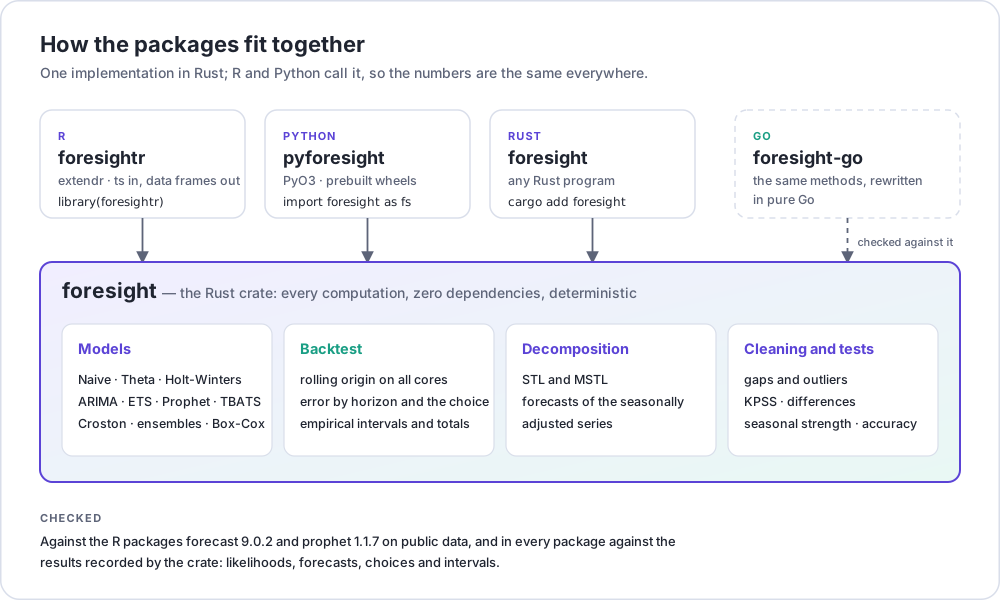
The models, the backtest and the utilities are the Rust crate foresight, compiled into the package: the numbers are the crate's, the backtest runs on all cores, and nothing else is needed at run time. NumPy and pandas are accepted and, for pandas, produced on request, but neither is required.
Website: https://strategicprojects.github.io/pyforesight/ · Português
Install
pip install pyforesight
Python 3.9 or later. Wheels are ready for Linux (x86-64 and aarch64), macOS
(Intel and Apple silicon) and Windows; elsewhere pip compiles the Rust code,
which needs a Rust toolchain (https://rustup.rs). The package is imported
as foresight.
Use
import foresight as fs

# monthly data whose first observation is in March
y = fs.monthly(values, first_month=3)

# replay the last 36 months, 12 months ahead, with the 11 default models
report = fs.backtest(y)

best = report.best
print(f"{best.name}: MAPE {best.score:.1f}%")
for p in best.forecast:
    lo, hi = p.interval(0.80)
    print(p.horizon, round(p.mean), round(lo), round(hi))

half_year = best.cumulative(6)      # the total of the next six months, with its own interval
report.to_pandas()                  # one row per candidate (needs pandas)
best.to_pandas()                    # the forecast with its intervals
One model on its own:
# seasonal ARIMA on the log scale
fit = fs.log(fs.Arima.airline()).fit(y)
next_year = fit.forecast(12)

# orders chosen from the data, inspected
auto = fs.AutoArima().fit(fs.monthly(log_values, first_month=3))
auto.details["order"], auto.details["seasonal_order"], auto.aicc
A trend that bends, with dated events:
model = fs.Prophet(
    events={"campaign": [10, 34, 58, 82, 106, 130]},  # future ones included
    steps={"new_law": 80},                              # a lasting change of level
)
fit = model.fit(y)
fit.details["changepoints"], fit.details["effects"]
Several models combined, and the wider set of candidates:
ensemble = fs.Ensemble(fs.defaults(), weighting="stacked")
report = fs.backtest(y, fs.thorough() + [ensemble.named("my_ensemble")])
Any sequence of numbers works where a series is expected: a list, a NumPy
array, a pandas Series. Only the values are read (an index of dates is not),
so say what the series is with fs.monthly, fs.quarterly or fs.Series, or
pass the seasonal period: fs.Theta().fit(values, period=12). Missing values
(None, NaN) are only accepted by the cleaning functions.
Good to know:
- Positions count from 0 at the first observation: Prophet's
eventsandsteps,Outlier.index,Report.first_originand the changepoints of a fit. Months and quarters (first_month,first_season) count from 1. - A candidate that cannot forecast at every origin and from the whole series
is left out of the report, with a warning;
report.droppednames them. fs.set_max_threads(n)limits the threads of backtests and ensembles; the results do not depend on it. The GIL is released while models are fitted.- Models, fits and reports hold Rust objects and cannot be pickled or copied; a model is cheap to build again in another process.
What is in it
| Piece | What it does |
|---|---|
Series, monthly, quarterly |
values + seasonal period + season of the first observation |
Model / Fit |
fit once, forecast any horizon, inspect params, details, likelihood and residuals |
| Models | Mean, Naive, Drift, SeasonalNaive, Theta, HoltWinters, LogLinear (optionally deflated by a price index), Arima (seasonal, exact maximum likelihood, optionally with regressors), AutoArima, Ets, AutoEts, Prophet (changepoints, Fourier seasonality, dated events and steps), Tbats (several seasonal periods, not necessarily whole numbers), Croston (with SBA and TSB) |
Transformed, log |
any model on the log or another Box-Cox scale, λ fixed or by Guerrero's method |
Decomposed, stl, mstl |
trend, seasonal patterns and remainder by LOESS; any model on the seasonally adjusted series |
Ensemble |
average, median, weights by inverse error or stacked weights |
Regressors |
external variables, Fourier terms, seasonal dummies |
defaults, thorough |
ready sets of 11 and 18 candidates |
backtest, set_max_threads |
rolling origin (expanding or fixed window) on all cores, or as many as allowed; MAPE, MAE, RMSE, MASE and bias by horizon; average of the best models; choice by out-of-sample error; empirical intervals by horizon and for totals |
interpolate, outliers, clean |
gaps filled and outliers found and replaced, with the season taken into account |
| Measures and tests | mape, bias, mae, rmse, mase, acf, difference, kpss, ndiffs, nsdiffs, seasonal_strength, box_cox, inv_box_cox, guerrero |
How it differs from the usual toolkits
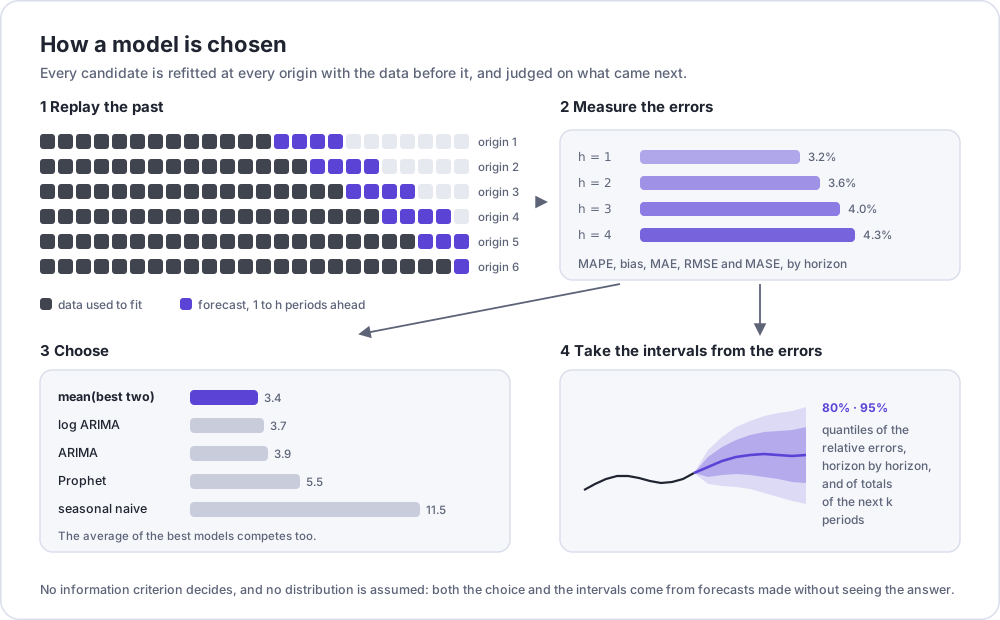
Most forecasting libraries choose a model by an in-sample information criterion and derive intervals from distributional assumptions. Here the choice and the intervals both come from forecasts made without seeing the future they are judged against. The interval for a total (say, the rest of a fiscal year) is measured on totals, because adding up monthly limits overstates its uncertainty.
Checked
The package runs the Rust crate, so its numbers are the crate's; the tests
check that nothing is lost on the way, against results recorded by the crate:
ARIMA, regression with ARIMA errors, ETS, Prophet, TBATS, STL and MSTL,
Croston, cleaning, ensembles, tests of stationarity and seasonality, and the
backtests of 11 and 18 candidates on three public series. The crate itself is
compared with the R packages forecast 9.0.2 and prophet 1.1.7, and
reproduced independently by the Go edition
foresight-go. The same methods are
available in R: foresightr.
pip install maturin pytest
maturin develop --release
pytest                 # about 30 s; pytest -m "not slow" skips TBATS and the thorough backtest
Data
tests/data has two public series: the monthly ICMS and FPE revenue of the
state of Piauí, Brazil (Siconfi/STN, with the IPCA price index from the
Central Bank of Brazil), and the airline passengers of Box & Jenkins.
Citation
Zenodo: https://doi.org/10.5281/zenodo.23050402 (all versions); see also CITATION.cff.
Authors
André Leite, Marcos Wasiliew, Hugo Vasconcelos, Carlos Amorim and Diogo Bezerra.
License
MIT.
1 maintainer

Metadata
1 maintainer
Release files for pyforesight 0.1.2
For a detailed explanation of source distributions (sdists) and built distributions (wheels), please see the package formats documentation.
Source distribution (sdist)
| File | Size | Uploaded | |
|---|---|---|---|
| pyforesight-0.1.2.tar.gz | 101.0 kB | Details |
Built distributions (wheels)
| File | Reset | |||
|---|---|---|---|---|
| pyforesight-0.1.2-cp39-abi3-win_amd64.whl | CPython 3.9 | abi3 | Windows x86-64 | Details |
| pyforesight-0.1.2-cp39-abi3-manylinux_2_17_x86_64.manylinux2014_x86_64.whl | CPython 3.9 | abi3 | Linux glibc 2.17+ x86-64 | Details |
| pyforesight-0.1.2-cp39-abi3-manylinux_2_17_aarch64.manylinux2014_aarch64.whl | CPython 3.9 | abi3 | Linux glibc 2.17+ ARM64 | Details |
| pyforesight-0.1.2-cp39-abi3-macosx_11_0_arm64.whl | CPython 3.9 | abi3 | macOS 11.0+ ARM64 | Details |
| pyforesight-0.1.2-cp39-abi3-macosx_10_12_x86_64.whl | CPython 3.9 | abi3 | macOS 10.12+ x86-64 | Details |
Total release size: 2.9 MB
Release files / pyforesight-0.1.2.tar.gz
| Download URL | pyforesight-0.1.2.tar.gz |
|---|---|
| Size | 101.0 kB |
| Tags | Source |
|
SHA-256 checksum How to use checksums |
9f5686b139fe0ba239ab9addd484bd8c4bc9dbd8d38997cae31fd59f55ccee97
|
|
BLAKE2b-256 checksum How to use checksums |
2aeca7dc9b4c8fc8bf1fd626c009c630002466953757bc603b1ff3f90bb6cebe
|
| Upload date | |
|
Uploaded using Trusted Publishing? What is trusted publishing? |
Yes |
| Uploaded via |
twine/7.0.0 CPython/3.13.14
|
Provenance
Provenance describes where a file came from. On PyPI, provenance is shared via attestations, which provide a verifiable record of the build or publishing details. View details, limitations and caveats.


PyPI Publish Attestation
PyPI verified that this artifact, at this checksum, originated from the publisher listed below.
Signed by GitHub Actions, verified by PyPI on Sep 30, 2026.
Transparency logRelease files / pyforesight-0.1.2-cp39-abi3-win_amd64.whl
| Download URL | pyforesight-0.1.2-cp39-abi3-win_amd64.whl |
|---|---|
| Size | 502.7 kB |
| Tags | CPython 3.9 Windows x86-64 abi3 |
|
SHA-256 checksum How to use checksums |
e4a90c854892aabc3e869a7f7bdf8dfeafb195b180ca73507eb47afe8b95f457
|
|
BLAKE2b-256 checksum How to use checksums |
9bd7a6fc761e66f003a00fe632c611f0df7b08527f0dcaeab3911624b92581aa
|
| Upload date | |
|
Uploaded using Trusted Publishing? What is trusted publishing? |
Yes |
| Uploaded via |
twine/7.0.0 CPython/3.13.14
|
Provenance
Provenance describes where a file came from. On PyPI, provenance is shared via attestations, which provide a verifiable record of the build or publishing details. View details, limitations and caveats.
PyPI Publish Attestation
PyPI verified that this artifact, at this checksum, originated from the publisher listed below.
Signed by GitHub Actions, verified by PyPI on Sep 30, 2026.
Transparency logRelease files / pyforesight-0.1.2-cp39-abi3-manylinux_2_17_x86_64.manylinux2014_x86_64.whl
| Download URL | pyforesight-0.1.2-cp39-abi3-manylinux_2_17_x86_64.manylinux2014_x86_64.whl |
|---|---|
| Size | 613.3 kB |
| Tags | CPython 3.9 Linux glibc 2.17+ x86-64 abi3 |
|
SHA-256 checksum How to use checksums |
1d816d0c5d6b7c8049bcdf7a3d32a6ed65bc741b1227f6fa19ae431dbbceb45f
|
|
BLAKE2b-256 checksum How to use checksums |
1b8816b6f3194445e686665bbab5c40644c48ebd715f993559fc1ac8a1485621
|
| Upload date | |
|
Uploaded using Trusted Publishing? What is trusted publishing? |
Yes |
| Uploaded via |
twine/7.0.0 CPython/3.13.14
|
Provenance
Provenance describes where a file came from. On PyPI, provenance is shared via attestations, which provide a verifiable record of the build or publishing details. View details, limitations and caveats.
PyPI Publish Attestation
PyPI verified that this artifact, at this checksum, originated from the publisher listed below.
Signed by GitHub Actions, verified by PyPI on Sep 30, 2026.
Transparency logRelease files / pyforesight-0.1.2-cp39-abi3-manylinux_2_17_aarch64.manylinux2014_aarch64.whl
| Download URL | pyforesight-0.1.2-cp39-abi3-manylinux_2_17_aarch64.manylinux2014_aarch64.whl |
|---|---|
| Size | 580.7 kB |
| Tags | CPython 3.9 Linux glibc 2.17+ ARM64 abi3 |
|
SHA-256 checksum How to use checksums |
4f1a1f86e2f5595076acc5c294b1af20642ae01c9bbc531860fb18ce3810284e
|
|
BLAKE2b-256 checksum How to use checksums |
61038e86183c7f81ca3deaa7cdc82157b1db0e58fe092b794ade767fd5cfbc12
|
| Upload date | |
|
Uploaded using Trusted Publishing? What is trusted publishing? |
Yes |
| Uploaded via |
twine/7.0.0 CPython/3.13.14
|
Provenance
Provenance describes where a file came from. On PyPI, provenance is shared via attestations, which provide a verifiable record of the build or publishing details. View details, limitations and caveats.
PyPI Publish Attestation
PyPI verified that this artifact, at this checksum, originated from the publisher listed below.
Signed by GitHub Actions, verified by PyPI on Sep 30, 2026.
Transparency logRelease files / pyforesight-0.1.2-cp39-abi3-macosx_11_0_arm64.whl
| Download URL | pyforesight-0.1.2-cp39-abi3-macosx_11_0_arm64.whl |
|---|---|
| Size | 544.7 kB |
| Tags | CPython 3.9 abi3 macOS 11.0+ ARM64 |
|
SHA-256 checksum How to use checksums |
7ba6b1dccec8b04d1a46694ab5432d40b8ff60a9d748f6e6689142139785e1d7
|
|
BLAKE2b-256 checksum How to use checksums |
26ee79eb6ebbb19275a9c9e771102b22a304d3ef98eba70bd285abd00e9235b2
|
| Upload date | |
|
Uploaded using Trusted Publishing? What is trusted publishing? |
Yes |
| Uploaded via |
twine/7.0.0 CPython/3.13.14
|
Provenance
Provenance describes where a file came from. On PyPI, provenance is shared via attestations, which provide a verifiable record of the build or publishing details. View details, limitations and caveats.
PyPI Publish Attestation
PyPI verified that this artifact, at this checksum, originated from the publisher listed below.
Signed by GitHub Actions, verified by PyPI on Sep 30, 2026.
Transparency logRelease files / pyforesight-0.1.2-cp39-abi3-macosx_10_12_x86_64.whl
| Download URL | pyforesight-0.1.2-cp39-abi3-macosx_10_12_x86_64.whl |
|---|---|
| Size | 570.6 kB |
| Tags | CPython 3.9 abi3 macOS 10.12+ x86-64 |
|
SHA-256 checksum How to use checksums |
32fd2c96d4ed8eb2bd402ee5ee5dc5ecaa0b1b5e9dedf289032b9998daafbbda
|
|
BLAKE2b-256 checksum How to use checksums |
2490c71dcc53e33225dee463d308b2492aab02a1da3e1ef8753c6038027b68c9
|
| Upload date | |
|
Uploaded using Trusted Publishing? What is trusted publishing? |
Yes |
| Uploaded via |
twine/7.0.0 CPython/3.13.14
|
Provenance
Provenance describes where a file came from. On PyPI, provenance is shared via attestations, which provide a verifiable record of the build or publishing details. View details, limitations and caveats.
PyPI Publish Attestation
PyPI verified that this artifact, at this checksum, originated from the publisher listed below.
Signed by GitHub Actions, verified by PyPI on Sep 30, 2026.
Transparency log













