
Python bindings for the GBS library

Project description
PyGbs: Python Binding for GBS
PyGbs is a modern Python binding for the GBS C++ library. It offers fast, object-oriented, and dimension-templated geometry tools—including NURBS curves and surfaces—with implementations of many algorithms from The NURBS Book.
Features
-
High Performance:
PyGbs runs roughly 10× faster than SciPy’s interpolation routines. -
Object-Oriented and Dimension-Templated:
Support for 1D, 2D, 3D, and higher-dimensional geometrical objects.- Curves: Line, Circle, BSPline Curve, NURBS Curve, etc.
- Surfaces: BSPline Surface, NURBS Surface, etc.
-
Rich NURBS Functionality:
Implements key algorithms including interpolation, approximation, knot insertion, extrema, extension, revolution, loft, and more.
Installation
Install PyGbs via pip:
pip install pygbs
Quick Performance Comparison
PyGbs outperforms SciPy’s interpolation in speed. For example:
SciPy CubicSpline
import numpy as np
from scipy.interpolate import CubicSpline
x = np.arange(10)
y = np.sin(x)
PyGbs Interpolation
from pygbs import core
from pygbs import interpolate

points = [[x_, y_] for x_, y_ in zip(x, y)]
%%timeit
cs = CubicSpline(x, y)
86.8 μs ± 3.41 μs per loop (mean ± std. dev. of 7 runs, 10,000 loops each)
%%timeit
crv = interpolate.interpolate_cn(points, 3)
14.8 μs ± 406 ns per loop (mean ± std. dev. of 7 runs, 100,000 loops each)
Object-Oriented and Dimension-Templated Design
-
Multi-Dimensional Support:
Works seamlessly with 1D, 2D, 3D, and higher-dimensional geometries. -
Core Geometric Objects:
- Curves:
- Line
- Circle
- B-Spline Curve
- NURBS Curve
- and more...
- Surfaces:
- B-Spline Surface
- NURBS Surface
- and more...
- Curves:
Comprehensive Implementation of The NURBS Book Algorithms
PyGbs implements a broad range of algorithms inspired by The NURBS Book, including:
- Interpolation
- Approximation
- Knot Insertion
- Extrema Calculation
- Extension Techniques
- Surface Revolution
- Lofting
- and many others...
Examples
Direct curves creation
from pygbs import core

    poles = [
        [0.,0.,0.], # Pole 1 [x, y, z]
        [1.,0.,0.], # Pole 2 [x, y, z]
    ]
    knots          = [0.0, 1.0] # Curve parametrization
    multiplicities = [1, 1]
    degree         = 1
    curve = core.BSCurve3d(
        poles,
        knots,
        multiplicities,
        degree
    )

    point = crv(0.5)
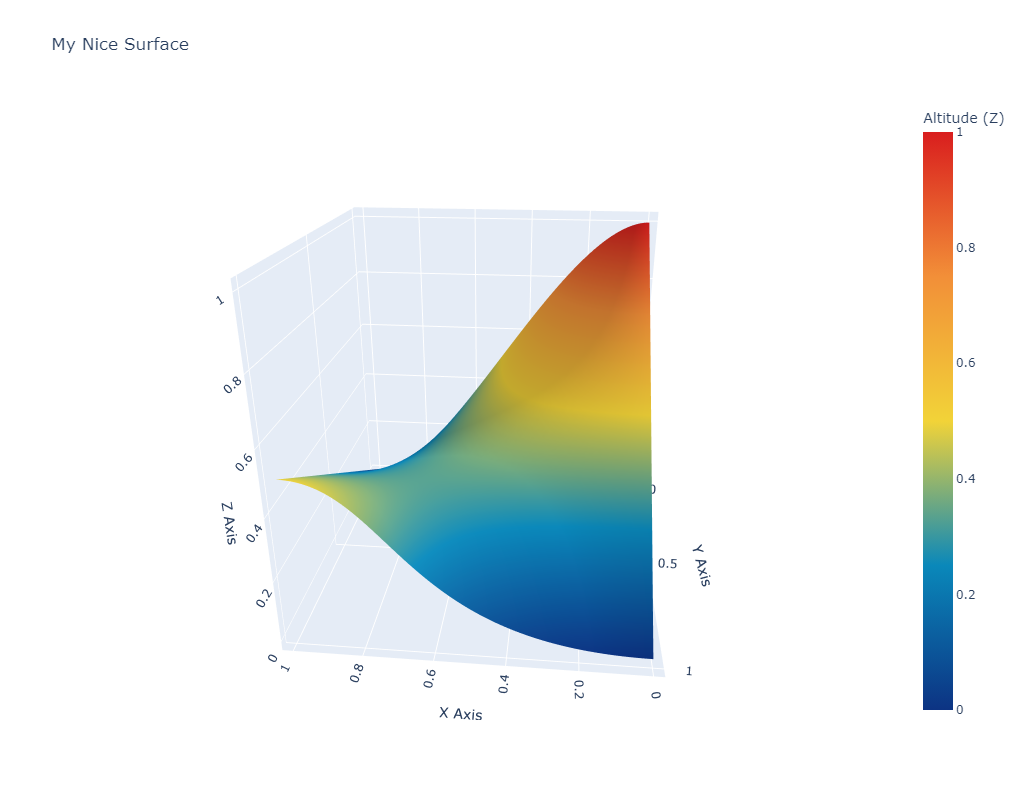
Direct surface creeation
from pygbs import core

dz = 1.
srf = core.BSSurface3d(
    poles = [
        [0.,0.,dz],[.3,0.,dz],[.7,0.,0.],[1.,0.,0],
        [0.,1.,0.],[.7,1.,0.],[.7,1.,0.5*dz],[1.,1.,0.5*dz]
    ],
    knotsU=[0., 1],
    knotsV=[0., 1],
    multsU=[4, 4],
    multsV=[2, 2],
    degreeU=3,
    degreeV=1)

import numpy as np
u = np.linspace(0, 1, 100)
v = np.linspace(0, 1, 100)
u,v = np.meshgrid(u,v)
u = u.flatten()
v = v.flatten()

pts = srf(u,v)
Surface mesh display from points
Points interpolation
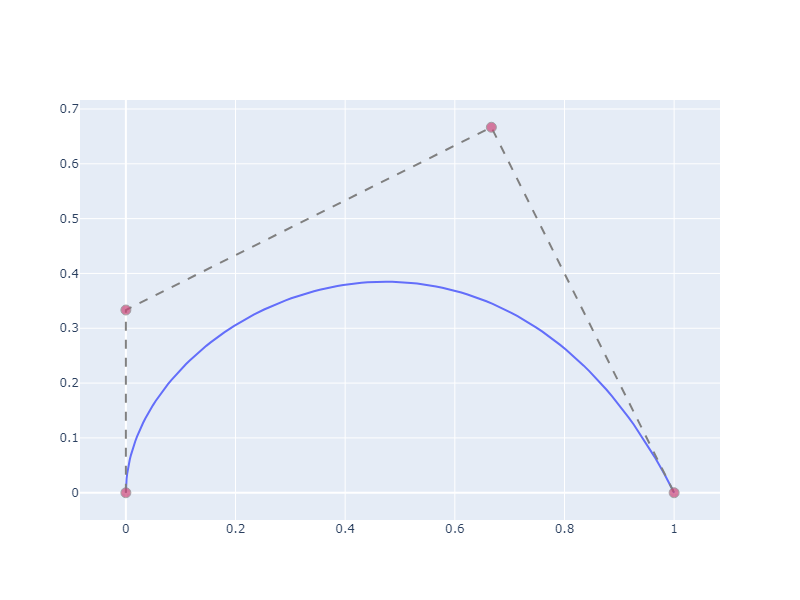
For instance point interpolation with tangency control:
from pygbs.core import BSCurve2d
from pygbs.interpolate import interpolate_c1
from pygbs.plotlyplot import plot_bs_curve_2d

constraints = [
    [ [0.,0.], [0., 1.] ], # [ [x0, y0], [dx0/du, dy0/du] ]
    [ [1.,0.], [0.,-2.] ], # [ [x1, y1], [dx1/du, dy1/du] ]
]

curve = interpolate_c1(constraints)

plot_bs_curve_2d(curve)
Points approximation
# Create points
import requests

foil_name = 'e1098'
url = f"http://airfoiltools.com/airfoil/seligdatfile?airfoil={foil_name}-il"

response = requests.get(url)
lines = response.text.split("\n")
lines .pop(0)
lines .pop(-1)

points = [ list(map(float, line.split())) for line in lines]
# Create an approximation of degree 3
from pygbs import core
from pygbs import interpolate

curve = interpolate.approx(
    points,
    deg=3
)
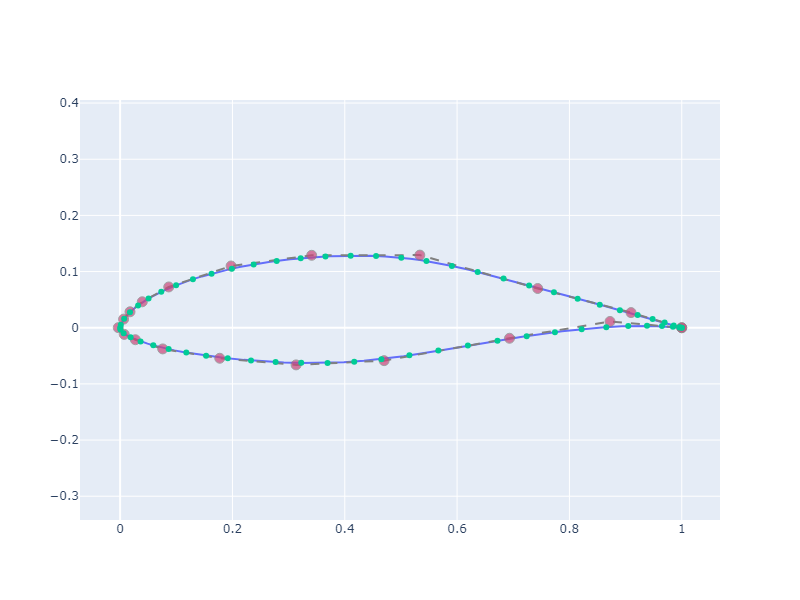
The green dots are representing the foil's points and the purple ones the control points of the approximating curve.
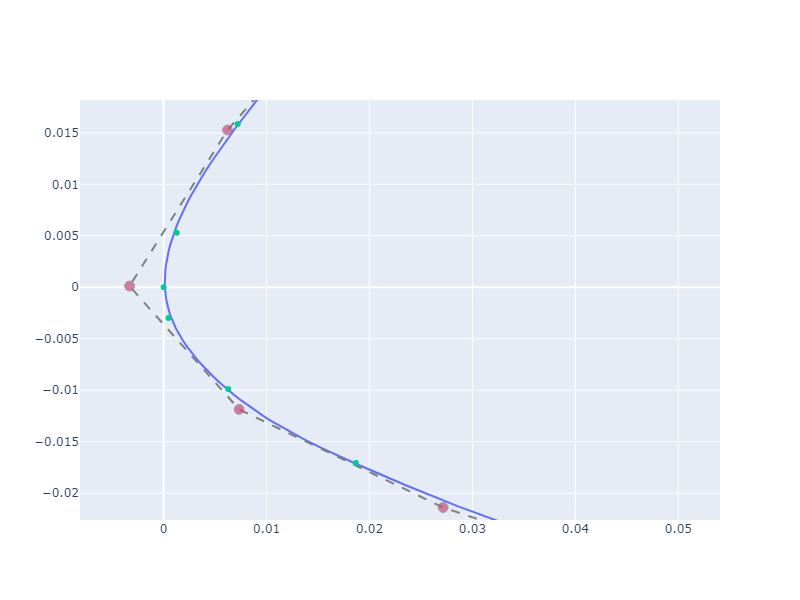
A closer look shows the benefit of approximation on stiff interpolation, in the case of a poorly discretized profile the algorythm is able to produce a smooth curve.
Release history Release notifications | RSS feed


Download files
Download the file for your platform. If you're not sure which to choose, learn more about installing packages.
Source Distributions
Built Distribution
Filter files by name, interpreter, ABI, and platform.
If you're not sure about the file name format, learn more about wheel file names.
Copy a direct link to the current filters
File details
Details for the file pygbs-0.4.2-cp311-cp311-win_amd64.whl.
File metadata
- Download URL: pygbs-0.4.2-cp311-cp311-win_amd64.whl
- Upload date:
- Size: 2.3 MB
- Tags: CPython 3.11, Windows x86-64
- Uploaded using Trusted Publishing? No
- Uploaded via: twine/6.0.1 CPython/3.11.11
File hashes
| Algorithm | Hash digest | |
|---|---|---|
| SHA256 |
8956bc27550bc66ad17fa8fd05c93d151c8841df039a09bb8513eac274822124
|
|
| MD5 |
11879dccdd21d8952e75dbdface24eae
|
|
| BLAKE2b-256 |
f47572d725a7d03d96050f5e19f2accf0bf512814505677da2830d5f84790055
|






