
Python API for GEMC geometry definition and output analysis
Verified details
These details have been verified by PyPIProject links
GitHub Statistics
Maintainers

Project description
pygemc




pygemc is the Python API used by GEMC to define detector geometry, materials, optical properties, mirrors, geometry variations, and lightweight output-analysis workflows. It lets users build GEMC databases with Python scripts, preview geometry with PyVista, and inspect GEMC CSV or ROOT output without writing C++.
The package is installed as part of the GEMC source build and can also be developed as a standalone Python project.
Features
- Python classes for GEMC geometry and material databases
GVolumehelpers for common Geant4 solids such as boxes, tubes, cones, and trapezoidsGMaterialhelpers for chemical formulas, fractional-mass mixtures, and optical/scintillation propertiesGConfigurationrun, variation, factory, SQLite, ASCII, and PyVista configuration handlingautogeometry()convenience setup for detector scripts- SQLite and ASCII database output
- PyVista rendering, interactive Qt display, and VTK.js
.vtkszexport for geometry inspection and documentation gemc-system-templateCLI for generating ready-to-run detector systems- Python code snippets for supported Geant4 solid constructors
gemc-analyzerCLI for summarizing and plotting GEMC CSV or ROOT output- Unit conversion helpers for length, angle, time, and energy strings
- Pytest suite that does not require a compiled
gemcbinary
Installation
Use a Python virtual environment for direct pip installs:
python3 -m venv ~/venv/pygemc
source ~/venv/pygemc/bin/activate
python -m pip install --upgrade pip
Stable PyPI Install
Install pygemc with:
python -m pip install pygemc
Optional ROOT-file analysis dependencies:
python -m pip install "pygemc[root]"
Development Snapshot
Install the moving GitHub dev prerelease with:
python -m pip install "pygemc @ git+https://github.com/gemc/pygemc.git@dev"
Use this when you need the latest development version before the next stable PyPI release.
Local Clone Development Install
Use this when you are editing pygemc from a local clone:
git clone https://github.com/gemc/pygemc.git
cd pygemc
python -m pip install -e ".[dev]"
Optional ROOT-file analysis dependencies for local development:
python -m pip install -e ".[dev,root]"
The package requires Python 3.10 or newer and depends on NumPy, VTK, PyVista, PyVistaQt, PyQt6, pandas, and matplotlib.
Installed with GEMC
When GEMC is built from source, the parent Meson project installs pygemc into the GEMC Python environment. After adding the GEMC Python environment to PATH, the commands below are available:
gemc-system-template --help
gemc-analyzer --help
Quickstart
Create a detector template:
gemc-system-template -s counter
cd counter
./counter.py
The generated system contains:
| File | Purpose |
|---|---|
counter.py |
Main geometry-builder script |
geometry.py |
Example volumes, including a flux detector |
materials.py |
Example methane-gas material |
counter.yaml |
GEMC steering card |
README.md |
Placeholder notes for the generated detector |
Run with PyVista visualization:
./counter.py -pv
Export a VTK.js scene:
./counter.py -pvvtk counter -pvz 0.25
Run the generated simulation with GEMC when the compiled gemc executable is available:
gemc counter.yaml
Analyze output:
gemc-analyzer counter_t0_digitized.csv totEdep --kind csv --bins 50
Geometry API
Typical geometry scripts create a configuration and publish volumes/materials to it:
from pygemc import GMaterial, GVolume, autogeometry

cfg = autogeometry("examples", "counter")

gas = GMaterial("methaneGas")
gas.description = "methane gas CH4 0.000667 g/cm3"
gas.density = 0.000667
gas.addNAtoms("C", 1)
gas.addNAtoms("H", 4)
gas.publish(cfg)

flux = GVolume("flux_box")
flux.description = "air flux box"
flux.make_box(40.0, 40.0, 2.0)
flux.set_position(0, 0, 100)
flux.material = "G4_AIR"
flux.color = "3399FF"
flux.style = 1
flux.digitization = "flux"
flux.set_identifier("box", 2)
flux.publish(cfg)
Common command-line options accepted by geometry scripts:
| Option | Purpose |
|---|---|
-f, --factory |
Select sqlite or ascii output |
-v, --variation |
Select the geometry variation |
-r, --run |
Select the run number |
-sql, --dbhost |
Select the SQLite file path |
-pv |
Show a PyVista window |
-pvb |
Show a PyVistaQt background plotter |
-pvvtk |
Export a VTK.js .vtksz scene |
-pvz |
Set the VTK.js export zoom |
PyVista Visualization
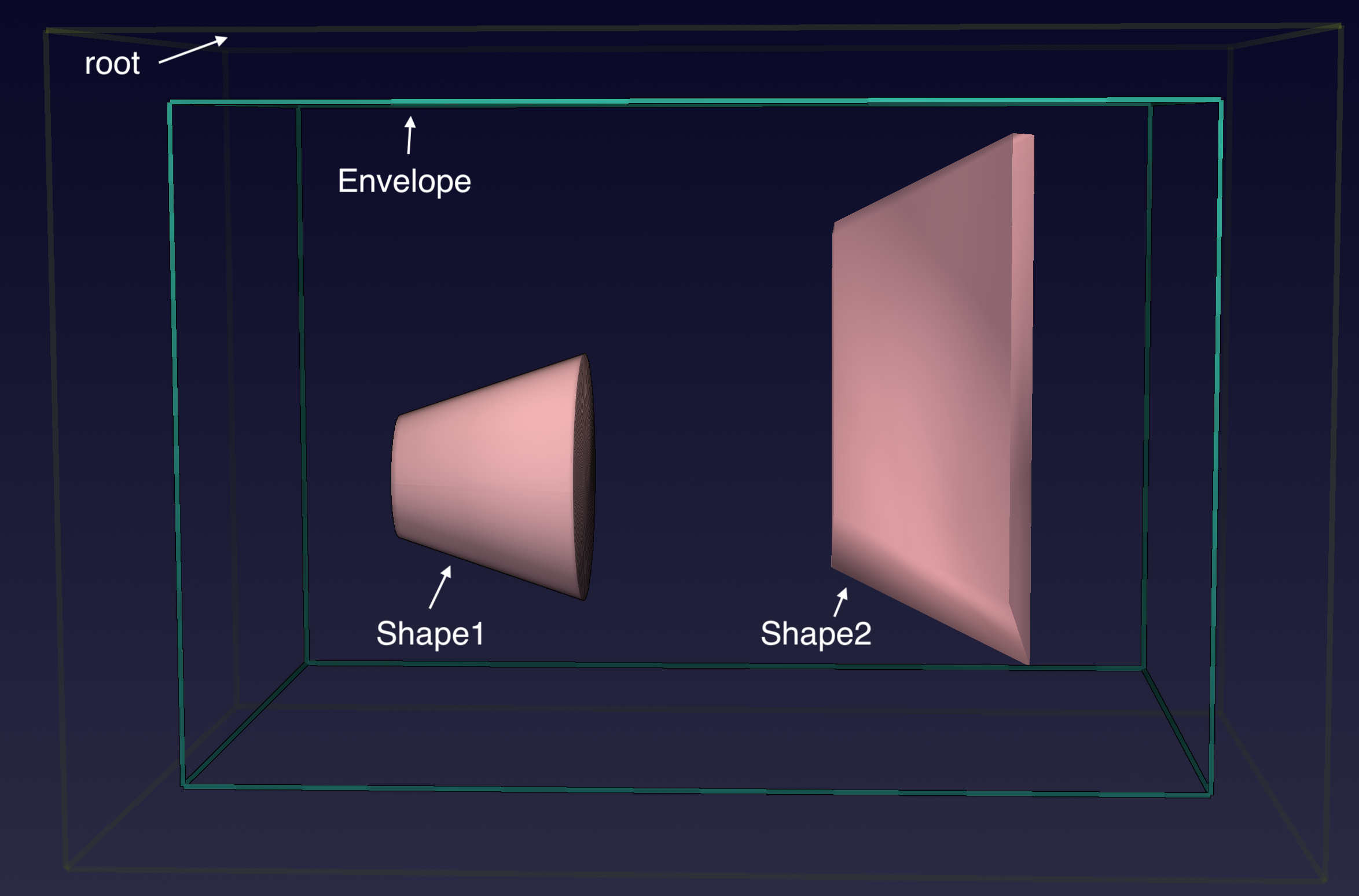
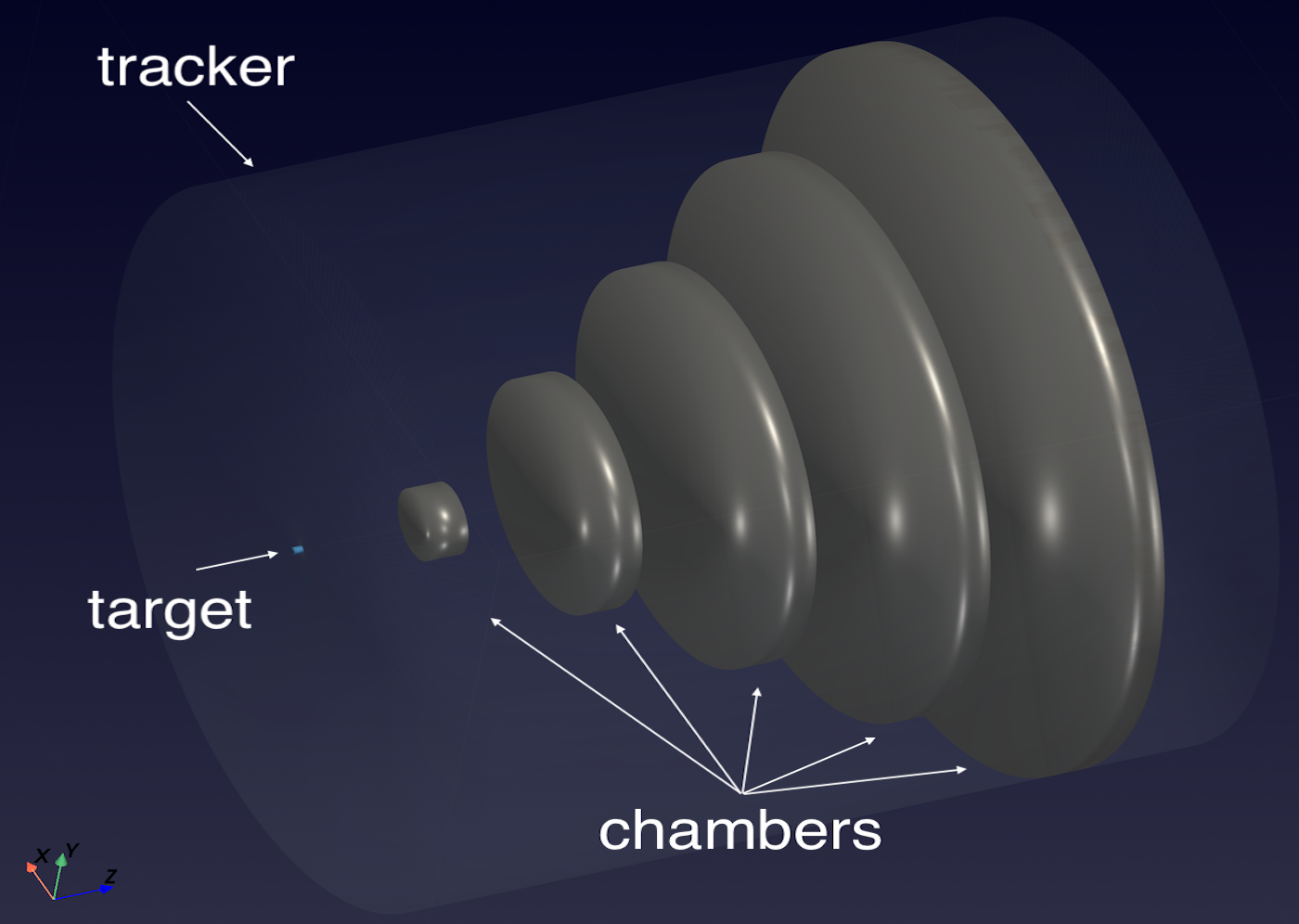
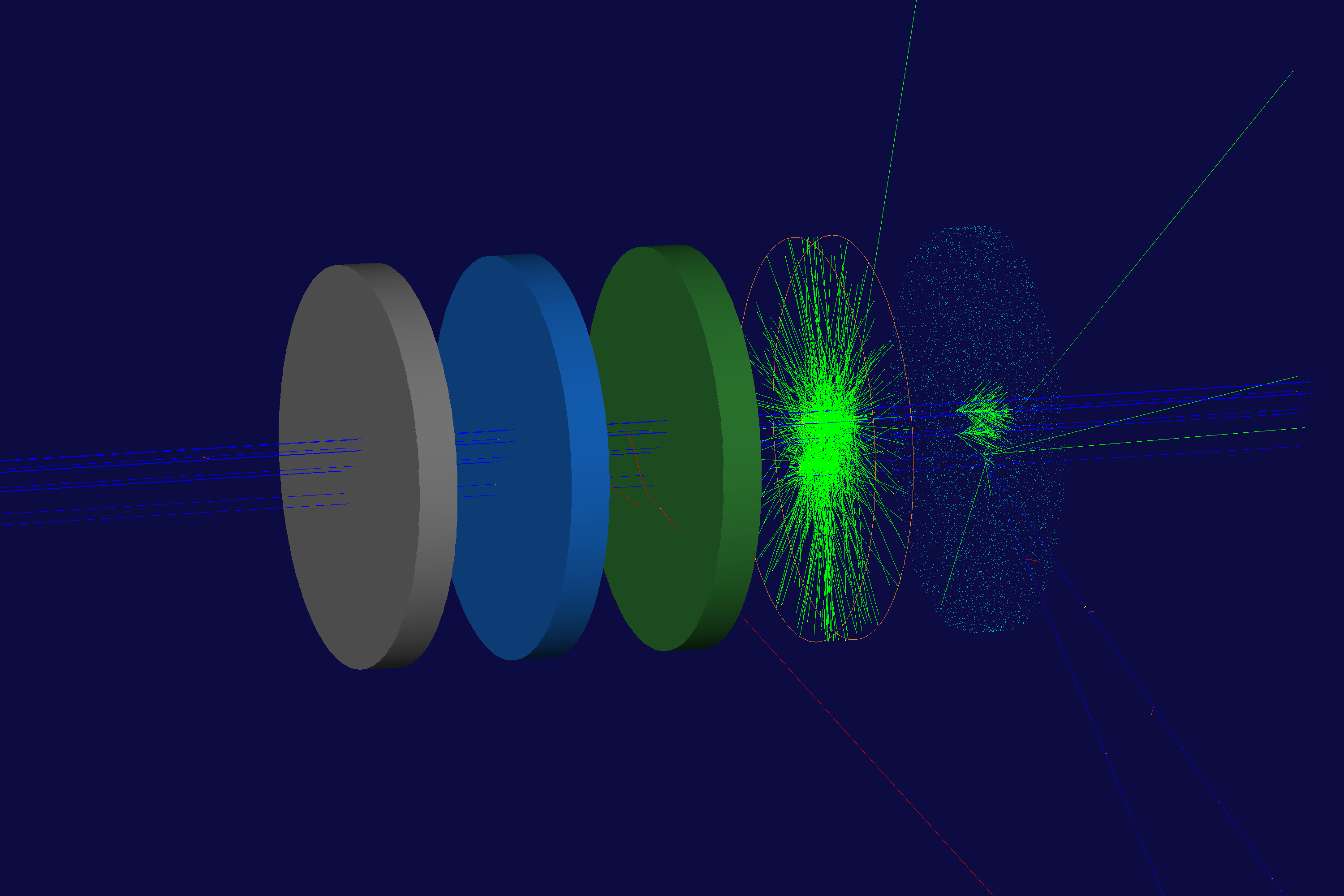
PyVista support is central to pygemc: geometry scripts can display the detector as they build it, open an interactive Qt viewer, or export a .vtksz scene that can be published in documentation.
| B1 | B2 |
|---|---|
 |
 |
| Materials | Simple Flux |
 |
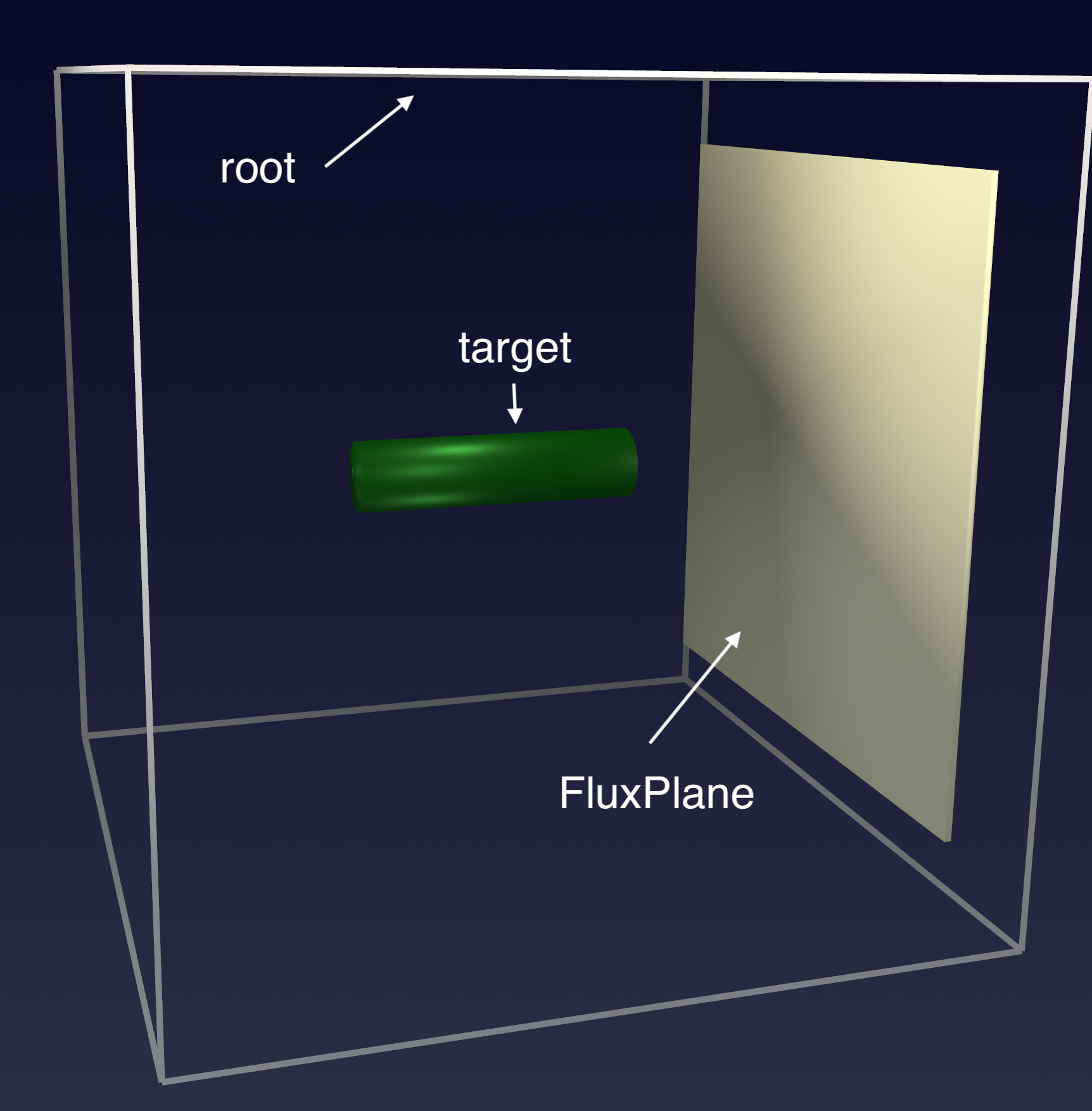 |
Open the linked interactive PyVista scenes generated from the GEMC examples.
GitHub README pages cannot embed .vtksz files directly, so the preview image links to the hosted VTK.js viewer.
Command-Line Tools
gemc-system-template
Generate a detector skeleton:
gemc-system-template -s counter
List supported solid snippets:
gemc-system-template -sl
Print a volume-construction snippet:
gemc-system-template -gv G4Box
Write a snippet to a file:
gemc-system-template -gv G4Tubs -write_to geometry.py -geo_sub build_tube
gemc-analyzer
Summarize an output file:
gemc-analyzer counter_t0_digitized.csv --kind csv
Plot a variable:
gemc-analyzer counter_t0_digitized.csv totEdep --kind csv --bins 50
Save a figure without opening a GUI:
gemc-analyzer out.root E --kind root --detector flux --save energy.png
Analyzer inputs:
- CSV output files or CSV root names
- ROOT files when
pygemc[root]dependencies are installed - Digitized and true-information data streams
Tests
Run the standalone Python tests:
pytest
pytest tests/test_cli.py
pytest tests/test_geometry.py
pytest -v
pytest -k "sqlite"
The tests cover CLI behavior and geometry database generation. They intentionally do not require Geant4 or a compiled gemc executable; full simulation tests live in the parent GEMC Meson build.
Project Layout
| Path | Purpose |
|---|---|
src/pygemc/api/ |
Geometry, materials, units, SQLite output, PyVista support, and templates |
src/pygemc/analyzer/ |
CSV/ROOT readers, plotting, and analyzer CLI |
tests/ |
Standalone pytest suite |
releases/ |
Release notes |
pyproject.toml |
Python packaging metadata and console scripts |
meson.build |
Meson subproject integration used by GEMC |
Documentation
Contributing
Keep patches focused and run the relevant pytest targets before opening a pull request. If a change affects the integrated GEMC build, also run the parent repository Meson tests for the affected examples or modules.
License
pygemc is distributed under the GEMC Software License, the same license used by the main GEMC source repository. See LICENSE.md.
Project details
Verified details
These details have been verified by PyPIProject links
GitHub Statistics
Maintainers
Release history Release notifications | RSS feed

Download files
Download the file for your platform. If you're not sure which to choose, learn more about installing packages.
Source Distribution
Built Distribution
Filter files by name, interpreter, ABI, and platform.
If you're not sure about the file name format, learn more about wheel file names.
Copy a direct link to the current filters
File details
Details for the file pygemc-0.2.0.tar.gz.
File metadata
- Download URL: pygemc-0.2.0.tar.gz
- Upload date:
- Size: 52.2 kB
- Tags: Source
- Uploaded using Trusted Publishing? Yes
- Uploaded via: twine/6.1.0 CPython/3.13.12
File hashes
| Algorithm | Hash digest | |
|---|---|---|
| SHA256 |
588769a8d26cf7bb5674d6299066f8d4ad864746ff91f58f9326607abaaf571b
|
|
| MD5 |
d85d2f434c6b6fb728f3cf47529e829e
|
|
| BLAKE2b-256 |
262874334410cd1f392759e4f091ef300fb32d76feb6dee9fb71879c985440e2
|
Provenance
The following attestation bundles were made for pygemc-0.2.0.tar.gz:
Publisher:
publish_pypi.yml on gemc/pygemc
-
Statement:
-
Statement type:
https://in-toto.io/Statement/v1 -
Predicate type:
https://docs.pypi.org/attestations/publish/v1 -
Subject name:
pygemc-0.2.0.tar.gz -
Subject digest:
588769a8d26cf7bb5674d6299066f8d4ad864746ff91f58f9326607abaaf571b - Sigstore transparency entry: 1657379648
- Sigstore integration time:
-
Permalink:
gemc/pygemc@ad4f82614308e425ad7e908a60c4213393d66a25 -
Branch / Tag:
refs/heads/main - Owner: https://github.com/gemc
-
Access:
public
-
Token Issuer:
https://token.actions.githubusercontent.com -
Runner Environment:
github-hosted -
Publication workflow:
publish_pypi.yml@ad4f82614308e425ad7e908a60c4213393d66a25 -
Trigger Event:
workflow_dispatch
-
Statement type:
File details
Details for the file pygemc-0.2.0-py3-none-any.whl.
File metadata
- Download URL: pygemc-0.2.0-py3-none-any.whl
- Upload date:
- Size: 63.9 kB
- Tags: Python 3
- Uploaded using Trusted Publishing? Yes
- Uploaded via: twine/6.1.0 CPython/3.13.12
File hashes
| Algorithm | Hash digest | |
|---|---|---|
| SHA256 |
9ed326e3919cfeadfa7b4cdff4a7a7647dd266b60b949f9faf971e984fec7df2
|
|
| MD5 |
690befa255598a88af667a1cab9a0712
|
|
| BLAKE2b-256 |
41f9bb7490acb1a2fa0d8bb2330bb8ebeb0d56f4f6a1a3678e6e373d501ab675
|
Provenance
The following attestation bundles were made for pygemc-0.2.0-py3-none-any.whl:
Publisher:
publish_pypi.yml on gemc/pygemc
-
Statement:
-
Statement type:
https://in-toto.io/Statement/v1 -
Predicate type:
https://docs.pypi.org/attestations/publish/v1 -
Subject name:
pygemc-0.2.0-py3-none-any.whl -
Subject digest:
9ed326e3919cfeadfa7b4cdff4a7a7647dd266b60b949f9faf971e984fec7df2 - Sigstore transparency entry: 1657379778
- Sigstore integration time:
-
Permalink:
gemc/pygemc@ad4f82614308e425ad7e908a60c4213393d66a25 -
Branch / Tag:
refs/heads/main - Owner: https://github.com/gemc
-
Access:
public
-
Token Issuer:
https://token.actions.githubusercontent.com -
Runner Environment:
github-hosted -
Publication workflow:
publish_pypi.yml@ad4f82614308e425ad7e908a60c4213393d66a25 -
Trigger Event:
workflow_dispatch
-
Statement type:






