anywidget wrapper for globe.gl
Project description
pyglobegl
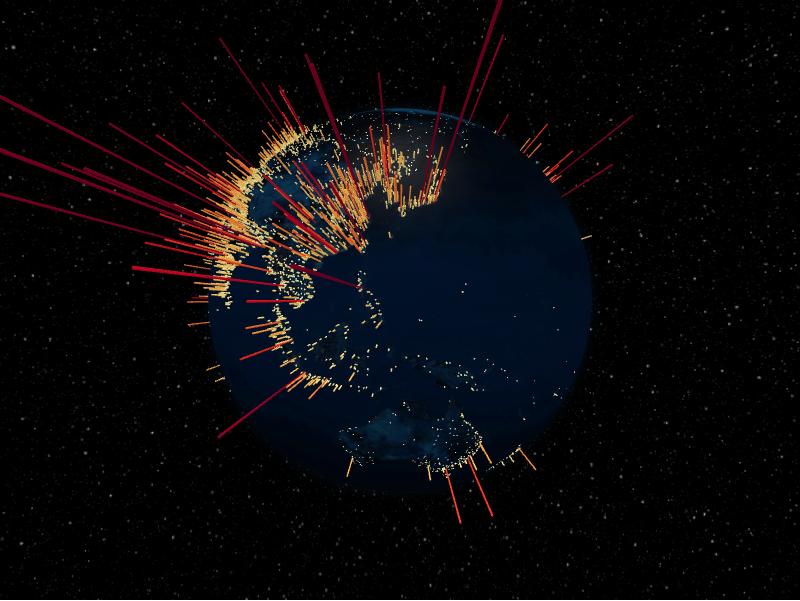
anywidget wrapper for globe.gl with integrations with popular Python spatial packages.
Installation
pip install pyglobegl
Or with uv:
uv add pyglobegl
Optional GeoPandas + Pandera extra:
pip install pyglobegl[geopandas]
uv add pyglobegl[geopandas]
Optional MovingPandas extra (includes GeoPandas + Pandera):
pip install pyglobegl[movingpandas]
uv add pyglobegl[movingpandas]
Quickstart
from IPython.display import display
from pyglobegl import GlobeWidget
display(GlobeWidget())
Image Inputs
Globe image fields expect URLs, but you can pass a PIL image by converting it to a PNG data URL:
from PIL import Image
from pyglobegl import GlobeLayerConfig, image_to_data_url
image = Image.open("earth.png")
config = GlobeLayerConfig(globe_image_url=image_to_data_url(image))
Points Layer
from IPython.display import display
from pyglobegl import (
GlobeConfig,
GlobeLayerConfig,
GlobeWidget,
PointDatum,
PointsLayerConfig,
)
points = [
PointDatum(lat=0, lng=0, altitude=0.25, color="#ff0000", label="Center"),
PointDatum(lat=15, lng=-45, altitude=0.12, color="#00ff00", label="West"),
]
config = GlobeConfig(
globe=GlobeLayerConfig(
globe_image_url="https://cdn.jsdelivr.net/npm/three-globe/example/img/earth-day.jpg"
),
points=PointsLayerConfig(points_data=points),
)
display(GlobeWidget(config=config))
pyglobegl expects layer data as Pydantic models (for example: PointDatum,
ArcDatum, PolygonDatum, PathDatum, HeatmapDatum, HexBinPointDatum,
HexPolygonDatum, TileDatum, ParticleDatum, RingDatum, LabelDatum).
Dynamic accessor remapping is not supported; per-datum values are read from the
model field names. Numeric fields reject string values, and data model defaults
mirror globe.gl defaults so omitted values still render predictably.
Arcs Layer
from IPython.display import display
from pyglobegl import (
ArcDatum,
ArcsLayerConfig,
GlobeConfig,
GlobeLayerConfig,
GlobeWidget,
)
arcs = [
ArcDatum(
start_lat=0,
start_lng=-30,
end_lat=10,
end_lng=40,
altitude=0.2,
color="#ffcc00",
stroke=1.2,
),
ArcDatum(
start_lat=20,
start_lng=10,
end_lat=-10,
end_lng=-50,
altitude=0.1,
color="#ffcc00",
stroke=1.2,
),
]
config = GlobeConfig(
globe=GlobeLayerConfig(
globe_image_url="https://cdn.jsdelivr.net/npm/three-globe/example/img/earth-day.jpg"
),
arcs=ArcsLayerConfig(arcs_data=arcs),
)
display(GlobeWidget(config=config))
Polygons Layer
from IPython.display import display
from geojson_pydantic import Polygon
from pyglobegl import (
GlobeConfig,
GlobeLayerConfig,
GlobeWidget,
PolygonDatum,
PolygonsLayerConfig,
)
polygon = Polygon(
type="Polygon",
coordinates=[
[
(-10, 0),
(-10, 10),
(10, 10),
(10, 0),
(-10, 0),
]
],
)
config = GlobeConfig(
globe=GlobeLayerConfig(
globe_image_url="https://cdn.jsdelivr.net/npm/three-globe/example/img/earth-day.jpg"
),
polygons=PolygonsLayerConfig(
polygons_data=[
PolygonDatum(geometry=polygon, cap_color="#ffcc00", altitude=0.05)
],
),
)
display(GlobeWidget(config=config))
Paths Example
from pyglobegl import GlobeConfig, GlobeWidget, PathDatum, PathsLayerConfig
paths = [
PathDatum(
path=[(0, 0), (5, 5), (10, 0)], color="#66ccff", dash_length=0.02
),
]
config = GlobeConfig(
paths=PathsLayerConfig(paths_data=paths, path_transition_duration=0),
)
display(GlobeWidget(config=config))
Heatmaps Layer
from pyglobegl import (
GlobeConfig,
GlobeWidget,
HeatmapDatum,
HeatmapPointDatum,
HeatmapsLayerConfig,
)
heatmap = HeatmapDatum(
points=[
HeatmapPointDatum(lat=0, lng=0, weight=1.0),
HeatmapPointDatum(lat=10, lng=10, weight=0.6),
],
bandwidth=0.8,
color_saturation=2.5,
)
config = GlobeConfig(heatmaps=HeatmapsLayerConfig(heatmaps_data=[heatmap]))
display(GlobeWidget(config=config))
Hex Bin Layer (MicroPython Accessors)
from pyglobegl import (
GlobeConfig,
GlobeWidget,
HexBinLayerConfig,
HexBinPointDatum,
frontend_python,
)
@frontend_python
def hex_altitude(hexbin):
return hexbin["sumWeight"] * 0.01
@frontend_python
def point_weight(point):
# point is an individual input row from hex_bin_points_data
return point["weight"] * 2.0
@frontend_python
def hex_color(hexbin):
return "#ff5500" if hexbin["sumWeight"] > 2 else "#66ccff"
@frontend_python
def hex_label(hexbin):
return f"<b>{len(hexbin['points'])}</b> points in this hex bin"
points = [
HexBinPointDatum(lat=0, lng=0, weight=1.0),
HexBinPointDatum(lat=12, lng=15, weight=3.5),
]
config = GlobeConfig(
hex_bin=HexBinLayerConfig(
hex_bin_points_data=points,
hex_bin_point_weight=point_weight,
hex_altitude=hex_altitude,
hex_top_color=hex_color,
hex_side_color=hex_color,
hex_label=hex_label,
)
)
display(GlobeWidget(config=config))
Frontend callback arguments are normalized to plain Python values (dict/list/
str/float/bool/None) when they are JSON-serializable, so dict methods like
.get(...) work in callbacks such as hex_label.
Hexbin callback I/O guide:
hex_bin_point_lat(point) -> float:pointis one row fromhex_bin_points_data.hex_bin_point_lng(point) -> float:pointis one row fromhex_bin_points_data.hex_bin_point_weight(point) -> float:pointis one row fromhex_bin_points_data.hex_top_color(hexbin) -> str: CSS color string.hex_side_color(hexbin) -> str: CSS color string.hex_altitude(hexbin) -> float: non-negative altitude in globe-radius units.hex_label(hexbin) -> str: HTML/text tooltip content.
The hexbin argument shape is:
{"h3Idx": str, "points": list[dict], "sumWeight": float}.
For compatibility across upstream changes, prefer defensive access (for example,
hexbin.get("sumWeight", 0)) in case keys are missing or values change shape.
hex_margin, hex_bin_point_lat, hex_bin_point_lng, and
hex_bin_point_weight also accept @frontend_python callbacks when you need
frontend-computed accessors without writing JavaScript.
Hexed Polygons Layer
from geojson_pydantic import Polygon
from pyglobegl import (
GlobeConfig,
GlobeWidget,
HexPolygonDatum,
HexedPolygonsLayerConfig,
)
geometry = Polygon(
type="Polygon",
coordinates=[
[(-10, 0), (-10, 10), (10, 10), (10, 0), (-10, 0)],
],
)
hexed = [
HexPolygonDatum(geometry=geometry, color="#ffcc00", altitude=0.05),
]
config = GlobeConfig(
hexed_polygons=HexedPolygonsLayerConfig(hex_polygons_data=hexed)
)
display(GlobeWidget(config=config))
Tiles Layer
from pyglobegl import (
GlobeConfig,
GlobeMaterialSpec,
GlobeWidget,
TileDatum,
TilesLayerConfig,
)
tiles = [
TileDatum(
lat=0,
lng=0,
width=10,
height=10,
material=GlobeMaterialSpec(
type="MeshLambertMaterial",
params={"color": "#66ccff", "opacity": 0.6, "transparent": True},
),
)
]
config = GlobeConfig(tiles=TilesLayerConfig(tiles_data=tiles))
display(GlobeWidget(config=config))
Particles Layer
from pyglobegl import (
GlobeConfig,
GlobeWidget,
ParticleDatum,
ParticlePointDatum,
ParticlesLayerConfig,
)
particles = [
ParticleDatum(
particles=[
ParticlePointDatum(lat=0, lng=0, altitude=0.2, label="Alpha"),
ParticlePointDatum(lat=10, lng=10, altitude=0.2, label="Beta"),
],
color="palegreen",
size=2.0,
)
]
config = GlobeConfig(particles=ParticlesLayerConfig(particles_data=particles))
display(GlobeWidget(config=config))
Rings Layer
from pyglobegl import GlobeConfig, GlobeWidget, RingDatum, RingsLayerConfig
rings = [
RingDatum(lat=0, lng=0, max_radius=4, color="#ff66cc"),
RingDatum(lat=20, lng=10, max_radius=6, color="#66ccff"),
]
config = GlobeConfig(rings=RingsLayerConfig(rings_data=rings))
display(GlobeWidget(config=config))
Labels Layer
from pyglobegl import GlobeConfig, GlobeWidget, LabelDatum, LabelsLayerConfig
labels = [
LabelDatum(lat=0, lng=0, text="Center", color="#ffcc00"),
LabelDatum(lat=15, lng=20, text="North", color="#66ccff", include_dot=True),
]
config = GlobeConfig(labels=LabelsLayerConfig(labels_data=labels))
display(GlobeWidget(config=config))
Runtime Updates and Callbacks
Use GlobeWidget setters to update data and accessors after the widget is
rendered. Each datum includes an auto-generated UUID4 id unless provided.
Callback payloads include the datum (and its id) so you can update visuals in
response to user input.
Runtime update helpers validate UUID4 ids; invalid ids raise a validation error.
Batch updates use the patch models (PointDatumPatch, ArcDatumPatch,
PolygonDatumPatch, PathDatumPatch, HeatmapDatumPatch,
HexPolygonDatumPatch, TileDatumPatch, ParticleDatumPatch,
RingDatumPatch, LabelDatumPatch) so updates are
serialized with the correct globe.gl field names.
widget = GlobeWidget(config=config)
display(widget)
def on_polygon_hover(current, previous):
if previous:
widget.update_polygon(
previous["id"],
cap_color=previous["base_color"],
altitude=previous["altitude"],
)
if current:
widget.update_polygon(
current["id"],
cap_color="#2f80ff",
altitude=current["altitude"] + 0.03,
)
widget.on_polygon_hover(on_polygon_hover)
Hover callbacks are only wired when you register a hover handler. This avoids continuous hover traffic for layers you are not interacting with, and matches globe.gl behavior (no hover cursor when no hover callback is registered).
GeoPandas Helpers (Optional)
Convert GeoDataFrames into layer data using Pandera DataFrameModel validation.
These helpers return Pydantic models (PointDatum, ArcDatum, PolygonDatum,
PathDatum, HeatmapDatum, HexPolygonDatum, TileDatum, ParticleDatum,
RingDatum, LabelDatum).
Point geometries are reprojected to EPSG:4326 before extracting lat/lng.
points_from_gdf defaults to a point geometry column named point if present,
otherwise it uses the active GeoDataFrame geometry column (override with
point_geometry=). arcs_from_gdf expects point geometry columns named
start and end (override with start_geometry= and end_geometry=).
polygons_from_gdf defaults to a geometry column named polygons if present,
otherwise it uses the active GeoDataFrame geometry column (override with
geometry_column=). paths_from_gdf defaults to a geometry column named
paths if present, otherwise it uses the active GeoDataFrame geometry column
(override with geometry_column=).
Points Example
import geopandas as gpd
from shapely.geometry import Point
from pyglobegl import points_from_gdf
gdf = gpd.GeoDataFrame(
{
"name": ["A", "B"],
"population": [1000, 2000],
"point": [Point(0, 0), Point(5, 5)],
},
geometry="point",
crs="EPSG:4326",
)
points = points_from_gdf(gdf, include_columns=["name", "population"])
Arcs Example
import geopandas as gpd
from shapely.geometry import Point
from pyglobegl import arcs_from_gdf
gdf = gpd.GeoDataFrame(
{
"name": ["Route A", "Route B"],
"value": [1, 2],
"start": [Point(0, 0), Point(10, 5)],
"end": [Point(20, 10), Point(-5, -5)],
},
geometry="start",
crs="EPSG:4326",
)
arcs = arcs_from_gdf(gdf, include_columns=["name", "value"])
Polygons Example
import geopandas as gpd
from shapely.geometry import Polygon
from pyglobegl import polygons_from_gdf
gdf = gpd.GeoDataFrame(
{
"name": ["Zone A"],
"polygons": [
Polygon([(-10, 0), (-10, 10), (10, 10), (10, 0), (-10, 0)]),
],
},
geometry="polygons",
crs="EPSG:4326",
)
polygons = polygons_from_gdf(gdf, include_columns=["name"])
Paths Example
import geopandas as gpd
from shapely.geometry import LineString
from pyglobegl import paths_from_gdf
gdf = gpd.GeoDataFrame(
{
"name": ["Route A"],
"paths": [LineString([(0, 0), (5, 5), (10, 0)])],
},
geometry="paths",
crs="EPSG:4326",
)
paths = paths_from_gdf(gdf, include_columns=["name"])
Heatmaps Example
import geopandas as gpd
from shapely.geometry import Point
from pyglobegl import heatmaps_from_gdf
gdf = gpd.GeoDataFrame(
{
"weight": [1.0, 0.6],
"point": [Point(0, 0), Point(10, 10)],
},
geometry="point",
crs="EPSG:4326",
)
heatmaps = heatmaps_from_gdf(gdf, weight_column="weight", bandwidth=0.8)
Hex Bin Points Example
import geopandas as gpd
from shapely.geometry import Point
from pyglobegl import hexbin_points_from_gdf
gdf = gpd.GeoDataFrame(
{
"population": [2_100_000, 450_000],
"point": [Point(0, 0), Point(10, 10)],
},
geometry="point",
crs="EPSG:4326",
)
hex_points = hexbin_points_from_gdf(gdf, weight_column="population")
Hexed Polygons Example
import geopandas as gpd
from shapely.geometry import Polygon
from pyglobegl import hexed_polygons_from_gdf
gdf = gpd.GeoDataFrame(
{
"name": ["Zone A"],
"polygons": [
Polygon([(-10, 0), (-10, 10), (10, 10), (10, 0), (-10, 0)]),
],
},
geometry="polygons",
crs="EPSG:4326",
)
hexed = hexed_polygons_from_gdf(gdf, include_columns=["name"])
Tiles Example
import geopandas as gpd
from shapely.geometry import Point
from pyglobegl import tiles_from_gdf
gdf = gpd.GeoDataFrame(
{
"width": [10.0],
"height": [10.0],
"point": [Point(0, 0)],
},
geometry="point",
crs="EPSG:4326",
)
tiles = tiles_from_gdf(gdf, include_columns=["width", "height"])
Particles Example
import geopandas as gpd
from shapely.geometry import Point
from pyglobegl import particles_from_gdf
gdf = gpd.GeoDataFrame(
{
"altitude": [0.2, 0.2],
"point": [Point(0, 0), Point(10, 10)],
},
geometry="point",
crs="EPSG:4326",
)
particles = particles_from_gdf(
gdf, altitude_column="altitude", color="palegreen"
)
Rings Example
import geopandas as gpd
from shapely.geometry import Point
from pyglobegl import rings_from_gdf
gdf = gpd.GeoDataFrame(
{
"max_radius": [4.0, 6.0],
"color": ["#ff66cc", "#66ccff"],
"point": [Point(0, 0), Point(20, 10)],
},
geometry="point",
crs="EPSG:4326",
)
rings = rings_from_gdf(gdf, include_columns=["max_radius", "color"])
Labels Example
import geopandas as gpd
from shapely.geometry import Point
from pyglobegl import labels_from_gdf
gdf = gpd.GeoDataFrame(
{
"text": ["Center", "North"],
"color": ["#ffcc00", "#66ccff"],
"point": [Point(0, 0), Point(15, 20)],
},
geometry="point",
crs="EPSG:4326",
)
labels = labels_from_gdf(gdf, include_columns=["color"])
MovingPandas Helpers (Optional)
MovingPandas Example
import geopandas as gpd
import movingpandas as mpd
import pandas as pd
from shapely.geometry import Point
from pyglobegl import paths_from_mpd
df = pd.DataFrame(
[
{"geometry": Point(0, 0), "t": pd.Timestamp("2023-01-01 12:00:00")},
{"geometry": Point(1, 1), "t": pd.Timestamp("2023-01-01 12:01:00")},
{"geometry": Point(2, 0), "t": pd.Timestamp("2023-01-01 12:02:00")},
]
).set_index("t")
gdf = gpd.GeoDataFrame(df, crs="EPSG:4326")
traj = mpd.Trajectory(gdf, 1)
paths = paths_from_mpd(traj)
Goals
- Provide a modern AnyWidget-based globe.gl wrapper for Jupyter, JupyterLab, Colab, VS Code, and marimo.
- Ship a prebuilt JupyterLab extension via pip install (no separate lab build/extension install).
- Keep the Python API friendly for spatial data workflows.
Roadmap
-
Near term
- Expose globe.gl APIs in order (by section):
- Initialisation
- Container layout
- Globe layer
- Points layer
- Arcs layer
- Polygons layer
- Paths layer
- Heatmaps layer
- Hex bin layer
- Hexed polygons layer
- Tiles layer
- Particles layer
- Rings layer
- Labels layer
- HTML elements layer
- 3D objects layer
- Custom layer
- Render control
- Utility options
- Prioritize strongly typed, overload-heavy Python APIs with flexible input unions (e.g., accept Pillow images, NumPy arrays, or remote URLs anywhere globe.gl accepts textures/images).
- Solidify a CRS-first API: detect CRS on inputs and auto-reproject to EPSG:4326 before emitting lat/lng data for globe.gl layers.
- Expose globe.gl APIs in order (by section):
-
Mid term
- GeoPandas adapter: map geometry types to globe.gl layers with sensible defaults and schema validation.
- MovingPandas trajectories (static): accept trajectory/segment outputs and render via paths/arcs without time animation in v1.
- Geometry-only inputs: accept bare geometry collections (Shapely or GeoJSON-like) as a convenience layer when CRS metadata is explicit.
-
Long term / research
- GeoPolars exploration: track maturity and define an adapter plan once CRS metadata and extension types are stable upstream.
- Raster feasibility: investigate mapping rasters to globe.gl via tiles, heatmaps, or sampled grids; document constraints and recommended workflows.
Contributing
Build Assets (Release Checklist)
cd frontend && pnpm run builduv build
UI Test Artifacts
- Canvas captures are saved under
ui-artifactsas{test-name}-pass-<timestamp>.pngor{test-name}-fail-<timestamp>.png. - Canvas comparisons use SSIM (structural similarity) with a fixed threshold
(currently
0.86).
Project details
Release history Release notifications | RSS feed
Download files
Download the file for your platform. If you're not sure which to choose, learn more about installing packages.
Source Distribution
Built Distribution
Filter files by name, interpreter, ABI, and platform.
If you're not sure about the file name format, learn more about wheel file names.
Copy a direct link to the current filters
File details
Details for the file pyglobegl-0.8.0.tar.gz.
File metadata
- Download URL: pyglobegl-0.8.0.tar.gz
- Upload date:
- Size: 1.3 MB
- Tags: Source
- Uploaded using Trusted Publishing? Yes
- Uploaded via: uv/0.10.3 {"installer":{"name":"uv","version":"0.10.3","subcommand":["publish"]},"python":null,"implementation":{"name":null,"version":null},"distro":{"name":"Ubuntu","version":"24.04","id":"noble","libc":null},"system":{"name":null,"release":null},"cpu":null,"openssl_version":null,"setuptools_version":null,"rustc_version":null,"ci":true}
File hashes
| Algorithm | Hash digest | |
|---|---|---|
| SHA256 |
218b03cc0b8581fe4d432e064b40be1a4e1281f25dc407e255faf8497b994fc1
|
|
| MD5 |
b8b4e048a3aa9ffa0ea05c065df593e8
|
|
| BLAKE2b-256 |
fc5f4a3166d136f416ec9d036e10f7a787bfb9ae486a4b3c378956a6b4295c03
|
File details
Details for the file pyglobegl-0.8.0-py3-none-any.whl.
File metadata
- Download URL: pyglobegl-0.8.0-py3-none-any.whl
- Upload date:
- Size: 1.3 MB
- Tags: Python 3
- Uploaded using Trusted Publishing? Yes
- Uploaded via: uv/0.10.3 {"installer":{"name":"uv","version":"0.10.3","subcommand":["publish"]},"python":null,"implementation":{"name":null,"version":null},"distro":{"name":"Ubuntu","version":"24.04","id":"noble","libc":null},"system":{"name":null,"release":null},"cpu":null,"openssl_version":null,"setuptools_version":null,"rustc_version":null,"ci":true}
File hashes
| Algorithm | Hash digest | |
|---|---|---|
| SHA256 |
f842ffd362f2218e5e79c316745a053492399a4f81ccaf9085f5c7d0926d13bc
|
|
| MD5 |
8f35d0c99a86155ddc1fbe29383b203b
|
|
| BLAKE2b-256 |
400b63d23101797f546cf238d037cf9be6d534e629508c78aa6c957e673544d2
|












