A correctness-first incremental query engine for Python.
Project description
pyinc
pip install pyinc
pyinc re-runs only the work whose inputs actually changed — and proves the
result matches a from-scratch run. You decorate functions with @query,
declare where external state comes from (files, env vars, directories), and
pyinc caches results, records the dependency graph as your code runs, and on
the next call recomputes just the affected queries.
It is pure-Python, stdlib-only, with zero runtime dependencies.
The design space is the one occupied by Salsa, Jane Street Incremental, and Bazel/Skyframe — adapted to Python's realities: mutable defaults, hidden ambient I/O, and pervasive object identity.
The problem it solves
Programs that cache derived results usually invalidate by hand: a watcher that
clears a dict, a hash checked at the top of a function, a stale? flag flipped
at known points. Every shortcut of that shape has a failure mode where a real
input changed but the cache didn't notice — and the program silently serves a
stale value.
pyinc removes that class of bug. The caller never reasons about invalidation.
You declare inputs and resources and write plain functions; the runtime captures
the dependency graph, snapshots every value crossing a cached boundary, and
re-validates top-down on each request. Anything whose dependencies are unchanged
is reused. Anything that recomputes to a semantically equal result is
backdated (early cutoff), so its downstream consumers stay valid without
re-running.
Quick example
from pyinc import Database, FileResource, query
_FILES = FileResource()
@query
def read_config(db, path):
return _FILES.read(db, path) # tracked file read
@query
def parse_names(db, path):
text = read_config(db, path)
return [line.strip() for line in text.splitlines() if line.strip()]
db = Database(mode="strict")
result = db.get(parse_names, "/tmp/names.txt") # computes from scratch
result = db.get(parse_names, "/tmp/names.txt") # reuses memo — file unchanged
# Edit the file: only affected queries re-execute.
# Comment-only edits can be backdated (early cutoff) with a cutoff= function.
# Raw open() inside a query raises UntrackedReadError.
# In strict mode, returned values are frozen — mutation raises TypeError.
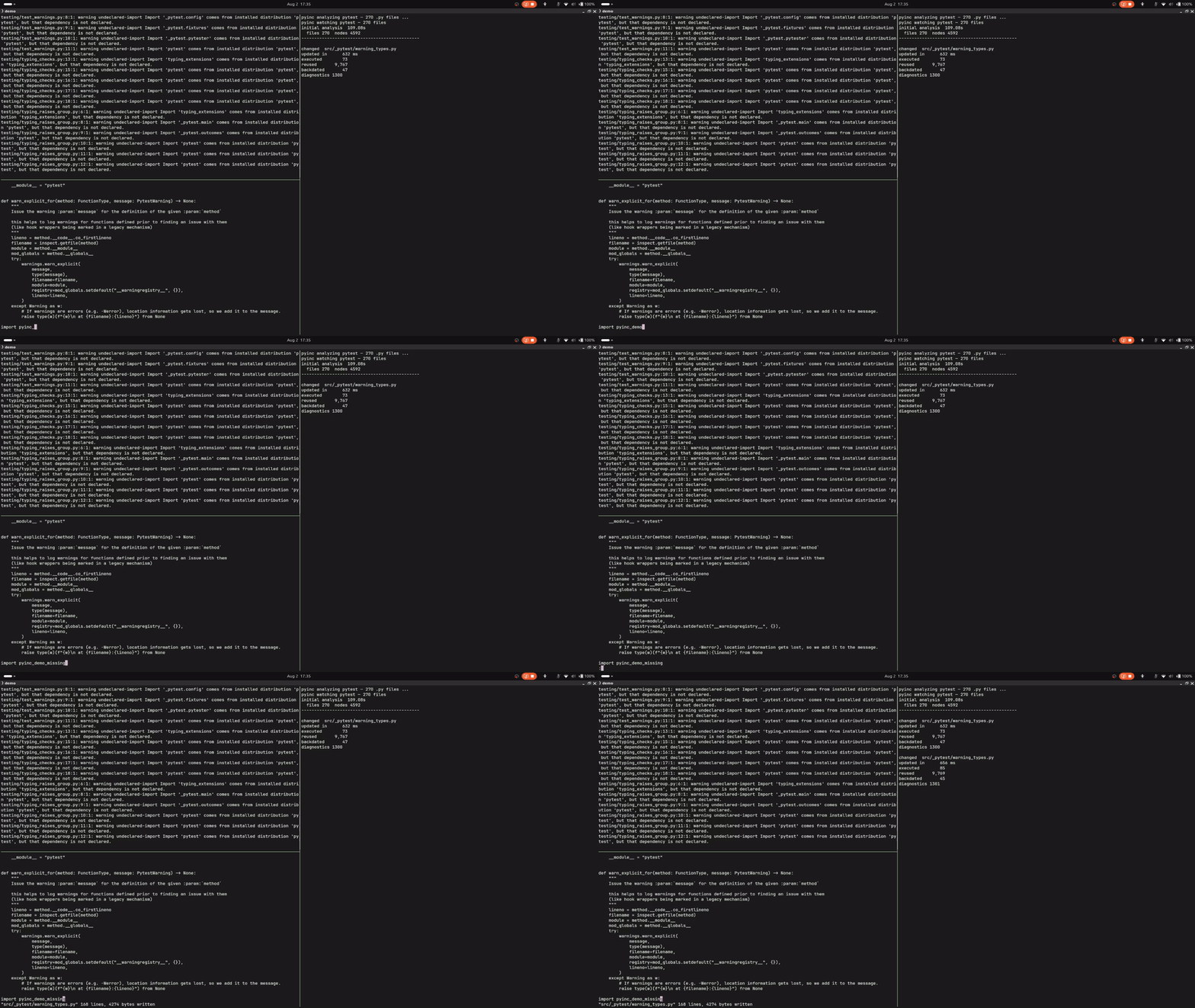
examples/correctness_demo.py walks through backdating, mutation protection,
untracked-read enforcement, and provenance inspection. The examples/ directory
also has focused scripts for push observers, the artifact store, the
mutable-graph boundary, cross-run checkpoints, the notebook integration, the
@action reconciliation layer (action_reconcile_demo.py), and the end-to-end
calc fixture (calc_demo.py, examples/calc/).
What's in the box
| Area | What it gives you | Learn more |
|---|---|---|
| Kernel | The @query runtime: dependency capture, red-green verification, backdating, three execution modes, bounded memoization, provenance/inspection. |
kernel-contract.md |
| Actions | Turn query-derived desired artifacts into files on disk without side effects in queries — atomic writes, tamper repair, orphan cleanup, dry-run. | action-contract.md |
| Integrations | Narrow, stdlib-only analyzers (Python source, configs, requirements, symbols, notebooks…) that compose at the query layer. | integration-contract.md |
| Tooling | pyinc-tools: a CLI analyzer and an LSP server, built only on the stable integration surface. |
pyinc-tools-guide.md |
| Codegen | pyinc_codegen: a JSON-Schema → typed-Python compiler, the reference file→file consumer. |
codegen-guide.md |
| Benchmarks | A reproducible timing + correctness harness (bench/), not shipped in the wheel. |
below |
New here? Start with docs/architecture.md for the map, then docs/kernel-contract.md for the guarantee.
What pyinc guarantees
pyinc guarantees from-scratch consistency: incremental evaluation produces
the same result as a fresh evaluation on the same declared inputs and resources.
The guarantee holds when, and only when, three conditions hold:
- Value boundary ownership — every value crossing a cached boundary is
snapshot-safe (an immutable scalar, a tuple, a
freeze-convertible container, a dataclass, or a registeredValueAdapter). Mutable graphs with shared identity or cycles round-trip throughFrozenGraph/FrozenRef. - Tracked ambient reads — every read of external state inside a query goes
through a
Resource(or is explicitly declared viadb.report_untracked_read(reason)). The runtime interceptsbuiltins.open,io.open,os.getenv,os.environ,os.listdir,os.scandir, andPath.iterdirduring query execution and raisesUntrackedReadErroron escapes. - Deterministic queries — the same tracked dependencies produce a semantically equal value. Mutable closure or global captures are rejected at decoration time, so memo reuse can't silently depend on hidden mutation.
The full contract — soundness envelope, the three modes, out-of-scope cases, and documented escape hatches — is in docs/kernel-contract.md.
Kernel surface
The stable top-level API, grouped by what you reach for:
- Define work —
@queryfor derived values;Inputfor base leaves; optionaleq=/cutoff=policies for custom equivalence and backdating;ValueAdapterfor custom snapshot-safe boundary types. - Track external state —
FileResource,FileStatResource,EnvResource,DirectoryResource. - Run — pull-based recomputation with
strict/checked/fastmodes; bounded memoization viaDatabase(max_query_nodes=...)(LRU at request boundaries; inputs and resources stay resident); atomic batch invalidation viaDatabase.set_many(...). - Inspect —
Database.dependency_graph()for a machine-readable export;Database.inspect(...)/Database.explain(...)for per-node provenance (observational and human-readable);Database.statistics()/Database.query_profile()for counters and per-query timing. - Observe —
Database.observe(callback, query, *args, **kwargs)for push observers.QueryChangeEvents fire after the outermost request completes (so callbacks may safely re-enter) and only onexecuteddecisions —reusedandbackdateddon't fire because the stored value didn't move. - Mutable graphs —
FrozenGraph/FrozenRefcarry shared or cyclic object graphs across the boundary;freezememoizes containers by id andthawreconstructs identity faithfully (a list-containing-itself round-trips). Pure trees pay no overhead. - Persist — content-addressed artifact storage via the
ArtifactStoreProtocol (InMemoryArtifactStore,FileSystemArtifactStore).Database(store=...)writes every boundary snapshot keyed by itsfingerprint_snapshotdigest;serialize_snapshot/deserialize_snapshotexpose the byte form. - Reconcile — the
@actionlayer: queries deriveOutput(path, content)(snapshot-safe, sotuple[Output, ...]is a valid query return); a separate@actionreconciles them with the filesystem. Side effects never enter a query. See action-contract.md.
Database is thread-safe across instances and on a single shared instance; the
ambient-read guard is installed once globally and dispatches per-context, so
threads inside queries on different databases don't interfere.
Integrations
pyinc.integrations ships narrow, stdlib-only analyzers that compose at the
query layer — the kernel tracks cross-integration calls as ordinary dependency
edges, so no extra wiring is needed. Each entry is a one-line summary; the full
public surface per integration is in
docs/integration-contract.md.
| Integration | Analyzes |
|---|---|
python_source |
Workspace module discovery, top-level imports/definitions, export tracking, and import resolution (workspace / stdlib / installed / missing / ambiguous). |
installed_packages |
Installed packages via .dist-info, stdlib modules via sys.stdlib_module_names, and import-name resolution. |
deep_module_resolution |
sys.path walking, .pth processing, PEP 420 namespace packages, and dotted-name → file resolution. |
symbol_resolution |
Module- and class-level symbol tables, re-export following with cycle detection, annotation-text extraction, and a reverse-reference index. |
dependency_check |
Composes installed_packages + python_source to flag undeclared imports and missing / mismatched packages. |
toml_config / json_config / xml_config |
Single-file inspection: sections, keys, traversal, and parse diagnostics. |
requirements_txt |
Requirement specs, file references, index directives, editable/URL installs, and recursive -r following with cycle detection. |
requirement_evaluation |
PEP 440 specifier satisfaction and PEP 508 marker evaluation for the current environment. |
env_file |
.env parsing: quoted/unquoted values, export prefixes, and interpolation references. |
csv_data |
CSV/TSV structure: header/column discovery, delimiter sniffing, row counts, and inconsistency diagnostics. |
notebook |
Jupyter .ipynb analysis with cutoff-based backdating that ignores outputs / execution_count. |
pyinc.integrations re-exports only the stable dataclass/result types and
high-level entrypoints; low-level payload queries and decode helpers stay
experimental in their defining submodules.
Consumer tooling
LSP wiring and filesystem watchers are deliberately out of scope for the
kernel. They live in pyinc_tools, a separate consumer layer built only on the
stable pyinc.integrations surface:
pyinc-tools analyze <root>— one-shot or threaded--watchworkspace analysis via a polling watcher.pyinc-tools lsp— a stdio LSP server with document/workspace symbols, diagnostics (push and LSP 3.17 pull channels), hover, goto-definition, and find-references, all backed bysymbol_resolution. It starts a threaded filesystem watcher so external edits (git pull, formatters) publish fresh diagnostics even without editordidChangeWatchedFilesevents.
See docs/pyinc-tools-guide.md for install, editor wiring, the overlay model, and the supported-vs.-not-yet feature table.
Code generation
pyinc_codegen is a reference consumer that compiles a JSON Schema into typed
Python models — one model and one doc file per definition plus an aggregate
__init__.py — emitted through the @action layer so only artifacts whose
content changed are rewritten. It is stdlib-only and builds on pyinc's public API
only.
from pyinc import Database
from pyinc_codegen import generate
generate(Database(mode="strict"), "schema.json", "generated/")
Whitespace edits rewrite nothing; a description-only edit rewrites only the doc file; a property change rewrites the affected model (and its reference-graph dependents, each only if its output changed); adding or removing a definition touches only that definition's files plus the index. See docs/codegen-guide.md.
Diagnostics and escape hatches
Database.inspect(...)is observational — it returns the last recorded provenance tree without a fresh pass.Database.inspect_fresh(...)verifies first, then returns the tree. Seeexamples/inspect_fresh_demo.py.- Query identity includes the function-definition payload and immutable captures;
mutable closure/global captures are rejected. Preview the classification with
pyinc.explain_query_captures(fn)before the firstdb.get(...). Seeexamples/capture_diagnostics.py. Database.report_untracked_read(reason)is the explicit impurity escape hatch: it marks the current query as always-re-executing and disables its backdating — the right trade-off when a dependency is real but not resource-trackable. Seeexamples/untracked_escape_hatch.py.- The package ships inline typing metadata via
py.typed.
Benchmarks
bench/ is a reproducible benchmark + correctness harness (not shipped in the
wheel). It exercises four targets — synthetic kernel query graphs, the
calc-with-includes fixture, JSON-Schema code generation, and action
reconciliation — across a canonical edit sequence (cold, unchanged, unreferenced
edit, comment-only edit, localized edit, high-fan-out shared edit, removed
artifact, tampered output, checkpoint restore), comparing pyinc against full
recomputation, a naive per-key cache, and joblib.Memory.
No performance claim ships without its harness: every scenario pairs its
timing with a correctness assertion that pyinc's incremental output equals a
fresh, cache-free run. The report (CSV + markdown) lands in bench/results/;
the naive cache is included precisely to show that a shortcut can be fast but
stale where pyinc stays correct.
pip install -e '.[bench]' # joblib is a bench-only optional dependency
PYTHONPATH=src python -m bench.run
Development
git clone https://github.com/Brumbelow/pyinc.git && cd pyinc
python3 -m venv .venv
. .venv/bin/activate
python3 -m pip install -e '.[dev]'
pytest -q
python3 -m mypy src tests
python3 -m ruff check src tests
Key references: the kernel contract (soundness envelope), the integration contract (stable API boundaries), and the integration authoring guide (how to write a new one).
Project details
Release history Release notifications | RSS feed
Download files
Download the file for your platform. If you're not sure which to choose, learn more about installing packages.
Source Distribution
Built Distribution
Filter files by name, interpreter, ABI, and platform.
If you're not sure about the file name format, learn more about wheel file names.
Copy a direct link to the current filters
File details
Details for the file pyinc-2.6.0.tar.gz.
File metadata
- Download URL: pyinc-2.6.0.tar.gz
- Upload date:
- Size: 375.5 kB
- Tags: Source
- Uploaded using Trusted Publishing? Yes
- Uploaded via: twine/6.1.0 CPython/3.13.12
File hashes
| Algorithm | Hash digest | |
|---|---|---|
| SHA256 |
5d1ea1a520ebc404f474f262c08608e7951e1a9d594fac8bbbe4bedc3e3d2083
|
|
| MD5 |
7532918840fac940dd067383e5e02ab5
|
|
| BLAKE2b-256 |
20762cb8eb5ae7782248ef1a241beb1b4f05651e7167aa31534929d8568eb54b
|
Provenance
The following attestation bundles were made for pyinc-2.6.0.tar.gz:
Publisher:
release.yml on Brumbelow/pyinc
-
Statement:
-
Statement type:
https://in-toto.io/Statement/v1 -
Predicate type:
https://docs.pypi.org/attestations/publish/v1 -
Subject name:
pyinc-2.6.0.tar.gz -
Subject digest:
5d1ea1a520ebc404f474f262c08608e7951e1a9d594fac8bbbe4bedc3e3d2083 - Sigstore transparency entry: 2083241068
- Sigstore integration time:
-
Permalink:
Brumbelow/pyinc@7756872a98930daf9c5824d014fab0a449238a90 -
Branch / Tag:
refs/tags/v2.6.0 - Owner: https://github.com/Brumbelow
-
Access:
public
-
Token Issuer:
https://token.actions.githubusercontent.com -
Runner Environment:
github-hosted -
Publication workflow:
release.yml@7756872a98930daf9c5824d014fab0a449238a90 -
Trigger Event:
push
-
Statement type:
File details
Details for the file pyinc-2.6.0-py3-none-any.whl.
File metadata
- Download URL: pyinc-2.6.0-py3-none-any.whl
- Upload date:
- Size: 173.3 kB
- Tags: Python 3
- Uploaded using Trusted Publishing? Yes
- Uploaded via: twine/6.1.0 CPython/3.13.12
File hashes
| Algorithm | Hash digest | |
|---|---|---|
| SHA256 |
e219d29bf82e954e08874803c6724313eda2c92bd06d998cc957cd9d4f06b5ac
|
|
| MD5 |
842ea40c8aed10ec6c1cac3ae750aa7f
|
|
| BLAKE2b-256 |
cd686b1342bebc89ec6cf479b0e34de720196dfea32745e02021ce23d5f251e9
|
Provenance
The following attestation bundles were made for pyinc-2.6.0-py3-none-any.whl:
Publisher:
release.yml on Brumbelow/pyinc
-
Statement:
-
Statement type:
https://in-toto.io/Statement/v1 -
Predicate type:
https://docs.pypi.org/attestations/publish/v1 -
Subject name:
pyinc-2.6.0-py3-none-any.whl -
Subject digest:
e219d29bf82e954e08874803c6724313eda2c92bd06d998cc957cd9d4f06b5ac - Sigstore transparency entry: 2083241107
- Sigstore integration time:
-
Permalink:
Brumbelow/pyinc@7756872a98930daf9c5824d014fab0a449238a90 -
Branch / Tag:
refs/tags/v2.6.0 - Owner: https://github.com/Brumbelow
-
Access:
public
-
Token Issuer:
https://token.actions.githubusercontent.com -
Runner Environment:
github-hosted -
Publication workflow:
release.yml@7756872a98930daf9c5824d014fab0a449238a90 -
Trigger Event:
push
-
Statement type: