
pyliferisk
Pyliferisk is a python library for life actuarial calculations, simple, powerful and easy-to-use.Date: 2026-11-11
Version: 1.13.0
Author: Francisco Garate - fgaratesantiago (at) gmail (dot) com
Documentation
Documentation: documentation_1.13.pdf
Disclaimer: qx is expressed per unit since version 1.13
Breaking change. Up to version 1.12, mt.qx[x], qx() and px() were expressed per mille (the true probability was qx/1000). Since version 1.13 they are expressed per unit (between 0 and 1), so mt.qx[x] is the true probability.
This library is mainly used for academic purposes, and the aim of this change is to align it with the reference bibliography, where qx and px are probabilities between 0 and 1.
Code written for previous versions must be reviewed: any division by 1000 (for instance mt.qx[x] / 1000) must be removed, otherwise the results will be wrong without any error message. The mortality tables included in pyliferisk.mortalitytables are still stored per mille and they are converted automatically when the table is loaded. See the documentation for the complete list of changes.
Introduction
Pyliferisk is an open library written in Python for life and actuarial calculation contracts, based on commonly used methodologies among actuaries (International Actuarial Notation).
This library is able to cover all life contingencies risks (since the actuarial formulas follow the International Actuarial Notation), as well as to support the main insurance products.
This library has no dependencies other than the Python Standard Library, making it amazingly fast. It requires Python 3.8 or higher.
Additionally, the package includes several life mortality tables (pyliferisk.mortalitytables), mainly extracted from academic textbooks. Tables are added in list format. ie: SCOT_DLT_00_02_M = [0, 6.205, 0.328, 0.26 ....]
First item indicates the age when table starts; the following items are the qx expressed per mille (they are converted to per unit when the table is loaded).
Quick Start
The names of the formulas follow the International Actuarial Notation and are easily guessable (qx, lx, px, w, dx, ex, Ax, Axn..), with a few exceptions regarding special characters.
The reserved variables (in addition of python language) are the following:
For the mortality assumptions in MortalityTable():
nt= The actuarial table used to perform life contingencies calculations. Syntax: nt=GKM95perc= Optional variable to indicate the percentage of mortality to be applied. Syntax: perc=85 Variableperccan be omitted, in this case it will be 100 by default.
For discounted (commutation) calculations use Actuarial(), which additionally requires:
i= interest rate. The effective rate of interest, namely, the total interest earned in a year. Syntax: i=0.02
All the actuarial formulas must include a minimum of 2 variables: mt (mortality table) and x (age)
If necessary, additional variables should be included with the following order:
n (horizon in years), m (m-monthly payments), t (n-years deferred period).
Variable m can be omitted, in this case it will be 1 (annual payment) by default.
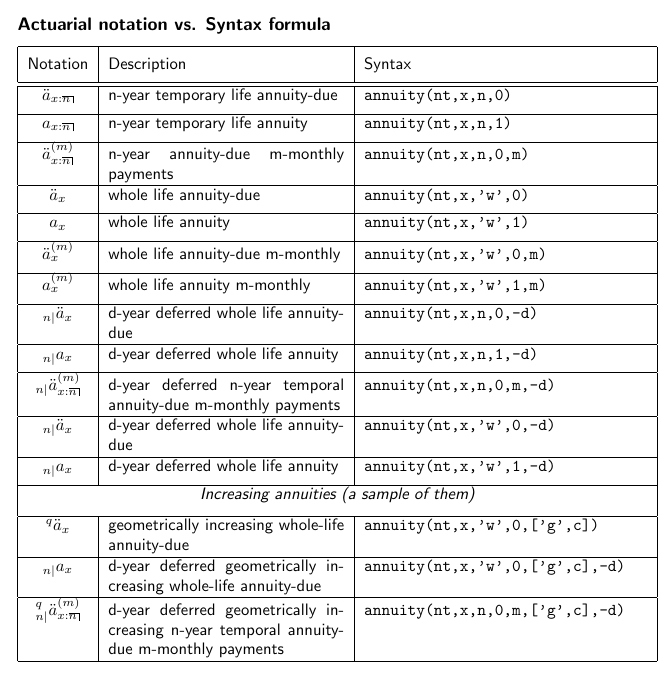
Additionally, there are two smart formulas: annuity() and A(), where the number of variables are not fixed:
annuity(mt, x, n, p, m=1, deferred=0, increase=None)
- mt = the mortality table
- x = the age as integer number.
- n = An integer number (term of insurance in years) or 'w' = whole-life.
- p = Moment of payment. Syntax: 0 = beginning of each period (annuity-due), 1 = end of each period (annuity-immediate), Optional variables:
- m = Payable 'm' per year (fractional payments). Default = 1 (annually)
- deferred = The deferring period in years. Default = 0
- increase = The increase rate: ['g',q] (geometrical) or ['a',q] (arithmetical). For example, increase=['g',0.03]
The legacy positional syntax annuity(mt, x, n, p, m, ['a/g', q], -d) (deferring period as a negative number) is still accepted but deprecated.
Example 1: Print the omega (limiting age) of the both mortality tables and the qx at 50 years-old:
from pyliferisk import MortalityTable
from pyliferisk.mortalitytables import INE2004, GKM95

tariff = MortalityTable(nt=INE2004)
experience = MortalityTable(nt=GKM95, perc=85)

# Print the omega (limiting age) of the both tables:
print(tariff.w)
print(experience.w)

# Print the qx at 50 years old:
print(tariff.qx[50])
print(experience.qx[50])
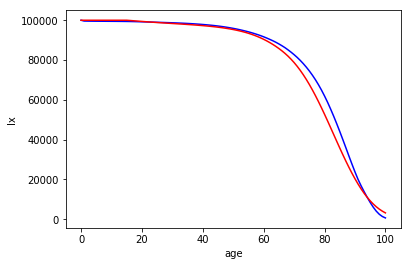
Example 2: Plotting a surviving graph:
import matplotlib.pyplot as plt
from pyliferisk import *
from pyliferisk.mortalitytables import INE2004, GKM95

tariff = MortalityTable(nt=INE2004)
experience = MortalityTable(nt=GKM95, perc=75)
x = range(0, tariff.w)
y = tariff.lx[:tariff.w]
z = experience.lx[:tariff.w]
plt.plot(x,y, color = 'blue')
plt.plot(x,z, color = 'red')
plt.ylabel('lx')
plt.xlabel('age')
Example 3:: A Life Temporal insurance for a male, 30 years-old and a horizon for 10 years, fixed annual premium (GKM80, interest 6%):
from pyliferisk import *
from pyliferisk.mortalitytables import GKM80

nt = Actuarial(nt=GKM80, i=0.06)
x = 30
n = 10
C = 1000

print(C * (Axn(nt, x, n) / annuity(nt, x, n, 0)))
Installation
Once Python is running, just install this library with pip install pyliferisk
Alternatively, install it from source: pip install . in the repository root.
Requirements
Python >= 3.8. Pyliferisk has no dependencies other than the Python Standard Library. That decreases the calculation runtime versus implementations under other libraries (such as Pandas).
License
This program is free software: you can redistribute it and/or modify it under the terms of the GNU General Public License as published by the Free Software Foundation, either version 3 of the License, or any later version.
This program is distributed in the hope that it will be useful, but WITHOUT ANY WARRANTY; without even the implied warranty of MERCHANTABILITY or FITNESS FOR A PARTICULAR PURPOSE. See the GNU General Public License for more details. The author does not take any legal responsibility for the accuracy, completeness, or usefulness of the information herein.
Contributions
Contributions, feedback and suggestions for improvements are greatly appreciated.
Discussions take place on our mailing list.
http://groups.google.com/group/openactuarial (subject: pyliferisk)
1 maintainer

Metadata
1 maintainer
Release files for pyliferisk 1.13.0
For a detailed explanation of source distributions (sdists) and built distributions (wheels), please see the package formats documentation.
Source distribution (sdist)
| File | Size | Uploaded | Provenance | Actions |
|---|---|---|---|---|
| pyliferisk-1.13.0.tar.gz | 49.8 kB | Without provenance | Details for pyliferisk-1.13.0.tar.gz |
Built distribution (wheel)
| File | Interpreter | ABI | Platform | Actions Reset |
|---|---|---|---|---|
| pyliferisk-1.13.0-py3-none-any.whl | Python 3 | none | any | Details for pyliferisk-1.13.0-py3-none-any.whl |
Total release size: 92.4 kB
Release files / pyliferisk-1.13.0.tar.gz
| Download URL | pyliferisk-1.13.0.tar.gz |
|---|---|
| Size | 49.8 kB |
| Tags | Source |
|
SHA-256 checksum How to use checksums |
7981e9b93779add924640d5ff2ba659765e2efcdc7b24a89f21eb90679b9d21e
|
|
BLAKE2b-256 checksum How to use checksums |
cfe58393b229b37aa78ff422b80669ba323d4a8cb3f508322f611c5ba39988ff
|
| Upload date | |
|
Uploaded using Trusted Publishing? What is trusted publishing? |
No |
| Uploaded via |
twine/7.0.0 CPython/3.12.13
|
Release files / pyliferisk-1.13.0-py3-none-any.whl
| Download URL | pyliferisk-1.13.0-py3-none-any.whl |
|---|---|
| Size | 42.5 kB |
| Tags | Python 3 |
|
SHA-256 checksum How to use checksums |
d49930aed0fa15032c2d7fb1e232948ca2d381317f9a3703ec6182099f517dea
|
|
BLAKE2b-256 checksum How to use checksums |
9df03ef432a168f614e8c17aafbf6537cdcefd904468ee67361918a7911803f6
|
| Upload date | |
|
Uploaded using Trusted Publishing? What is trusted publishing? |
No |
| Uploaded via |
twine/7.0.0 CPython/3.12.13
|
Security for pyliferisk 1.13.0
Provenance
Provenance describes where a file came from. On PyPI, provenance is shared via attestations, which provide a verifiable record of the build or publishing details. View details, limitations and caveats.
No provenance found
None of the files in this release were uploaded with provenance metadata.
A note on package security
PyPI is a repository for distributing packages, not a service for auditing them. While third-party security researchers and our staff do their best to detect and remove malicious packages, PyPI cannot guarantee the quality, security or suitability of any given package.
To learn more about protecting yourself from malicious actors, visit our package security documentation.














