
NLTP (necklink v1.2.0)
Loss-resilient, two-way UDP file and telemetry transport for wireless, marine radio, 4G/5G CGNAT, and satellite links — in Python, JavaScript / TypeScript, Java, zero-heap ANSI C99, and Arduino / ESP32.









30-Second Quick Start · JavaScript / TypeScript · Java 11+ / Android · Arduino / ESP32 · 4G/5G CGNAT Relay · Benchmarks · NLTP vs. ESP-NOW
Why NLTP?
Standard TCP and QUIC stall on bursty wireless fades, while raw microcontroller protocols like ESP-NOW cannot cross routers/SIM cards or reassemble multi-kilobyte files when chunks drop. NLTP v1.2 bridges embedded hardware, mobile/web gateways, and cloud/shore software with a single encrypted, FEC-protected UDP wire format:
- Survives
20%Packet Loss & Bursty Fades: SystematicGF(2^8)Cauchy forward error correction (8-shard generations + incremental Gauss-Jordan decoding) reconstructs lost packets without waiting for round-trip retransmission timeouts. - 1-RTT Bottleneck Pacing: Adaptive BBR-style delivery-rate and packet-train probing learns link capacity in a single round trip without overflowing router queues.
- One Wire Format Across 5 Platforms (
ESP32/ C99 ↔ Python ↔ JavaScript/TS ↔ Java): Zero-malloc ANSI C99 (~65 KBRAM onESP32) talks two-way (tx+rxon one UDP port) directly to Python, Node.js/Browser, and Java/Android endpoints, verified byChaCha20-Poly1305(256-bit AEAD),RFC 6479replay protection, and end-to-endSHA-256receipts (210/210cross-language pairings verified). - Built-In NAT & Carrier CGNAT Traversal:
RFC 5389STUN discovery, low-TTL (TTL=2) direct UDP hole-punching, keepalives, and automatic 3-second fallback to a zero-knowledge 1-port UDP relay (NLTPRelayHub).
flowchart LR
    A["ESP32 / C99 Node (Zero-Heap, ~65 KB RAM)"] <-->|"Wi-Fi / Marine Radio / Satellite"| B["Direct UDP + Cauchy FEC + ChaCha20-Poly1305"]
    B <--> C["Python · Node.js / TS · Java / Android Shore & Cloud"]
    A <-->|"4G/5G SIM Behind CGNAT"| D["STUN P2P Punch or 1-Port NLTPRelayHub (Zero Keys)"]
    D <--> C
⚡ 30-Second Quick Start
1. Python (pynltp — import nltp / import pynltp + nltp CLI)
Install on Windows, Linux, or macOS via pip:
pip install pynltp
# Or directly from GitHub:
pip install git+https://github.com/indian-aman/necklink.git
Send an out-of-line urgent command (send_reflex) and a SHA-256-verified encrypted file in 10 lines:
from nltp import NLTPServer, NLTPClient, generate_nltp_key

key = generate_nltp_key()  # 256-bit ChaCha20-Poly1305 key

with NLTPServer(("0.0.0.0", 9000), save_dir="./inbox", psk=key) as srv:
    with NLTPClient(("127.0.0.1", 9000), psk=key, max_tx_kbps=10_000) as cli:
        cli.send_reflex("ESTOP_CHECK")                 # Bypasses file queue (0 HOL blocking)
        receipt = cli.send_file("mission_log.bin")     # Cauchy FEC + SHA-256 verified
        assert receipt["verified_sha256"] is True
Or run directly from the terminal:
nltp gen-key
nltp stun
nltp serve --host 0.0.0.0 --port 9000 --psk "<KEY>" --save-dir ./inbox
nltp send-file --host <SERVER_IP> --port 9000 --psk "<KEY>" --file firmware.bin
2. JavaScript & TypeScript (Node.js / Browser / WebRTC)
Zero external dependencies (ESM + CommonJS + .d.ts TypeScript types + nltp/core for WebRTC / WebTransport):
npm install https://github.com/indian-aman/necklink/releases/download/v1.2.0/nltp-js-1.2.0.tgz
import { NLTPServer, NLTPClient, generateNltpKey } from 'nltp';

const key = generateNltpKey();
const srv = await NLTPServer.listen({ host: '0.0.0.0', port: 9000, psk: key, saveDir: './inbox' });
const cli = await NLTPClient.connect({ host: '127.0.0.1', port: 9000, psk: key, maxTxKbps: 10_000 });

await cli.sendReflex('ESTOP_CHECK');
const receipt = await cli.sendFile('mission_log.bin');
console.log('Verified SHA-256:', receipt.verifiedSha256);

await cli.close();
await srv.close();
3. Java 11+ & Android (io.necklink:nltp)
Zero external dependencies — includes portable constant-time RFC 8439 ChaCha20-Poly1305 and non-blocking NIO DatagramChannel (--release 11). Download nltp-java-1.2.0.jar or build via Maven/Gradle (java/):
import io.necklink.nltp.*;
import java.nio.charset.StandardCharsets;
import java.nio.file.Paths;

String key = NLTPWire.generateNltpKey();
try (NLTPServer srv = NLTPServer.builder().bind("0.0.0.0", 9000).psk(key).saveDir(Paths.get("./inbox")).build();
     NLTPClient cli = NLTPClient.builder().server("127.0.0.1", 9000).psk(key).maxTxKbps(10_000.0).build()) {
    cli.sendReflex("ESTOP_CHECK".getBytes(StandardCharsets.UTF_8));
    TransferReceipt receipt = cli.sendFile(Paths.get("mission_log.bin"), 60_000L);
    assert receipt.verifiedSha256();
}
4. Arduino IDE & PlatformIO (ESP32)
- Arduino IDE (1-Click
.ZIP): DownloadNLTP-Arduino-1.2.0.zip→ Sketch → Include Library → Add .ZIP Library... → open File → Examples → NLTP (ESP32_Encrypted_Receiver,ESP32_Marine_Buoy_Sender, orESP32_Relay_CGNAT_Node). - PlatformIO (
platformio.ini):lib_deps = https://github.com/indian-aman/necklink/releases/download/v1.2.0/NLTP-Arduino-1.2.0.zip
Minimal two-way encrypted ESP32 sketch (#include <NLTP.h>):
#include <WiFi.h>
#include <NLTP.h>

NLTPWiFiNode nltp;
uint8_t telemetryBatch[2048];

void setup() {
  WiFi.begin("YOUR_WIFI", "YOUR_PASS");
  while (WiFi.status() != WL_CONNECTED) delay(250);

  nltp.begin(9700, "shared-256bit-key-or-passphrase");
  nltp.setPeer(IPAddress(192, 168, 1, 100), 9700);     // Python laptop / shore server
}

void loop() {
  nltp.poll();                                         // Drives both TX pacing & RX FEC decoding

  if (nltp.hasReceivedFile() && nltp.isReceivedShaOk()) {
    // Handle command/config received from Python server (nltp.receivedData(), nltp.receivedLength())
    nltp.clearReceived();
    nltp.sendBytes(telemetryBatch, sizeof(telemetryBatch), "buoy_batch.bin");
  }
}
5. Traverse 4G/5G Carrier CGNAT in 3 Commands
When both sender and receiver sit behind carrier NAT/firewalls with no public IP or port forwarding, run nltp relay on any tiny 1-port VPS (holds zero keys, sees only ChaCha20-Poly1305 ciphertext):
# 1. Public 1-port relay VM:
nltp relay --host 0.0.0.0 --port 9000

# 2. Shore receiver behind Office NAT:
nltp serve --relay <RELAY_IP>:9000 --room buoy-01 --psk "<KEY>" --save-dir ./inbox

# 3. Field / buoy sender behind 4G SIM CGNAT (Python or ESP32 beginRelay()):
nltp send-file --relay <RELAY_IP>:9000 --room buoy-01 --psk "<KEY>" --file sensor_batch.bin
6. Portable Zero-Heap ANSI C99 Core (csrc/)
Compiles cleanly under -std=c99 -Wall -Wextra -pedantic -Werror with zero malloc and zero floating-point operations:
make -C csrc all test
python scripts/c_interop_test.py
Direct STUN hole-punching with automatic 3-second relay fallback from the C CLI:
./csrc/build/nltp_cli recv 0.0.0.0 0 ./out.bin \
  --psk "<KEY>" --stun stun.cloudflare.com:3478 --punch --relay <RELAY_IP>:9000 --room buoy-01

./csrc/build/nltp_cli send 0.0.0.0 0 ./firmware.bin \
  --psk "<KEY>" --stun stun.cloudflare.com:3478 --punch --relay <RELAY_IP>:9000 --room buoy-01
📊 Post-Upgrade Benchmarks & Hardware Verification
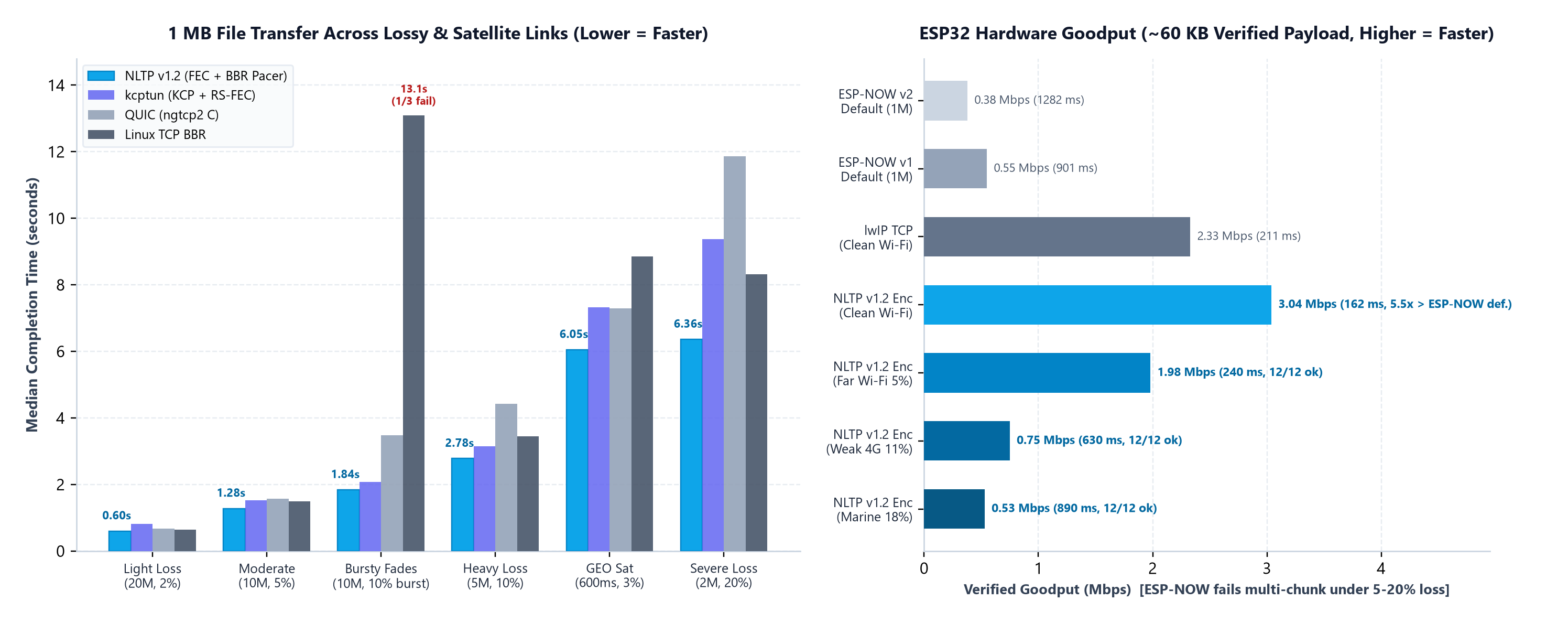
All results below reflect the final v1.2.0 codebase measured on Linux 6.18 network namespaces (tc netem + tbf, symmetric loss/rate limits in both directions, iptables wire-byte accounting including dropped packets) and real ESP32-D0WDQ6 hardware.
1. 1 MB File / Firmware Transfer vs. 8 Competing Protocols
Median completion time across 3 runs (wire bytes ÷ file size in parentheses):
| Emulated Link (Symmetric) | NLTP v1.2 |
TCP BBR |
QUIC (ngtcp2) |
KCP (w128) |
kcptun (FEC) |
UDT4 |
SRT |
|---|---|---|---|---|---|---|---|
Clean (20 Mbit, 20 ms, 0%) |
0.58 s (1.23x) |
0.51 s (1.04x) |
0.57 s (1.05x) |
0.60 s (1.54x) |
0.74 s (2.25x) |
0.95 s (1.15x) |
0.87 s (1.15x) |
Light Loss (20 Mbit, 40 ms, 2%) |
0.60 s (1.20x) |
0.65 s (1.07x) |
0.67 s (1.07x) |
0.85 s (1.25x) |
0.81 s (1.62x) |
3.02 s (1.07x) |
1.37 s (1.05x) |
Moderate Loss (10 Mbit, 100 ms, 5%) |
1.28 s (1.30x) |
1.49 s (1.12x) |
1.57 s (1.07x) |
1.74 s (1.45x) |
1.52 s (1.75x) |
9.98 s (1.19x) |
6.49 s (1.24x) |
Heavy Loss (5 Mbit, 200 ms, 10%) |
2.78 s (1.41x) |
3.45 s (1.15x) |
4.42 s (1.16x) |
4.08 s (1.61x) |
3.15 s (1.72x) |
26.47 s (1.37x) |
14.73 s (1/3) |
Severe Loss (2 Mbit, 300 ms, 20%) |
6.36 s (1.54x) |
8.31 s (1.32x) |
11.87 s (1.26x) |
8.98 s (2.11x) |
9.38 s (2.25x) |
FAIL (0/3) |
FAIL (0/3) |
Bursty Fades (10 Mbit, 100 ms, 10% burst) |
1.84 s (1.49x) |
13.10 s (2/3) |
3.48 s (CUBIC) |
2.16 s (1.63x) |
2.07 s (1.71x) |
9.55 s (1.34x) |
4.11 s (2/3) |
(Note: TCP CUBIC degraded from 1.80 s at 2% loss to 42.50 s at 10% loss and FAIL 0/3 at 20% loss; KCP w1024 overflowed router queues on 1 MB, taking 6.22–70.48 s and 3.1–6.2x wire bytes.)
2. Satellite, 10 MB Bursty Fades, Jitter, Reordering & 64 KB Transfers
| Scenario | Payload | NLTP v1.2 |
TCP BBR |
QUIC (ngtcp2) |
KCP (fast) |
kcptun (FEC) |
|---|---|---|---|---|---|---|
GEO Satellite (2 Mbit, 600 ms, 3%) |
64 KB |
0.91 s (enc) / 1.02 s |
2.77 s |
2.67 s |
1.12 s (3.25x) |
1.57 s (3.10x) |
GEO Satellite (2 Mbit, 600 ms, 3%) |
1 MB |
6.05 s (1.23x) |
8.85 s |
7.29 s |
8.56 s (1.68x) |
7.32 s (1.67x) |
Large Bursty Fades (10 Mbit, 100 ms, 10% burst) |
10 MB |
13.79 s (3/3 ok) |
10.86 s (1/3 ok) |
11.25 s (1/3 ok) |
— | 21.00 s (3/3 ok) |
Large Steady Loss (10 Mbit, 100 ms, 5%) |
10 MB |
11.28 s (1.28x) |
9.81 s (1.10x) |
9.85 s (1.11x) |
— | 14.41 s (1.78x) |
Large Clean Link (20 Mbit, 20 ms, 0%) |
10 MB |
5.64 s (1.24x) |
4.45 s (1.04x) |
4.78 s (1.05x) |
— | 7.13 s (2.31x) |
Packet Reordering (10 Mbit, 60 ms, 2%, 10% reorder) |
1 MB |
1.19 s (1.20x) |
1.12 s (1.08x) |
1.22 s (1.05x) |
1.42 s (1.32x) |
1.62 s (1.91x) |
Heavy Jitter (10 Mbit, 100 ± 20 ms, 5%) |
1 MB |
3.28 s (3/3 ok) |
2.60 s |
1.52 s |
2.36 s |
1.39 s |
Short Transfers (0–20% loss) |
64 KB |
0.08–1.42 s (0.17 s warm @ 5%) |
0.09–3.27 s |
0.17–2.73 s |
0.05–0.77 s |
0.06–1.37 s |
3. NLTP v1.2 vs. ESP-NOW on ESP32 Hardware
Measured side-by-side on ESP32-D0WDQ6 (2.4 GHz Ch 11, -47 dBm, ESP-NOW v2.0, 5 runs/cell; results/esp32_espnow_vs_nltp.json). NLTP v1.2 and TCP cross 2 Wi-Fi hops (ESP32 ↔ Router ↔ PC) with end-to-end SHA-256 receipt verification; ESP-NOW is 1-hop RF air-time with IEEE 802.11 hardware ACK frames (100% ACKed, without receiver-side reassembly overhead):
A. Speeds by Payload Size (Clean -47 dBm RF)
Protocol / Mode on ESP32 |
250 B |
1.47 KB |
4 KB |
16 KB |
60 KB |
|---|---|---|---|---|---|
| ESP-NOW v1 Default (1 Mbps PHY) | 0.60 Mbps (73 KB/s, 3.4 ms) |
0.53 Mbps (65 KB/s, 22.2 ms) |
0.53 Mbps (64 KB/s, 62.3 ms) |
0.47 Mbps (57 KB/s, 279 ms) |
0.55 Mbps (67 KB/s, 901 ms) |
| ESP-NOW v2 Default (1 Mbps PHY) | 0.60 Mbps (74 KB/s, 3.3 ms) |
0.45 Mbps (55 KB/s, 26.3 ms) |
0.50 Mbps (61 KB/s, 65.4 ms) |
0.44 Mbps (54 KB/s, 299 ms) |
0.38 Mbps (47 KB/s, 1282 ms) |
NLTP v1.2 Plain (ESP32 → PC) |
0.20 Mbps (24 KB/s, 10.3 ms) |
0.66 Mbps (80 KB/s, 17.9 ms) |
0.92 Mbps (112 KB/s, 35.7 ms) |
1.44 Mbps (176 KB/s, 91.0 ms) |
2.53 Mbps (309 KB/s, 194 ms) |
NLTP v1.2 Encrypted (ESP32 → PC) |
0.24 Mbps (29 KB/s, 8.4 ms) |
0.78 Mbps (95 KB/s, 15.1 ms) |
1.86 Mbps (226 KB/s, 17.7 ms) |
2.67 Mbps (326 KB/s, 49.0 ms) |
2.57 Mbps (314 KB/s, 191 ms) |
NLTP v1.2 Encrypted (PC → ESP32) |
0.14 Mbps (17 KB/s, 14.8 ms) |
0.80 Mbps (98 KB/s, 14.7 ms) |
1.78 Mbps (217 KB/s, 18.5 ms) |
2.16 Mbps (263 KB/s, 60.8 ms) |
3.04 Mbps (371 KB/s, 162 ms) |
TCP (PC → ESP32 lwIP) |
0.07 Mbps (9 KB/s, 27.9 ms) |
0.38 Mbps (47 KB/s, 30.6 ms) |
0.71 Mbps (86 KB/s, 46.4 ms) |
1.60 Mbps (195 KB/s, 82.1 ms) |
2.33 Mbps (284 KB/s, 211 ms) |
ESP-NOW v1 Tuned MCS7 (1-hop) |
3.25 Mbps (394 KB/s, 0.6 ms) |
5.22 Mbps (637 KB/s, 2.3 ms) |
5.40 Mbps (659 KB/s, 6.1 ms) |
5.41 Mbps (660 KB/s, 24.3 ms) |
5.79 Mbps (707 KB/s, 84.9 ms) |
ESP-NOW v2 Tuned MCS7 (1-hop) |
2.01 Mbps (246 KB/s, 1.0 ms) |
11.24 Mbps (1.37 MB/s, 1.1 ms) |
19.26 Mbps (2.35 MB/s, 1.7 ms) |
23.52 Mbps (2.87 MB/s, 5.6 ms) |
25.82 Mbps (3.15 MB/s, 19.0 ms) |
B. Speeds by Link Condition (58–60 KB Verified File Transfer on ESP32, 48/48 Encrypted)
| Link Condition | NLTP v1.2 (Encrypted) |
ESP-NOW Default (1 Mbps) | ESP-NOW Tuned MCS7 (72 Mbps) |
TCP (lwIP) |
|---|---|---|---|---|
Clean Desk Wi-Fi (0% loss) |
2.57–3.04 Mbps (0.16–0.19 s) |
0.38–0.55 Mbps (0.90–1.28 s) |
5.79–25.82 Mbps (0.02–0.08 s) |
2.33 Mbps (0.21 s) |
Far Wi-Fi (5 Mbit, 5% loss) |
1.90–1.98 Mbps (0.24–0.25 s, 12/12 ok) |
FAIL (missing chunks, no FEC) |
FAIL (weak -72 dBm range + no FEC) |
Degrades sharply |
Weak 4G (2 Mbit, 9–13% loss) |
0.56–0.75 Mbps (0.63–0.85 s, 12/12 ok) |
Cannot cross 4G / routers | Cannot cross 4G / routers | Stalls on fades |
Marine Radio (1 Mbit, 6–18% loss) |
0.31–0.53 Mbps (0.89–1.53 s, 12/12 ok) |
Cannot cross IP radio | Cannot cross IP radio | Stalls on fades |
Severe Loss (1 Mbit, 20.8% loss) |
0.17–0.28 Mbps (1.68–2.80 s, 12/12 ok) |
FAIL (0% intact file delivery) |
FAIL (0% intact file delivery) |
Times out |
C. ESP-NOW vs. NLTP v1.2 Capability Matrix
| Feature | ESP-NOW (Espressif) | NLTP v1.2 (necklink) |
|---|---|---|
| Network Layer & Direction | Layer 2 raw 802.11 action frames; two-way | Layer 4/7 over UDP/IP (or byte callback); two-way (tx+rx on one port) |
| Internet / 4G / Satellite | No — local 2.4 GHz hop only (~100–400 m; cannot cross routers or SIMs) | Yes — works over Wi-Fi routers, 4G/5G CGNAT, satellite, and marine IP radios |
| Direct Laptop / Cloud Link | No — ESP-to-ESP only (needs an extra USB bridge ESP32 on PC) | Yes — ESP32 talks directly to any Python laptop or Linux cloud server |
| Payload Size & Loss Recovery | 250 B (v1) / 1,470 B (v2) per packet; no file chunking or FEC |
Multi-MB files & batches; GF(2^8) Cauchy FEC + SHA-256 survives 20% loss |
| Encryption & Peer Limit | AES-128 CCMP, capped at 6–17 encrypted peers (20 total MAC peers) |
ChaCha20-Poly1305 (256-bit) + RFC 6479 replay window; no peer-table cap |
| Deep-Sleep Coin-Cell Use | Wins (~1–3 ms wake-and-tx, no Wi-Fi router handshake) |
Higher power — requires an active Wi-Fi / cellular IP session (~65 KB RAM) |
4. Cross-Language (Python ↔ C99 ↔ JavaScript ↔ Java) & Dual-NAT / CGNAT Verification
210/2104-Language Wire & Encryption Interoperability (scripts/multilang_interop_test.py/results/multilang_interop_test.json):192/192Full 4×4 Directional Matrix: Everysender → receiverpair across Python, ANSI C99, JavaScript (Node.js ESM/CJS), and Java (JDK 11+ NIO) across plaintext, 256-bit Base64 keys, and passphrases at0%and15%packet loss (1 KBshortk=1generation and64 KBmulti-generation FEC).8/8256 KBLossy Cross-Language Stress: Heterogeneous encrypted multi-window streams (py↔js,js↔java,java↔c,c↔py) at15%packet loss.6/6Cross-Language Zero-KnowledgeNLTPRelayHub: Python, JavaScript, and Java relay hubs forwarding encrypted64 KBstreams across heterogeneous language pairs at10%loss.4/4Cross-Language Urgentsend_reflex: Out-of-line encryptedESTOPdelivery acrossPython ↔ JSandPython ↔ Java.
9/9C99 +9/9JS +7/7Java Security & FEC Self-Tests: Verified cross-SDK key derivation parity, bit-flipped packet rejection +GF(2^8)erasure recovery,RFC 6479replay rejection, wrong-key rejection, and plaintext-downgrade rejection.18/18Dual-NAT & Symmetric-CGNAT Suite (scripts/virtual_nat_test.py):1 MBencrypted transfers across two separate Linux NAT routers (40 msRTT +5%loss on each last mile):- Direct STUN + low-TTL UDP hole-punching (
C↔CandC↔Python):9/9direct P2P (1.22–2.26 s). - Zero-knowledge
NLTPRelayHub:3/3(1.31–2.19 s). - Symmetric CGNAT (
MASQUERADE --random-fully): automatic 3-second fallback toNLTPRelayHubcompleted in1.80 s. 4 sUDP NAT expiry across an8 sidle gap:1 skeepalives preserved the mapping (1.59 ssecond file).
- Direct STUN + low-TTL UDP hole-punching (
🎯 When to Use NLTP — and When Not To
🗂️ Repository Layout
| Path | Contents |
|---|---|
necklink/ & nltp/ |
Python package & import nltp alias (NLTPServer, NLTPClient, NLTPRelayHub, STUN/hole-punch, ChaCha20-Poly1305 AEAD, nltp CLI) |
js/ |
Zero-dependency JavaScript / TypeScript SDK (ESM + CommonJS + .d.ts + Browser/WebRTC NLTPEndpoint + Node UDP NLTPServer/NLTPClient/NLTPRelayHub + nltp-js CLI) |
java/ |
Zero-dependency Pure Java 11+ / Android SDK (io.necklink:nltp, Maven pom.xml + Gradle, portable ChaCha20-Poly1305, NIO UDP + NLTPCli executable JAR) |
arduino/NLTP/ |
Drop-in Arduino IDE (.zip) & PlatformIO library (#include <NLTP.h>) with 3 ready-to-flash ESP32 .ino sketches |
examples/ |
Runnable Python (examples/python/), JavaScript (examples/javascript/), and Java (examples/java/) examples |
csrc/ |
Portable zero-heap, zero-float ANSI C99 core (nltp_core.{h,c}, nltp_net.{h,c}, nltp_sha256.{h,c}, nltp_wire.h), POSIX CLI, and 9/9 security self-test |
esp32/ |
PlatformIO ESP32 hardware firmware (Arduino-ESP32), verified bidirectional over encrypted Wi-Fi and emulated radio profiles |
scripts/ |
Live field-trial kit (field_test.py), 210/210 4-language interop (multilang_interop_test.py), 72/72 C↔Python interop, 18/18 dual-NAT suite, and netem harnesses |
tests/ |
pytest unit and integration suite (20 tests) |
docs/ |
Installation & PyPI publishing guide (INSTALL_AND_PYPI.md) and GitHub Actions CI workflow (github-ci.yml) |
🚤 Run Your Own Live Radio / Marine Field Trial
Benchmark NLTP side-by-side against kernel TCP between any two reachable hosts over a real vessel, buoy, radio, or cellular link:
# Shore / receiver host:
python scripts/field_test.py server --port 9700 --psk "<KEY>"

# Vessel / field host:
python scripts/field_test.py client --host <SHORE_IP> --port 9700 --psk "<KEY>" --sizes 64k,256k,1m --runs 5
License
Released under the MIT License.
1 maintainer

Metadata
1 maintainer
Release files for pynltp 1.2.0
For a detailed explanation of source distributions (sdists) and built distributions (wheels), please see the package formats documentation.
Source distribution (sdist)
| File | Size | Uploaded | Provenance | Actions |
|---|---|---|---|---|
| pynltp-1.2.0.tar.gz | 89.0 kB | Without provenance | Details for pynltp-1.2.0.tar.gz |
Built distribution (wheel)
| File | Interpreter | ABI | Platform | Actions Reset |
|---|---|---|---|---|
| pynltp-1.2.0-py3-none-any.whl | Python 3 | none | any | Details for pynltp-1.2.0-py3-none-any.whl |
Total release size: 173.0 kB
Release files / pynltp-1.2.0.tar.gz
| Download URL | pynltp-1.2.0.tar.gz |
|---|---|
| Size | 89.0 kB |
| Tags | Source |
|
SHA-256 checksum How to use checksums |
7c931a5530700fb6d93bafcb0c1eda7e50f35dd7c325a76e87776ff6a442575b
|
|
BLAKE2b-256 checksum How to use checksums |
ec2dbffc45c0886857aaa34777d81f1ada1db64a66ccecd4c3d3e054309e1c2a
|
| Upload date | |
|
Uploaded using Trusted Publishing? What is trusted publishing? |
No |
| Uploaded via |
twine/7.0.0 CPython/3.12.10
|
Release files / pynltp-1.2.0-py3-none-any.whl
| Download URL | pynltp-1.2.0-py3-none-any.whl |
|---|---|
| Size | 84.0 kB |
| Tags | Python 3 |
|
SHA-256 checksum How to use checksums |
0c3241cc803defe657586484bfae8917f53fa2d34f1b3e0371377259addaf9c9
|
|
BLAKE2b-256 checksum How to use checksums |
ff6f3b0ff62010560e3ad8b703ff740b36fe7203e45f29b99be5494dc10e22e0
|
| Upload date | |
|
Uploaded using Trusted Publishing? What is trusted publishing? |
No |
| Uploaded via |
twine/7.0.0 CPython/3.12.10
|
Security for pynltp 1.2.0
Provenance
Provenance describes where a file came from. On PyPI, provenance is shared via attestations, which provide a verifiable record of the build or publishing details. View details, limitations and caveats.
No provenance found
None of the files in this release were uploaded with provenance metadata.
A note on package security
PyPI is a repository for distributing packages, not a service for auditing them. While third-party security researchers and our staff do their best to detect and remove malicious packages, PyPI cannot guarantee the quality, security or suitability of any given package.
To learn more about protecting yourself from malicious actors, visit our package security documentation.














