


PyNNDescent
PyNNDescent is a Python nearest neighbor descent for approximate nearest neighbors. It provides a python implementation of Nearest Neighbor Descent for k-neighbor-graph construction and approximate nearest neighbor search, as per the paper:
Dong, Wei, Charikar Moses, and Kai Li. “Efficient k-nearest neighbor graph construction for generic similarity measures.” Proceedings of the 20th international conference on World wide web. ACM, 2011.
This library supplements that approach with the use of random projection trees for initialisation. This can be particularly useful for the metrics that are amenable to such approaches (euclidean, minkowski, angular, cosine, etc.). Graph diversification is also performed, pruning the longest edges of any triangles in the graph.
Currently this library targets relatively high accuracy (80%-100% accuracy rate) approximate nearest neighbor searches.
Why use PyNNDescent?
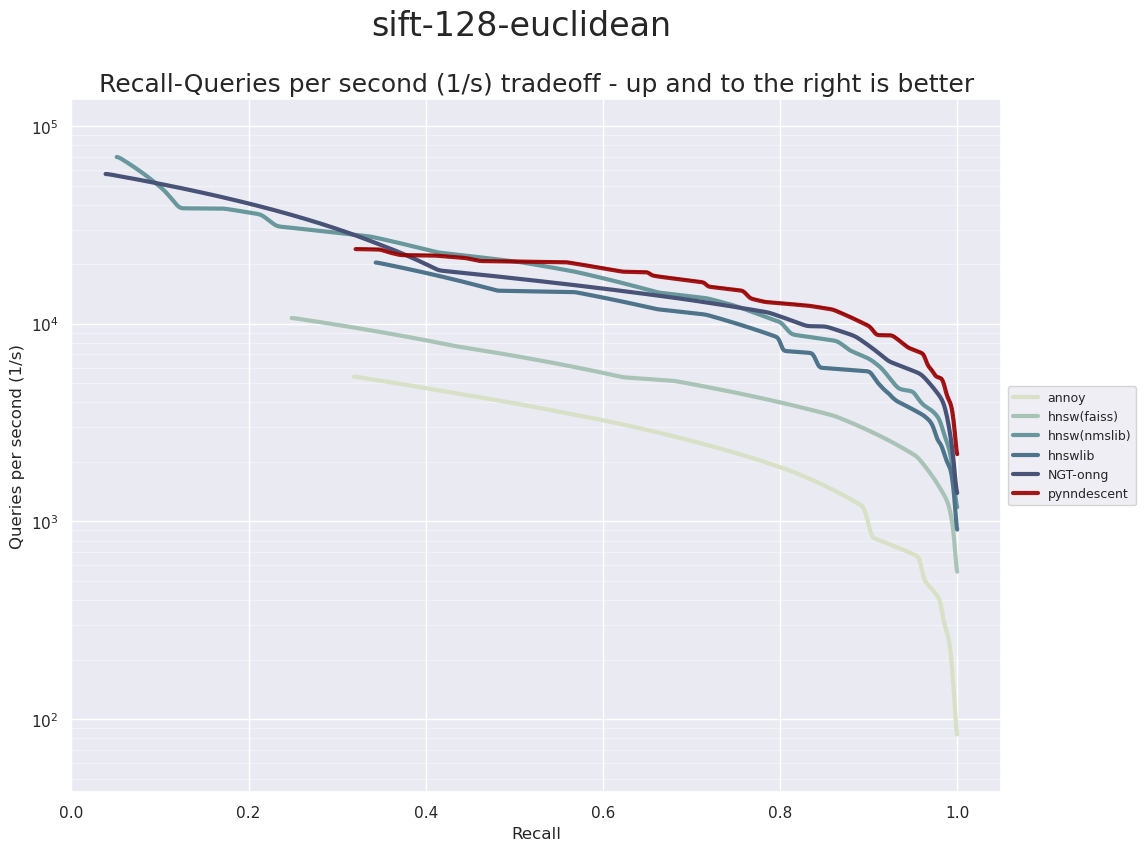
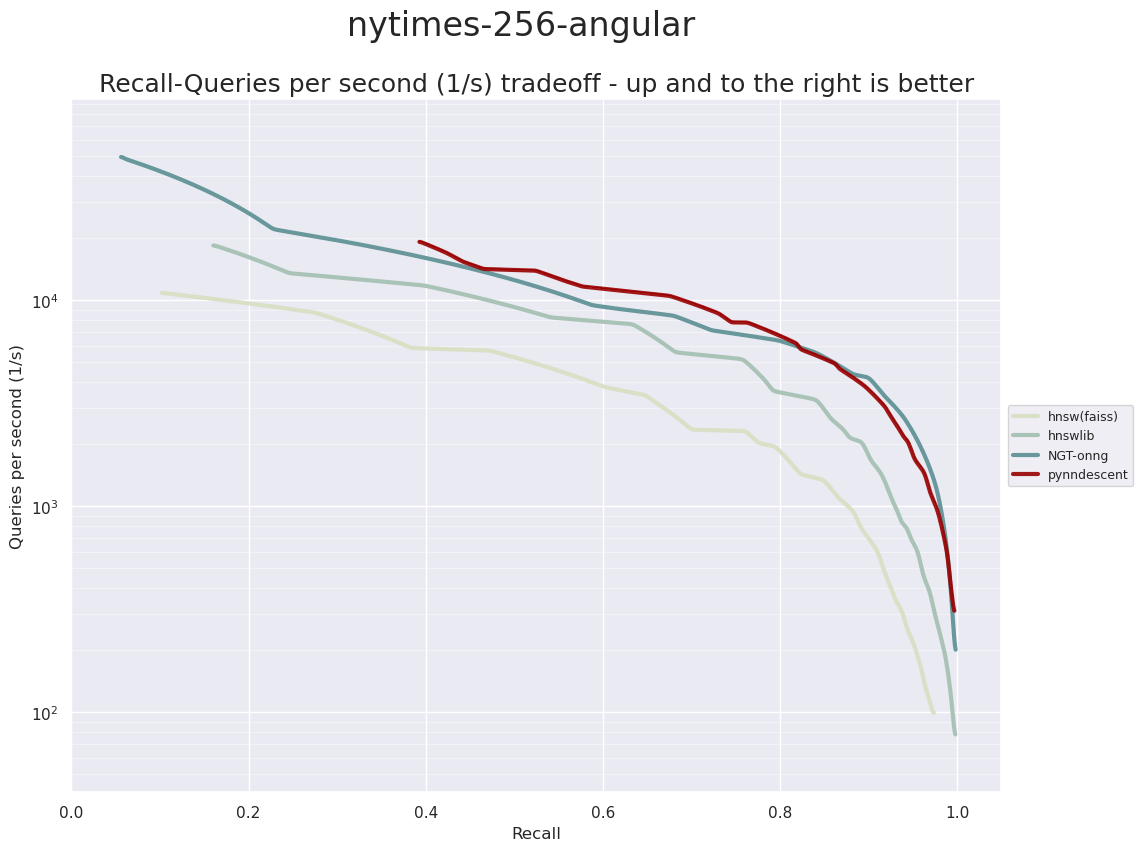
PyNNDescent provides fast approximate nearest neighbor queries. The ann-benchmarks system puts it solidly in the mix of top performing ANN libraries:
SIFT-128 Euclidean
NYTimes-256 Angular
While PyNNDescent is among fastest ANN library, it is also both easy to install (pip and conda installable) with no platform or compilation issues, and is very flexible, supporting a wide variety of distance metrics by default:
Minkowski style metrics
euclidean
manhattan
chebyshev
minkowski
Miscellaneous spatial metrics
canberra
braycurtis
haversine
Normalized spatial metrics
mahalanobis
wminkowski
seuclidean
Angular and correlation metrics
cosine
dot
correlation
spearmanr
tsss
true_angular
Probability metrics
hellinger
wasserstein
Metrics for binary data
hamming
jaccard
dice
russelrao
kulsinski
rogerstanimoto
sokalmichener
sokalsneath
yule
and also custom user defined distance metrics while still retaining performance.
PyNNDescent also integrates well with Scikit-learn, including providing support for the KNeighborTransformer as a drop in replacement for algorithms that make use of nearest neighbor computations.
How to use PyNNDescent
PyNNDescent aims to have a very simple interface. It is similar to (but more limited than) KDTrees and BallTrees in sklearn. In practice there are only two operations – index construction, and querying an index for nearest neighbors.
To build a new search index on some training data data you can do something like
from pynndescent import NNDescent
index = NNDescent(data)
You can then use the index for searching (and can pickle it to disk if you wish). To search a pynndescent index for the 15 nearest neighbors of a test data set query_data you can do something like
index.query(query_data, k=15)and that is pretty much all there is to it. You can find more details in the documentation.
Installing
PyNNDescent is designed to be easy to install being a pure python module with relatively light requirements:
numpy
scipy >= 1.0
scikit-learn >= 0.18
numba >= 0.55
joblib >= 0.11
all of which should be pip or conda installable. The easiest way to install should be via conda:
conda install -c conda-forge pynndescentor via pip:
pip install pynndescentTo manually install this package:
wget https://github.com/lmcinnes/pynndescent/archive/master.zip
unzip master.zip
rm master.zip
cd pynndescent-master
pip install .
Help and Support
This project is still young. The documentation is still growing. In the meantime please open an issue and I will try to provide any help and guidance that I can. Please also check the docstrings on the code, which provide some descriptions of the parameters.
License
The pynndescent package is 2-clause BSD licensed. Enjoy.
Contributing
Contributions are more than welcome! There are lots of opportunities for potential projects, so please get in touch if you would like to help out. Everything from code to notebooks to examples and documentation are all equally valuable so please don’t feel you can’t contribute. To contribute please fork the project make your changes and submit a pull request. We will do our best to work through any issues with you and get your code merged into the main branch.
2 maintainers


Metadata
2 maintainers
Release files for pynndescent 0.7.0
For a detailed explanation of source distributions (sdists) and built distributions (wheels), please see the package formats documentation.
Source distribution (sdist)
| File | Size | Uploaded | Provenance | Actions |
|---|---|---|---|---|
| pynndescent-0.7.0.tar.gz | 3.0 MB | Without provenance | Details for pynndescent-0.7.0.tar.gz |
Built distribution (wheel)
| File | Interpreter | ABI | Platform | Actions Reset |
|---|---|---|---|---|
| pynndescent-0.7.0-py3-none-any.whl | Python 3 | none | any | Details for pynndescent-0.7.0-py3-none-any.whl |
Total release size: 3.2 MB
Release files / pynndescent-0.7.0.tar.gz
| Download URL | pynndescent-0.7.0.tar.gz |
|---|---|
| Size | 3.0 MB |
| Tags | Source |
|
SHA-256 checksum How to use checksums |
54f097a003bfdb917225e1bcf55c4027e283a37a2b5e3cae4b4aaf21197f6d1c
|
|
BLAKE2b-256 checksum How to use checksums |
fcc6e8772d376540049f9caeaffe7927b7f3088982e6c095397bb41d9d224a30
|
| Upload date | |
|
Uploaded using Trusted Publishing? What is trusted publishing? |
No |
| Uploaded via |
twine/7.0.0 CPython/3.10.22
|
Release files / pynndescent-0.7.0-py3-none-any.whl
| Download URL | pynndescent-0.7.0-py3-none-any.whl |
|---|---|
| Size | 112.6 kB |
| Tags | Python 3 |
|
SHA-256 checksum How to use checksums |
05592399f5fbf07d77590f532ed2a2e3b035ec066813eb5a097632b9ffb9e938
|
|
BLAKE2b-256 checksum How to use checksums |
e163fe905ec765fcb92a8a235e5a77ba591f620316c192a960dda1ce07d028eb
|
| Upload date | |
|
Uploaded using Trusted Publishing? What is trusted publishing? |
No |
| Uploaded via |
twine/7.0.0 CPython/3.10.22
|
Security for pynndescent 0.7.0
Provenance
Provenance describes where a file came from. On PyPI, provenance is shared via attestations, which provide a verifiable record of the build or publishing details. View details, limitations and caveats.
No provenance found
None of the files in this release were uploaded with provenance metadata.
A note on package security
PyPI is a repository for distributing packages, not a service for auditing them. While third-party security researchers and our staff do their best to detect and remove malicious packages, PyPI cannot guarantee the quality, security or suitability of any given package.
To learn more about protecting yourself from malicious actors, visit our package security documentation.














