



A Python package for GPU-accelerated 3D Phase Field Crystal simulations
Overview
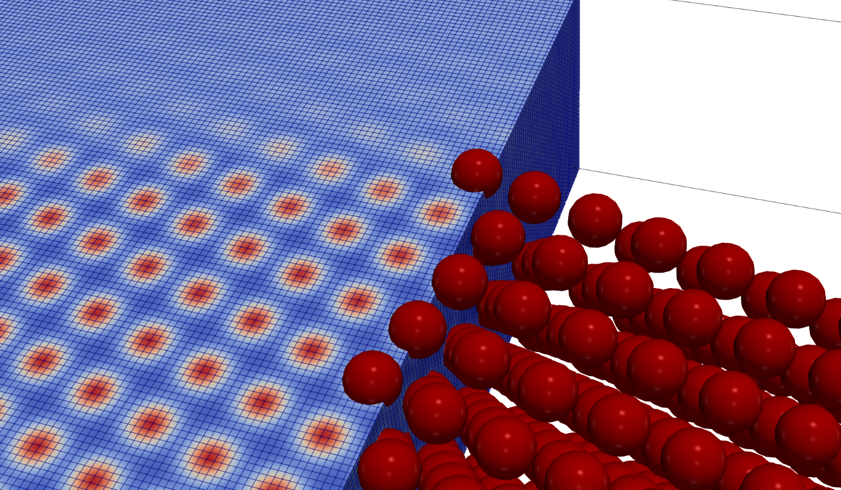
pyPFC is a high-performance simulation framework designed for modeling crystal structures and their evolution using the Phase Field Crystal (PFC) method. The code uses PyTorch to allow execution on both CPUs and GPUs, with particularly efficiency gained on GPU platforms. pyPFC is developed with a combined focus on computational efficiency, flexibility and accessibility, making it suitable for both research and educational purposes.
Installation instructions, examples and API documentation can be found in the pyPFC documentation.
Licencing
This software is released under a GNU GPLv3 license.
References
Further details on PFC modeling and example applications can be found in:
- H. Hallberg and K.H. Blixt, pyPFC: an open-source Python package for phase field crystal simulations, Modelling and Simulation in Materials Science and Engineering, 34(1):015004, 2026
- K.H. Blixt and H. Hallberg, Phase Field Crystal Modeling of Grain Boundary Migration: Mobility, Energy and Structural Variability, Acta Materialia, 297:121318, 2025
- H. Hallberg and K.H. Blixt, Assessing grain boundary variability through phase field crystal simulations, Physical Review Materials, 8(3):113605, 2024
- K.H. Blixt and H. Hallberg, Phase field crystal modeling of grain boundary structures in diamond cubic systems, Physical Review Materials, 8(3):033606, 2024
- H. Hallberg and K.H. Blixt, Multiplicity of grain boundary structures and related energy variations, Materials Today Communications, 38:107724, 2024
- H. Hallberg and K.H. Blixt, Evaluation of Nanoscale Deformation Fields from Phase Field Crystal Simulations, Metals, 12(10):1630, 2022
- K.H. Blixt and H. Hallberg, Grain boundary and particle interaction: Enveloping and pass-through mechanisms studied by 3D phase field crystal simulations, Materials & Design, 220:110845, 2022
- K.H. Blixt and H. Hallberg, Grain boundary stiffness based on phase field crystal simulations, Materials Letters, 318:132178, 2022
- K.H. Blixt and H. Hallberg, Evaluation of grain boundary energy, structure and stiffness from phase field crystal simulations, Modelling and Simulation in Materials Science and Engineering, 30(1):014002, 2022
1 maintainer

Metadata
1 maintainer
Release files for pypfc 0.0.4
For a detailed explanation of source distributions (sdists) and built distributions (wheels), please see the package formats documentation.
Source distribution (sdist)
| File | Size | Uploaded | |
|---|---|---|---|
| pypfc-0.0.4.tar.gz | 63.2 kB | Details |
Built distribution (wheel)
| File | Interpreter | ABI | Platform | Reset |
|---|---|---|---|---|
| pypfc-0.0.4-py3-none-any.whl | Python 3 | none | any | Details |
Total release size: 130.1 kB
Release files / pypfc-0.0.4.tar.gz
| Download URL | pypfc-0.0.4.tar.gz |
|---|---|
| Size | 63.2 kB |
| Tags | Source |
|
SHA-256 checksum How to use checksums |
a2684e85840e20eed6507f43f68ecc14a9f483f084cbc926583a45140b4f8127
|
|
BLAKE2b-256 checksum How to use checksums |
73d143b1a9a22bf41aec686d45da1e5948b113ceac1fcbbdf59dfd04a4202c07
|
| Upload date | |
|
Uploaded using Trusted Publishing? What is trusted publishing? |
Yes |
| Uploaded via |
twine/6.1.0 CPython/3.13.7
|
Provenance
Provenance describes where a file came from. On PyPI, provenance is shared via attestations, which provide a verifiable record of the build or publishing details. View details, limitations and caveats.


PyPI Publish Attestation
PyPI verified that this artifact, at this checksum, originated from the publisher listed below.
Signed by GitHub Actions, verified by PyPI on Dec 19, 2025.
Transparency logRelease files / pypfc-0.0.4-py3-none-any.whl
| Download URL | pypfc-0.0.4-py3-none-any.whl |
|---|---|
| Size | 66.9 kB |
| Tags | Python 3 |
|
SHA-256 checksum How to use checksums |
d80486d18df80df69fe15b70e4c054d89a0a96840c95d6b69370f9a3c20380be
|
|
BLAKE2b-256 checksum How to use checksums |
6e5433ac5b29336dfbefb35265f562de8e0f891f0cd2e04790ea1cdb1043acfe
|
| Upload date | |
|
Uploaded using Trusted Publishing? What is trusted publishing? |
Yes |
| Uploaded via |
twine/6.1.0 CPython/3.13.7
|
Provenance
Provenance describes where a file came from. On PyPI, provenance is shared via attestations, which provide a verifiable record of the build or publishing details. View details, limitations and caveats.
PyPI Publish Attestation
PyPI verified that this artifact, at this checksum, originated from the publisher listed below.
Signed by GitHub Actions, verified by PyPI on Dec 19, 2025.
Transparency log













