
pypi-tracker
pypi-tracker is a lightweight tool for collecting and preserving PyPI package download statistics. It maintains historical data beyond PyPIStats' retention window. It generates static, chart-ready JSON reports that can be used to visualize download trends, track package adoption, and power dashboards or other applications without a backend.
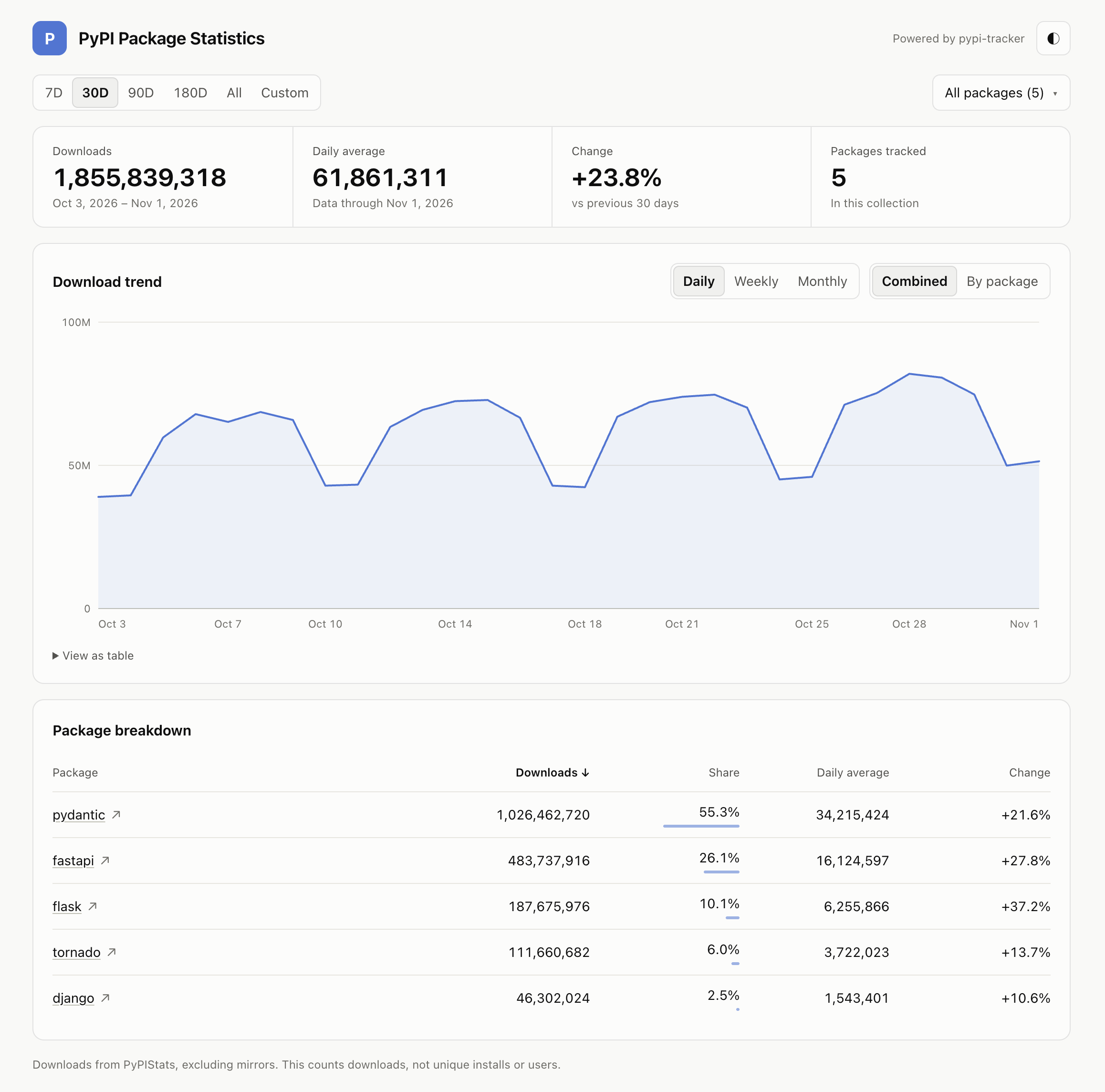
Try it
pip install pypi-tracker


pypi-tracker sync --package dj-control-room
You now have the full history in data/dj-control-room.csv and reports in
public/packages/dj-control-room/ (public/aggregate/ covers all your packages together), such as last-30-days.json:
{
  "package": "dj-control-room",
  "report": "last-30-days",
  "as_of": "2026-11-01",
  "downloads": 38071,
  "complete": true,
  "observations": [
    {"date": "2026-10-03", "downloads": 510},
    {"date": "2026-10-04", "downloads": 757}
  ]
}
The observations list has one entry per day in the window (shortened here). A day with no data is null,
never 0, and complete tells you whether any day is missing.
Commands
| Command | What it does |
|---|---|
init |
Creates a starter config file. |
sync |
Runs collect, then build. This is the one to schedule. |
collect |
Fetches new data from PyPIStats and merges it into the CSVs. |
build |
Writes the JSON report files to publish. |
dashboard |
Runs build, then writes a static website that charts the reports. |
serve |
Runs dashboard, then previews the site locally, reloading it when anything changes. |
validate |
Checks the CSVs for bad data and missing dates. |
Tracking several packages
You will typically want to keep a config file where you specify the packages you want to track.
pypi-tracker init # generates a pypi-tracker.toml file, which commands in this directory then use
A complete config file will have the sections seen below. Note that the pypi-tracker also
allows for cli args that can supersede these config values; though typically it is much
easier to simply rely on a config file.
# pypi-tracker.toml
packages = [
    "dj-control-room",
    "dj-control-room-base",
    "dj-redis-panel",
    "dj-cache-panel",
    "dj-celery-panel",
    "dj-urls-panel",
    "dj-signals-panel",
]

[reports]
rolling_days = [7, 30, 90, 180]
calendar = ["weekly", "monthly", "yearly"]
historical = ["daily"]
summary = true

[dashboard]
enabled = true
title = "PyPI Package Statistics"

[storage]
directory = "data/"

[output]
directory = "public/"
You can update both reports and historical data by running a single sync command.
pypi-tracker sync --config pypi-tracker.toml
Publish a dashboard
dashboard turns your history into a complete static website, ready for any static host. It needs no
backend and no configuration, though you can brand it:
pypi-tracker serve # generates the site, then previews it at http://localhost:8000/
[dashboard]
enabled = true  # sync updates the site too
title = "Django Control Room"
description = "Download statistics across the DCR ecosystem"
logo = "assets/logo.svg"
accent_color = "#6366f1"
Keep your CSVs
Run sync on a schedule and commit data/, because the CSV files are your history. If you lose them, or
stop collecting for longer than PyPIStats keeps data, those days are gone. History also can't reach back
further than PyPIStats did on your first run, so totals are "recorded" downloads, not lifetime downloads.
More
The guide covers configuration, every report format, the Python API, and GitHub Actions and Cloudflare Pages setup.
Available reports
build writes these JSON files for each package to public/packages/<package>/, and for all packages
combined to public/aggregate/. The [reports] config section chooses which are generated.
| File | Contents |
|---|---|
summary.json |
First and last recorded dates, total recorded downloads and any coverage gaps. |
last-7-days.json, last-30-days.json, last-90-days.json, last-180-days.json |
Rolling windows: a total plus one observation per day, ending at the latest recorded date. One file per entry in rolling_days. |
weekly.json |
Totals for every ISO week, Monday through Sunday. |
monthly.json |
Totals for every calendar month. |
yearly.json |
Totals for every calendar year. |
daily/<year>.json |
Every recorded day in that year, such as daily/2026.json. |
Aggregate rolling reports also include breakdown, each package's own numbers for that window. The
dashboard links to the files behind whatever it is showing.
1 maintainer

Metadata
1 maintainer
Release files for pypi-tracker 0.4.0
For a detailed explanation of source distributions (sdists) and built distributions (wheels), please see the package formats documentation.
Source distribution (sdist)
| File | Size | Uploaded | Provenance | Actions |
|---|---|---|---|---|
| pypi_tracker-0.4.0.tar.gz | 48.3 kB | With provenance | Details for pypi_tracker-0.4.0.tar.gz |
Built distribution (wheel)
| File | Interpreter | ABI | Platform | Actions Reset |
|---|---|---|---|---|
| pypi_tracker-0.4.0-py3-none-any.whl | Python 3 | none | any | Details for pypi_tracker-0.4.0-py3-none-any.whl |
Total release size: 86.3 kB
Release files / pypi_tracker-0.4.0.tar.gz
| Download URL | pypi_tracker-0.4.0.tar.gz |
|---|---|
| Size | 48.3 kB |
| Tags | Source |
|
SHA-256 checksum How to use checksums |
70180be517229b73528fcc3472a8c3d4b3dca04941292453d8259867c043ff9f
|
|
BLAKE2b-256 checksum How to use checksums |
79953436f8ac35f5da86f503b4ce8ce2fea8330426762e0692d84ddc36640e6a
|
| Upload date | |
|
Uploaded using Trusted Publishing? What is trusted publishing? |
Yes |
| Uploaded via |
twine/7.0.0 CPython/3.13.16
|
Provenance
Provenance describes where a file came from. On PyPI, provenance is shared via attestations, which provide a verifiable record of the build or publishing details. View details, limitations and caveats.


PyPI Publish Attestation
PyPI verified that this artifact, at this checksum, originated from the publisher listed below.
Signed by GitHub Actions, verified by PyPI on Nov 3, 2026.
Transparency logRelease files / pypi_tracker-0.4.0-py3-none-any.whl
| Download URL | pypi_tracker-0.4.0-py3-none-any.whl |
|---|---|
| Size | 38.0 kB |
| Tags | Python 3 |
|
SHA-256 checksum How to use checksums |
419721b7a12f216ef1f3cc8444179f930446d25324267ab230ff007d12d0139e
|
|
BLAKE2b-256 checksum How to use checksums |
3af633abafb9f2c6c7678fd4ffc3941ed1618c0a74cefd8f33aca3141042538a
|
| Upload date | |
|
Uploaded using Trusted Publishing? What is trusted publishing? |
Yes |
| Uploaded via |
twine/7.0.0 CPython/3.13.16
|
Provenance
Provenance describes where a file came from. On PyPI, provenance is shared via attestations, which provide a verifiable record of the build or publishing details. View details, limitations and caveats.
PyPI Publish Attestation
PyPI verified that this artifact, at this checksum, originated from the publisher listed below.
Signed by GitHub Actions, verified by PyPI on Nov 3, 2026.
Transparency logSecurity for pypi-tracker 0.4.0
Provenance
Provenance describes where a file came from. On PyPI, provenance is shared via attestations, which provide a verifiable record of the build or publishing details. View details, limitations and caveats.
Full provenance
All 2 files in this release have been uploaded with provenance metadata.
Attestation for pypi_tracker-0.4.0.tar.gz
PyPI Publish Attestation
PyPI verified that this artifact, at this checksum, originated from the publisher listed below.
Signed by GitHub Actions, verified by PyPI on Nov 3, 2026.
Transparency logA note on package security
PyPI is a repository for distributing packages, not a service for auditing them. While third-party security researchers and our staff do their best to detect and remove malicious packages, PyPI cannot guarantee the quality, security or suitability of any given package.
To learn more about protecting yourself from malicious actors, visit our package security documentation.














