
pyplAI-MCP
An MCP server that lets a language model play board games against search algorithms, and use those same algorithms as tools to choose its own moves.
Language models reason in words; they do not search. Ask one to play Ultimate tic-tac-toe and it
will explain its moves well and choose them badly. This server gives the model the search it lacks:
the Monte Carlo tree search, minimax and information set MCTS algorithms of
pyplAI, my open-source Python library on
PyPI. The model calls analyze_position, gets every legal move
ranked with its win rate, and explains the choice in plain language.
Here is a real call (numbers vary between runs). The board is an Ultimate tic-tac-toe position
where the opponent has just won the centre board and sent you to the top-centre board, B1:
{
  "algorithm": "mcts",
  "metric": "win_rate",
  "best_move": "B1:a3",
  "moves": [
    {"move": "B1:a3", "visits": 121, "value": 0.4711},
    {"move": "B1:c1", "visits": 70, "value": 0.4357},
    {"move": "B1:c3", "visits": 89, "value": 0.4326}
  ],
  "iterations": 777,
  "seconds": 2.001,
  "note": "Monte Carlo tree search (UCT). value is the share of simulated games won after each move, counting draws as half."
}
Games
| Game | Information | Opponents and analysis |
|---|---|---|
| Tic-tac-toe | Perfect | MCTS, minimax, random |
| Ultimate tic-tac-toe | Perfect | MCTS, minimax, random |
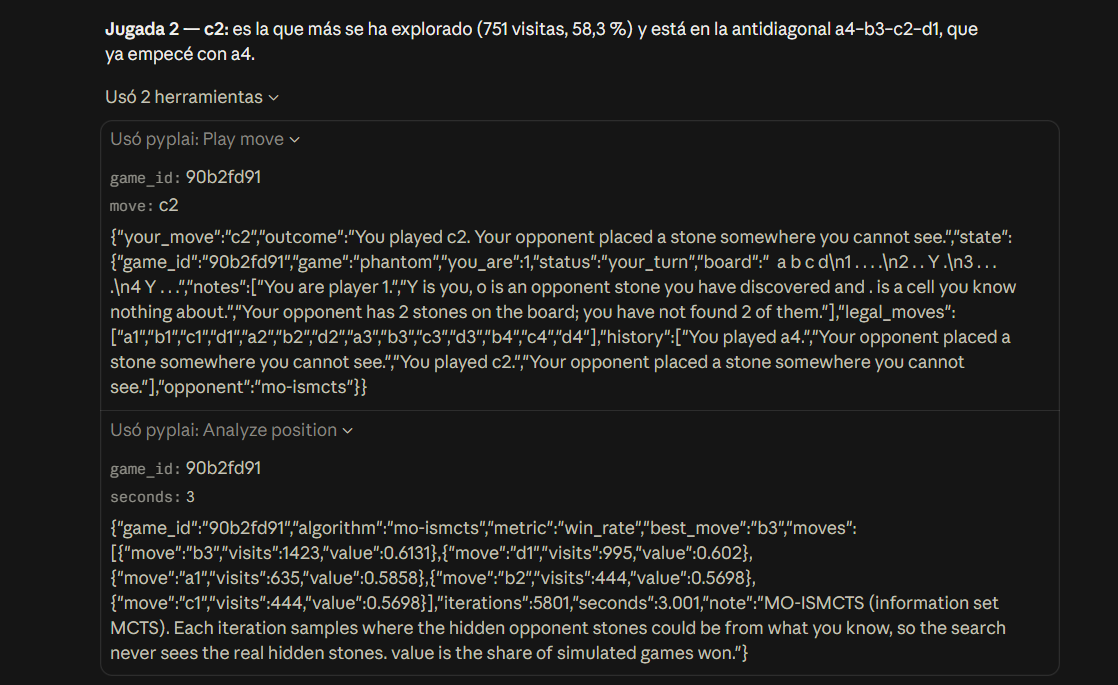
| Phantom (4,4,4) | Imperfect: you cannot see your opponent's stones | MO-ISMCTS, SO-ISMCTS, random |
Phantom is where the design matters. A perfect-information search would read the hidden stones from the game state and cheat, so the server does not offer one. The information set searches sample where the hidden stones could be from what the player knows, and a test plays whole games checking that nothing the player receives reveals a hidden stone.
Tools
| Tool | What it does |
|---|---|
list_games |
Games, move notation, opponents and analysis algorithms. |
get_rules |
The full rules of a game. |
new_game |
Starts a game. Options: who moves first, the opponent, its thinking time or depth, a seed and opening moves to set up a position. |
get_state |
The board as you see it, your legal moves and the history. |
play_move |
Plays your move; the opponent replies in the same call. Illegal moves return an error listing the legal ones. |
analyze_position |
Ranks your legal moves with MCTS, minimax or information set MCTS. |
end_game |
Frees a game. |
The rules are also the rules://{game} resource, but get_rules exists because a model often
cannot read resources on its own: in Claude Desktop it only calls tools. A play_game prompt asks
the model to analyse, explain and play a whole game, and every tool returns structured output with
a published schema.
Use it
Requires uv. The server speaks MCP over stdio, and uvx installs and
runs it from PyPI. It is also listed in the
MCP Registry as io.github.plss12/pyplai-mcp.
Claude Code
claude mcp add pyplai -- uvx pyplai-mcp
Claude Desktop (claude_desktop_config.json)
{
  "mcpServers": {
    "pyplai": {
      "command": "uvx",
      "args": ["pyplai-mcp"]
    }
  }
}
Any other client: run uvx pyplai-mcp over stdio, or add
--transport streamable-http --port 8000 and connect to http://127.0.0.1:8000/mcp.
Then ask for a game, for example: "Play Phantom against the MO-ISMCTS opponent, and analyse each position before you move."
Here is a real game that Claude played and won from Claude Desktop, analysing every position before moving:
Design notes
- The search never touches the real game. Every analysis runs on a copy of the state, and in Phantom on samples of it.
- Search runs off the event loop. Tools are synchronous functions, which the MCP SDK runs on worker threads, so a 10-second search does not block other requests. Games are locked per session.
- stdout belongs to the protocol. Over stdio any stray
printcorrupts the JSON-RPC stream. pyplAI 1.1 addedanaliza()for exactly this reason: it returns the search statistics as data instead of printing them. Logs go to stderr, and an end-to-end test runs the server as a subprocess over stdio. - Errors the model can fix are tool errors. An illegal move, a finished game or an unknown id comes back as a readable error, so the model can correct itself. Arguments are validated against their schema (for example, analysis time between 0.1 and 10 seconds).
- Bounded memory. At most 100 games are kept, and idle games expire after an hour.
Benchmark
Does a small model play better with these tools? benchmarks/ lets Llama 3.2 3B,
served locally with Ollama, play 960 games through the server, with and without
analyze_position. In tic-tac-toe the tool cut its losses against MCTS from 100% to 31%, and in the
34 games where it followed every recommendation it never lost. In Ultimate tic-tac-toe it gained
nothing (no wins, against 82% for the search alone), because it ignored the analysis most often
there. The search helps a small model about as much as the model trusts it.
Development
uv sync
uv run pytest
uv run ruff check . && uv run ruff format --check .
uv run pyright
Try the tools by hand with the MCP Inspector:
npx @modelcontextprotocol/inspector uv run pyplai-mcp
Roadmap
- More pyplAI games: draughts, Escoba and Stratego.
References
- C. B. Browne et al. A survey of Monte Carlo tree search methods. IEEE TCIAIG, 4(1), 2012.
- P. I. Cowling, E. J. Powley and D. Whitehouse. Information set Monte Carlo tree search. IEEE TCIAIG, 4(2), 2012.
- D. E. Knuth and R. W. Moore. An analysis of alpha-beta pruning. Artificial Intelligence, 6(4), 1975.
License
MIT. Built on pyplAI, by the same author.
1 maintainer

Metadata
1 maintainer
Release files for pyplai-mcp 0.1.0
For a detailed explanation of source distributions (sdists) and built distributions (wheels), please see the package formats documentation.
Source distribution (sdist)
| File | Size | Uploaded | Provenance | Actions |
|---|---|---|---|---|
| pyplai_mcp-0.1.0.tar.gz | 17.0 kB | With provenance | Details for pyplai_mcp-0.1.0.tar.gz |
Built distribution (wheel)
| File | Interpreter | ABI | Platform | Actions Reset |
|---|---|---|---|---|
| pyplai_mcp-0.1.0-py3-none-any.whl | Python 3 | none | any | Details for pyplai_mcp-0.1.0-py3-none-any.whl |
Total release size: 38.1 kB
Release files / pyplai_mcp-0.1.0.tar.gz
| Download URL | pyplai_mcp-0.1.0.tar.gz |
|---|---|
| Size | 17.0 kB |
| Tags | Source |
|
SHA-256 checksum How to use checksums |
6458071a06674d4f8f82ffd53c4866abe87a047186827ba070a8fe0d2670e6e8
|
|
BLAKE2b-256 checksum How to use checksums |
13b616902f13cdc7cecf59b35757e1576d9de5453592243a468f0d018fdb57f1
|
| Upload date | |
|
Uploaded using Trusted Publishing? What is trusted publishing? |
Yes |
| Uploaded via |
twine/7.0.0 CPython/3.13.16
|
Provenance
Provenance describes where a file came from. On PyPI, provenance is shared via attestations, which provide a verifiable record of the build or publishing details. View details, limitations and caveats.


PyPI Publish Attestation
PyPI verified that this artifact, at this checksum, originated from the publisher listed below.
Signed by GitHub Actions, verified by PyPI on Nov 25, 2026.
Transparency logRelease files / pyplai_mcp-0.1.0-py3-none-any.whl
| Download URL | pyplai_mcp-0.1.0-py3-none-any.whl |
|---|---|
| Size | 21.1 kB |
| Tags | Python 3 |
|
SHA-256 checksum How to use checksums |
f17264bc1f01b7922b346f42bde7135a8032a8986f949b10845420d9136a9dbd
|
|
BLAKE2b-256 checksum How to use checksums |
4152747ef57540c45d4d56b91ed05b9a6cf3d48625827d8dde4c84dec50170b3
|
| Upload date | |
|
Uploaded using Trusted Publishing? What is trusted publishing? |
Yes |
| Uploaded via |
twine/7.0.0 CPython/3.13.16
|
Provenance
Provenance describes where a file came from. On PyPI, provenance is shared via attestations, which provide a verifiable record of the build or publishing details. View details, limitations and caveats.
PyPI Publish Attestation
PyPI verified that this artifact, at this checksum, originated from the publisher listed below.
Signed by GitHub Actions, verified by PyPI on Nov 25, 2026.
Transparency logSecurity for pyplai-mcp 0.1.0
Provenance
Provenance describes where a file came from. On PyPI, provenance is shared via attestations, which provide a verifiable record of the build or publishing details. View details, limitations and caveats.
Full provenance
Both files in this release have been uploaded with provenance metadata.
Attestation for pyplai_mcp-0.1.0.tar.gz
PyPI Publish Attestation
PyPI verified that this artifact, at this checksum, originated from the publisher listed below.
Signed by GitHub Actions, verified by PyPI on Nov 25, 2026.
Transparency logA note on package security
PyPI is a repository for distributing packages, not a service for auditing them. While third-party security researchers and our staff do their best to detect and remove malicious packages, PyPI cannot guarantee the quality, security or suitability of any given package.
To learn more about protecting yourself from malicious actors, visit our package security documentation.













