
pyramid_session_multi
Build Status:

Provides a framework for making multiple ad-hoc binds of ISession compliant Sessions onto
a request.session_multi namespace.
In other words...
Instead of having a single request.session configured, you can configure multiple Pyramid session handlers to use request.session_multi["your_identifier"]
Usage
Include pyramid_session_multi, then register some ISessionFactory factories
that are compliant with the ISession interface -- just like you would with
Pyramid's built-in .session system.
from pyramid.session import SignedCookieSessionFactory

session_factory_a = SignedCookieSessionFactory(
	'secret', cookie_name='session_a'
)
session_factory_b = SignedCookieSessionFactory(
	'secret', cookie_name='session_b'
)

def main(global_config, **settings):
    config = Configurator(settings=settings)
    config.include('pyramid_session_multi')
    pyramid_session_multi.register_session_factory(
    	config, 'session1', session_factory_a
    )
    pyramid_session_multi.register_session_factory(
    	config, 'session2', session_factory_b
    )
    return config.make_wsgi_app()
Note: The second argument to pyramid_session_multi.register_session_factory
is a namespace, which we then use to access Session data in views/etc:
request.session_multi['session1']['foo'] = "bar"
request.session_multi['session2']['bar'] = "foo"
pyramid_session_multi lazily evaluates each Session namespace independently of
each other, so accessing request.session_multi will not instantiate any of the
component Sessions.
pyramid_session_multi is completely independent of Pyramid's built-in Session
support, so you can still use request.session alongside this library!
Advanced Usage
register_session_factory accepts an optional argument: "discriminator".
A "discriminator" is a callable function that will receive a single argument: the active request.
If the discriminator function returns True, the SessionFactory will be invoked
and a Session object will be mounted onto the namespace.
If the discriminator function returns a non-True value (e.g. False or None),
the SessionFactory will NOT be invoked, and None will be mounted onto the
session's namespace.
Consider an application that is run on both http and https protocols. In the
following example, .session_multi["weak"] can always be accessed, but
.session_multi["https_only"] will only be available on https connections.
from pyramid.session import SignedCookieSessionFactory

session_factory_a = SignedCookieSessionFactory(
	'secret', cookie_name='weak_cookie'
)
session_factory_b = SignedCookieSessionFactory(
	'secret', cookie_name='secure_cookie', secure=True, httponly=True
)

def session_b_discriminator(request):
	if request.scheme == 'https'
		return True
	return False

def main(global_config, **settings):
    config = Configurator(settings=settings)
    config.include('pyramid_session_multi')
    pyramid_session_multi.register_session_factory(
    	config, 'weak', session_factory_a
    )
    pyramid_session_multi.register_session_factory(
    	config, 'https_only', session_factory_b, discriminator=session_b_discriminator
    )
    return config.make_wsgi_app()
With this discriminator in place, .session_multi["https_only"] will only be
a Pyramid ISession on https connections; on http connections it will be None.
why?
Pyramid ships with support for a single Session, which is bound to
request.session. That design is great for many/most web applications, but as
your applications scale, your needs may grow:
- If you have a HTTP site that uses HTTPS for account management, you may need to support separate Sessions for HTTP and HTTPS, otherwise a "man in the middle" or network traffic spy could use HTTP cookie to access the HTTPS endpoints.
- Client-side Sessions and signed cookies are usually faster, but sometimes you have data that needs to be saved as server-side Sessions because it has security implications (like a third-party oAuth token) or is too big.
- You may have multiple interconnected apps that each need to save/share isolated bits of Session data.
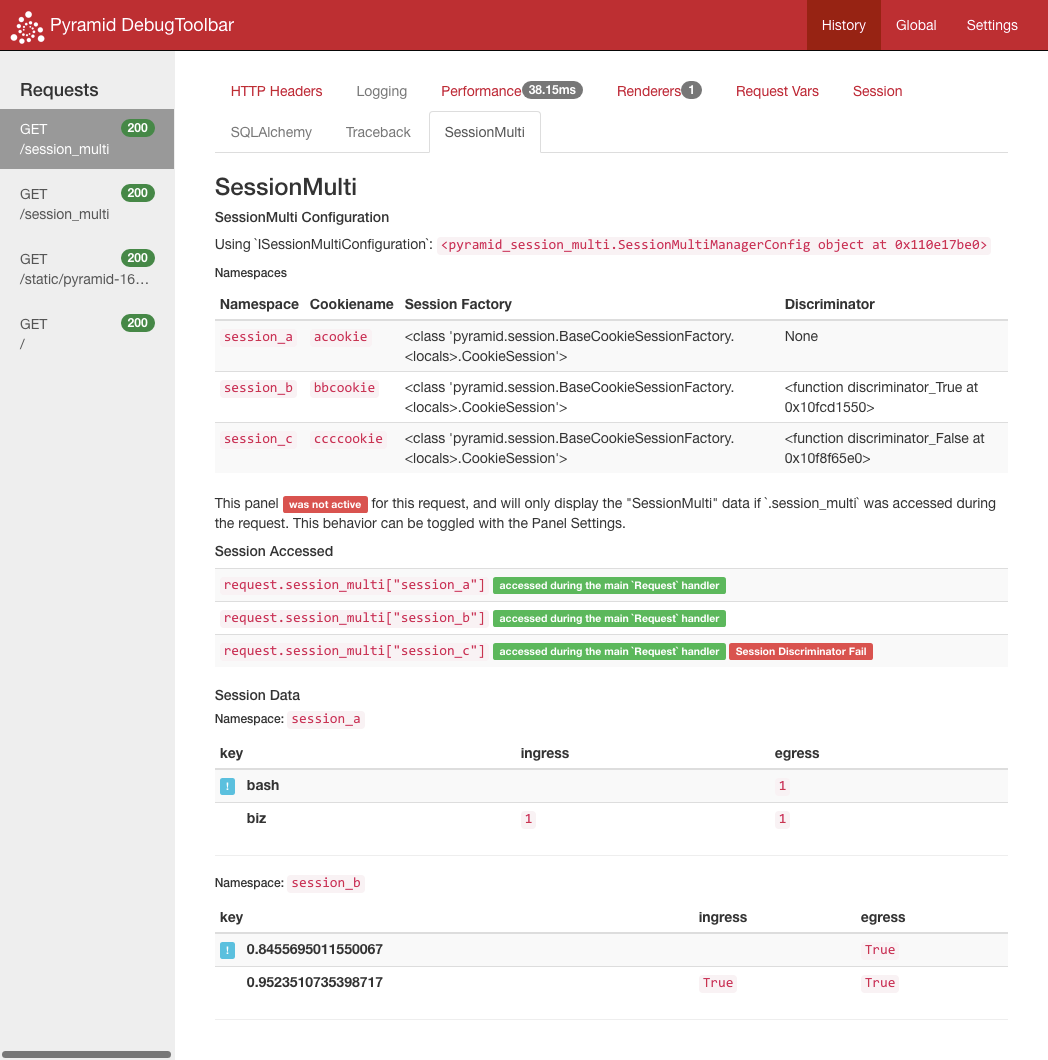
built-in pyramid_debugtoolbar support!
Just add to your "development.ini" or equivalent configuration method
debugtoolbar.includes = pyramid_session_multi.debugtoolbar
The debugtoolbar will now have a SessionMulti panel which has the following
info:
- configuration data on all Session namespaces
- ingress Request values of all accessed Sessions
- egress Response values of all accessed Sessions
The SessionMulti panel can also be enabled to track Sessions on every Request,
regardless of the Sessions being accessed or not.
There are two ways to enable the extended Session display used by the
:guilabel:SessionMulti panel.
#. Under the :guilabel:Settings tab in the navigation bar, click the red
:guilabel:X mark. When there is a green :guilabel:check mark, each
request will have the ingress and egress data tracked and displayed on the
:guilabel:Settings panel output regardless of the Session being accessed
during the request. When there is a red :guilabel:X mark, only requests
which accessed the Session will have the ingress and egress data displayed.
#. Send a pdtb_active cookie on a per-request basis.
This panel's name for cookie activation is "session_multi".
What does the Panel look like?
How does this library work?
Instead of registering one Session factory to request.session, this library
creates a Request attribute request.session_multi and registers the various
session factories to namespaces provided within it.
request.session_multi is a special dict that maps the namespace keys to your
ISession compliant Sessions. Sessions are lazily created on-demand, so you
won't incur any costs/cookies/backend-data until you use them.
This should work with most Session libraries written for Pyramid. Pyramid's
session support mostly just binds a Session factory to the request.session
property. Most libraries and implementations of Pyramid's ISession interface
act completely independent of the framework and implement of their own logic for
detecting changes and deciding what to do when something changes.
This library has been used in production for several years with:
- Pyramid's
SignedCookieSessionFactory - pyramid_session_redis
Miscellaneous
There are a few "safety" checks for conflicts.
- A
pyramid.exceptions.ConfigurationErrorwill be raised if a namespace of Session factory is null - A
pyramid.exceptions.ConfigurationErrorwill be raised if a namespace or factory or cookie name is re-used.
A given factory instance can not be re-used, because that can cause conflicts with cookies or backend storage keys.
You can re-use a single cookie library/type multiple times by creating a factory
for each setting (see the example above, which re-uses
SignedCookieSessionFactory twice).
If you do not register a factory with a cookie_name, this library will
try to derive one based on a ._cooke_name attribute. If neither option is
available, an Exception will be raised on configuration.
What if Sessions should only run in certain situations?
register_session_factory accepts a kwarg for discriminator, which is a
function that expects a single argument of a Request object.
If provided and the discriminator function returns an non-True value, the
.session_multi namespace will be set to None, otherwise the namespace will be
populated with the result of the factory.
License
MIT
1 maintainer

Metadata
1 maintainer
Release files for pyramid-session-multi 0.4.0
For a detailed explanation of source distributions (sdists) and built distributions (wheels), please see the package formats documentation.
Source distribution (sdist)
| File | Size | Uploaded | Provenance | |
|---|---|---|---|---|
| pyramid_session_multi-0.4.0.tar.gz | 22.5 kB | Without provenance | Details |
Release files / pyramid_session_multi-0.4.0.tar.gz
| Download URL | pyramid_session_multi-0.4.0.tar.gz |
|---|---|
| Size | 22.5 kB |
| Tags | Source |
|
SHA-256 checksum How to use checksums |
4bdbd55a4c941e48dfb89143b300c397dcee09c364fb3f83e895f2037a60a91a
|
|
BLAKE2b-256 checksum How to use checksums |
a8dddb6dc3c1f1af2ed1d6e01d819d9de8334d7c8138f37abe4b539de29f2f78
|
| Upload date | |
|
Uploaded using Trusted Publishing? What is trusted publishing? |
No |
| Uploaded via |
twine/6.1.0 CPython/3.10.2
|
Security for pyramid-session-multi 0.4.0
Provenance
Provenance describes where a file came from. On PyPI, provenance is shared via attestations, which provide a verifiable record of the build or publishing details. View details, limitations and caveats.
No provenance found
None of the files in this release were uploaded with provenance metadata.
A note on package security
PyPI is a repository for distributing packages, not a service for auditing them. While third-party security researchers and our staff do their best to detect and remove malicious packages, PyPI cannot guarantee the quality, security or suitability of any given package.














