





Pyreqwest_impersonate
Note
This project was renamed to primp.
Table of Contents
Installation
pip install -U pyreqwest_impersonate
Features
- Impersonate: impersonate option mimics web browsers by replicating their headers and TLS/JA3/JA4/HTTP2 fingerprints.
- Automatic Character Encoding Detection: the encoding is taken from the
Content-Typeheader or<meta ... charset=within the html, or if not found,UTF-8. If the encoding does not match the content, the library automatically detects and uses the correct encoding to decode the text. - Html2text: the
text_plain|text_markdownresponse attributes extract plain|markdown text from html. - All decoders:
gzip,brotli,zstdare already included and do not require third party packages. - Small Size: the compiled library is about 6.9MB in size.
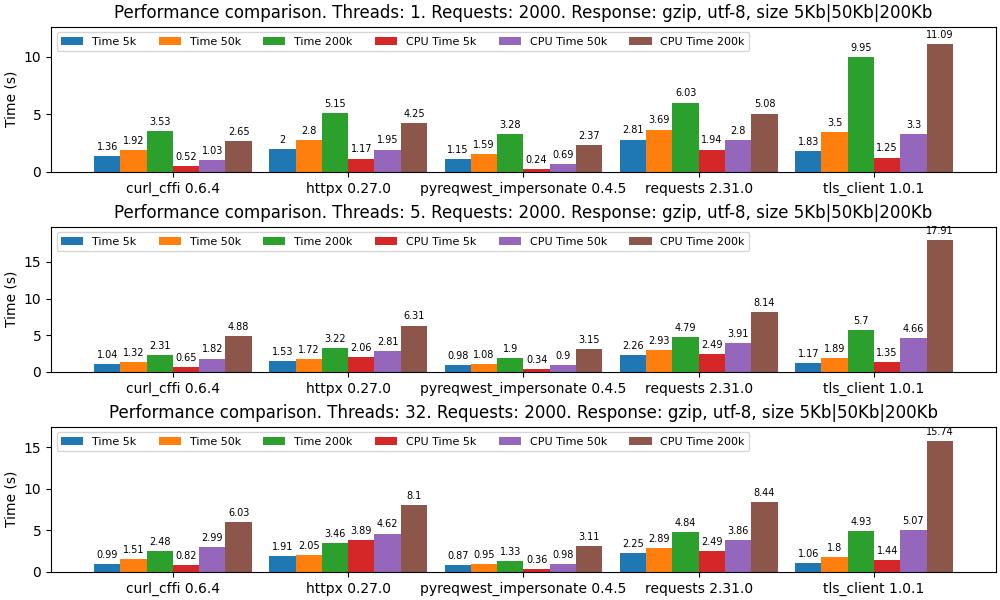
- High Performance: the library is designed for a large number of threads, uses all processors, and releases the GIL.
- Thread-safe: library can be safely used in multithreaded environments.
Benchmark
Usage
I. Client
HTTP client that can impersonate web browsers.
class Client:
    """Initializes an HTTP client that can impersonate web browsers.

    Args:
        auth (tuple, optional): A tuple containing the username and password for basic authentication. Default is None.
        auth_bearer (str, optional): Bearer token for authentication. Default is None.
        params (dict, optional): Default query parameters to include in all requests. Default is None.
        headers (dict, optional): Default headers to send with requests. If `impersonate` is set, this will be ignored.
        cookies (dict, optional): - An optional map of cookies to send with requests as the `Cookie` header.
        timeout (float, optional): HTTP request timeout in seconds. Default is 30.
        cookie_store (bool, optional): Enable a persistent cookie store. Received cookies will be preserved and included
            in additional requests. Default is True.
        referer (bool, optional): Enable or disable automatic setting of the `Referer` header. Default is True.
        proxy (str, optional): Proxy URL for HTTP requests. Example: "socks5://127.0.0.1:9150". Default is None.
        impersonate (str, optional): Entity to impersonate. Example: "chrome_124". Default is None.
            Chrome: "chrome_99","chrome_100","chrome_101","chrome_104","chrome_105","chrome_106","chrome_107",
                "chrome_108","chrome_109","chrome_114","chrome_116","chrome_117","chrome_118","chrome_119",
                "chrome_120","chrome_123","chrome_124","chrome_126"
            Safari: "safari_ios_16.5","safari_ios_17.2","safari_ios_17.4.1","safari_15.3","safari_15.5","safari_15.6.1",
                "safari_16","safari_16.5","safari_17.2.1","safari_17.4.1","safari_17.5"
            OkHttp: "okhttp_3.9","okhttp_3.11","okhttp_3.13","okhttp_3.14","okhttp_4.9","okhttp_4.10","okhttp_5"
            Edge: "edge_99","edge_101","edge_122"
        follow_redirects (bool, optional): Whether to follow redirects. Default is True.
        max_redirects (int, optional): Maximum redirects to follow. Default 20. Applies if `follow_redirects` is True.
        verify (bool, optional): Verify SSL certificates. Default is True.
        http1 (bool, optional): Use only HTTP/1.1. Default is None.
        http2 (bool, optional): Use only HTTP/2. Default is None.

    """
Client methods
The Client class provides a set of methods for making HTTP requests: get, head, options, delete, post, put, patch, each of which internally utilizes the request() method for execution. The parameters for these methods closely resemble those in httpx.
def get(
    url: str,
    params: Optional[Dict[str, str]] = None,
    headers: Optional[Dict[str, str]] = None,
    cookies: Optional[Dict[str, str]] = None,
    auth: Optional[Tuple[str, Optional[str]]] = None,
    auth_bearer: Optional[str] = None,
    timeout: Optional[float] = 30,
):
    """Performs a GET request to the specified URL.

    Args:
        url (str): The URL to which the request will be made.
        params (Optional[Dict[str, str]]): A map of query parameters to append to the URL. Default is None.
        headers (Optional[Dict[str, str]]): A map of HTTP headers to send with the request. Default is None.
        cookies (Optional[Dict[str, str]]): - An optional map of cookies to send with requests as the `Cookie` header.
        auth (Optional[Tuple[str, Optional[str]]]): A tuple containing the username and an optional password
            for basic authentication. Default is None.
        auth_bearer (Optional[str]): A string representing the bearer token for bearer token authentication. Default is None.
        timeout (Optional[float]): The timeout for the request in seconds. Default is 30.

    """
def post(
    url: str,
    params: Optional[Dict[str, str]] = None,
    headers: Optional[Dict[str, str]] = None,
    cookies: Optional[Dict[str, str]] = None,
    content: Optional[bytes] = None,
    data: Optional[Dict[str, str]] = None,
    json: Any = None,
    files: Optional[Dict[str, bytes]] = None,
    auth: Optional[Tuple[str, Optional[str]]] = None,
    auth_bearer: Optional[str] = None,
    timeout: Optional[float] = 30,
):
    """Performs a POST request to the specified URL.

    Args:
        url (str): The URL to which the request will be made.
        params (Optional[Dict[str, str]]): A map of query parameters to append to the URL. Default is None.
        headers (Optional[Dict[str, str]]): A map of HTTP headers to send with the request. Default is None.
        cookies (Optional[Dict[str, str]]): - An optional map of cookies to send with requests as the `Cookie` header.
        content (Optional[bytes]): The content to send in the request body as bytes. Default is None.
        data (Optional[Dict[str, str]]): The form data to send in the request body. Default is None.
        json (Any): A JSON serializable object to send in the request body. Default is None.
        files (Optional[Dict[str, bytes]]): A map of file fields to file contents to be sent as multipart/form-data. Default is None.
        auth (Optional[Tuple[str, Optional[str]]]): A tuple containing the username and an optional password
            for basic authentication. Default is None.
        auth_bearer (Optional[str]): A string representing the bearer token for bearer token authentication. Default is None.
        timeout (Optional[float]): The timeout for the request in seconds. Default is 30.

    """
Response object
resp.content
resp.cookies
resp.encoding
resp.headers
resp.json()
resp.status_code
resp.text
resp.text_markdown  # html is converted to markdown text
resp.text_plain  # html is converted to plain text
resp.url
Examples
import pyreqwest_impersonate as pri

client = pri.Client(impersonate="chrome_126")

# GET request
resp = client.get("https://tls.peet.ws/api/all")
print(resp.json())

# GET request with passing params and setting timeout
params = {"param1": "value1", "param2": "value2"}
resp = client.post(url="https://httpbin.org/anything", params=params, timeout=10)
print(r.text)

# POST Binary Request Data
content = b"some_data"
resp = client.post(url="https://httpbin.org/anything", content=content)
print(r.text)

# POST Form Encoded Data
data = {"key1": "value1", "key2": "value2"}
resp = client.post(url="https://httpbin.org/anything", data=data)
print(r.text)

# POST JSON Encoded Data
json = {"key1": "value1", "key2": "value2"}
resp = client.post(url="https://httpbin.org/anything", json=json)
print(r.text)

# POST Multipart-Encoded Files
files = {'file1': open('file1.txt', 'rb').read(), 'file2': open('file2.txt', 'rb').read()}
r = client.post("https://httpbin.org/post", files=files)
print(r.text)

# Authentication using user/password
auth = ("user", "password")
resp = client.post(url="https://httpbin.org/anything", auth=auth)
print(r.text)

# Authentication using auth bearer
auth_bearer = "bearerXXXXXXXXXXXXXXXXXXXX"
resp = client.post(url="https://httpbin.org/anything", auth_bearer=auth_bearer)
print(r.text)

# Using proxy
resp = pri.Client(proxy="http://127.0.0.1:8080").get("https://tls.peet.ws/api/all")
print(resp.json())

# You can also use convenience functions that use a default Client instance under the hood:
# pri.get() | pri.head() | pri.options() | pri.delete() | pri.post() | pri.patch() | pri.put()
# These functions can accept the `impersonate` parameter:
resp = pri.get("https://httpbin.org/anything", impersonate="chrome_126")
print(r.text)
II. AsyncClient
TODO
1 maintainer

Metadata
1 maintainer
Release files for pyreqwest-impersonate 0.5.5
For a detailed explanation of source distributions (sdists) and built distributions (wheels), please see the package formats documentation.
Source distribution (sdist)
| File | Size | Uploaded | |
|---|---|---|---|
| pyreqwest_impersonate-0.5.5.tar.gz | 78.2 kB | Details |
Release files / pyreqwest_impersonate-0.5.5.tar.gz
| Download URL | pyreqwest_impersonate-0.5.5.tar.gz |
|---|---|
| Size | 78.2 kB |
| Tags | Source |
|
SHA-256 checksum How to use checksums |
b6b84e2779250f791343800d8dfbe61abbc0bc4c53880fb4d1485525e8917966
|
|
BLAKE2b-256 checksum How to use checksums |
312741e60bd8f14bd771f1d1067ccd2fe53415ae5887859d236e2338d688efb9
|
| Upload date | |
|
Uploaded using Trusted Publishing? What is trusted publishing? |
No |
| Uploaded via |
twine/6.2.0 CPython/3.13.5
|














