
PyRust Engine





Make your Python code faster by adding one line.
Put @optimize above a function. PyRust turns that function into Rust, compiles it and runs it as native machine code. You keep writing normal Python, and your answers never change: anything PyRust can't run safely runs as normal Python instead.
- ✍️ Write plain Python. No new language, no build step, no rewrite. Type annotations are optional.
- ⚡ Get real speed on CPU-heavy code: arithmetic,
mathfunctions, bit operations, helper functions, recursion and NumPy arrays run about 6× to 110× faster in our tests on Linux, macOS and Windows. - 🧰 Use everyday Python: lists, strings, dicts, sets, float32 embeddings, pandas columns (pandas 3 text columns too), polars Series and
randomcompile too, with the same results as plain Python. - 🐼 Speed up small functions over whole columns with
@vectorize: a faster replacement fordf.apply,Series.mapand polarsmap_elements(about 20× faster on number columns, 3–4× on text columns). - 🤖 Built for AI apps and agents: ready-made
pyrust_engine.ai(BM25 with add/remove/save/load, a drop-inBM25Okapiforrank_bm25, cosine, binary and int8 top-k with filters, chunking, metrics, batches),suggest/applywith JSON output, and an MCP server for coding assistants. - 🧶 Ready for free-threaded Python 3.14t: tested in CI, and PyRust never turns the GIL back on.
- 🧵 Use every CPU core with
prange()for loops whose iterations are independent. - 🛟 Never get a wrong answer. Big integers, math errors, Ctrl-C and anything unsupported fall back to normal Python with the exact same result or exception.
- 🔍 See what's happening.
fn.explain()and a one-time warning say which line can't be sped up, why, and how to rewrite it.
📖 Documentation · 🚀 Getting started · 🧩 Examples · 📓 Notebook · 📚 API reference · 🤝 Contributing · 📝 Changelog
import math
import numpy as np
from pyrust_engine import optimize, prange

def distance(x, y):
    return math.sqrt(x * x + y * y)           # plain helper, compiled together with its caller

@optimize
def total_distance(n):
    total = 0.0
    for i in range(n):
        total += distance(float(i), float(n - i))
    return total

@optimize
def mean_and_spread(values):                   # NumPy array in, two values out
    mean = sum(values) / len(values)
    spread = 0.0
    for x in values:
        spread = max(spread, abs(x - mean))
    return mean, spread

@optimize
def transform(values, out) -> int:             # all CPU cores; result identical to Python
    positive = 0
    for i in prange(len(values)):
        out[i] = math.sqrt(abs(values[i])) * 2.0
        if values[i] > 0:
            positive += 1
    return positive

total_distance(300_000)                        # ~64x faster than plain Python on Linux in our benchmark
print(total_distance.explain())                # compiles? if not: which line, why, and a hint
Everyday Python and AI work (0.7.1 and 0.7.2):
import random
from pyrust_engine import optimize, vectorize

@optimize
def edit_distance(a: str, b: str) -> int:      # strings and lists
    prev = [0] * (len(b) + 1)
    cur = [0] * (len(b) + 1)
    for j in range(len(b) + 1):
        prev[j] = j
    for i in range(1, len(a) + 1):
        cur[0] = i
        for j in range(1, len(b) + 1):
            cost = 0 if a[i - 1] == b[j - 1] else 1
            cur[j] = min(prev[j] + 1, cur[j - 1] + 1, prev[j - 1] + cost)
        for j in range(len(b) + 1):
            prev[j] = cur[j]
    return prev[len(b)]

@optimize
def monte_carlo_pi(n: int) -> float:           # same numbers as plain Python after random.seed()
    inside = 0
    for _ in range(n):
        x, y = random.random(), random.random()
        if x * x + y * y <= 1.0:
            inside += 1
    return 4.0 * inside / n

@vectorize
def score(price: float, qty: int) -> float:    # write it for one row...
    return price * qty * (0.9 if qty > 10 else 1.0)

df["score"] = score(df["price"], df["qty"])    # ...run it over whole pandas columns in one native loop

@optimize
def word_counts(text: str) -> dict[str, int]:  # dicts, sets, str.split, f-strings
    counts = {}
    for word in text.lower().split():
        counts[word] = counts.get(word, 0) + 1
    return counts

from pyrust_engine.ai import BM25, cosine_top_k, chunk_text, token_f1
ids, scores = cosine_top_k(query_vec, embeddings, k=5)     # float32 embedding search on all cores
hits = BM25(chunk_text(document, 800, 100)).search("fast python", k=3)
New in 0.7.3:
from pyrust_engine.ai import BM25Okapi, binarize, hamming_top_k, tokenize_many

bm25 = BM25Okapi(tokenized_corpus)             # was: from rank_bm25 import BM25Okapi (same scores)
bm25.add(more_docs); bm25.remove([3]); bm25.save("index.npz")

ids, dist = hamming_top_k(binarize(query_vec), binarize(vectors), 10, mask=tenant == "acme")
tokens = tokenize_many(documents)              # all CPU cores, same result as one by one

@vectorize
def domain(email: str) -> str:                 # text columns in, text out
    return email[email.find("@") + 1:].lower()

df["domain"] = domain(df["email"])             # pandas 3 str column
pl_df.with_columns(pl.col("email").map_batches(domain))   # polars
For coding agents: python -m pyrust_engine suggest file.py --json, apply file.py --write, and claude mcp add pyrust -- python -m pyrust_engine mcp. See AI and agents and AGENTS.md.
Status: experimental. Not a general Python compiler and not production-hardened. 257 tests pass in CI on Linux, macOS and Windows with Python 3.10 to 3.15, and on free-threaded Python 3.14t.
Comparison at a glance
| Plain Python | PyRust 0.7 | |
|---|---|---|
| Integer loop (500k) | 34.8 ms · 1× | 1.12 ms · 31× |
| Float recurrence (300k) | 21.4 ms · 1× | 1.56 ms · 14× |
| Array kernel, read (100k float64) | 10.3 ms · 1× | 0.122 ms · 85× |
| Write into an output array (100k) | 33.8 ms · 1× | 0.380 ms · 89× |
Recursive fib(25) |
7.26 ms · 1× | 0.596 ms · 12× |
math.sqrt / sin / log loop (300k) |
41.0 ms · 1× | 3.74 ms · 11× |
| Helper function called in a loop (300k) | 47.6 ms · 1× | 0.745 ms · 64× |
Bit-mixing hash with ^ & << >> ** (300k) |
74.4 ms · 1× | 0.662 ms · 112× |
| Edit distance of two strings (288 chars each) · 0.7.1 | 11.2 ms · 1× | 0.758 ms · 15× |
Monte Carlo with random.random() (200k) · 0.7.1 |
24.9 ms · 1× | 3.38 ms · 7.4× |
Tiny function over 100k rows: @vectorize vs a Python loop · 0.7.1 |
13.4 ms · 1× | 0.653 ms · 20× |
| Variance of a Python list (100k floats, copy included) · 0.7.1 | 6.07 ms · 1× | 3.12 ms · 1.9× |
Tokenize 1.1M characters (ai.tokenize) · 0.7.2 |
60.4 ms · 1× | 15.4 ms · 3.9× |
| Word count with a dict (160k words) · 0.7.2 | 22.9 ms · 1× | 13.3 ms · 1.7× |
Edit distance of two 500-char strings (ai.levenshtein) · 0.7.2 |
53.0 ms · 1× | 3.09 ms · 17× |
| float32 dot product (100k, NumPy 2 rules) · 0.7.2 | 26.0 ms · 1× | 0.219 ms · 119× |
| BM25 query over 1,977 documents · 0.7.2 | 27.9 ms · 1× | 0.106 ms · 263× |
| Cosine top-10 over 50k×384 float32 vs NumPy BLAS · 0.7.2 | 20.2 ms (NumPy) | 22.1 ms · 0.9× |
BM25Okapi query over 5,000 documents vs the rank_bm25 package · 0.7.3 |
1.85 ms | 0.123 ms · 15× (same scores) |
| Binary-code top-10 over 200k × 384 bits vs NumPy · 0.7.3 | 12.6 ms (NumPy) | 3.70 ms · 3.4× |
| int8 top-10 over 100k × 384 vs NumPy (int32 copy + matmul) · 0.7.3 | 39.5 ms (NumPy) | 39.1 ms · 1.0× (no 4× copy) |
@vectorize over a 200k-row text column vs pandas Series.map · 0.7.4 |
83.3 ms | 18.4 ms · 4.5× |
tokenize_many, 2,000 documents, vs tokenize one by one (both compiled) · 0.7.4 |
242 ms | 147 ms · 1.65× |
Native call of a tiny function (native_loop_free=True) · 0.7.4 |
0.046 µs (Python) | 0.18 µs (0.7.3: 2.8 µs) |
A method updating self.x… over 20k steps · 0.7.5 |
2.12 ms | 0.176 ms · 12× |
| 1000 calls on a 32-element NumPy array · 0.7.5 | 3.91 ms | 0.44 ms · 8.9× (direct calls with arrays) |
Tiny add(a, b) per call |
≈1× | ≈1× (runs as plain Python on purpose; use @vectorize for columns) |
| JSON → array pipeline | 7.75 ms · 1× | 5.39 ms · 1.44× |
| Big integers / overflow / math errors | Exact | Exact (replays in Python) |
| Unsupported code | Runs | Runs in Python, with the line and a hint |
| Runtime dependencies | None | None (NumPy for arrays; Rust only to compile) |
| First call (compile) | None | 0.1–0.5 s (about 0.005 s from the disk cache) |
"time · speedup vs Python", measured by CI. Rows marked "vs NumPy" or "vs rank_bm25" compare with those libraries, not with plain Python. BM25 is compared with a straightforward pure-Python BM25 that scans the documents for each query; cosine top-k is compared with vectorized NumPy, which is already native code (PyRust is about even there). Runner: GitHub Actions ubuntu-latest runner (x86_64, Python 3.13, Rust 1.99). Shared CI machines are noisy; treat the numbers as approximate. Raw data: benchmarks/.
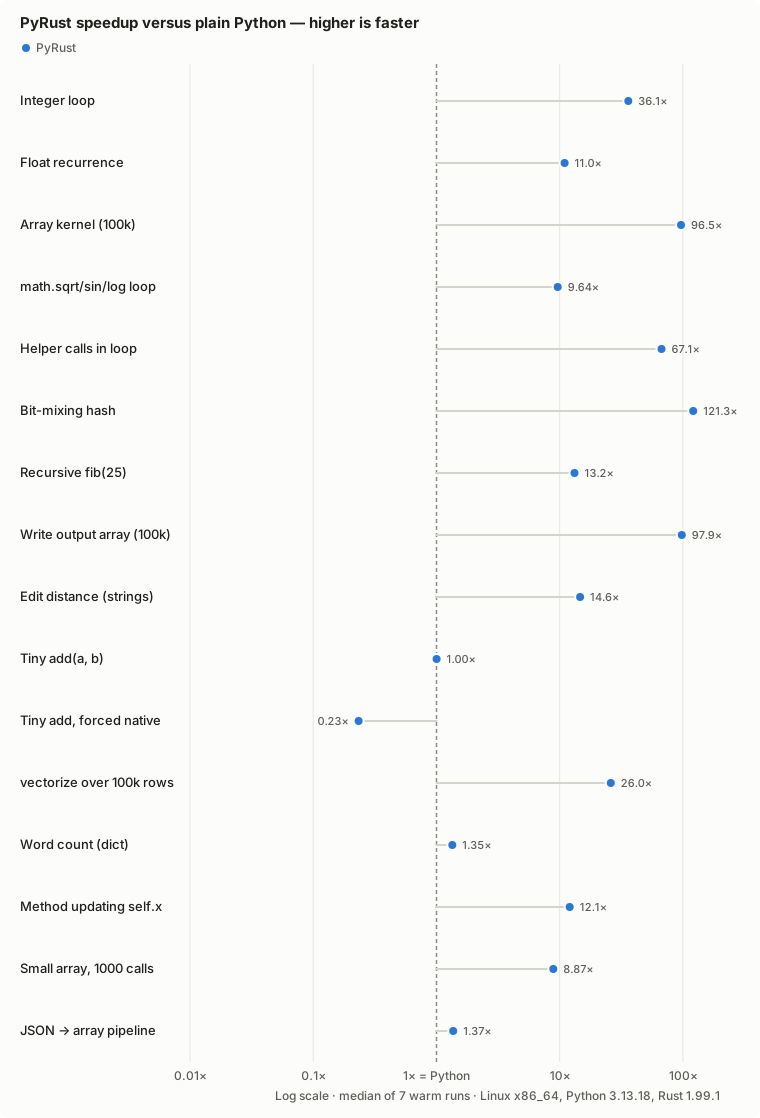
Speed on every platform
Speedup over plain Python, same CI run, Python 3.13 and Rust 1.99:
| Workload | Linux x86_64 | macOS Apple Silicon | Windows x86_64 |
|---|---|---|---|
| Integer loop | 31× | 39× | 29× |
| Float recurrence | 14× | 5.7× | 7.8× |
| Array kernel (read) | 85× | 42× | 86× |
| Write into an output array | 89× | 73× | 44× |
Recursive fib(25) |
12× | 13× | 12× |
math functions loop |
11× | 14× | 15× |
| Helper function in a loop | 64× | 91× | 83× |
| Bit-mixing hash | 112× | 72× | 104× |
Tiny add(a, b) (runs as Python) |
≈1× | ≈1× | ≈1× |
| Native call of a tiny function, per call · 0.7.4 | 0.18 µs | 0.16 µs | 0.19 µs |
Float recurrences and math-heavy loops gain less because the floating-point work itself costs the same in both; PyRust removes the interpreter overhead around it. A comparison with Numba is on the benchmarks page.
What compiles
| Values | int (64-bit, overflow-checked), float, bool, tuples (unpacking and multiple returns), NumPy float64/int64/float32 arrays (1-D and 2-D), lists of floats, ints or strings, str, bytes, dict, set, pandas Series (float64/int64/float32/str), polars Series |
| Operators | + - * / // % **, & | ^ ~ << >>, comparisons incl. chained and exact int-vs-float |
| Control flow | if/elif/else, for over range, an array, enumerate or prange, while, break, continue, return, x if c else y |
| Builtins | abs min max sum round divmod pow int float bool len ord chr str list set dict sorted zip, int.bit_count() |
| Strings | slicing, split strip find rfind count startswith endswith replace join lower upper, +, +=, f-strings, int(s), float(s), in |
| Lists | [], append pop extend sort reverse index count, literals, comprehensions, slicing, sorted(); lists you pass are written back |
| dict / set | d[k], get pop setdefault del in, loops over items(), max(d, key=d.get); sets add discard in & | - ^ |
random |
random uniform randint randrange gauss choice, exactly Python's sequence |
| pandas / polars | Series of numbers or str: s[i], s.iloc[i], len(s), for x in s; @vectorize over whole columns (numbers, bools, str) |
math |
sqrt exp log log2 log10 sin cos tan asin acos atan atan2 sinh cosh tanh fabs copysign fmod floor ceil trunc isnan isinf isfinite pi e tau inf nan |
| Arrays | a[i], a[i, j], a.shape, len(a), for x in a, writes (a[i] = v, +=), new arrays with np.zeros/empty/ones(_like) that can be returned |
| Classes | methods and functions reading obj.x and assigning number attributes (self.x += v); dataclasses, __slots__, class attributes |
| Functions | calls to your own functions (keyword and default arguments, recursion with a -> int/-> float annotation), module-level constants |
Everything else (method calls on objects, print, try, float formatting, NumPy slices, …) still runs, as plain Python, and explain() gives a hint. Full details: Guide.
What makes Python slow, and what PyRust does about it
| Why Python is slow | Example | PyRust 0.7 |
|---|---|---|
| Every operation is interpreted one bytecode at a time | loops | ✅ Compiled to native machine code |
| Every number is a heap object with type checks | total += i * i |
✅ Plain 64-bit ints, floats and bools in CPU registers |
| Function calls are expensive | helpers in a loop, recursion | ✅ Helpers and recursion compiled into the same native code |
| Math functions go through Python objects | math.sqrt(x), x ** 0.5 |
✅ Native calls, same results |
| Bit manipulation creates new int objects | hashing | ✅ Native bit operations |
| Indexing arrays goes through NumPy objects | a[i], out[i] = x |
✅ Reads and writes array memory directly |
| The GIL keeps one thread busy | CPU-bound loops | ✅ prange() runs independent iterations on all cores; ai.batch runs many items on threads; free-threaded 3.14t supported |
| Crossing into native code has a fixed cost | tiny functions called millions of times | ✅ @vectorize runs them over whole arrays in one call; ✅ since 0.7.4 CPython calls the native code directly: about 0.2 µs per call (was 2–4.5 µs) |
| Python values are generic objects | lists, text processing, counting | ✅ Lists, strings, dicts and sets as native data, with Python's exact rules |
| Random numbers go through Python calls | simulations, Monte Carlo | ✅ Python's own generator algorithm, natively, same sequence |
| Objects and classes are dynamic | methods, dataclasses | ✅ since 0.7.5 self.x reads and assignments compile (numbers, str, NumPy arrays); ❌ method calls on objects, JSON documents |
| I/O waits | network, disk, database | ❌ Not a CPU problem: use asyncio or threads |
Version comparison
| 0.5 | 0.6 | 0.7 | |
|---|---|---|---|
| Values | int, float, float64 arrays |
+ int64 arrays |
+ bool, tuples, 2-D arrays, new arrays |
| Loops | range, while |
same | + for x in a, enumerate, prange (multi-core) |
| Builtins | abs min max int pow, math.* |
same | + sum round divmod bool, atan2 copysign fmod |
| Functions | helper calls | + recursion | + keyword/default arguments, helpers may write arrays |
| Argument types | from annotations | same | compiled per type actually passed; annotations optional |
| Long calls | 10M-step budget, then slow replay | same | no limit, background thread, Ctrl-C works |
| Array writes | — | full copy per call | undo log (no copy for sparse writes) |
| Crashes in generated code | abort | abort | caught, replayed in Python |
| Deployment | needs Rust | + doctor, clear toolchain errors |
+ build ahead of time: no Rust needed at run time |
| Developer tools | explain(), warnings, check |
+ type hints, API docs | + hints in messages, Jupyter magics, docs website |
| Tests / CI | 89 / 3 OSes × 3 Pythons | 128 | 150 / 3 OSes × Python 3.10–3.15, lint, coverage, benchmark tracking |
0.7.1 added lists, str/bytes, pandas Series, the random module and @vectorize. 0.7.2 added float32, string values, growable lists, dicts and sets, the pyrust_engine.ai library, suggest/apply and an MCP server. 0.7.3 added pandas 3 text columns and polars, a drop-in BM25Okapi for rank_bm25, index add/remove/save/load, binary and int8 search with filters, batches on all cores, and free-threaded Python support. 0.7.4 let CPython call compiled functions directly (about 0.2 µs per call instead of 2–3 µs), and made text columns and text batches 2–4× faster. 0.7.5 (current) compiles methods (self.x reads and assignments; dataclasses, __slots__) and extends direct calls to NumPy arrays, str and bytes. Older releases: Changelog.
Install
| Needed | Version | Why |
|---|---|---|
| Python | 3.10 to 3.15 | runs PyRust |
Rust (rustc) |
any recent stable | compiles your functions (not needed for prebuilt libraries) |
| C linker | system default | Rust uses it to build the library |
| NumPy | optional | arrays |
| OS | Install Rust |
|---|---|
| macOS | xcode-select --install, then brew install rustup && rustup default stable |
| Linux | sudo apt install build-essential, then curl --proto '=https' --tlsv1.2 -sSf https://sh.rustup.rs | sh |
| Windows | Visual Studio Build Tools with "Desktop development with C++", then winget install Rustlang.Rustup |
pip install "pyrust-engine[arrays]"
python -m pyrust_engine doctor          # checks Python, Rust, the linker, NumPy, and compiles a test function
Without Rust, everything still runs correctly as plain Python, and PyRust shows one warning with the exact fix (including for half-installed toolchains, missing linkers and Jupyter's shorter PATH). See Troubleshooting. On macOS with Homebrew Python, install into a virtual environment first: python3 -m venv ~/pyrust-env && source ~/pyrust-env/bin/activate.
Usage highlights
Arrays: read, write, create
@optimize
def outer(a, b):
    out = np.zeros((len(a), len(b)))
    for i in range(len(a)):
        for j in range(len(b)):
            out[i, j] = a[i] * b[j]
    return out                                 # a new NumPy array
Writes into arrays you pass in go straight to memory with an undo log: if the call fails halfway, the writes are undone and the call replays in Python, so the array ends up exactly as plain Python would leave it.
Recursion and multiple return values
@optimize
def fib(n: int) -> int:                        # recursion needs the return annotation
    return n if n < 2 else fib(n - 1) + fib(n - 2)

@optimize
def fib_pair(n):
    a, b = 0, 1
    for _ in range(n):
        a, b = b, a + b
    return a, b
Parallel loops
prange() is range() in plain Python. Under PyRust it splits iterations across CPU cores, but only for patterns whose result is exactly the sequential one: each iteration writes its own element (out[i] = ...), and the only shared updates are += on int totals. Anything else is rejected with an explanation (float totals depend on the order of additions).
Diagnostics
fn.explain()        # compiles or not; the line, reason and a hint; types it was compiled for
fn.report()         # calls, native/fallback counts, fallback reasons, specializations, long calls
fn.rust_source()    # the generated Rust
PyRustFallbackWarning: simulate ran as plain Python: simulate, line 14: unsupported expression: `[x, y]`
  hint: List literals are compiled only as [value] * n. Pass lists of numbers as arguments, or create one with [0.0] * n and fill it in a loop.
In Jupyter: %load_ext pyrust_engine, then %pyrust_check fn and %pyrust_benchmark fn(args).
Lists, strings, pandas and random numbers
@optimize
def double_all(values: list[int]) -> None:
    for i in range(len(values)):
        values[i] *= 2                         # written back into the same list after the call

@optimize
def count_digits(text: str) -> int:
    count = 0
    for ch in text:
        if ch.isdigit():
            count += 1
    return count

@optimize
def mean_gap(prices) -> float:                 # a pandas column: mean_gap(df["price"])
    total = 0.0
    for i in range(1, len(prices)):
        total += abs(prices[i] - prices[i - 1])
    return total / (len(prices) - 1)
random.random(), uniform, randint, randrange, gauss and choice run Python's own Mersenne Twister algorithm natively: after random.seed(42) you get exactly the numbers plain Python gives, and the sequence continues correctly afterwards.
Web apps and threads
Compiled calls don't hold the GIL, so a CPU-heavy step in a FastAPI/Django/Flask endpoint can run in a worker thread (await asyncio.to_thread(fn, ...)) without blocking other requests. Ship prebuilt libraries so servers don't need Rust. On free-threaded Python 3.14t, plain Python threads run in parallel as well; PyRust is tested there and keeps the GIL off.
Deploy without Rust
python -m pyrust_engine build mypackage/kernels.py # writes mypackage/__pyrust__/ (+ manifest.json)
Ship the __pyrust__/ folder with your package. Machines without Rust load the prebuilt libraries (matched by platform and generated code, verified by SHA-256). See Deployment.
Options
@optimize(fallback=False)            # raise OptimizationError instead of running as Python
@optimize(max_iterations=10**9)      # hard limit; default None = unlimited, Ctrl-C works
@optimize(native_loop_free=True)     # compile tiny loop-free functions too
@optimize(warn_on_fallback=False)    # silence PyRustFallbackWarning
@optimize(timing=True)               # record native/fallback timings in report()
Why it exists
Most "make Python fast" tools ask you to give something up: a new interpreter, a build step, a different integer model, or a heavy dependency. PyRust takes a narrower bet:
- Correctness first. Integers stay arbitrary-precision; overflow, division by zero, bounds, math domain errors and anything unexpected stop the native call, undo its array writes and replay the original Python function, so you get exactly Python's result or exception.
- Opt-in, per function. Decorate the hot function, leave everything else alone.
- Light footprint. Pure-Python package with no runtime dependencies. Uses
rustcdirectly throughctypes: no PyO3, Maturin or crates.
| PyRust | Numba | Cython | PyPy | |
|---|---|---|---|---|
| How you use it | decorator | decorator | separate build step | different interpreter |
| Integer overflow | exact (replays in Python) | wraps at 64 bits | C rules for C types | exact |
| Unsupported code | runs as Python, with a hint | compile error | compiles via the C API | runs everything |
| Plain helpers called inside | compiled together | must be @njit too |
yes | yes |
| Runtime dependencies | none | numba + llvmlite | none after build | whole runtime |
| Maturity | experimental | mature | mature | mature |
Limitations
- A subset of Python. Methods compile only through attribute reads and number assignments (
self.x,self.x += 1); calling methods on objects, closures, generators,try/with, float formatting, NumPy slices orprintin compiled code (they run as Python). - Containers hold one type (a list of floats, a dict of str to int, ...). Lists, dicts and sets passed in are copied: lists of numbers are written back, lists of strings, dicts and sets are read-only. For simple work on big lists the copy dominates (variance of 100k floats: 1.9×); NumPy arrays avoid it. Looping over a set isn't compiled (no reproducible order);
sorted(s)is. - Strings:
lower/upper/is...are native for ASCII; other characters replay in Python (same result, slower). - float32 needs NumPy 2; mixing float32 with values from float64 arrays runs as Python.
random: only the shared generator's functions listed above; not insideprange, and don't draw random numbers from another thread during a compiled call.min/maxover mixed int and float,round(x, ndigits)andmath.hypotaren't compiled (Python's results depend on details native code can't match exactly).- NumPy scalars: in Python,
a[i]givesnp.float64; PyRust returns a plainfloatwith the same value. - Recursion needs a return annotation and runs natively up to 300 levels deep.
- Per-call overhead: about 0.2–0.4 µs for calls with numbers, NumPy arrays,
strorbytesreturning a number, bool orNone(CPython calls the native code directly); 1–3 µs otherwise (lists, dicts, returned strings or arrays, objects; viactypes). A plain Python call costs about 0.05 µs, so loop-free functions still run as Python by default. - First call compiles (0.1–0.5 s, cached on disk). Use
fn.prepare()or ship prebuilt libraries. - Arrays: 1-D and 2-D, C-contiguous
float64/int64/float32. pandas Series need afloat64/int64/float32/strdtype, no missing values and the default index; polars Series need no nulls. Series of str only supports[i],len, loops andsorted/list/set/min/max/join(Series operators work element by element and run as Python). batch/tokenize_manywith the GIL only run the native part in parallel; converting text in and out still takes turns (tokenize_many: 1.7–1.9×).- Text columns in
@vectorizegain 3.4–4.5× over pandasmapand 1.5–2.2× over polarsmap_elements; number and bool columns gain 20× or more. prangeonly accepts independent iterations (see above).- Experimental. Not production-hardened and not a sandbox: only run trusted code.
Correctness evidence
- 257 automated tests, passing on Linux, macOS and Windows with Python 3.10, 3.12, 3.13, 3.14 and 3.15 (15 CI jobs) and free-threaded Python 3.14t (3 jobs), plus lint (ruff), type checks (mypy) and a package build check on every push.
- Edge cases for every operation: NaN, ±0.0, ±inf, overflow, math domain errors, huge exponents and shifts, int/float comparisons around 253 and 263, writes that fail halfway, overlapping and read-only arrays, recursion depth, Ctrl-C on long calls, prebuilt libraries without Rust.
- Generated-program fuzzing: random programs using the supported operators and
mathfunctions are compiled and compared with CPython on all three operating systems, including which exception is raised. - Benchmark tracking: every CI job compares its speedups with the last release and flags drops in the job summary.
Details: VALIDATION.md.
How it works
your function ─► AST check, per argument types ─► Rust source (checked int ops, exact float rules)
   ─► rustc (cached on disk, or a prebuilt library) ─► direct CPython call (numbers) or ctypes call
   ─► status 0: return the result
   ─► status ≠ 0 (overflow, ÷0, bounds, math error, panic, ...): undo array writes, replay in Python
   ─► more than 50M steps: re-run in a background thread with no limit (Ctrl-C stops it)
Generated Rust never contains raw user text: identifiers are mapped to internal names and only allowed AST nodes are translated.
Safety
- Run trusted code only. Compiled libraries run inside your process; this is not a sandbox.
- Keep the cache private (it must be owned by you and not group/world-writable on POSIX).
- Don't change arrays, function code or globals from another thread while a call is running.
Project layout
pyrust_engine/   compiler.py (Python AST → Rust), runtime.py (decorator, dispatch), cache.py,
                 compiler_text.py + rust_text.py (strings, lists, dicts, sets), kinds.py, packing.py,
                 vectorize.py (@vectorize), ai.py (AI library), advisor.py (suggest/apply), mcp.py (MCP server),
                 toolchain.py (Rust detection, doctor), prebuilt.py (ahead-of-time builds),
                 ipython.py (Jupyter magics), profiling.py, __main__.py (CLI), py.typed
tests/           test_engine.py, test_v2.py … test_v73.py, test_ai.py, test_tools.py, test_toolchain.py, test_fuzz.py
examples/        pyrust_vs_python.ipynb, rag_retriever.py, fastapi_app.py, eval_metrics.py, docker/,
                 benchmark_suite.py, workloads.py
benchmarks/      raw results per release and platform, compare.py (regression report)
docs/            documentation website (MkDocs), API.md, benchmark chart
Roadmap
- Direct calls for more types: lists, dicts, objects and returned strings or arrays still go through
ctypes(1–3 µs). - More of classes: calling other methods (
self.helper()), lists and objects as attributes. - More array types:
int32,uint8,boolarrays in@optimize, 3-D arrays and slices likea[i, :]. - LSH buckets for
minhash(near-duplicates in near-linear time), MMR and rank fusion helpers. - Faster dense array writes (an optimised path for functions that fill whole arrays).
- Benchmarks on ARM Linux, and against Cython and PyPy.
License
MIT © 2026 Suraj Mhaske
1 maintainer

Metadata
1 maintainer
Release files for pyrust-engine 0.7.5
For a detailed explanation of source distributions (sdists) and built distributions (wheels), please see the package formats documentation.
Source distribution (sdist)
| File | Size | Uploaded | Provenance | Actions |
|---|---|---|---|---|
| pyrust_engine-0.7.5.tar.gz | 168.7 kB | With provenance | Details for pyrust_engine-0.7.5.tar.gz |
Built distribution (wheel)
| File | Interpreter | ABI | Platform | Actions Reset |
|---|---|---|---|---|
| pyrust_engine-0.7.5-py3-none-any.whl | Python 3 | none | any | Details for pyrust_engine-0.7.5-py3-none-any.whl |
Total release size: 293.5 kB
Release files / pyrust_engine-0.7.5.tar.gz
| Download URL | pyrust_engine-0.7.5.tar.gz |
|---|---|
| Size | 168.7 kB |
| Tags | Source |
|
SHA-256 checksum How to use checksums |
f3be6efd2767168c213168ccb0be4c19de8d8aa6e28a5e3249c71be3b674fa81
|
|
BLAKE2b-256 checksum How to use checksums |
1b5cdd00a91789a3719535095b9455fb795843bc95634538ceaaf15779719758
|
| Upload date | |
|
Uploaded using Trusted Publishing? What is trusted publishing? |
Yes |
| Uploaded via |
twine/7.0.0 CPython/3.13.16
|
Provenance
Provenance describes where a file came from. On PyPI, provenance is shared via attestations, which provide a verifiable record of the build or publishing details. View details, limitations and caveats.


PyPI Publish Attestation
PyPI verified that this artifact, at this checksum, originated from the publisher listed below.
Signed by GitHub Actions, verified by PyPI on Nov 8, 2026.
Transparency logRelease files / pyrust_engine-0.7.5-py3-none-any.whl
| Download URL | pyrust_engine-0.7.5-py3-none-any.whl |
|---|---|
| Size | 124.8 kB |
| Tags | Python 3 |
|
SHA-256 checksum How to use checksums |
123d230eb8e3f9dfea7636335ec6c54f873c31cf7e60c2f628bebcb656353883
|
|
BLAKE2b-256 checksum How to use checksums |
276be83bcd4ac5d189448636fe00799a8eaf42c5995d5f6f8bfd3ff1c2d69bb7
|
| Upload date | |
|
Uploaded using Trusted Publishing? What is trusted publishing? |
Yes |
| Uploaded via |
twine/7.0.0 CPython/3.13.16
|
Provenance
Provenance describes where a file came from. On PyPI, provenance is shared via attestations, which provide a verifiable record of the build or publishing details. View details, limitations and caveats.
PyPI Publish Attestation
PyPI verified that this artifact, at this checksum, originated from the publisher listed below.
Signed by GitHub Actions, verified by PyPI on Nov 8, 2026.
Transparency logSecurity for pyrust-engine 0.7.5
Provenance
Provenance describes where a file came from. On PyPI, provenance is shared via attestations, which provide a verifiable record of the build or publishing details. View details, limitations and caveats.
Full provenance
Both files in this release have been uploaded with provenance metadata.
Attestation for pyrust_engine-0.7.5.tar.gz
PyPI Publish Attestation
PyPI verified that this artifact, at this checksum, originated from the publisher listed below.
Signed by GitHub Actions, verified by PyPI on Nov 8, 2026.
Transparency logA note on package security
PyPI is a repository for distributing packages, not a service for auditing them. While third-party security researchers and our staff do their best to detect and remove malicious packages, PyPI cannot guarantee the quality, security or suitability of any given package.
To learn more about protecting yourself from malicious actors, visit our package security documentation.














