
pyspecter



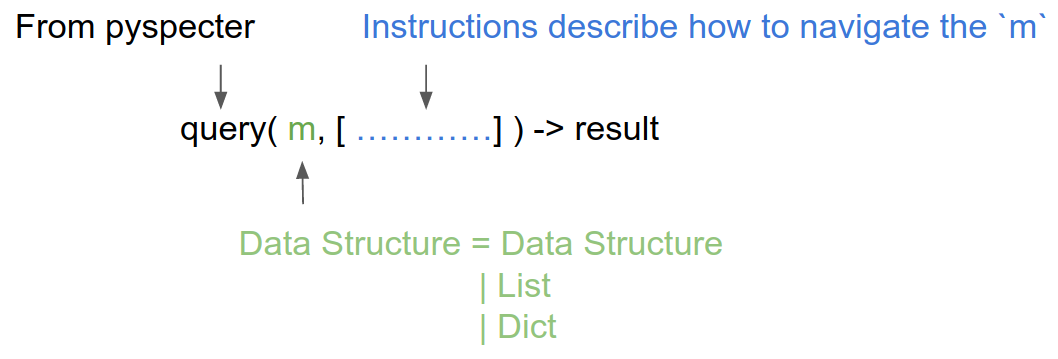
A Python library to query nested structure, inspired by specter
If you are dealing with nested python structure and it require complex rule to search the data underneath like:
- Key start with a pattern
- Value to be filter
- Conditional path to walk into
- ...
this is the right library fit the use case as it extract the Navigation rule to a list, saving your a lot of trouble writting your own logic to navigate the nested data.
Get started
Examples
m = {"A":{"B1":[10,20],"B2":2,"B3":3}
     ,"C":{"B1":[1,2],"B2":[3,4]}
     ,"D":[1,2,3,4]
     ,"E":[None,2,3,4]
     ,"F":{"G":1}
     ,"H":["A1","A2","A3"]}
Navigate to specific item
FIRST/LAST
assert query(m, ["D", S.FIRST]) == 1
assert query(m, ["A", S.FIRST]) == ("B1", [10, 20]) # first element from dict.items()

assert query(m, ["D", S.LAST]) == 4
assert query(m, ["A", S.LAST]) == ("B3", 3) # last element from dict.items()
Nth
Navigate to the Nth element
assert query(m, ["D", (S.NTH, 1)]) == 2
assert query(m, ["D",(S.NTH, 1, 2)]) == [ 2, 3 ]
Operation on dict
Navigate to values or keys of current position
assert query(m, ["C", S.MVALS]) == [[1, 2], [3, 4]]
assert query(m, ["C", S.MKEYS]) == ['B1', 'B2']
Navigate to a sub map of current position
assert query(m, ["A", (S.SUB_MAP, "B1")]) == {"B1":[10,20]}
Annotate with index with current position
assert query(m, ["A", S.INDEXED_VALS]) == [(0, ("B1", [10,20])), (1, ("B2", 2)), (2, ("B3", 3))]
assert query(m, ["C", "B1", S.INDEXED_VALS]) == [(0, 1), (1, 2)]
Filtering
filter elements by supplying a function
assert query(m, ["A", "B1", (S.FILTER, lambda x: x > 10)]) == [20]
assert query(m, ["C", (S.FILTER, lambda k, v: k.endswith("2"))]) == [[3, 4]]
Navigate to map which its key or value satisify a custom function
assert query(m, ["A", (S.MKEY_IF, lambda x:x.endswith("1"))]) == [[10, 20]]
assert query(m, ["A", (S.MVAL_IF, lambda x:x==[10,20])]) == [[10, 20]]
Branching paths
Branching by multiple paths
mpath = {"A":{"B":1,
              "C":[2,3,4,5]}}
assert query(mpath,["A",
                    (S.MULTI_PATH,["B"]
                                 ,["C", S.LAST])]) == [1,5]
Conditional Navigation
Navigate to a specifie path
assert query(m, ["D", (S.NTH_PATH, 2)]) == [3]
Navigate to a position if and only if the path exists
assert query(m, [(S.MUST,"F","G")]) == 1
assert query(m, [(S.MUST,"F","G","NOT_EXISTS")]) == None
Navigate to a range
assert query(m, ["D",(S.SRANGE,2,3)]) == [3]
Navigate to a 2nd path if 1st path exists, else return None
assert query(m,[(S.IF_PATH,["C","B1"],["E"])]) == [None,2,3,4]
assert query(m,[(S.IF_PATH,["C","B1"],["NOT_EXISTS"])]) == None
Navigate to a 2nd path if 1st path exists, else navigate to 3rd path
assert query(m,[(S.IF_PATH,["C","B3"],["E"],["F"])]) == {'G': 1}
Navigate to values of dict if key satisfy a regex expression:
assert query(m, ["A",(S.REGEX,r"B[23]")]) == [ 2,3 ]
Navigate to values of list if elements satisfy a regex expression:
assert query(m, ["H",(S.REGEX,r"\S1")]) == [ "A1" ]
Navigate with optional path node
assert query(m, [(S.MAYBE,"F","G")]) == 1
Handling None value
Return default value if current position is None
assert query(None,[(S.NONE_VAL,10)]) == 10
If current position is not a None,then return the value of current position
assert query(5,[(S.NONE_VAL,10)]) == 5
Operation on results
user can operate on the query result by
- REUDCE -> perform
reduceon thelistordictresult ,from left to right.
m2 = {"A":{"B":["C1","C2","C3"]}}
assert query(m2, ["A","B",(H.REDUCE,lambda acc,x:acc+"|"+x, ">>>")]) == ">>>|C1|C2|C3"
assert query(m2, ["A","B",(H.REDUCE,lambda acc,x:acc+"|"+x)]) == "C1|C2|C3"

m2 = {"A":{"B":1,"D":2}}
assert query(m2, ["A",(H.REDUCE,lambda acc,x:acc+"|"+str(x[1]),">>")]) == ">>|1|2"
assert query(m2, ["A",(H.REDUCE,lambda acc,x:acc+"|"+str(x[0]),">>")]) == ">>|B|D"
- MAP -> performn a
transformationon thelistordictresult
m2 = {"A":{"B":["C1","C2","C3"]}}
assert query(m2, ["A","B",(H.MAP,lambda x:x+"!")]) == ["C1!","C2!","C3!"]

m2 = {"A":{"B":"C1","D":"C2"}}
assert query(m2, ["A",(H.MAP,(lambda k,v: v+"!"))]) == ["C1!","C2!"]
- SUM ->
sum()the result list, with optional custom function passed before summing.
m2 = {"A":{"B":[1,2]}}
assert query(m2, ["A","B",H.SUM]) == 3

m2 = {"A":{"B":"1","D":"2"}}
assert query(m2, ["A",S.MVALS,(H.SUM,lambda x: int(x))]) == 3
- MAX/MIN -> Using built-in
max()/min()on thelistresult, with optioanl custom function passed before max/min
m2 = {"A":{"B":[3,5,2]}}
assert query(m2, ["A","B",H.MIN]) == 2
assert query(m2, ["A","B",(H.MIN,str)]) == "2"
assert query(m2, ["A","B",H.MAX]) == 5
assert query(m2, ["A","B",(H.MAX, str)]) == "5"
- ORDER -> using
sorted()to sort the result list, with optional custom function passed before sorting.
m2 = {"A":{"B":[3,5,2]}}
m2 = {"A":{"B":[3,5,2]}}
assert query(m2, ["A","B",H.ORDER]) == [2,3,5]
assert query(m2, ["A","B",(H.ORDER, str)]) == ["2","3","5"]
1 maintainer

Metadata
1 maintainer
Release files for pyspecter 0.1.1
For a detailed explanation of source distributions (sdists) and built distributions (wheels), please see the package formats documentation.
Source distribution (sdist)
| File | Size | Uploaded | Provenance | Actions |
|---|---|---|---|---|
| pyspecter-0.1.1.tar.gz | 6.1 kB | Without provenance | Details for pyspecter-0.1.1.tar.gz |
Built distribution (wheel)
| File | Interpreter | ABI | Platform | Actions Reset |
|---|---|---|---|---|
| pyspecter-0.1.1-py3-none-any.whl | Python 3 | none | any | Details for pyspecter-0.1.1-py3-none-any.whl |
Total release size: 12.3 kB
Release files / pyspecter-0.1.1.tar.gz
| Download URL | pyspecter-0.1.1.tar.gz |
|---|---|
| Size | 6.1 kB |
| Tags | Source |
|
SHA-256 checksum How to use checksums |
aeb2a4254f55c3863b5004cbd08f82f4b1eea1428d80f2a4553ab3db2dd01a55
|
|
BLAKE2b-256 checksum How to use checksums |
693e9cf1083e08aada33115d2deb5215626a38c32325f76f1a26e29a005af047
|
| Upload date | |
|
Uploaded using Trusted Publishing? What is trusted publishing? |
No |
| Uploaded via |
twine/4.0.2 CPython/3.9.17
|
Release files / pyspecter-0.1.1-py3-none-any.whl
| Download URL | pyspecter-0.1.1-py3-none-any.whl |
|---|---|
| Size | 6.2 kB |
| Tags | Python 3 |
|
SHA-256 checksum How to use checksums |
1101f053408fd7927eb7bf6cb89c6aeff3c0ba6de756195e773ada01f4a6ad43
|
|
BLAKE2b-256 checksum How to use checksums |
1d0fae4b663ae3324346bec9ff6a7a3b46583f4f94252b533fb4cc1f0af8167c
|
| Upload date | |
|
Uploaded using Trusted Publishing? What is trusted publishing? |
No |
| Uploaded via |
twine/4.0.2 CPython/3.9.17
|
Security for pyspecter 0.1.1
Provenance
Provenance describes where a file came from. On PyPI, provenance is shared via attestations, which provide a verifiable record of the build or publishing details. View details, limitations and caveats.
No provenance found
None of the files in this release were uploaded with provenance metadata.
A note on package security
PyPI is a repository for distributing packages, not a service for auditing them. While third-party security researchers and our staff do their best to detect and remove malicious packages, PyPI cannot guarantee the quality, security or suitability of any given package.
To learn more about protecting yourself from malicious actors, visit our package security documentation.














