
PyStratify





Light scattering and emission by multilayered films, cylinders and spheres, in Python. One modal-response core solves all three geometries under plane waves, electric and magnetic point dipoles and focused (Cassegrain) beams, with numerics rebuilt so that every quantity stays finite and accurate: thin metal shells, multipole orders in the thousands, emitters a fraction of a nanometre from a surface.
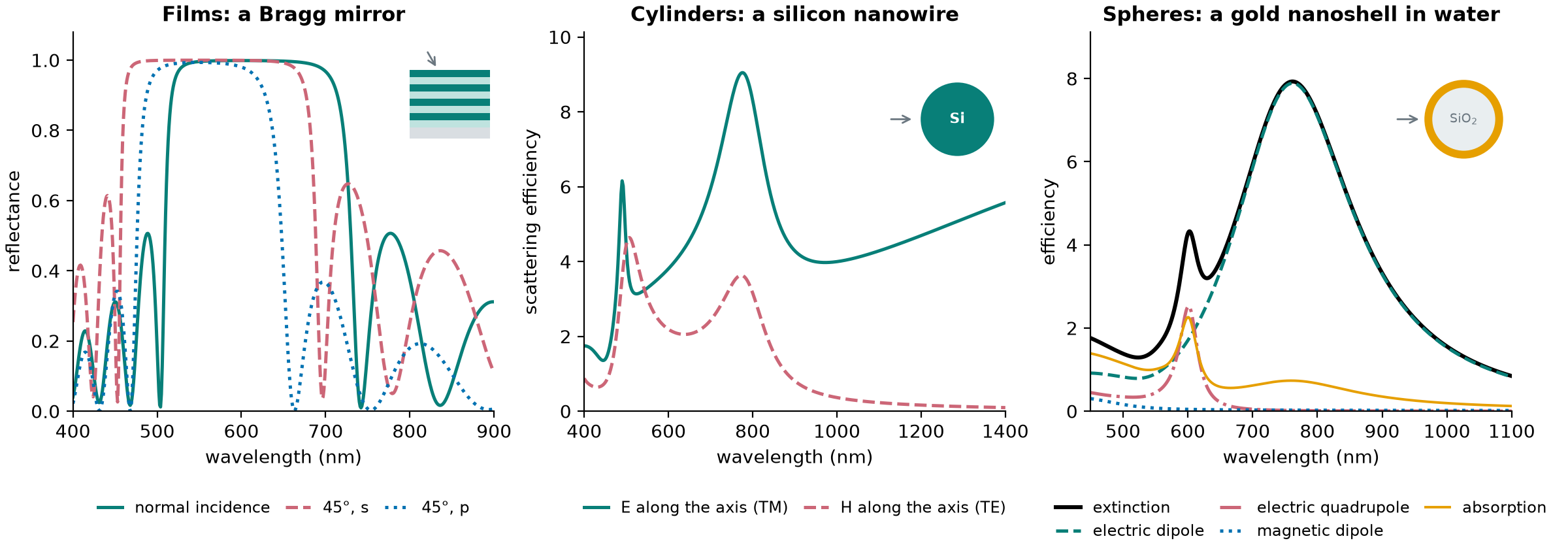
PyStratify is the engine of multilayer.app, a free browser calculator for the same three geometries, with a theory guide and every comparison with other codes plotted.
Why PyStratify
- Three geometries, one method. The transfer-matrix method for films (after Byrnes's
tmm, whose function names it keeps), its cylindrical analogue for coated wires and fibres, and for spheres the recursive transfer-matrix method of Moroz (2005) as used by STRATIFY (Rasskazov, Carney & Moroz, OSA Continuum 3, 2290 (2020)). - Sources beyond the plane wave. Electric and magnetic dipoles inside or outside the structure, with decay rates split into radiated, guided and absorbed power; focused beams as in FT-IR microspectroscopy.
- Spheres go further. Absorbing, magnetic, gain and chiral (Pasteur) shells; 2D materials and Feibelman d-parameters on the interfaces; electric, magnetic, chiral and quadrupole emitters; angle-resolved far fields, near fields, stored energy, Casimir–Polder potentials and two-point Green's dyadics.
- Accurate where others break down. Special functions as complex logarithms and a scaled two-sided recursion keep 1e-12 agreement with 60-digit references, energy balance to 1e-14 at 0.05 nm from a lossless interface, and absorbing spheres to size parameter 20 000 (docs/NUMERICS.md).
- Checked in public. Every comparison with another code is a script in
benchmarks/that anyone can rerun (below). - Light to install. Pure Python on NumPy and SciPy; whole spectra are vectorised.
Install
pip install pystratify
Python ≥ 3.10, NumPy ≥ 1.24, SciPy ≥ 1.10. The development version:
pip install git+https://github.com/multilayerapp/PyStratify.git.
Quick start
Lengths share one unit of your choosing (here nanometres), angles are in radians, and indices are n + ik. No optical constants are shipped: take them from a database such as refractiveindex.info.
Films. The planar module keeps the tmm interface: here a quarter-wave
Bragg mirror, 8 pairs of TiO₂ / SiO₂ on glass.
import numpy as np
import pystratify as ps
from pystratify import planar

n_list = [1.0] + [2.35, 1.46] * 8 + [1.52]                    # incident medium, layers, substrate
d_list = [np.inf] + [600 / 4 / 2.35, 600 / 4 / 1.46] * 8 + [np.inf]
R = [planar.coh_tmm("s", n_list, d_list, 0.0, wl)["R"] for wl in np.linspace(400, 900, 501)]
Cylinders. A silicon nanowire of radius 80 nm at normal incidence, both polarisations.
wire = ps.solve_cylinder([80.0], [3.6, 1.0], 775.0)            # radii, indices (host last), wavelength
ps.cross_widths(wire, "axial-electric")["efficiency_scattering"]
ps.cross_widths(wire, "axial-magnetic")["efficiency_scattering"]
Spheres. A silica–gold nanoshell in water over a whole spectrum, with its multipole decomposition.
wavelength = np.linspace(450, 1100, 651)
n_gold = 0.2 + 3.5j                                           # use tabulated n, k for real work
n = np.stack([np.full(651, 1.45), np.full(651, n_gold), np.full(651, 1.33)], axis=1)
sol = ps.solve([60.0, 75.0], n, wavelength)                   # radii of every interface, n per shell
cs = ps.cross_sections(sol)
cs.q_ext, cs.q_sca, cs.q_abs                                  # efficiencies over wavelength
cs.ext_by_order[:, ps.TM, 0] / cs.geometric                   # the electric dipole's share
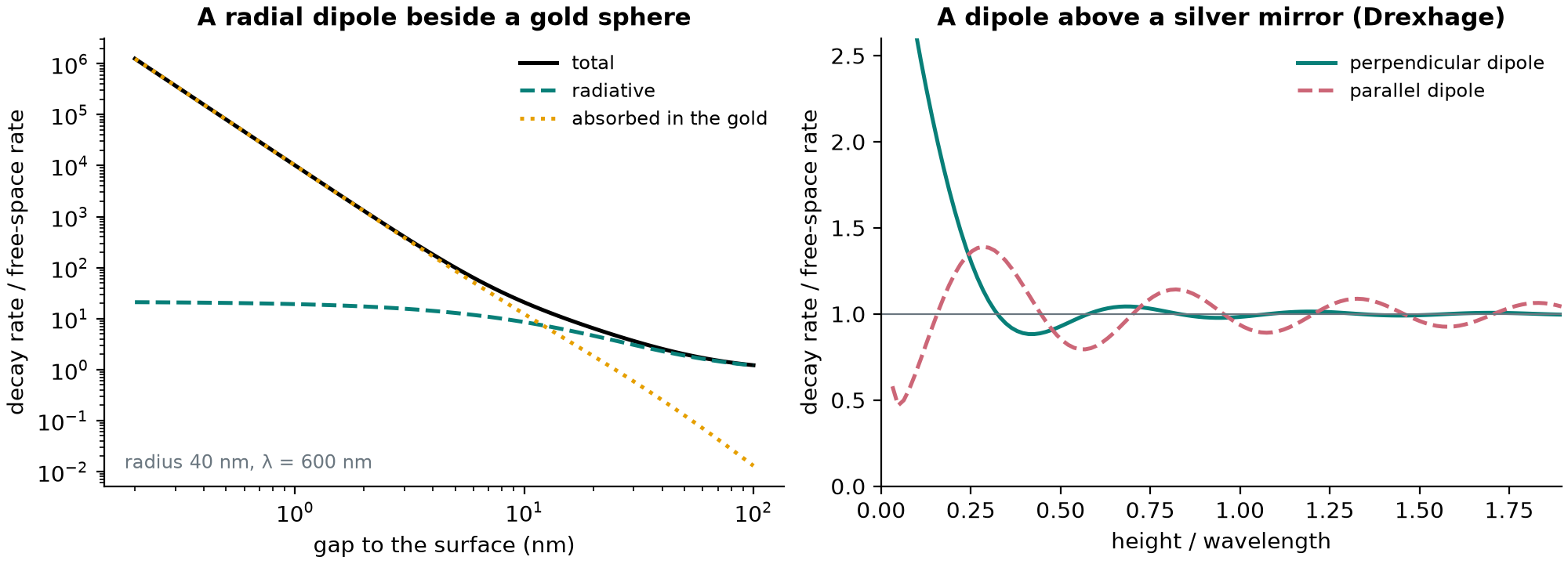
Emitters. Decay rates of a dipole beside a sphere, and above a silver mirror through the unified
solve_problem interface, which takes the same arguments for all three geometries.
rates = ps.decay_rates([40.0], [n_gold, 1.0], 600.0, r=40.0 + np.geomspace(0.2, 100, 60))
rates.total, rates.radiative, rates.nonradiative               # (positions, [radial, tangential])

mirror = ps.Problem("films", [np.inf, 200.0, np.inf], [1.0, 0.135 + 3.99j, 1.52], 633.0,
                    ps.PointDipole(-100.0, "electric", layer=0))  # 100 nm above 200 nm of silver on glass
result = ps.solve_problem(mirror)
result["total"], result["escape"], result["absorbed"]          # perpendicular, parallel, isotropic
Focused beams. An FT-IR objective (NA 0.5, central obscuration 0.23) on a polymer fibre.
beam = ps.FocusedBeam(0.5, 0.23)                              # NA, obscuration NA
wavenumber = np.linspace(1000, 4000, 61)                      # cm⁻¹
fibre = ps.focused_cylinders([5.0], [1.49 + 0.01j, 1.0], 1e4 / wavenumber, beam)   # lengths in µm here
fibre.apparent_absorbance
Far more is in the user guide:
conventions, every source and output, chiral media, 2D sheets and the full sphere toolbox. The runnable scripts in
examples/ (multipole spectra, scattering patterns,
near-field maps, decay rates, circular dichroism, quadrupole emitters, graphene-coated spheres…) each save a figure,
and crosscheck/ recomputes figures of classic
papers from their stated parameters.
Verified against independent codes
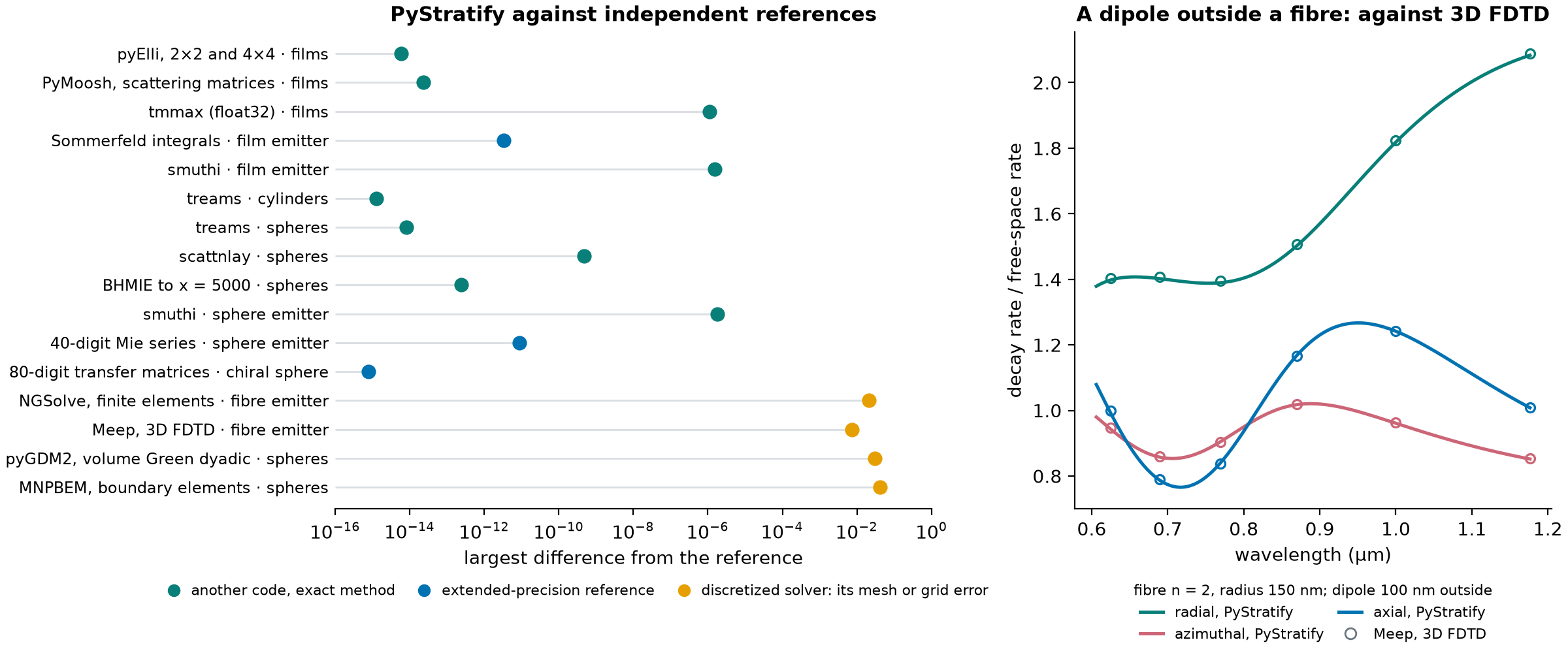
Codes that solve the same equations exactly agree with PyStratify to between 1e-15 and 2e-6, the larger differences
being the reference's own precision (float32 in tmmax, a contour integral in smuthi). Solvers that discretize space
agree to their mesh or grid error, 0.7–4%; for Meep and MNPBEM the difference was shown to shrink as the grid or mesh
is refined. Each point is a script in
benchmarks/ that writes its own report, and
python benchmarks/verify_all.py reruns the whole study in pinned environments
(benchmarks/README.md).
MATRIX.md maps every check by geometry,
source and quantity, and the Verification page plots each one.
Speed
Typical timings on one core:
| task | time |
|---|---|
| 601-wavelength spectrum, gold nanoshell | 25 ms |
| sphere of size parameter 500, all orders | 8 ms |
| decay rates at 100 positions 0.5–25 nm from a gold nanoshell | 0.15 s |
| scattering pattern on a 181 × 361 (θ, φ) grid | 10 ms |
| 300 × 300 near-field map | 1.4 s |
More, and the accuracy to expect in every regime: docs/NUMERICS.md.
Documentation
| User guide | the problem description, focused beams, the sphere toolbox, conventions |
| API contract | which names are stable for 1.x, provisional, legacy or internal |
| Numerics | how accuracy is kept, accuracy to expect, known limitations, timings |
| Benchmarks | every comparison with another code, and how to rerun it |
| Tests | what each test file checks |
| Changelog | what changed in each release |
| Audit of STRATIFY | the defects of the MATLAB code that PyStratify fixes |
| Learn | the theory, from Maxwell's equations to each geometry, with live figures |
PyStratify is before 1.0: the names listed as frozen in the API contract keep their meaning from 1.0 on. Questions and bug reports are welcome in issues.
Tests
pip install -e ".[test]"
pytest
Citing
PyStratify implements the method of STRATIFY; please cite the paper,
I. L. Rasskazov, P. S. Carney and A. Moroz, "STRATIFY: a comprehensive and versatile MATLAB code for a multilayered sphere," OSA Continuum 3, 2290 (2020), doi:10.1364/OSAC.399979,
and the software itself: doi:10.5281/zenodo.23287561 names every version and resolves to the latest; each release also has its own DOI on that Zenodo page, which is the one to cite for the exact code you ran (CITATION.cff).
Licence
GPL-3.0-or-later, as STRATIFY (this is a derivative work). The planar routines derive from Byrnes's tmm and keep
its MIT notice (src/pystratify/PLANAR-LICENSE.txt).
1 maintainer

Metadata
1 maintainer
Release files for pystratify 0.10.6
For a detailed explanation of source distributions (sdists) and built distributions (wheels), please see the package formats documentation.
Source distribution (sdist)
| File | Size | Uploaded | Provenance | Actions |
|---|---|---|---|---|
| pystratify-0.10.6.tar.gz | 249.0 kB | With provenance | Details for pystratify-0.10.6.tar.gz |
Built distribution (wheel)
| File | Interpreter | ABI | Platform | Actions Reset |
|---|---|---|---|---|
| pystratify-0.10.6-py3-none-any.whl | Python 3 | none | any | Details for pystratify-0.10.6-py3-none-any.whl |
Total release size: 457.3 kB
Release files / pystratify-0.10.6.tar.gz
| Download URL | pystratify-0.10.6.tar.gz |
|---|---|
| Size | 249.0 kB |
| Tags | Source |
|
SHA-256 checksum How to use checksums |
da4b674a7598d881adef9b7573478994f9f0ae3b4bfc1f0a08e4069f48505f26
|
|
BLAKE2b-256 checksum How to use checksums |
3d0a488f437e3fbc3ce062c2b88244a56f0df094a6136abfeb7009ddb6a12fb8
|
| Upload date | |
|
Uploaded using Trusted Publishing? What is trusted publishing? |
Yes |
| Uploaded via |
twine/7.0.0 CPython/3.13.14
|
Provenance
Provenance describes where a file came from. On PyPI, provenance is shared via attestations, which provide a verifiable record of the build or publishing details. View details, limitations and caveats.


PyPI Publish Attestation
PyPI verified that this artifact, at this checksum, originated from the publisher listed below.
Signed by GitHub Actions, verified by PyPI on Oct 14, 2026.
Transparency logRelease files / pystratify-0.10.6-py3-none-any.whl
| Download URL | pystratify-0.10.6-py3-none-any.whl |
|---|---|
| Size | 208.2 kB |
| Tags | Python 3 |
|
SHA-256 checksum How to use checksums |
b5cff8e6cf176222797e1a82f904be4898ccd37135a7143ba4ee6240d7caac28
|
|
BLAKE2b-256 checksum How to use checksums |
f789bba1d47dc4c335b205d75842b2884b491ac44e68d820c78d001c318cf770
|
| Upload date | |
|
Uploaded using Trusted Publishing? What is trusted publishing? |
Yes |
| Uploaded via |
twine/7.0.0 CPython/3.13.14
|
Provenance
Provenance describes where a file came from. On PyPI, provenance is shared via attestations, which provide a verifiable record of the build or publishing details. View details, limitations and caveats.
PyPI Publish Attestation
PyPI verified that this artifact, at this checksum, originated from the publisher listed below.
Signed by GitHub Actions, verified by PyPI on Oct 14, 2026.
Transparency logSecurity for pystratify 0.10.6
Provenance
Provenance describes where a file came from. On PyPI, provenance is shared via attestations, which provide a verifiable record of the build or publishing details. View details, limitations and caveats.
Full provenance
All 2 files in this release have been uploaded with provenance metadata.
Attestation for pystratify-0.10.6.tar.gz
PyPI Publish Attestation
PyPI verified that this artifact, at this checksum, originated from the publisher listed below.
Signed by GitHub Actions, verified by PyPI on Oct 14, 2026.
Transparency logA note on package security
PyPI is a repository for distributing packages, not a service for auditing them. While third-party security researchers and our staff do their best to detect and remove malicious packages, PyPI cannot guarantee the quality, security or suitability of any given package.
To learn more about protecting yourself from malicious actors, visit our package security documentation.














