
A library for text_to_svg, image_to_svg, and SVG resizing and optimization.

Project description
✨ Pysvgenius ✨
Text ➜ SVG | Image ➜ SVG | Smart SVG Resizing
Turn your text or images into optimized, scalable SVGs effortlessly.


📖 Description
Pysvgenius is a powerful Python library designed for generating and optimizing scalable vector graphics (SVGs). It provides an end‑to‑end workflow that includes:
-
Text‑to‑SVG: Generate SVG illustrations directly from text prompts.
-
Image‑to‑SVG: Convert raster images into clean, scalable vector graphics.
-
Smart SVG Optimization & Resizing: Optimize paths and file size while preserving visual quality.
With Pysvgenius, you can effortlessly create high‑quality SVGs for design, AI applications, and modern web projects, ensuring both scalability and efficiency.
🖼️ Demo
| Input | Text-to-Image | Image-to-SVG | Optimized SVG |
|---|---|---|---|
| "A lighthouse overlooking the ocean" |  |
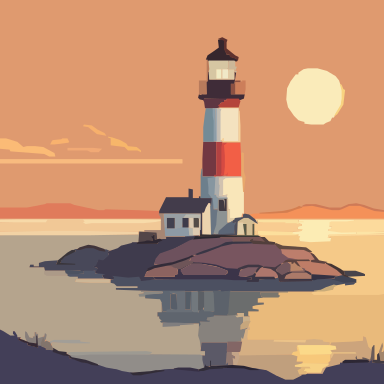 |
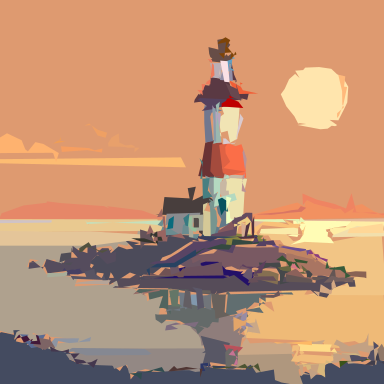 |
| "A serene Asian dragon" |  |
 |
 |
| "Futuristic skyscraper with neon lights" |  |
 |
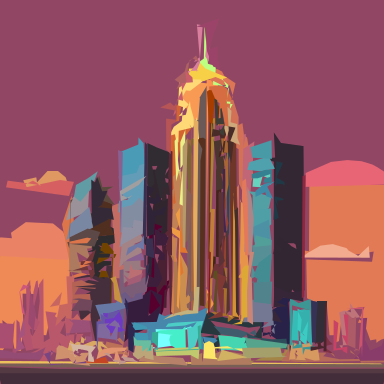 |
🖥️ System Requirements
To install and run pysvgenius smoothly, we recommend the following minimum setup:
- OS: Linux / macOS / Windows 10+ (x86_64)
- Python: 3.10 or higher
- CPU: 4 cores (Intel i5/Ryzen 5 or higher)
- RAM: 16 GB minimum (24 GB recommended for large models)
- Storage: ~30 GB for models & caches
- GPU: NVIDIA GPU with CUDA 11+ for faster generation and DiffVG optimization
- Recommended: 16 GB VRAM or more
⚡ Tip: CPU-only mode works but is slower for image generation and optimization.
📦 Installation
# Basic installation
pip install pysvgenius

# With OpenAI CLIP support
pip install pysvgenius[clip]

# Full installation with all extras
pip install pysvgenius[clip,diff_jpeg]
🔧 (Optional) Build DiffVG for Optimizer
To use advanced SVG optimization features, you need to build diffvg from source.
# 1. Clone diffvg repository
git clone https://github.com/BachiLi/diffvg.git
cd diffvg

# 2. Initialize submodules
git submodule update --init --recursive

# 3. Install into current Python environment
python setup.py install
🚀 Usage
1️⃣ Text-to-SVG Generation
Generate SVGs directly from text prompts using the built-in generator:
from pysvgenius.generator import load_generator
from pysvgenius.common import registry

# List all available generator models
print(registry.list_generator())

# Load the generator (example: SDXL-Turbo)
generator = load_generator("sdxl-turbo")

# Generate 5 SVGs from a text prompt
images = generator("A lighthouse overlooking the ocean", num_images=5)

# images is a list of PIL.Image objects or SVG paths depending on the mode
for idx, img in enumerate(images):
    img.save(f"lighthouse_{idx}.png")
2️⃣ Image-to-SVG Converter
Convert images to SVG paths with the built-in converters:
from pysvgenius.converter import load_converter
from pysvgenius.common import registry

# List all available converters
print(registry.list_converter())

# Load the converter (example: VTracer Binary Search)
converter = load_converter("vtracer-binary-search")

# Convert an image to SVG paths
# `image` can be a PIL.Image or a path to an image
svgs = converter(image, limit=10000)

# `svgs` is a list of SVG path strings
for idx, svg in enumerate(svgs):
    with open(f"output_{idx}.svg", "w") as f:
        f.write(svg)
3️⃣ SVG Ranking (Optional)
After generating SVG candidates, you can rank them using different strategies:
- Aesthetic Ranker → Scores based on visual aesthetics.
- SigLIP Ranker → Scores based on semantic similarity to a text prompt.
from pysvgenius import setup_path
from pysvgenius.ranker import load_ranker
from pysvgenius.common import registry

# ✅ Setup paths (run ONCE at the start of your script)
setup_path()

# Check available rankers
print(registry.list_ranker())

# Load rankers
aesthetic_ranker = load_ranker("aesthetic")
siglip_ranker = load_ranker("siglip")

# Rank purely by visual aesthetics (top 5 SVGs)
aesthetic_results = aesthetic_ranker(svgs=svgs, top_k=5)

# Rank by semantic similarity to a text prompt (top 1 SVG)
prompt = "a serene Asian dragon flying over green mountains"
siglip_results = siglip_ranker(svgs=svgs, prompt=prompt, top_k=1)

print("Aesthetic Ranking:", aesthetic_results)
print("SigLIP Ranking:", siglip_results)
4️⃣ Optimize SVGs with DiffVG (Optional)
from pysvgenius.optimizer import load_optimizer
from pysvgenius import load_config, setup_path

# Initialize paths and configuration
setup_path()                     # Run once before loading any model
config = load_config()           # Load default configuration
args = config.optimizer_cfg["diffvg"]["args"]  # Get DiffVG optimizer arguments

# Load the DiffVG Optimizer
optimizer = load_optimizer("diffvg")

# Optimize the SVG based on the original image
# ⚠ Note: 'limit' should match the converter's limit for the best results
optimized_svg = optimizer(
    svg=svgs[0],         # Input SVG
    image=image,         # Original image for comparison
    args=args,           # Optimizer arguments
    limit=20000          # Sampling points, ideally the same as converter's limit
)
📂 Project Structure
pysvgenius/
├── src/
│   ├── generator/          # Text-to-image generation models
│   │   ├── sdxl_turbo_generator.py
│   │   ├── factory.py
│   │   └── base.py
│   ├── converter/          # Image-to-SVG conversion
│   │   ├── vtracer.py
│   │   ├── factory.py
│   │   └── base.py
│   ├── ranker/            # Aesthetic & similarity ranking
│   │   ├── aesthetic_ranker.py
│   │   ├── siglip_ranker.py
│   │   ├── paligemma_ranker.py
│   │   ├── factory.py
│   │   └── base.py
│   ├── optimizer/         # SVG optimization with DiffVG
│   │   ├── diffvg_optimizer.py
│   │   ├── factory.py
│   │   └── base.py
│   ├── utils/             # Utilities and helpers
│   │   ├── image_utils.py
│   │   ├── svg_utils.py
│   │   └── logger.py
│   └── services/          # Service layer
├── configs/               # Configuration files
│   └── configs.yaml
├── models/               # Pre-trained model cache
├── data/                 # Test data and results
│   ├── test/            # Sample input files
│   └── results/         # Output results
├── notebooks/            # Example notebooks
📚 References & Acknowledgments
This project builds upon the amazing work of the following projects and research:
-
VTracer – Vector image tracer
-
CLIP – Connecting vision and language
-
Improved Aesthetic Predictor
-
DiffVG – Differentiable Vector Graphics
-
Hugging Face Transformers – Model hosting and inference
-
Kaggle: Drawing with LLMs – Discussion and inspiration
🤝 Contributing
Contributions are welcome! Please open an issue or submit a pull request.
Release history Release notifications | RSS feed


Download files
Download the file for your platform. If you're not sure which to choose, learn more about installing packages.
Source Distribution
Built Distribution
Filter files by name, interpreter, ABI, and platform.
If you're not sure about the file name format, learn more about wheel file names.
Copy a direct link to the current filters
File details
Details for the file pysvgenius-0.1.5.2.tar.gz.
File metadata
- Download URL: pysvgenius-0.1.5.2.tar.gz
- Upload date:
- Size: 15.3 MB
- Tags: Source
- Uploaded using Trusted Publishing? No
- Uploaded via: twine/6.1.0 CPython/3.10.13
File hashes
| Algorithm | Hash digest | |
|---|---|---|
| SHA256 |
a89a1229d044a99028247c638654d8acbc0e067ef85833a5f957e2779401e8a9
|
|
| MD5 |
eefe6fe459c5b02531e8db8d2feea4b0
|
|
| BLAKE2b-256 |
2f6e2b9777a928c3e5a841a9cee12c686017fa3f17798ae6e6db7932b70f27f4
|
File details
Details for the file pysvgenius-0.1.5.2-py3-none-any.whl.
File metadata
- Download URL: pysvgenius-0.1.5.2-py3-none-any.whl
- Upload date:
- Size: 16.8 MB
- Tags: Python 3
- Uploaded using Trusted Publishing? No
- Uploaded via: twine/6.1.0 CPython/3.10.13
File hashes
| Algorithm | Hash digest | |
|---|---|---|
| SHA256 |
6fc00a3526e5568f4d19c396730f809044691c68994b5b24a3a30174e7b74b80
|
|
| MD5 |
6018b03c53d5d7bda2de842428429833
|
|
| BLAKE2b-256 |
3f3e954f90bf3cb43251523baa083878e1ece6c0e26befe0131ea325a835dfac
|






