


PyTabKit: Tabular ML models and benchmarking (NeurIPS 2024)
| Paper | Documentation | RealMLP-TD-S standalone implementation | Grinsztajn et al. benchmark code | Data archive |
|---|
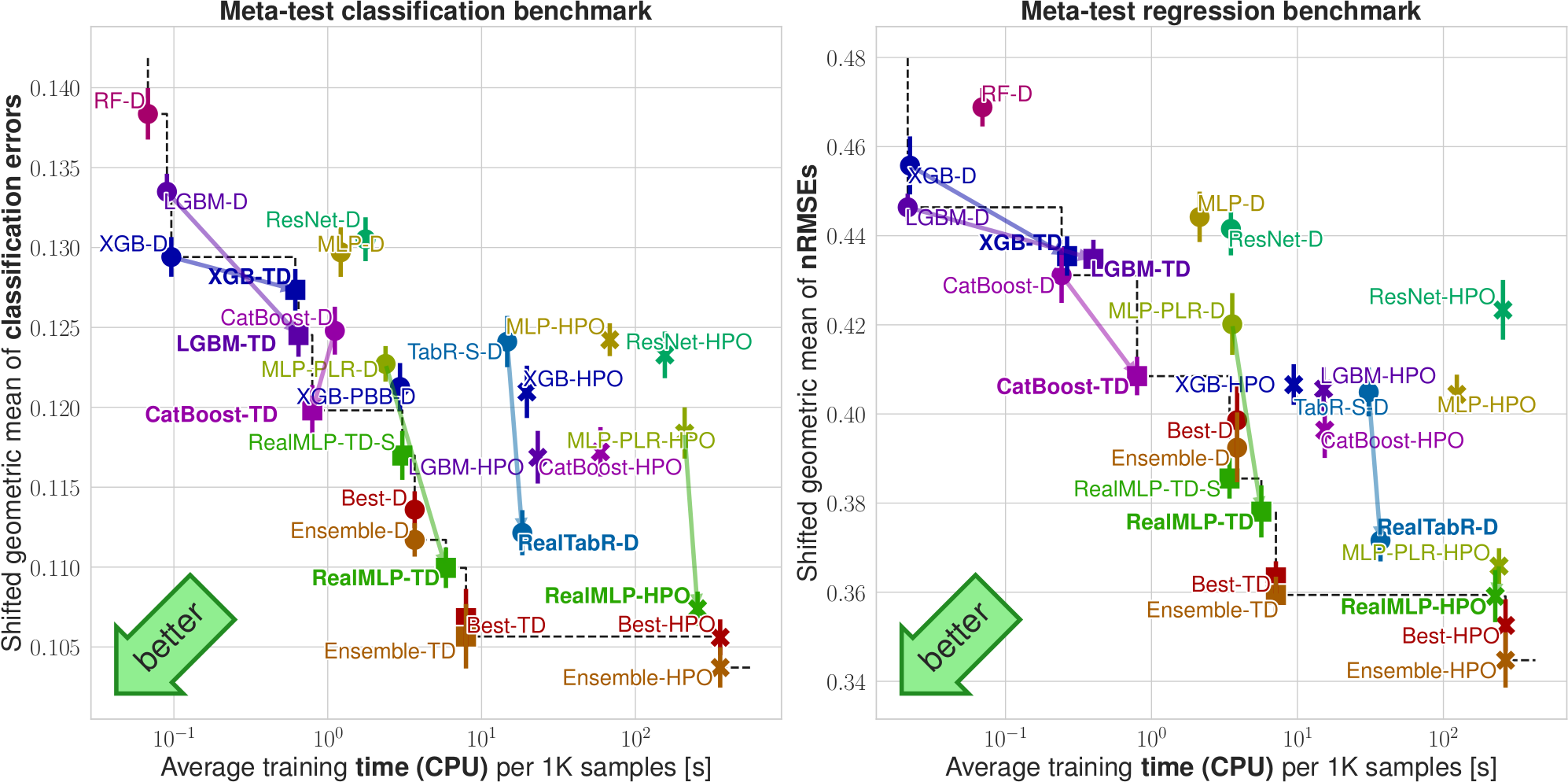
PyTabKit provides scikit-learn interfaces for modern tabular classification and regression methods benchmarked in our paper, see below. It also contains the code we used for benchmarking these methods on our benchmarks.
When (not) to use pytabkit
- To get the best possible results:
- Generally we recommend AutoGluon for the best possible results, though it does not include all the models from pytabkit. AutoGluon 1.4 includes RealMLP (though not in a default configuration) and TabM (in the "extreme" preset for <= 30K samples).
- To get the best possible results from
pytabkit, we recommend usingEnsemble_HPO_Classifier(n_cv=8, use_full_caruana_ensembling=True, use_tabarena_spaces=True, n_hpo_steps=50)with aval_metric_namecorresponding to your target metric (e.g.,class_error,cross_entropy,brier,1-auc_ovr), or the correspondingRegressor. (This might take very long to fit.) - For only a single model, we recommend using
RealMLP_HPO_Classifier(n_cv=8, hpo_space_name='tabarena-new', use_caruana_ensembling=True, n_hyperopt_steps=50), also withval_metric_nameas above, or the correspondingRegressor.
- Models: TabArena
also includes some newer models like RealMLP and TabM
with more general preprocessing (missing numericals, text, etc.),
as well as very good boosted tree implementations.
pytabkitis currently still easier to use and supports vectorized cross-validation for RealMLP, which can significantly speed up the training. - Benchmarking: While pytabkit can be good for quick benchmarking for development, for method evaluation we recommend TabArena.
Installation (new in 1.4.0: optional model dependencies)
pip install pytabkit[models]
- RealMLP (and TabM) can be used without the
[models]part. - For xRFM on GPU, faster kernels will be used if you install
kermac[cu12]orkermac[cu11](depending on your CUDA version). - The KumoTabular wrapper needs the
structured-data-modelspackage, which is only installed with[models]for Python >= 3.11 (it also requirestorch>=2.7). - If you want to use TabR, you have to manually install faiss, which is only available on conda.
- Please install torch separately if you want to control the version (CPU/GPU etc.)
- On macOS, LightGBM and XGBoost need OpenMP (e.g.,
brew install libomp). Using PyTorch-based models (like RealMLP) and LightGBM/XGBoost in the same process (e.g., in the ensembles) can then crash with a segmentation fault, since the pip wheels load two different OpenMP runtimes. Installingpytorch,lightgbm, andxgboostfrom conda-forge avoids this. - Use
pytabkit[models,autogluon,extra,hpo,bench,dev]to install additional dependencies for the other models, AutoGluon models, extra preprocessing, hyperparameter optimization methods beyond random search (hyperopt/SMAC), the benchmarking part, and testing/documentation. For the hpo part, you might need to install swig (e.g. via pip) if the build of pyrfr fails. See also the documentation. To run the data download for the meta-train benchmark, you need one of rar, unrar, or 7-zip to be installed on the system.
Using the ML models
Most of our machine learning models are directly available via scikit-learn interfaces. For example, you can use RealMLP-TD for classification as follows:
from pytabkit import RealMLP_TD_Classifier

model = RealMLP_TD_Classifier()  # or TabR_S_D_Classifier, CatBoost_TD_Classifier, etc.
model.fit(X_train, y_train)
model.predict(X_test)
The code above will automatically select a GPU if available,
try to detect categorical columns in dataframes,
preprocess numerical variables and regression targets (no standardization required),
and use a training-validation split for early stopping.
All of this (and much more) can be configured through the constructor
and the parameters of the fit() method.
For example, it is possible to do bagging
(ensembling of models on 5-fold cross-validation)
simply by passing n_cv=5 to the constructor.
Here is an example for some of the parameters that can be set explicitly:
from pytabkit import RealMLP_TD_Classifier

model = RealMLP_TD_Classifier(device='cpu', random_state=0, n_cv=1, n_refit=0,
                              n_epochs=256, batch_size=256, hidden_sizes=[256] * 3,
                              val_metric_name='cross_entropy',
                              use_ls=False,  # for metrics like AUC / log-loss
                              lr=0.04, verbosity=2)
model.fit(X_train, y_train, X_val, y_val, cat_col_names=['Education'])
model.predict_proba(X_test)
See this notebook for more examples. Missing numerical values are currently not allowed and need to be imputed beforehand.
Available ML models
Our ML models are available in up to three variants, all with best-epoch selection:
- library defaults (D)
- our tuned defaults (TD)
- random search hyperparameter optimization (HPO), sometimes also tree parzen estimator (HPO-TPE) or weighted ensembling (Ensemble)
We provide the following ML models:
- RealMLP (TD, HPO, Ensemble): Our new neural net models with tuned defaults (TD), random search hyperparameter optimization (HPO), or Ensembling
- XGB, LGBM, CatBoost (D, TD, HPO, HPO-TPE): Interfaces for gradient-boosted tree libraries XGBoost, LightGBM, CatBoost
- MLP, ResNet, FTT (D, HPO): Models from Revisiting Deep Learning Models for Tabular Data
- MLP-PLR (D, HPO): MLP with numerical embeddings from On Embeddings for Numerical Features in Tabular Deep Learning
- TabR (D, HPO): TabR model from TabR: Tabular Deep Learning Meets Nearest Neighbors
- TabM (D, HPO): TabM model from TabM: Advancing Tabular Deep Learning with Parameter-Efficient Ensembling
- XRFM (D, HPO): xRFM model from here (original repo)
- RealTabR (D): Our new TabR variant with default parameters
- Ensemble-TD: Weighted ensemble of all TD models (RealMLP, XGB, LGBM, CatBoost)
Post-hoc calibration and refinement stopping
For using post-hoc temperature scaling and refinement stopping from our paper Rethinking Early Stopping: Refine, Then Calibrate, you can pass the following parameters to the scikit-learn interfaces:
from pytabkit import RealMLP_TD_Classifier
clf = RealMLP_TD_Classifier(
    val_metric_name='ref-ll-ts',  # short for 'refinement_logloss_ts-mix_all'
    calibration_method='ts-mix',  # temperature scaling with laplace smoothing
    use_ls=False  # recommended for cross-entropy loss
)
Other calibration methods and validation metrics from probmetrics can be used as well.
For reproducing the results from this paper, we refer to the documentation.
Benchmarking code
Our benchmarking code has functionality for
- dataset download
- running methods highly parallel on single-node/multi-node/multi-GPU hardware, with automatic scheduling and trying to respect RAM constraints
- analyzing/plotting results
For more details, we refer to the documentation.
The benchmarking code also contains wrappers for further models,
such as TabPFN, TabICL, and the KumoTabular foundation model (KumoTabularInterfaceWrapper).
Few-shot benchmark (new in 1.8.0).
The code for the few-shot benchmark from the TabICLv2 paper (ICML) is included:
datasets from the TALENT benchmark with 100–2000 samples (binary classification and regression),
where methods only get 16 samples for training and validation.
Import the datasets with import_talent_tiny=True in scripts/download_data.py,
run the methods with scripts/run_fewshot_experiments.py,
and create the result tables with scripts/create_fewshot_tables.py.
Preprocessing code
While many preprocessing methods are implemented in this repository, a standalone version of our robust scaling + smooth clipping can be found here.
Citation
If you use this repository for research purposes, please cite our paper:
@inproceedings{holzmuller2024better,
  title={Better by default: {S}trong pre-tuned {MLPs} and boosted trees on tabular data},
  author={Holzm{\"u}ller, David and Grinsztajn, Leo and Steinwart, Ingo},
  booktitle = {Neural {Information} {Processing} {Systems}},
  year={2024}
}
Contributors
- David Holzmüller (main developer)
- Léo Grinsztajn (deep learning baselines, plotting)
- Ingo Steinwart (UCI dataset download)
- Katharina Strecker (PyTorch-Lightning interface)
- Daniel Beaglehole (part of the xRFM implementation)
- Lennart Purucker (some features/fixes)
- Jérôme Dockès (deployment, continuous integration)
Acknowledgements
Code from other repositories is acknowledged as well as possible in code comments. Especially, we used code from https://github.com/yandex-research/rtdl and sub-packages (Apache 2.0 license), code from https://github.com/catboost/benchmarks/ (Apache 2.0 license), and https://docs.ray.io/en/latest/cluster/vms/user-guides/community/slurm.html (Apache 2.0 license).
Releases (see git tags)
- v1.8.0:
- Added a standalone, simplified RealMLP implementation in
pytabkit.models.realmlp(plain PyTorch, no Lightning or fitter framework), which additionally supports missing numerical values. It is experimental and half vibe-coded, but it has been confirmed experimentally to yield similarly good results as the original implementation. See its README for the differences to the original implementation. - Added the code for the few-shot benchmark from the TabICLv2 paper (ICML), see the benchmarking section.
- Added a benchmark wrapper for the KumoTabular foundation model (
KumoTabularInterfaceWrapper). It requires thestructured-data-modelspackage (Python >= 3.11), which is now an optional dependency inpytabkit[models]. - Other benchmarking additions: dummy baselines, TabICL for regression, selectable TabPFN versions,
refitting for RF, ExtraTrees, linear models, TabPFN, and TabICL,
and limits on the number of training/validation and test samples (
max_trainval_samples,max_test_samplesinRunConfig). - Bugfixes found through the few-shot benchmark:
- CatBoost no longer crashes if the training set contains only a single class or if the regression target is constant.
- The CatBoost validation metric now also works when CatBoost passes (all-one) sample weights.
- The expected calibration error no longer fails when only a single class is present.
- Fixed
batch_size='auto'in RealMLP: the batch size was chosen based on the number of vectorized splits instead of the number of training samples, so it was effectively always 64. - Pytorch-Lightning's info messages ("GPU available: ..." etc.) are no longer printed for every fit/predict
of RealMLP and TabR (with
verbosity=0), fixing #39. - TabR now raises a clear error if
candidate_encoding_batch_sizeis set withoutmemory_efficient=True(#44). - Fixed a
FutureWarningon everyfit()with scikit-learn 1.6 and 1.7 (#41, #42). - Documented that RealMLP applies the lr and wd factors of a parameter twice in the weight decay (#40). This is kept for backward compatibility; the new standalone implementation applies them once.
- Dropped support for Python 3.9.
The CI now installs OpenMP (
libomp) on macOS (see #42). - Python 3.13 is now also tested in the CI (Ray provides Windows wheels for Python 3.13 now).
- Added a standalone, simplified RealMLP implementation in
- v1.7.3:
- disabled RealMLP lightning log file creation that was accidentally introduced in predict() in >=v1.7.0.
- removed pynvml dependency.
- v1.7.2:
- Added scikit-learn 1.8 compatibility.
- Removed debug print in RealMLP.
- fixed device memory estimation error in the scheduler when
CUDA_VISIBLE_DEVICESwas used.
- v1.7.1:
- LightGBM now processes the
extra_trees,max_cat_to_onehot, andmin_data_per_groupparameters used in the'tabarena'search space, which should improve results. - Scikit-learn interfaces for RealMLP (TD, HPO) now support moving the model to a different device
(e.g., before saving). This can be achived using, e.g.,
model.to('cpu')(which is in-place). - Fixed an xRFM bug in handling binary categorical features.
- LightGBM now processes the
- v1.7.0:
- added xRFM (D, HPO)
- added new
'tabarena-new'search space for RealMLP-HPO, including per-fold ensembling (more expensive) and tuning two more categorical hyperparameters (with better results) - reduced RealMLP pickle size by not storing the dataset (#33)
- fixed gradient clipping for TabM (it did nothing previously, see #34). To ensure backward compatibility, it is set to None in the HPO search spaces now (it was already None in the default parameters).
- removed debug print in TabM training loop
- v1.6.1:
- For
n_ens>1, changed the default behavior for classification to averaging probabilities instead of logits. This can be reverted by settingens_av_before_softmax=True. - Implemented time limit for HPO/ensemble methods through
time_limit_sparameter. - Support
torch>=2.6and Python 3.13.
- For
- v1.6.0:
- Added support for other training losses in TabM through the
train_metric_nameparameter, for example, (multi)quantile regression viatrain_metric_name='multi_pinball(0.05,0.95)'. - RealMLP-TD now adds the
n_enshyperparameter, which can be set to values >1 to train ensembles per train-validation split (called PackedEnsemble in the TabM paper). This is especially useful when using holdout validation instead of cross-validation ensembles, and to get more reliable validation predictions and scores for tuning/ensembling. - fixed RealMLP TabArena search space (
hpo_space_name='tabarena') for classification (allow no label smoothing throughuse_ls=Falseinstead ofuse_ls="auto").
- Added support for other training losses in TabM through the
- v1.5.2: fixed more device bugs for HPO and ensembling
- v1.5.1: fixed a device bug in TabM for GPU
- v1.5.0:
- added
n_repeatsparameter to scikit-learn interfaces for repeated cross-validation - HPO sklearn interfaces (the ones using random search)
can now do weighted ensembling instead by setting
use_caruana_ensembling=True. Removed theRealMLP_Ensemble_ClassifierandRealMLP_Ensemble_Regressorfrom v1.4.2 since they are now redundant through this feature. - renamed
spaceparameter of GBDT HPO interface tohpo_space_nameso now it also works with non-TPE versions. - Added new TabArena search spaces for boosted trees (not TPE), which should be almost equivalent to the ones from TabArena except for the early stopping logic.
- TabM now supports
val_metric_namefor early stopping on different metrics. - fixed issues #20 and #21 regarding HPO
- small updates for the "Rethinking Early Stopping" paper
- added
- v1.4.2:
- fixed handling of custom
val_metric_nameHPO models andEnsemble_TD_Regressor. - if
tmp_folderis specified in HPO models, save each model to disk immediately instead of holding all of them in memory. This can considerably reduce RAM/VRAM usage. In this case, pickled HPO models will still rely on the models stored in thetmp_folder. - We now provide
RealMLP_Ensemble_ClassifierandRealMLP_Ensemble_Regressor, which will use weighted ensembling and usually perform better than HPO (but have slower inference time). We recommend using the newhpo_space_name='tabarena'for best results.
- fixed handling of custom
- v1.4.1:
- moved dill to optional dependencies
- updated TabM code to a newer version: added option share_training_batches=False (old version: True), exclude certain parameters from weight decay.
- added documentation for using the scheduler with custom jobs.
- fixed bug in RealMLP refitting.
- updated process start method for scheduler to speed up benchmarking
- v1.4.0:
- moved some imports to the new
modelsoptional dependencies to have a more light-weight RealMLP installation - Added GPU support for CatBoost with help from Maximilian Schambach in #16 (not guaranteed to produce exactly the same results).
- Ensembling now saves models after training if a path is supplied, to reduce memory usage
- Added more search spaces
- fixed error in multiquantile output when the passed y was one-dimensional
instead of having shape
(n_samples, 1) - Added some examples to the documentation
- moved some imports to the new
- v1.3.0:
- Added multiquantile regression for RealMLP: see the documentation
- More hyperparameters for RealMLP
- Added TabICL wrapper
- Small fixes
- v1.2.1: avoid error for older skorch versions
- v1.2.0:
- Included post-hoc calibration and more metrics through probmetrics.
- Added benchmarking code for Rethinking Early Stopping: Refine, Then Calibrate.
- Updated format for saving predictions, allow to stop on multiple metrics during the same training in the benchmark.
- Better categorical handling, avoiding an error for string and object columns, not ignoring boolean columns by default but treating them as categorical.
- Added Ensemble_HPO_Classifier and Ensemble_HPO_Regressor.
- v1.1.3:
- Fixed a bug where the categorical encoding was incorrect if categories were missing in the training or validation set. The bug affected XGBoost and potentially many other models except RealMLP.
- Scikit-learn interfaces now accept and auto-detect categorical datatypes (category, string, object) in dataframes.
- v1.1.2:
- Some compatibility improvements for scikit-learn 1.6 (but disabled 1.6 since skorch is not compatible with it).
- Improved documentation for Pytorch-Lightning interface.
- Other small bugfixes and improvements.
- v1.1.1:
- Added parameters
weight_decay,tfms, andgradient_clipping_normto TabM. The updated default parameters now apply the RTDL quantile transform.
- Added parameters
- v1.1.0:
- Included TabM
- Replaced
__by_in parameter names for MLP, MLP-PLR, ResNet, and FTT, to comply with scikit-learn interface requirements. - Fixed non-determinism in NN baselines by initializing the random state of quantile (and KDI) preprocessing transforms.
- n_threads parameter is not ignored by NNs anymore.
- Changes by Lennart Purucker:
Add time limit for RealMLP,
add support for
lightning(but also still allowingpytorch-lightning), making skorch a lazy import, removed msgpack_numpy dependency.
- v1.0.0: Release for the NeurIPS version and arXiv v2+v3.
- More baselines (MLP-PLR, FT-Transformer, TabR-HPO, RF-HPO), also some un-polished internal interfaces for other methods, esp. the ones in AutoGluon.
- Updated benchmarking code (configurations, plots) including the new version of the Grinsztajn et al. benchmark
- Updated fit() parameters in scikit-learn interfaces, etc.
- v0.0.1: First release for arXiv v1. Code and data are archived at DaRUS.
1 maintainer

Metadata
1 maintainer
Release files for pytabkit 1.8.0
For a detailed explanation of source distributions (sdists) and built distributions (wheels), please see the package formats documentation.
Source distribution (sdist)
| File | Size | Uploaded | Provenance | Actions |
|---|---|---|---|---|
| pytabkit-1.8.0.tar.gz | 341.7 kB | Without provenance | Details for pytabkit-1.8.0.tar.gz |
Built distribution (wheel)
| File | Interpreter | ABI | Platform | Actions Reset |
|---|---|---|---|---|
| pytabkit-1.8.0-py3-none-any.whl | Python 3 | none | any | Details for pytabkit-1.8.0-py3-none-any.whl |
Total release size: 730.0 kB
Release files / pytabkit-1.8.0.tar.gz
| Download URL | pytabkit-1.8.0.tar.gz |
|---|---|
| Size | 341.7 kB |
| Tags | Source |
|
SHA-256 checksum How to use checksums |
fb5d36bc7fe058774d68c151832329d21a4687f727ba9bbbc1155b926ad17e02
|
|
BLAKE2b-256 checksum How to use checksums |
27f90f604847b27c241747ed4589bdd62def6b9c62bbe65efa59076f8947fb52
|
| Upload date | |
|
Uploaded using Trusted Publishing? What is trusted publishing? |
No |
| Uploaded via |
Hatch/1.16.2 cpython/3.12.3 HTTPX/0.28.1
|
Release files / pytabkit-1.8.0-py3-none-any.whl
| Download URL | pytabkit-1.8.0-py3-none-any.whl |
|---|---|
| Size | 388.2 kB |
| Tags | Python 3 |
|
SHA-256 checksum How to use checksums |
11637959137946de1447e18192c81aae903262b25c3ed49524eaf61d1ef98e9e
|
|
BLAKE2b-256 checksum How to use checksums |
1a4854cc7825bfdee238ff0a9a76ca1315e4c29eb6705dbfb8c51d67ad3b7b58
|
| Upload date | |
|
Uploaded using Trusted Publishing? What is trusted publishing? |
No |
| Uploaded via |
Hatch/1.16.2 cpython/3.12.3 HTTPX/0.28.1
|
Security for pytabkit 1.8.0
Provenance
Provenance describes where a file came from. On PyPI, provenance is shared via attestations, which provide a verifiable record of the build or publishing details. View details, limitations and caveats.
No provenance found
None of the files in this release were uploaded with provenance metadata.
A note on package security
PyPI is a repository for distributing packages, not a service for auditing them. While third-party security researchers and our staff do their best to detect and remove malicious packages, PyPI cannot guarantee the quality, security or suitability of any given package.
To learn more about protecting yourself from malicious actors, visit our package security documentation.














