
WireCheck
Your tests pass. Your Claude API calls return 400. WireCheck checks what your code really sends to the Claude API in tests, and fails the build if a request would break under API version 2026-10-21.
PyPI: pytest-wirecheck · GitHub Marketplace: WireCheck for Claude API · Demo
Why
On 21 Oct 2026 Anthropic released Claude API version 2026-10-21. The new SDK majors (Python anthropic 2.0.0 and later) send it by default. Under it, a Messages request that sends temperature, top_p or top_k returns 400, even at the default value (migration guide).
Most test suites mock the API, so they never see that 400. And these parameters are hard to grep for. Since anthropic 1.0.0, temperature= is no longer a keyword of messages.create (passing it is a TypeError, so tests catch it), and the SDK 1.0 migration guide said to pass it through extra_body instead. extra_body is merged into the JSON at runtime, so no type checker sees it, and it often sits in a shared wrapper or a defaults dict, far from the call. That is exactly how Nojoin broke: a loose version floor pulled in anthropic 2.x, a wrapper still sent temperature: 0.2 through extra_body, and the tests mocked the client, so they all passed.
WireCheck looks at the final request as it leaves the HTTP client, after the SDK has merged every wrapper, default and extra_body.
Quick start
pip install pytest-wirecheck
pytest --wirecheck
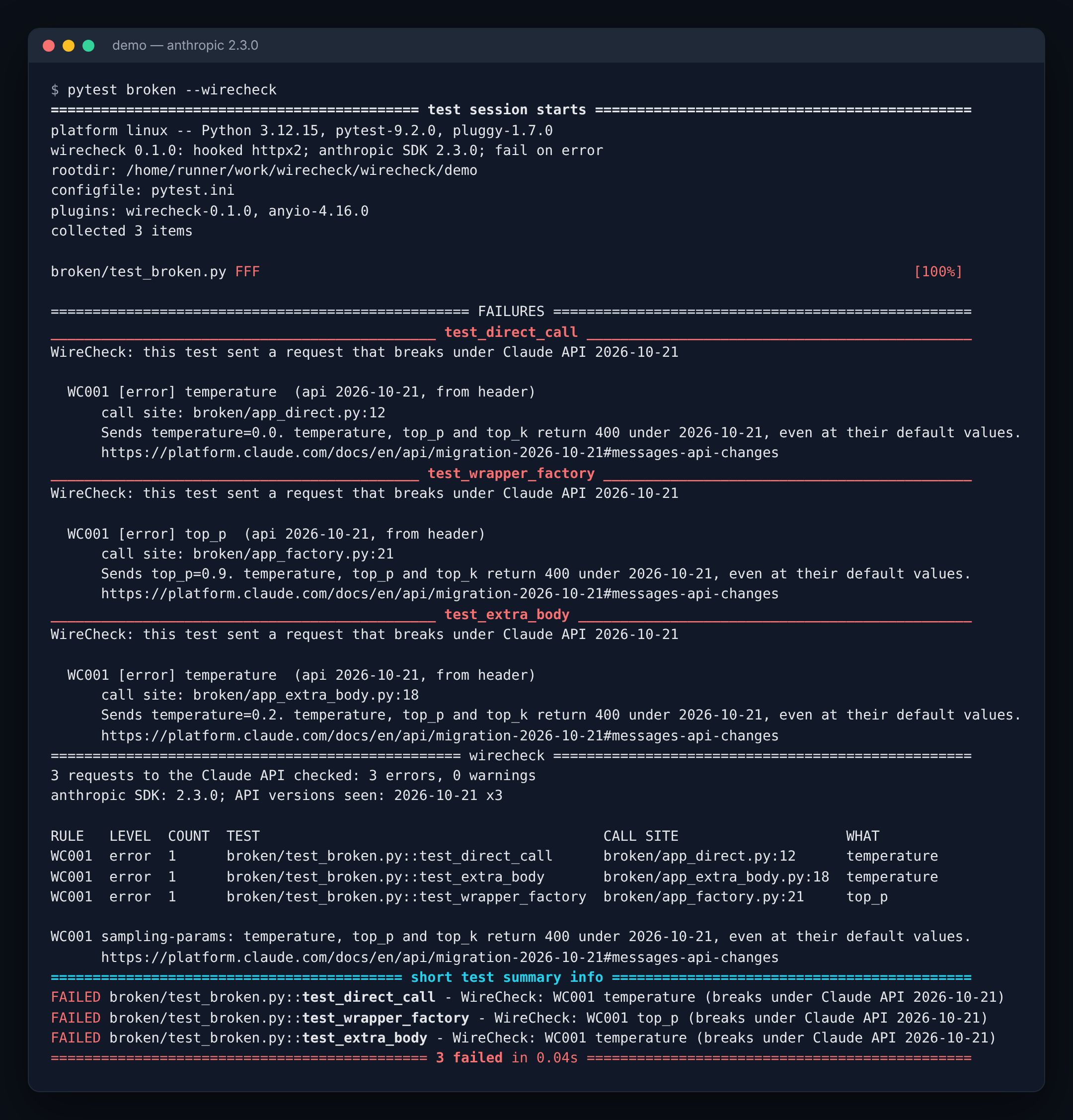
A test that sends a breaking request now fails, and the run ends with a short report. This is the demo on anthropic 2.3.0:
3 requests to the Claude API checked: 3 errors, 0 warnings
anthropic SDK: 2.3.0; API versions seen: 2026-10-21 x3

RULE   LEVEL  COUNT  TEST                                         CALL SITE                    WHAT
WC001  error  1      broken/test_broken.py::test_direct_call      broken/app_direct.py:12      temperature
WC001  error  1      broken/test_broken.py::test_extra_body       broken/app_extra_body.py:18  temperature
WC001  error  1      broken/test_broken.py::test_wrapper_factory  broken/app_factory.py:21     top_p
Each row shows the rule, the test that sent the request, and the file and line in your code that made the call. Works with pytest-xdist too.
GitHub Action
name: WireCheck
on: pull_request
permissions:
  contents: read
  pull-requests: write   # to post the findings comment
jobs:
  wirecheck:
    runs-on: ubuntu-latest
    steps:
      - uses: actions/checkout@v7
      - uses: actions/setup-python@v7
        with:
          python-version: "3.12"
      - run: pip install -e ".[test]"        # your project and its test deps
      - uses: ishanyash/wirecheck@v0.1.0
        with:
          pytest-args: tests/
The Action runs the static scan and your tests with --wirecheck, writes the findings to the job summary, and posts one pull request comment with a findings table (it updates the same comment on later pushes).
| Input | Default | Meaning |
|---|---|---|
path |
. |
Folders for the static scan |
run-pytest |
true |
Run pytest --wirecheck |
pytest-args |
Extra pytest arguments | |
working-directory |
. |
Where to run |
fail-on |
error |
error, warn or never |
comment |
true |
Post the PR comment |
install |
action |
action installs WireCheck from the tagged Action source; skip if you install it yourself |
What it checks
Rules come from the migration guide and the release notes.
In the real requests your tests send (pytest --wirecheck):
| Rule | What | Level |
|---|---|---|
| WC001 | temperature, top_p or top_k in a Messages, token count or batch request |
error on 2026-10-21 |
| WC002 | document block directly in an assistant message |
error on 2026-10-21 |
| WC003 | text block with non-empty citations in a user message, including inside search_result |
error on 2026-10-21 |
| WC004 | X-Api-Key header set by your code. SDK 2.x sends Authorization: Bearer, so your key no longer replaces the client key (both are sent) |
warning |
| WC005 | claude-opus-4-8 with speed: "fast" |
warning now, error from 2026-11-30 |
In source (wirecheck scan):
| Rule | What | Level |
|---|---|---|
| WCS001 | MessageParam(...) / BetaMessageParam(...) called or subclassed (TypeError in SDK 2.x) |
error |
| WCS002 | X-Api-Key in extra_headers / default_headers |
warning |
| WCS003 | ant --api-key / ant --auth-token (removed in the ant CLI 2.0.0) |
error |
| WCS004 | Text Completions calls (client.completions.create, /v1/complete) |
error |
| WCS005 | temperature / top_p / top_k visible in a Messages call (a hint; the runtime check is the real one) |
warning |
wirecheck scan .                 # text
wirecheck scan src --format json # or markdown
Which API version applies
For each request WireCheck reads the anthropic-version header. If there is none, it uses the installed SDK (anthropic 2.0.0 and later means 2026-10-21).
- On
2026-10-21, WC001 to WC003 are errors and fail the test that sent the request. - On
2023-06-01(SDK 1.x and older), the same findings are warnings. Your code works today and breaks when you upgrade. Use--wirecheck-fail-on=warnto fail on them now.
How it works
When enabled, the plugin wraps Client.send and AsyncClient.send of httpx2 (used by anthropic 1.x and 2.x) and httpx (older SDKs). Every request to api.anthropic.com, $ANTHROPIC_BASE_URL or a --wirecheck-base-url is recorded before it reaches the transport, so it is seen even when the test mocks the response with a mock transport, respx, or the wirecheck_stub fixture, and even when there is no network. API keys are redacted before anything is stored. The hook is removed when the run ends.
Options
| Option | Meaning |
|---|---|
--wirecheck |
Turn it on (or wirecheck = true in your pytest ini, or WIRECHECK=1) |
--wirecheck-fail-on |
error (default), warn, or never |
--wirecheck-base-url URL |
Also capture a gateway or proxy URL (repeatable) |
--wirecheck-report PATH |
Write findings as JSON |
--wirecheck-markdown PATH |
Write findings as Markdown |
WIRECHECK_TODAY=YYYY-MM-DD |
Pin the date used by date-based rules |
Fixtures and markers:
wirecheck_stubanswers every Claude API request in a test with a canned reply, with no network. It mocks the response, not the client, so WireCheck still sees what you send. Setwirecheck_stub["text"]to change the reply.wirecheck_requestslists the requests the current test sent.@pytest.mark.wirecheck_skipignores requests from one test.
Known limits
- It only sees requests that are really built. If a test replaces
client.messages.create(or the whole client) with aMagicMock, no request exists and WireCheck sees nothing. It prints a hint when a run captured no requests. Mock the HTTP response instead. - Python only, and only the
httpx/httpx2HTTP clients (the SDK default). The optionalaiohttpbackend is not hooked. - Bedrock and Vertex requests go to other hosts and carry the version differently. Add their URL with
--wirecheck-base-urlif you want them recorded; version detection there falls back to the SDK version. wirecheck_stubanswers non-streaming calls only.- WC003 checks the places the guide names (user
textblocks andsearch_resultblocks). It does not flag baretextblocks insidetool_result, because the guide does not say. - The static scanner is a set of simple patterns. It misses anything assembled at runtime, which is why the pytest plugin exists.
- No auto-fix and no TypeScript or other SDKs in v0.1.
Licence
MIT. See LICENSE.
Built by Ishan Yash
1 maintainer

Metadata
1 maintainer
Release files for pytest-wirecheck 0.1.0
For a detailed explanation of source distributions (sdists) and built distributions (wheels), please see the package formats documentation.
Source distribution (sdist)
| File | Size | Uploaded | Provenance | Actions |
|---|---|---|---|---|
| pytest_wirecheck-0.1.0.tar.gz | 31.7 kB | With provenance | Details for pytest_wirecheck-0.1.0.tar.gz |
Built distribution (wheel)
| File | Interpreter | ABI | Platform | Actions Reset |
|---|---|---|---|---|
| pytest_wirecheck-0.1.0-py3-none-any.whl | Python 3 | none | any | Details for pytest_wirecheck-0.1.0-py3-none-any.whl |
Total release size: 58.0 kB
Release files / pytest_wirecheck-0.1.0.tar.gz
| Download URL | pytest_wirecheck-0.1.0.tar.gz |
|---|---|
| Size | 31.7 kB |
| Tags | Source |
|
SHA-256 checksum How to use checksums |
6bc7021f9bc8406b634000614d5d6407f6629b9bd3d240593531755e2817c969
|
|
BLAKE2b-256 checksum How to use checksums |
a6fb8dbc0c2b9d5e363fe4f0aaa13b562c3225a0b30e922be8327d65f4cb54fb
|
| Upload date | |
|
Uploaded using Trusted Publishing? What is trusted publishing? |
Yes |
| Uploaded via |
twine/7.0.0 CPython/3.13.16
|
Provenance
Provenance describes where a file came from. On PyPI, provenance is shared via attestations, which provide a verifiable record of the build or publishing details. View details, limitations and caveats.


PyPI Publish Attestation
PyPI verified that this artifact, at this checksum, originated from the publisher listed below.
Signed by GitHub Actions, verified by PyPI on Nov 1, 2026.
Transparency logRelease files / pytest_wirecheck-0.1.0-py3-none-any.whl
| Download URL | pytest_wirecheck-0.1.0-py3-none-any.whl |
|---|---|
| Size | 26.3 kB |
| Tags | Python 3 |
|
SHA-256 checksum How to use checksums |
33ed3af52927e3a870871dae605f4c2bf1e2f99eca25f808f0c1514c8d52143b
|
|
BLAKE2b-256 checksum How to use checksums |
4c67bf7c56fe239c0d38600d20b029e64bb09f939bbfae9ba88cb24df4af9409
|
| Upload date | |
|
Uploaded using Trusted Publishing? What is trusted publishing? |
Yes |
| Uploaded via |
twine/7.0.0 CPython/3.13.16
|
Provenance
Provenance describes where a file came from. On PyPI, provenance is shared via attestations, which provide a verifiable record of the build or publishing details. View details, limitations and caveats.
PyPI Publish Attestation
PyPI verified that this artifact, at this checksum, originated from the publisher listed below.
Signed by GitHub Actions, verified by PyPI on Nov 1, 2026.
Transparency logSecurity for pytest-wirecheck 0.1.0
Provenance
Provenance describes where a file came from. On PyPI, provenance is shared via attestations, which provide a verifiable record of the build or publishing details. View details, limitations and caveats.
Full provenance
Both files in this release have been uploaded with provenance metadata.
Attestation for pytest_wirecheck-0.1.0.tar.gz
PyPI Publish Attestation
PyPI verified that this artifact, at this checksum, originated from the publisher listed below.
Signed by GitHub Actions, verified by PyPI on Nov 1, 2026.
Transparency logA note on package security
PyPI is a repository for distributing packages, not a service for auditing them. While third-party security researchers and our staff do their best to detect and remove malicious packages, PyPI cannot guarantee the quality, security or suitability of any given package.
To learn more about protecting yourself from malicious actors, visit our package security documentation.













