
Pythinker — a tiny agent framework with built-in chat channels, memory, MCP, and an OpenAI-compatible API.
Verified details
These details have been verified by PyPIProject links
GitHub Statistics
Maintainers

Project description

Pythinker




🤖 Pythinker is an open-source tiny agent framework. It keeps the core agent loop compact and readable while still supporting chat channels, long-term memory, MCP, and practical deployment paths — so you can go from local setup to a long-running personal agent with minimal overhead.
Powered by a tiny, multiplexing agent loop: one Python process listens to Slack, Telegram, Discord, WhatsApp, Matrix, MS Teams, email, a WebSocket WebUI, and an OpenAI-compatible HTTP API — all backed by a single session-scoped memory layer.
What's new in 2.6.0 — New Signal channel (signal-cli HTTP/SSE) with full DM and group support. New DM pairing system: first-time senders receive a one-time code; owner approves via
/pairing approve. Channel modules now load lazily (only enabled channels import their SDKs at startup), and the OpenAI-compatible provider client initializes on first use (~700 ms cold-start savings).AnthropicProvidertransparently retries long requests via streaming. Shell tool detaches stdin so interactive prompts no longer block turns. See the changelog for details.
💡 Key Features
- Tiny agent — a compact readable core. Stable long-running behavior without orchestration sprawl.
- Channel-agnostic — Slack, Telegram, Discord, WhatsApp, Matrix, MS Teams, email, WebSocket, plus an OpenAI-compatible HTTP API.
- Full-screen TUI —
pythinker-ai tui(aliaschat) opens aprompt_toolkitchat with live streaming, slash-command pickers (/model,/provider,/sessions,/theme,/help,/status), fuzzy search, themable chrome (default + monochrome), and Ctrl+C cancellation of in-flight turns. - Provider-rich — 25+ LLM providers (Anthropic, OpenAI, Azure OpenAI, OpenAI Codex, GitHub Copilot, Qwen/DashScope, MiniMax, VolcEngine, Moonshot, DeepSeek, StepFun, and more) behind a single interface.
- Provider hot-reload — edits to model / provider / API key in
~/.pythinker-ai/config.jsonland at the next turn boundary. No restart of the SDK or gateway. Same-signature snapshots short-circuit; broken configs are logged and swallowed so an in-flight session can't crash on a typo. - Headless browser tool (opt-in) — drives Playwright-managed Chromium for JavaScript-rendered pages, click/form flows, screenshots, and DOM snapshots.
mode="auto"launches a packaged headless Chromium without Docker;mode="cdp"connects to an external service for hardened deployments. First-use Chromium binary installs lazily, with idle eviction, per-context page caps, SSRF route handling, and turn-boundary hot reload of browser config. - Governed-execution runtime (off by default) — opt-in
RuntimeConfigwires aPolicyService(allow-lists from agent manifests, per-turn budgets, recursion depth), aToolEgressGatewaychokepoint, anAgentRegistrydirectory loader,RequestContext+BudgetCountersplumbing, and a pluggableTelemetrySink(loguru / JSONL / composite). When the loader isNoneand policy is off, the runtime is bit-for-bit identical to the legacy path. - Autonomous subagent tracking — spawned subagents are first-class task records with durable output under
.pythinker-ai/task-results/. Pick a role at spawn time —coder(full tools),explore(read-only navigation), orplan(planning-only, no write/edit/shell) — and use/tasks,/task-output <task_id>, and/task-stop <task_id>to inspect or stop background work from chat. - Memory that learns — a two-phase "Dream" process consolidates long-term memory into
MEMORY.md/SOUL.md/USER.md, auto-versioned with pure-Python git. - Skills & MCP — bundled skills (GitHub, cron, weather, tmux, summarize, skill-creator, …) plus first-class Model Context Protocol tool access with defensive HTTP probing and provider-safe tool names.
- Research-grade PDF reports — opt-in
make_pdftool renders structured Markdown to a styled PDF via ReportLab (pip install 'pythinker-ai[reports]'). - Safer channel ingress — chat/email adapters apply
allowFrombefore costly side effects like media downloads, attachment extraction, or voice transcription; Matrix also drops replayed pre-startup events. - Sandboxed shell — every command is wrapped in a bubblewrap sandbox on Linux; file tools enforce workspace boundaries.
- Hackable — the Python package is ~58k LOC with zero monolithic orchestration layer. Read it, fork it, extend it.
📦 Install
Pythinker ships native installers for every platform alongside the PyPI
wheel. Pick the row that matches your OS — no Python, Node, or uv prerequisite
for the native paths.
✅ Status note (May 2026): native installers are now the canonical path for new installs. The short URLs below always resolve to the latest GitHub Release artifact, verify its
.sha256sidecar, and installpythinker-ai.
| Platform | One-line install | Artifact |
|---|---|---|
| 🪟 Windows | irm https://pythinker.com/ai.ps1 | iex |
PythinkerSetup-<version>.exe |
| 🍎 / 🐧 macOS / Linux | curl -fsSL https://pythinker.com/ai | bash |
native tarball |
| 🍎 macOS (Homebrew) | brew install mohamed-elkholy95/pythinker/pythinker-ai |
Homebrew tap |
| 🐧 Linux packages | .deb / .rpm from Releases |
system package |
| 🐍 Python fallback | pip install pythinker-ai |
PyPI |
Every artifact ships with a matching .sha256 file — verify before install on
any platform with sha256sum, shasum -a 256, or Get-FileHash.
After install, on any OS:
pythinker-ai --version                # confirm install
pythinker-ai onboard                  # interactive setup wizard
pythinker-ai                          # start the interactive CLI
In-app updates —
pythinker-ai updatequeries the GitHub Releases API and re-runs the right installer for your build with SHA-256 verification. SetPYTHINKER_AI_CLI_NO_AUTO_UPDATE=1to disable the proactive startup check.
🪟 Windows — native installer
The short PowerShell installer downloads the latest PythinkerSetup-<version>.exe,
verifies its .sha256 sidecar, and runs the Inno Setup installer silently.
It installs per-user into %LOCALAPPDATA%\Programs\Pythinker, registers
pythinker-ai on your user PATH (HKCU\Environment), broadcasts
WM_SETTINGCHANGE so new shells see the change, and does not require UAC.
irm https://pythinker.com/ai.ps1 | iex
pythinker-ai --version
For a pinned version or an IT-managed per-machine install, download the script first and pass flags:
irm https://pythinker.com/ai.ps1 -OutFile install.ps1
powershell -ExecutionPolicy Bypass -File .\install.ps1 -Version 2.7.1
powershell -ExecutionPolicy Bypass -File .\install.ps1 -AllUsers
Manual .exe downloads from Releases
still work; verify them with Get-FileHash before running.
Upgrade: pythinker-ai update from inside the running app — it downloads
the newest installer, verifies SHA-256, and re-runs it silently
(/VERYSILENT /SUPPRESSMSGBOXES /NORESTART).
Uninstall: Apps & Features → Pythinker → Uninstall reverts both the files and the PATH edit.
🛡 First-launch SmartScreen warning — until the Authenticode cert is provisioned in CI, the installer ships unsigned and Windows shows "Windows protected your PC." Click More info → Run anyway. Use the published
.sha256as your integrity check until signing comes online.
🍎 macOS — Homebrew tap
# 1. Install — always pulls the newest pythinker-ai release on PyPI
brew install mohamed-elkholy95/pythinker/pythinker-ai

# 2. Verify
pythinker-ai --version
which pythinker-ai       # -> /opt/homebrew/bin/pythinker-ai (Apple Silicon)
                         #    or /usr/local/bin/pythinker-ai (Intel)
Works on Apple Silicon and Intel — brew picks the right Python build for
you. The formula provisions a clean venv and installs pythinker-ai
unpinned, so every fresh brew install resolves the newest release on PyPI;
the tap also auto-republishes its url/sha256 block on every Pythinker
release so brew info reflects the current version.
Upgrade: brew upgrade pythinker-ai works once the tap has refreshed
for the new release. To pick up a PyPI point release immediately (between
tap refreshes), brew reinstall pythinker-ai.
Uninstall: brew uninstall pythinker-ai && brew untap mohamed-elkholy95/pythinker.
The tap repo is mohamed-elkholy95/homebrew-pythinker — auto-maintained, do not hand-edit.
🐧 Linux — system packages
Native .deb and .rpm packages for both x86_64 and aarch64 are attached
to every GitHub Release.
# Debian / Ubuntu (x86_64)
sudo dpkg -i pythinker-ai_2.7.1_amd64.deb
sudo apt-get install -f       # only if dpkg reports missing deps

# Debian / Ubuntu (ARM64)
sudo dpkg -i pythinker-ai_2.7.1_arm64.deb

# Fedora / RHEL / openSUSE (x86_64)
sudo rpm -i pythinker-ai-2.7.1.x86_64.rpm
# or use the package manager (preferred — handles deps):
sudo dnf install ./pythinker-ai-2.7.1.x86_64.rpm
sudo zypper install ./pythinker-ai-2.7.1.x86_64.rpm

# Fedora / RHEL (aarch64)
sudo rpm -i pythinker-ai-2.7.1.aarch64.rpm
Both packages drop a small /usr/bin/pythinker-ai launcher that execs the real
binary under /usr/lib/pythinker/, so your $PATH stays tidy.
Verify before install:
sha256sum -c pythinker-ai_2.7.1_amd64.deb.sha256        # Debian/Ubuntu
sha256sum -c pythinker-ai-2.7.1.x86_64.rpm.sha256       # Fedora/RHEL
Upgrade: download the new .deb/.rpm from Releases and dpkg -i /
dnf install over it. Or run pythinker-ai update from inside the running app —
it'll fetch the matching new package and prompt for sudo to install.
Uninstall:
sudo dpkg -r pythinker-ai                                # Debian/Ubuntu
sudo rpm -e pythinker-ai                                 # Fedora/RHEL
🌐 macOS / Linux — curl-bash native installer
For containers, fresh VMs, or any host without a system package manager. The
install-native.sh helper detects your OS + arch,
downloads the matching PyInstaller-frozen tarball, verifies its SHA-256, and
lands the single binary at ~/.local/bin/pythinker-ai.
# Latest release
curl -fsSL https://pythinker.com/ai | bash

# Pin a specific version
curl -fsSL https://pythinker.com/ai | bash -s -- --version 2.7.1

# Custom prefix (defaults to $HOME/.local)
curl -fsSL https://pythinker.com/ai | bash -s -- --prefix /opt/pythinker
Supported targets:
uname -s / -m |
Tarball asset |
|---|---|
| Linux / x86_64 | pythinker-<version>-x86_64-unknown-linux-gnu.tar.gz |
| Linux / aarch64 | pythinker-<version>-aarch64-unknown-linux-gnu.tar.gz |
| Darwin / arm64 | pythinker-<version>-aarch64-apple-darwin.tar.gz |
The script prints PATH guidance if ~/.local/bin isn't already on your $PATH.
Intel macOS users — use Homebrew or pip install pythinker-ai; no
PyInstaller-built Intel Darwin binary is published.
Uninstall: rm ~/.local/bin/pythinker-ai.
🛠 Power-user / legacy install paths
🚧 Deprecated. These paths still work, but the per-OS native installers above are the canonical install method for all new releases. The legacy options below remain for existing automation; new tooling, examples, and support docs target the native installers exclusively.
Legacy uv / pipx / pip / source paths
# uv (one-off run)
uvx pythinker-ai

# uv tool install (isolated env)
uv tool install pythinker-ai

# pipx (equivalent to uv tool install, slower):
pipx install pythinker-ai

# Plain pip (last resort — you may need to add ~/.local/bin to PATH):
pip install --user pythinker-ai

# From source (contributors only):
git clone git@github.com:mohamed-elkholy95/Pythinker.git
cd Pythinker && uv sync --all-extras
If pythinker-ai isn't found after install, run pythinker-ai doctor (via
python -m pythinker doctor if needed) for diagnostics.
The legacy scripts/install.sh and scripts/install.ps1 wrappers print a
deprecation banner; set PYTHINKER_AI_INSTALL_QUIET_DEPRECATION=1 to silence it.
3. Optional extras
Pythinker ships with the Python browser automation library needed by the
browser tool. Optional extras are for add-on channels and heavier document
features:
uv tool install 'pythinker-ai[reports]'   # Markdown → PDF reports (research/report deliverables)
uv tool install 'pythinker-ai[matrix]'    # Matrix channel (E2E messaging)
uv tool install 'pythinker-ai[discord]'   # Discord channel
uv tool install 'pythinker-ai[msteams]'   # Microsoft Teams channel
uv tool install 'pythinker-ai[pdf]'       # Read PDF files (PyMuPDF)
uv tool install 'pythinker-ai[api]'       # OpenAI-compatible HTTP server
# Combine: uv tool install 'pythinker-ai[reports,discord,api]'
The historical pythinker-ai[browser] extra is still accepted as a
compatibility alias, but it no longer adds packages. Enable the browser tool in
config with tools.web.browser.enable=true; the managed Chromium binary is
installed lazily on first browser use when allowed, or explicitly with
python -m playwright install chromium.
4. Install / pin a specific version
pythinker-ai follows SemVer — major-version
upgrades are not auto-installed. To pin or to opt into a major bump,
use the explicit pin form for your install method:
| Goal | Command |
|---|---|
Pin exactly 2.0.0 (uv tool — recommended) |
uv tool install --reinstall "pythinker-ai==2.0.0" |
Pin exactly 2.0.0 (pipx) |
pipx install --force "pythinker-ai==2.0.0" |
Pin exactly 2.0.0 (plain pip) |
python -m pip install --force-reinstall "pythinker-ai==2.0.0" |
| Stay at the latest stable release | pythinker-ai upgrade |
| From inside pythinker, target a specific version | pythinker-ai update --target 2.0.0 -y |
pip install -U pythinker-ai==2.0.0 works too, but it's semantically
noisy: the exact pin controls the version, not -U. pythinker upgrade will refuse to cross a major version (e.g. 1.x → 2.x)
without an explicit pythinker-ai update --target opt-in.
🚀 Quick Start
pythinker-ai onboard                           # write a config at ~/.pythinker-ai/config.json
pythinker-ai provider login openai-codex       # OAuth sign-in (the default provider)
pythinker-ai agent                             # interactive CLI chat
pythinker-ai tui                               # full-screen interactive chat (alias: chat)
pythinker-ai onboard ships a config preconfigured for OpenAI Codex via ChatGPT OAuth (no API key needed). To use a different provider/model, edit ~/.pythinker-ai/config.json — see Configuration for the full catalog of 25+ providers.
Want several independent agents on one host? pythinker agents lays out per-agent configs under ~/.pythinker-ai/agents/<name>/ with isolated workspace, history, and memory; pass --agent <name> to any subcommand to target one.
- Want different LLM providers, web search, MCP, security settings, or more config options? See Configuration.
- Want to run Pythinker in chat apps like Telegram, Discord, Slack, WhatsApp, or Matrix? See Chat Apps.
- Want Docker or Linux service deployment? See Deployment.
- Want governed-execution (policy allow-lists, budgets, telemetry) for hardened deployments? See Architecture §5.X —
pythinker/runtime/. The layer is opt-in viaruntime.policyEnabledinconfig.json.
🧠 Agent Runtime Controls
Pythinker can launch subagents for background coding, research, and maintenance work. The runtime now tracks those subagents as autonomous tasks instead of relying on chat text alone.
| Command | What it does |
|---|---|
/tasks |
List active and recent autonomous tasks for the current session |
/task-output <task_id> |
Show the latest bounded output tail for a task |
/task-stop <task_id> |
Cancel a running subagent by id |
Task output is written to .pythinker-ai/task-results/, so large results do not flood the conversation and recovered output can still be inspected after a process restart. In-memory records are session-scoped; restart-recovered orphan output is workspace-wide by design for Pythinker's single-user/local deployment model.
🖥️ TUI
pythinker-ai tui (alias pythinker-ai chat) opens a full-screen prompt_toolkit interface for interactive sessions — a step up from pythinker-ai agent's line-by-line REPL.
pythinker-ai tui                               # opens with the default theme
pythinker-ai tui --theme monochrome            # high-contrast / accessibility-friendly
pythinker-ai tui --workspace ~/work/agent      # override per-session workspace
pythinker-ai tui --logs ~/.pythinker-ai/tui.log   # mirror loguru output to a file
Layout. A persistent chat pane (streamed assistant tokens render live with markdown swap-in once the turn ends), a status bar showing session/model/provider/iteration count, a hint footer for the current keymap, and a multiline editor with slash-command autocomplete.
Slash commands. Open in-app overlays for everything you'd normally configure on the CLI:
| Command | Opens |
|---|---|
/help |
Built-in cheat sheet |
/status |
Live snapshot — session key, model, provider, message count, recent activity |
/sessions |
Fuzzy-pick from past sessions and resume |
/model |
Fuzzy-pick a model from the active provider |
/provider |
Switch LLM provider |
/theme |
Swap between default and monochrome themes (persisted to cli.tui.theme) |
/mcp |
Show MCP status — configured servers, connected servers, registered tools; /mcp reconnect reloads MCP config and reconnects |
/login / /logout |
OAuth sign-in / sign-out for providers like OpenAI Codex and GitHub Copilot, with in-terminal prompts |
/init |
Generate a tuned AGENTS.md for the current workspace from the bundled template |
/clear |
Clear the chat pane (/clear --hard also wipes session memory) |
/exit |
Quit |
Pickers support fuzzy search — start typing to filter, ↑/↓ to navigate, Enter to commit, Esc to dismiss.
Keymap.
| Key | Action |
|---|---|
Enter |
Submit message |
Ctrl+J |
Newline inside the editor |
Ctrl+C |
Cancel the in-flight turn (or quit when idle) |
Esc |
Close the active overlay / picker |
↑ / ↓ |
Move cursor in pickers; PageUp / PageDown for 5-step jumps |
Theming. Two themes ship by default. Set cli.tui.theme in ~/.pythinker-ai/config.json or pass --theme. Both themes provide separate prompt_toolkit chrome styles and Rich content styles so the chat panel and the surrounding UI stay visually consistent.
🧪 WebUI (Development)
[!NOTE] The WebUI development workflow currently requires a source checkout and is not yet shipped together with the official packaged release. See the WebUI README for full WebUI development docs and build steps.
1. Enable the WebSocket channel in ~/.pythinker-ai/config.json
{ "channels": { "websocket": { "enabled": true } } }
2. Start the gateway
pythinker-ai gateway
3. Start the WebUI dev server
cd webui
bun install
bun run dev
🏗️ Architecture
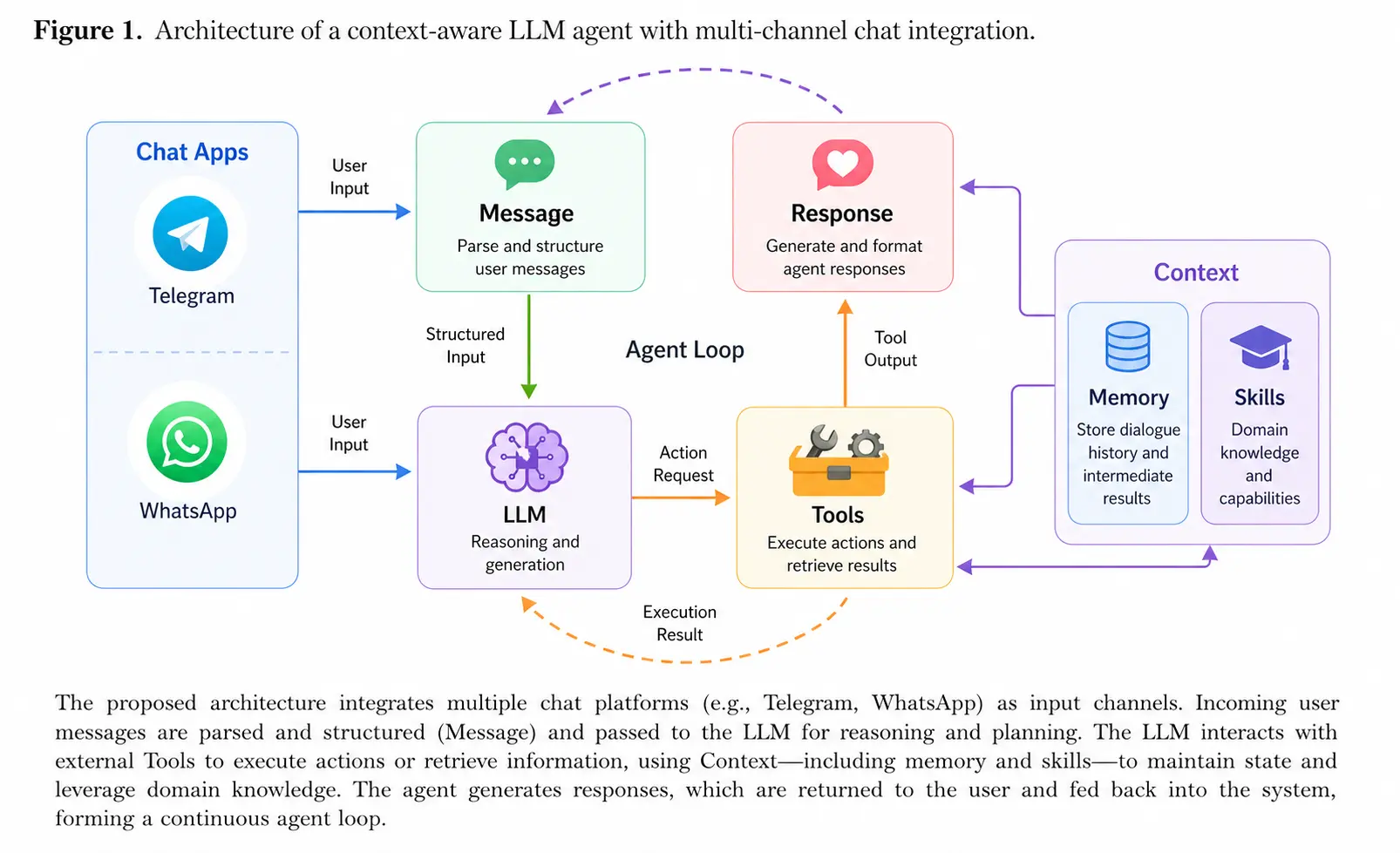
🤖 Pythinker stays tiny by centering everything around a tiny agent loop: messages come in from chat apps, the LLM decides when tools are needed, and memory or skills are pulled in only as context instead of becoming a heavy orchestration layer. That keeps the core path readable and easy to extend, while still letting you add channels, tools, memory, and deployment options without turning the system into a monolith.
See docs/ARCHITECTURE.md for a forensic walkthrough of the runtime.
✨ Features
📈 24/7 Real-Time Market Analysis |
🚀 Full-Stack Software Engineer |
📅 Smart Daily Routine Manager |
📚 Personal Knowledge Assistant |
|---|---|---|---|
| Discovery • Insights • Trends | Develop • Deploy • Scale | Schedule • Automate • Organize | Learn • Memory • Reasoning |
📚 Docs
Browse the repo docs for the current GitHub development version.
- Talk to Pythinker from familiar chat apps: Chat Apps
- Configure providers, web search, MCP, and runtime behavior: Configuration
- Integrate Pythinker with local tools and automations: OpenAI-Compatible API · Python SDK
- Run Pythinker with Docker or as a Linux service: Deployment
- Deeper dives: Architecture · Memory · Multiple Instances · Channel Plugin Guide
🤝 Contribute & Roadmap
PRs welcome! The codebase is intentionally small and readable. 🤗
Branching Strategy
| Branch | Purpose |
|---|---|
main |
Stable releases — bug fixes and minor improvements |
dev |
Experimental features — new features and breaking changes |
Unsure which branch to target? See CONTRIBUTING.md for details.
Releases — When publishing a new version, keep the README “What's new” callout and CHANGELOG.md section in sync with the exact release version.
Roadmap — Pick an item and open a PR!
- Multi-modal — See and hear (images, voice, video)
- Long-term memory — Never forget important context
- Better reasoning — Multi-step planning and reflection
- More integrations — Calendar and more
- Self-improvement — Learn from feedback and mistakes
🔐 Security
Found a vulnerability? Please do not open a public issue. Follow the private disclosure process in SECURITY.md.
📄 License
Pythinker is released under the MIT License. Third-party components redistributed with the project are listed in THIRD_PARTY_NOTICES.md.
Thanks for visiting ✨ Pythinker!

Project details
Verified details
These details have been verified by PyPIProject links
GitHub Statistics
Maintainers
Release history Release notifications | RSS feed


Download files
Download the file for your platform. If you're not sure which to choose, learn more about installing packages.
Source Distribution
Built Distribution
Filter files by name, interpreter, ABI, and platform.
If you're not sure about the file name format, learn more about wheel file names.
Copy a direct link to the current filters
File details
Details for the file pythinker_ai-2.7.1.tar.gz.
File metadata
- Download URL: pythinker_ai-2.7.1.tar.gz
- Upload date:
- Size: 683.2 kB
- Tags: Source
- Uploaded using Trusted Publishing? Yes
- Uploaded via: twine/6.1.0 CPython/3.13.13
File hashes
| Algorithm | Hash digest | |
|---|---|---|
| SHA256 |
123d282778c60870133ace40926b39c9222d44698273edb659fdab58fb98908a
|
|
| MD5 |
e187a8ee790b6279cc8fba47e538ebcb
|
|
| BLAKE2b-256 |
66b3eed6a6c2f5bc955d203e4febcf20572f048d51170a40061c8cfac91acfd5
|
Provenance
The following attestation bundles were made for pythinker_ai-2.7.1.tar.gz:
Publisher:
publish.yml on mohamed-elkholy95/Pythinker-ai
-
Statement:
-
Statement type:
https://in-toto.io/Statement/v1 -
Predicate type:
https://docs.pypi.org/attestations/publish/v1 -
Subject name:
pythinker_ai-2.7.1.tar.gz -
Subject digest:
123d282778c60870133ace40926b39c9222d44698273edb659fdab58fb98908a - Sigstore transparency entry: 1627307301
- Sigstore integration time:
-
Permalink:
mohamed-elkholy95/Pythinker-ai@9024c9832940b58bb5844d2ade8d665094d7ee72 -
Branch / Tag:
refs/tags/v2.7.1 - Owner: https://github.com/mohamed-elkholy95
-
Access:
public
-
Token Issuer:
https://token.actions.githubusercontent.com -
Runner Environment:
github-hosted -
Publication workflow:
publish.yml@9024c9832940b58bb5844d2ade8d665094d7ee72 -
Trigger Event:
release
-
Statement type:
File details
Details for the file pythinker_ai-2.7.1-py3-none-any.whl.
File metadata
- Download URL: pythinker_ai-2.7.1-py3-none-any.whl
- Upload date:
- Size: 801.9 kB
- Tags: Python 3
- Uploaded using Trusted Publishing? Yes
- Uploaded via: twine/6.1.0 CPython/3.13.13
File hashes
| Algorithm | Hash digest | |
|---|---|---|
| SHA256 |
bd8022d027d7141b860a6496e69344d0ddfe4635bb3e63242da4525edef748ab
|
|
| MD5 |
1811418f1a9b279a64d2c671202b3203
|
|
| BLAKE2b-256 |
4a5852b316d178dd6bdf84584bfb7016d8cfa43c247ae535970266e1d1932c69
|
Provenance
The following attestation bundles were made for pythinker_ai-2.7.1-py3-none-any.whl:
Publisher:
publish.yml on mohamed-elkholy95/Pythinker-ai
-
Statement:
-
Statement type:
https://in-toto.io/Statement/v1 -
Predicate type:
https://docs.pypi.org/attestations/publish/v1 -
Subject name:
pythinker_ai-2.7.1-py3-none-any.whl -
Subject digest:
bd8022d027d7141b860a6496e69344d0ddfe4635bb3e63242da4525edef748ab - Sigstore transparency entry: 1627307424
- Sigstore integration time:
-
Permalink:
mohamed-elkholy95/Pythinker-ai@9024c9832940b58bb5844d2ade8d665094d7ee72 -
Branch / Tag:
refs/tags/v2.7.1 - Owner: https://github.com/mohamed-elkholy95
-
Access:
public
-
Token Issuer:
https://token.actions.githubusercontent.com -
Runner Environment:
github-hosted -
Publication workflow:
publish.yml@9024c9832940b58bb5844d2ade8d665094d7ee72 -
Trigger Event:
release
-
Statement type:






