
 Pythinker Code
Think first, then code. Your terminal-native review-first AI engineering agent.
Code reviewer · Security & vulnerability scanner · Root-cause debugger — then code creator. Pythinker reads your repo, audits it, and only writes code after the analysis. All from the shell you already live in.









🌐 Website · ⚡ Quick Start · ✨ Features · 🧩 IDE Integration · 🔌 MCP · 🔐 Privacy · 🛠️ Develop
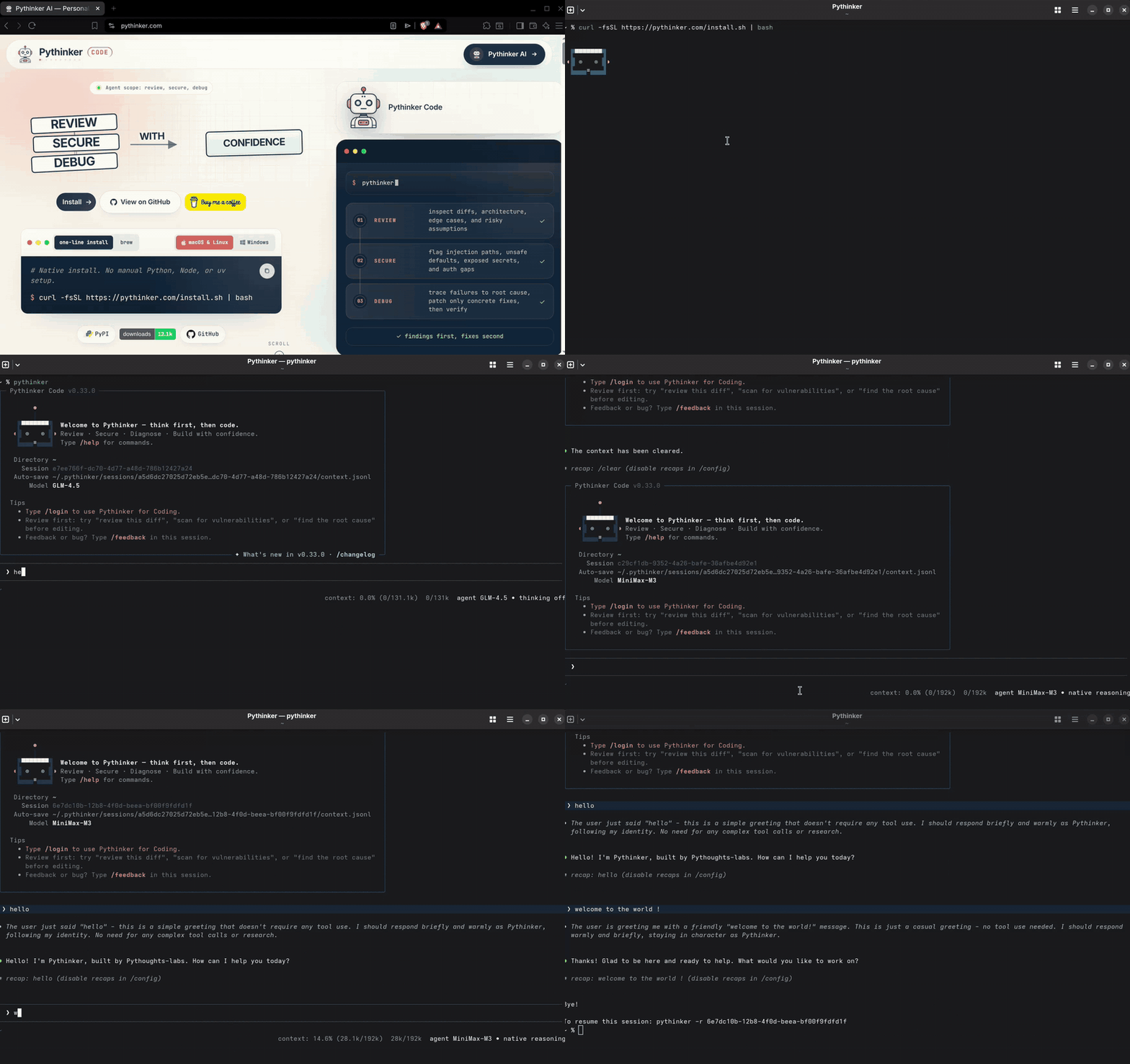
💡 What is Pythinker?
Pythinker Code is an open-source, review-first AI engineering agent that lives in your terminal. Before it writes a single line, it reads yours — auditing diffs, scanning for vulnerabilities, and root-causing failures. Unlike chat assistants that jump straight to code, Pythinker leads with code review, security scanning, and root-cause diagnosis, and only edits files once the analysis points at a fix.
It ships with first-class subagents for each role — code-reviewer for severity-scored diff critique, security-reviewer for validated vulnerability findings, debugger for failure root-causing, and coder/implementer for the scoped edits that follow. All running in a single iterative loop, driven by the model of your choice, with full access to your repo, the shell, the web, and MCP tools.
It speaks the Agent Client Protocol (ACP), so it slots cleanly into ACP-aware editors like Zed and JetBrains. It loads Model Context Protocol (MCP) servers, so the same tools your other agents use just work. And it's hackable: subagents, skills, hooks, and plugins are all first-class extension points.
🎯 Review · Secure · Diagnose · then Create. One agent, one shell, one workflow. No tab-switching. No context loss. No magic.
🆕 What's New in 0.62.0
- Updates surface during long-running sessions. Pythinker now checks periodically for newly available releases, shows each new update notice once per session, and bounds every check with a watchdog so a stalled attempt cannot prevent later retries.
- Repository-local agent workflows stay local. This checkout now treats its root
.agents/directory as local agent configuration instead of version-controlled project content.
Upgrade with pythinker update, pip install --upgrade pythinker-code==0.62.0, or use the native installer for your platform from the Releases page.
✨ Features
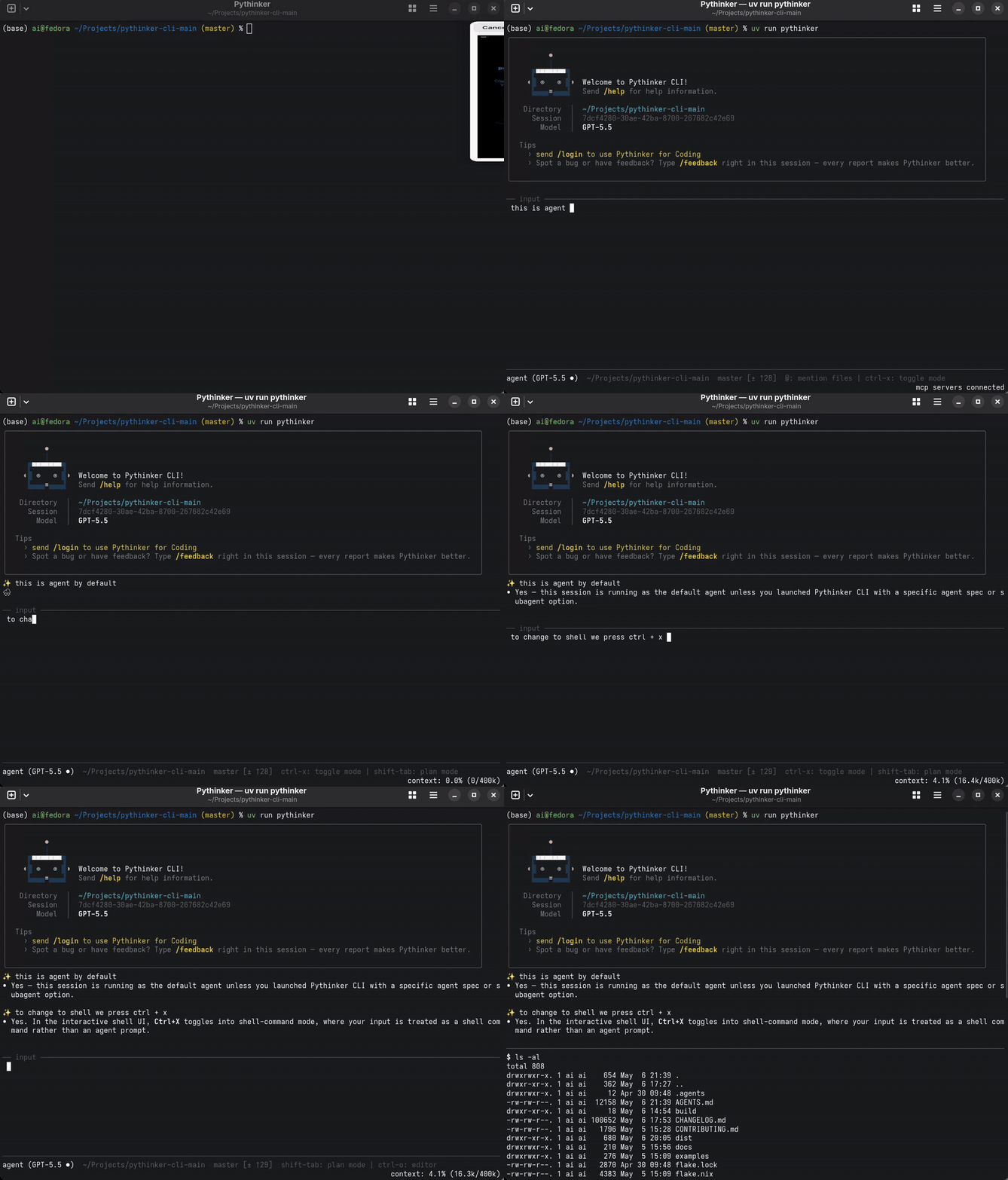
🖥️ Terminal-FirstPlan, edit, run, and verify without leaving your shell. Every action is visible, scriptable, and auditable. |
⚡ Shell Command ModePress |
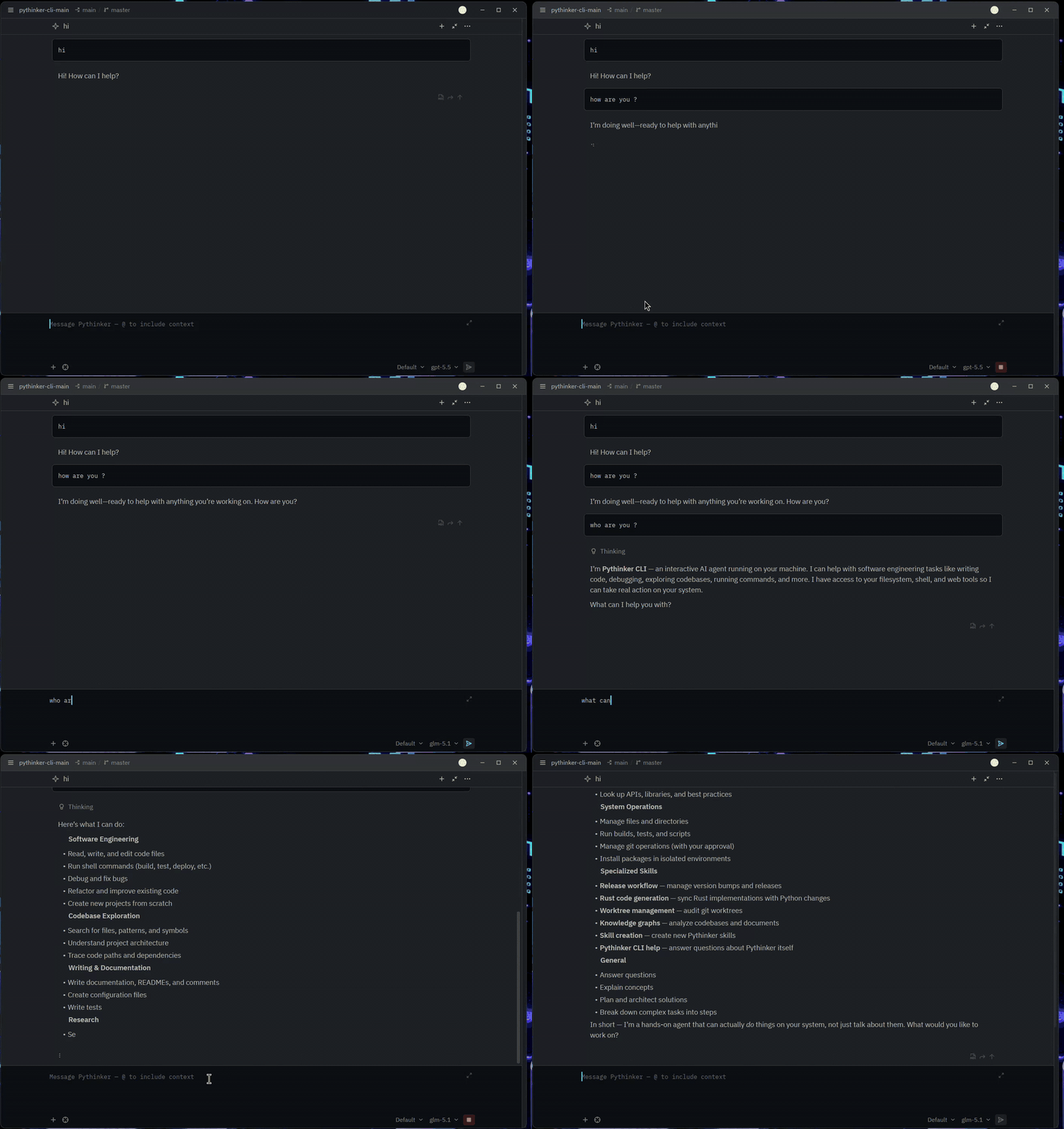
🧩 ACP IDE IntegrationRun |
🔌 MCP Tool LoadingManage stdio and HTTP MCP servers with |
🤖 Subagents & SkillsDelegate focused work to built-in subagents. Load reusable instructions via |
🪝 Hooks & PluginsObserve or block tool execution with hook events. Install community extensions with |
🌐 Web & Visualization UIsOptional web frontend and visualization frontend ship alongside the CLI for richer inspection workflows. |
🤖 Bring Your Own ModelSwap providers and models per-session: |
📊 Local BenchmarksRun |
🧪 SWE-Style FixturesRun trusted local JSONL fixtures with |
[!NOTE] Built-in shell commands such as
cdare not yet supported in shell command mode.
⚡ Quick Start
Pythinker ships native installers for every platform. Pick the row that
matches your OS — no Python, Node, or uv prerequisite.
| Platform | Recommended install | Artifact source |
|---|---|---|
| 🪟 Windows | irm https://pythinker.com/install.ps1 | iex |
PythinkerSetup-0.62.0.exe from Releases |
 / /  |
curl -fsSL https://pythinker.com/install.sh | bash |
native tarball from Releases |
| — Homebrew |
brew install Pythoughts-labs/pythinker/pythinker-code |
auto-published Homebrew tap |
| 🐳 Docker | docker run --rm -it ghcr.io/pythoughts-labs/pythinker-code |
GHCR multi-arch image |
| 🪟 Windows — Scoop | scoop bucket add pythinker https://github.com/Pythoughts-labs/scoop-pythinker && scoop install pythinker-code |
auto-published Scoop bucket |
| ❄️ Nix | nix run github:Pythoughts-labs/pythinker-code |
flake apps.default |
| — system package |
Download the .deb or .rpm for your distro below |
Releases |
| 🐍 Python fallback | pip install pythinker-code |
PyPI |
Every artifact ships with a matching .sha256 file — verify before install on
any platform with sha256sum, shasum -a 256, or Get-FileHash.
After install, on any OS:
pythinker --version            # confirm install
pythinker login                # (optional) authenticate a hosted provider
pythinker                      # start the interactive TUI
In-app updates —
pythinker updatequeries the GitHub Releases API and re-runs the right installer for your build with SHA-256 verification. SetPYTHINKER_CLI_NO_AUTO_UPDATE=1to disable the proactive startup check.
🪟 Windows — native installer
PythinkerSetup-0.62.0.exe is an Inno Setup wizard. Release builds are signed
when Authenticode secrets are configured in CI; otherwise the installer ships
unsigned. Installs per-user into %LOCALAPPDATA%\Programs\Pythinker, registers
pythinker on your user PATH (HKCU\Environment), broadcasts
WM_SETTINGCHANGE so new shells see the change. No UAC prompt.
# One-line install (downloads the native .exe, verifies SHA-256, runs per-user)
irm https://pythinker.com/install.ps1 | iex

# Or manually download the installer + checksum from the Releases page,
# verify with Get-FileHash, then run:
.\PythinkerSetup-0.62.0.exe

# Open a fresh PowerShell
pythinker --version
Per-machine install (IT-managed boxes): .\PythinkerSetup-0.62.0.exe /ALLUSERS
installs to %ProgramFiles%\Pythinker and writes PATH to HKLM (requires admin).
Upgrade: pythinker update from inside the running app — it downloads
the newest installer, verifies SHA-256, and launches the Inno installer
with visible progress (/SILENT /NORESTART /CURRENTUSER /CLOSEAPPLICATIONS /NORESTARTAPPLICATIONS).
Uninstall: Apps & Features → Pythinker Code → Uninstall reverts both the files and the PATH edit.
🛡 First-launch SmartScreen warning — Until Authenticode secrets are configured in CI for a release, the installer ships unsigned and Windows shows "Windows protected your PC." Click More info → Run anyway. Use the published
.sha256as your integrity check until signing comes online.
— Homebrew tap
# 1. Install
brew install Pythoughts-labs/pythinker/pythinker-code
#    Homebrew ≥ 5 may refuse the untrusted tap; trust it once, then re-run:
#      brew trust pythoughts-labs/pythinker

# 2. Verify
pythinker --version
which pythinker          # -> /opt/homebrew/bin/pythinker (Apple Silicon)
                         #    or /usr/local/bin/pythinker (Intel)
Works on Apple Silicon and Intel from the same native GitHub Release
tarballs used by the curl installer. The tap auto-publishes a fresh formula on
every Pythinker release, so brew upgrade pythinker-code always finds the
latest version.
Upgrade: brew upgrade pythinker-code (Homebrew packages don't
auto-update; run this whenever you want the latest).
Untrusted-tap refusal — Homebrew ≥ 5 (with
HOMEBREW_REQUIRE_TAP_TRUST) refuses third-party taps until you trust them once:brew trust pythoughts-labs/pythinker. The in-app updater detects the refusal and offers to run it for you.
Uninstall: brew uninstall pythinker-code && brew untap Pythoughts-labs/pythinker.
The tap repo is Pythoughts-labs/homebrew-pythinker — auto-maintained, do not hand-edit.
— system packages
Native .deb and .rpm packages for both x86_64 and aarch64 are
attached to every GitHub Release.
# Debian / Ubuntu (x86_64)
sudo dpkg -i pythinker-code_0.62.0_amd64.deb
sudo apt-get install -f       # only if dpkg reports missing deps

# Debian / Ubuntu (ARM64)
sudo dpkg -i pythinker-code_0.62.0_arm64.deb

# Fedora / RHEL / openSUSE (x86_64)
curl -LO https://github.com/Pythoughts-labs/pythinker-code/releases/download/v0.62.0/pythinker-code-0.62.0.x86_64.rpm
curl -LO https://github.com/Pythoughts-labs/pythinker-code/releases/download/v0.62.0/pythinker-code-0.62.0.x86_64.rpm.sha256
sha256sum -c pythinker-code-0.62.0.x86_64.rpm.sha256
# Fedora / RHEL:
sudo dnf install ./pythinker-code-0.62.0.x86_64.rpm
# openSUSE:
sudo zypper install ./pythinker-code-0.62.0.x86_64.rpm

# Fedora / RHEL (aarch64)
curl -LO https://github.com/Pythoughts-labs/pythinker-code/releases/download/v0.62.0/pythinker-code-0.62.0.aarch64.rpm
curl -LO https://github.com/Pythoughts-labs/pythinker-code/releases/download/v0.62.0/pythinker-code-0.62.0.aarch64.rpm.sha256
sha256sum -c pythinker-code-0.62.0.aarch64.rpm.sha256
sudo dnf install ./pythinker-code-0.62.0.aarch64.rpm
Both packages drop a small /usr/bin/pythinker launcher that execs the real
binary under /usr/lib/pythinker/, so your $PATH stays tidy.
Verify before install:
sha256sum -c pythinker-code_0.62.0_amd64.deb.sha256        # Debian/Ubuntu
sha256sum -c pythinker-code-0.62.0.x86_64.rpm.sha256       # Fedora/RHEL
Upgrade: download the new .deb/.rpm from Releases and dpkg -i /
dnf install over it. Or run pythinker update from inside the running
app — it'll fetch the matching new package and prompt for sudo to install.
Uninstall:
sudo dpkg -r pythinker-code                                # Debian/Ubuntu
sudo rpm -e pythinker-code                                 # Fedora/RHEL
/ — curl-bash native installer
For containers, fresh VMs, or any host without a system package manager.
The canonical https://pythinker.com/install.sh endpoint is backed by
scripts/install-native.sh. It serves shell
script content directly, detects your OS + arch, downloads the matching
PyInstaller-frozen tarball, verifies its SHA-256, and lands the single binary
at ~/.local/bin/pythinker.
# Latest release
curl -fsSL https://pythinker.com/install.sh | bash

# Pin a specific version
curl -fsSL https://pythinker.com/install.sh | bash -s -- --version 0.27.0

# Custom prefix (defaults to $HOME/.local)
curl -fsSL https://pythinker.com/install.sh | bash -s -- --prefix /opt/pythinker
Host /install.sh with:
Content-Type: text/x-shellscript; charset=utf-8
Cache-Control: public, max-age=300, s-maxage=900, stale-if-error=86400
Use long immutable caching only for versioned release artifact URLs, for
example Cache-Control: public, max-age=31536000, immutable on fixed-tag
assets.
Supported targets:
uname -s / -m |
Tarball asset |
|---|---|
| Linux / x86_64 | pythinker-<version>-x86_64-unknown-linux-gnu.tar.gz |
| Linux / aarch64 | pythinker-<version>-aarch64-unknown-linux-gnu.tar.gz |
| Darwin / arm64 | pythinker-<version>-aarch64-apple-darwin.tar.gz |
| Darwin / x86_64 | pythinker-<version>-x86_64-apple-darwin.tar.gz |
The script prints PATH guidance if ~/.local/bin isn't already on your
$PATH.
Uninstall: rm ~/.local/bin/pythinker.
🐍 Python fallback
Use the Python package only when a native installer is not available for your environment:
pip install pythinker-code
Native installs remain the supported path for new users and for in-app updates.
🔐 Authenticate (optional)
For hosted Pythinker models or ACP terminal auth:
pythinker login
Z.AI exposes two independent OpenAI-compatible routes. Choose the route that owns your key; both may coexist, and Pythinker never infers, migrates, falls back, or retries across them:
# Coding Plan subscription
pythinker login --z-ai-coding   # reads ZAI_CODING_API_KEY when set

# Standard pay-as-you-go API
pythinker login --z-ai-api      # reads ZAI_API_KEY when set
These create distinct z-ai-coding/* and z-ai-api/* model identities. See the
provider guide for endpoints,
curated GLM capabilities, and route-scoped /usage behavior.
💬 Try it out
# Interactive session
pythinker

# One-shot prompt
pythinker --prompt "summarize this repository and suggest the next test to add"

# Pick a specific model
pythinker --model openai/gpt-5.5

# Inline config override
pythinker --config '{"default_thinking": true}'
🏠 Using Local Models (LM Studio & Ollama)
Run Pythinker entirely on your own machine — no API key, no cloud. Pythinker speaks each runtime's OpenAI-compatible API, so tools, streaming, JSON mode, vision, and reasoning_effort all work the same as with hosted providers.
LM Studio
1. Set up LM Studio.
- Install LM Studio and download at least one chat model.
- In the LM Studio app, open the model and raise its Context Length (gear icon → Context Length). See Context length matters below.
- Start the server: Developer → Status: Running (or
lms server start --port 1234).
2. Connect Pythinker.
pythinker login --lm-studio
This auto-discovers every chat-capable model loaded in LM Studio, registers each as lm-studio/<model-id>, and picks the largest-context one as your default. Embedding models are filtered out.
3. Use it.
# Default LM Studio model
pythinker -p "explain quicksort"

# Specific model
pythinker -m lm-studio/qwen/qwen3-coder-next -p "write a python http server"

# Interactive shell, then switch models with /model
pythinker
4. Disconnect.
pythinker logout --lm-studio
Ollama
# 1. start the server in one terminal
ollama serve

# 2. pull a model
ollama pull llama3.1:8b

# 3. connect Pythinker
pythinker login --ollama

# 4. use it
pythinker -p "explain monad transformers"
pythinker -m ollama/llama3.1:8b -p "..."
pythinker logout --ollama
Discovery uses Ollama's /api/tags for the model list and /api/show per model to read the real context window.
Remote LM Studio / Ollama (LAN host or alternate port)
pythinker login --lm-studio --base-url http://192.168.1.10:1234/v1
pythinker login --ollama    --base-url http://lan-box:11434/v1
The override is saved in your config and used by every subsequent run.
From inside the interactive shell
The same wiring is available as slash commands:
/login lm-studio        # or  /login lmstudio  (no dash also accepted)
/login ollama
/logout lm-studio
/logout ollama
/login                  # opens a chooser; entries 9 and 10 are the local providers
/model lm-studio/google/gemma-4-e4b   # switch model mid-session
⚠️ Context length matters (a common gotcha)
Pythinker's agent prompt — system instructions + tool schemas + skills + your message + recent history — is large. Tens of thousands of tokens before you've even sent your first message.
LM Studio loads a model with a small default context window (often 4096). If you start chatting against that, you'll see:
LLM provider error: Error: The number of tokens to keep from the initial
prompt is greater than the context length (n_keep: 16690 >= n_ctx: 4096).
The shell now prints a friendly recovery hint when this happens, but the cure is in LM Studio:
- In LM Studio, open the model in the Chat tab and click the gear/settings icon (or My Models → Edit).
- Set Context Length to at least
32768, and prefer131072if your VRAM allows. Practical experience: 64k still triggers errors during longer sessions; 128k is a safer floor. - Reload the model (LM Studio prompts you).
- Restart Pythinker so it picks up the new state (
Ctrl+Dthenpythinker, orpythinker -r <session-id>to resume).
Tip: the bigger you set the context, the more VRAM the model uses. If you OOM, try a smaller quantization (e.g., Q4_K_M instead of Q8_0) or a smaller model variant.
Ollama configures context per-request and Pythinker reads the model's max from /api/show, so this gotcha is mostly LM-Studio-specific.
VRAM-friendly model picks
Local models vary wildly in memory use. Rough guide on a 16 GB GPU (e.g., RTX 5080 mobile):
| Model size | Quant | Approx. VRAM | Fits 16 GB? |
|---|---|---|---|
| 2-4 B | Q4-Q8 | 2-4 GB | Yes, easily |
| 7-8 B | Q4 | 5-6 GB | Yes |
| 7-8 B | Q8 | 8-9 GB | Yes |
| 13-14 B | Q4 | 8-10 GB | Yes |
| 27-31 B | Q4 | 17-20 GB | Tight / no |
| 27-31 B | Q8 | 30-35 GB | No |
If LM Studio errors with Failed to load model, you've exceeded VRAM — pick a smaller model or lower-bit quantization.
Environment variables
These override the defaults at both login and runtime:
| Variable | Purpose |
|---|---|
LM_STUDIO_BASE_URL |
Override http://localhost:1234/v1 |
LM_STUDIO_API_KEY |
Set if you've enabled token auth in LM Studio |
OLLAMA_BASE_URL |
Override http://localhost:11434/v1 |
OLLAMA_API_KEY |
Rarely needed (Ollama is unauthenticated by default) |
Example:
LM_STUDIO_BASE_URL=http://workstation.lan:1234/v1 pythinker -p "..."
Refreshing the model list
If you load/unload models in LM Studio (or ollama pull/rm), re-run login to refresh:
pythinker login --lm-studio # or --ollama
(Pythinker intentionally does NOT auto-refresh local providers in the background — login owns that state, so manual edits to your config aren't silently overwritten.)
🧩 IDE Integration via ACP
Pythinker speaks Agent Client Protocol natively. Point your ACP-compatible editor at pythinker acp and you get a multi-session agent server inside your IDE.
📝 Configuration for Zed / JetBrains
{
  "agent_servers": {
    "Pythinker Code": {
      "type": "custom",
      "command": "pythinker",
      "args": ["acp"],
      "env": {}
    }
  }
}
The ACP server provides:
| Capability | Description |
|---|---|
| 🔑 Terminal auth | pythinker login flow exposed to the IDE |
| 📂 Session listing & resume | Pick up where you left off |
| 🔄 Hot model swap | Change models for a running ACP session |
🔌 MCP Tooling
Pythinker loads Model Context Protocol tools from persistent config or ad-hoc files. Same tools, every agent — no rewriting.
🛠️ Manage persistent MCP servers
# 📚 Context7 stdio server (positional form: NAME -- COMMAND)
pythinker mcp add context7 -- npx -y @upstash/context7-mcp --api-key YOUR-API-KEY
# Added MCP server 'context7' to ~/.pythinker/mcp.json

# 🌐 Streamable HTTP server with API key
pythinker mcp add --transport http docs https://example.com/mcp \
  --header "API_KEY: your-key"

# 🔐 Streamable HTTP server with OAuth
pythinker mcp add --transport http --auth oauth linear https://mcp.linear.app/mcp

# 💻 stdio server with explicit transport
pythinker mcp add --transport stdio chrome-devtools -- npx chrome-devtools-mcp@latest

# 📋 List, authorize, test, and remove
pythinker mcp list
pythinker mcp auth linear
pythinker mcp test chrome-devtools
pythinker mcp remove chrome-devtools
📄 Use an ad-hoc MCP config file
{
  "mcpServers": {
    "context7": {
      "url": "https://mcp.context7.com/mcp",
      "headers": {
        "CONTEXT7_API_KEY": "YOUR_API_KEY"
      }
    },
    "chrome-devtools": {
      "command": "npx",
      "args": ["-y", "chrome-devtools-mcp@latest"]
    }
  }
}
pythinker --mcp-config-file /path/to/mcp.json
🧬 Extensibility
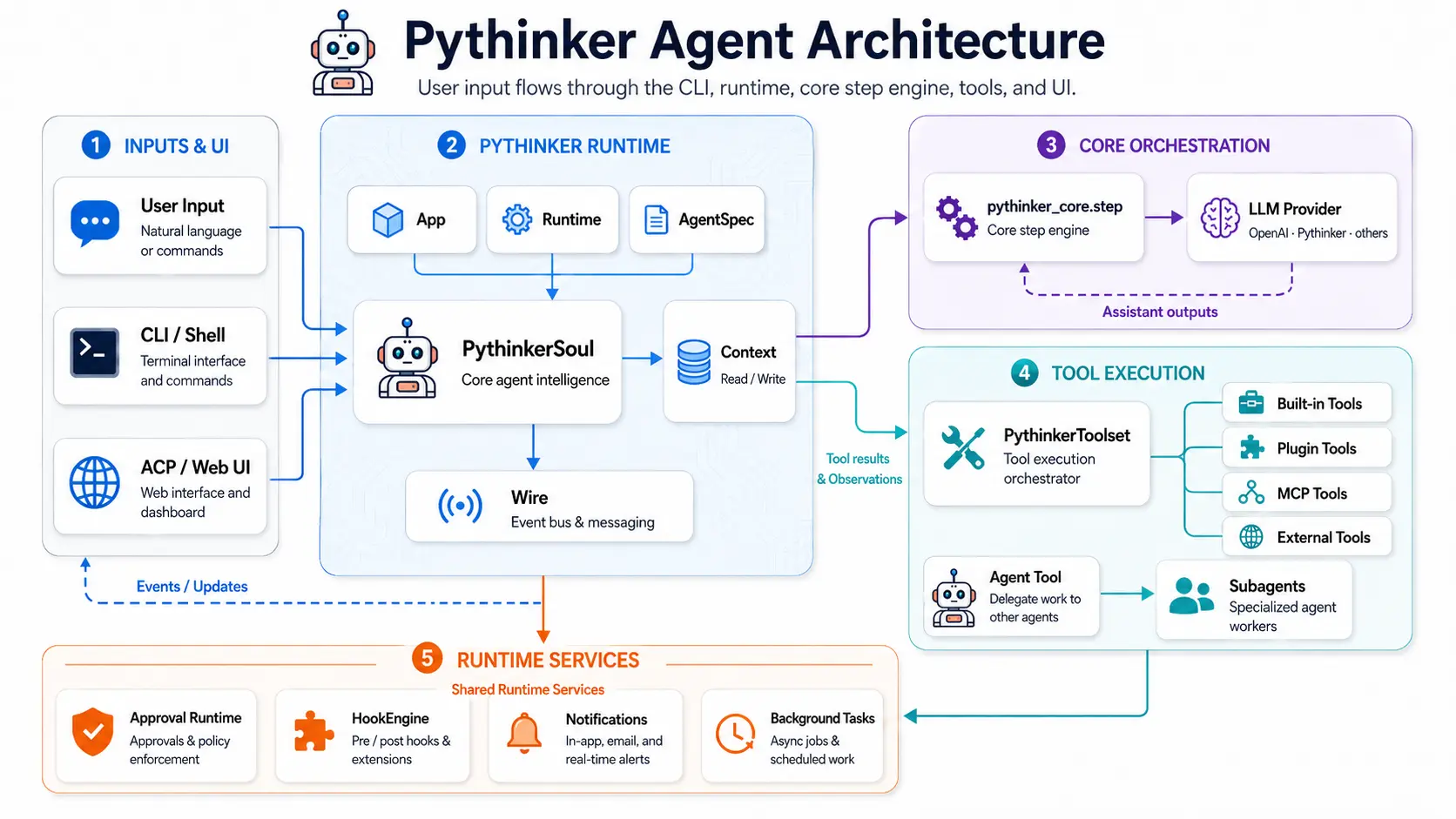
Pythinker is a small, extensible runtime — not a monolith. Build on it.
| Extension Point | What it does | Where to look |
|---|---|---|
| 🤖 Agents & subagents | YAML specs define tools, prompts, and built-in subagent types | src/pythinker_code/agents/ |
| 🎓 Skills | /skill:<name> loads reusable instructions on demand |
bundled & user-defined |
| 🌊 Flows | /flow:<name> executes bundled prompt flows |
bundled & user-defined |
| 🪝 Hooks | Observe or block tool execution; integrate policy or automation | hook events API |
| 🧩 Plugins | Installable extension packages | pythinker plugin |
| 📊 Benchmarks | Deterministic local coding tasks with verification reports | /benchmark, src/pythinker_code/benchmark/ |
🏗️ Architecture
🔐 Privacy & Telemetry
Pythinker is the agent framework, not the LLM. You bring your own API key (OpenAI, Anthropic, your local LM Studio model, etc.); your prompts and the model's responses go directly between your terminal and the model provider you configured. Pythinker never sees, stores, or forwards them.
If you opt in, Pythinker can collect a small amount of diagnostic telemetry about how the agent runs to improve the framework itself. It's strictly anonymous, never includes your prompts, model output, file contents, file paths, or any user-identifying data. Two channels:
| Channel | What lands there | Endpoint |
|---|---|---|
| Errors (Sentry-protocol) | Unhandled exceptions and crash stack traces, with absolute paths above site-packages/ rewritten to <env>/ so home directories don't leak |
errors.pythinker.com (self-hosted Bugsink) |
| Traces + structured logs (OpenTelemetry) | Lifecycle events (session_started, started, model_switch), agent-loop spans (pythinker.turn / pythinker.llm / pythinker.tool), and per-event counters |
otel.pythinker.com (self-hosted SigNoz) |
What we collect
- Lifecycle events: session start, command-line flags actually used (booleans only), startup timing, model name (just the identifier, e.g.
claude-opus-4-7), thinking-mode toggle, plan-mode toggle. - Agent-loop spans: turn duration, step count, stop reason (
no_tool_calls/max_steps/error), tool name (Read,Bash,Edit, …), tool success/failure, tool duration, LLM call duration, input/output token counts (numbers — never the content). - Crashes: exception class name, scrubbed stack trace, library versions. We do not send local variable values.
- Static context: pythinker version, OS family, Python version, terminal type (
TERM_PROGRAM), CI flag (CIenv var presence), locale. - A persistent, random
device_idso we can count "how many distinct installs" without identifying a person.
What we never collect
- Your prompts, the model's responses, or any conversation content
- File contents, file paths, working directory names, or workspace structure
- Your API keys, OAuth tokens, environment variables
- Your real name, email, IP address, hostname (host name field is dropped at the edge collector)
- Tool arguments (e.g. what file you read, what command you ran)
Turning it off
Telemetry is on by default. To turn it off:
# 1. Per-invocation CLI flag
pythinker --no-telemetry

# 2. Environment variable (works in shells, .env files, CI configs)
export PYTHINKER_DISABLE_TELEMETRY=1
pythinker

# 3. Permanently in your config file (~/.pythinker/config.toml)
[default]
telemetry = false
When telemetry is disabled, Pythinker short-circuits Sentry initialization, OTel exporter creation, and the in-process event sink. No network requests are made to the telemetry endpoints.
Pointing telemetry at your own infrastructure
If you operate pythinker for a team and want telemetry routed to your own SigNoz / Bugsink instead, override the endpoints via environment variables:
export PYTHINKER_SENTRY_DSN="https://<key>@your-bugsink.example.com/<project>"
export PYTHINKER_OTEL_ENDPOINT="https://your-otel-collector.example.com"
export PYTHINKER_OTEL_TOKEN="<your bearer token>"
The defaults point at infrastructure operated by the pythinker maintainers and are used automatically unless you turn telemetry off.
🛠️ Development
🏁 Prepare the workspace
git clone https://github.com/Pythoughts-labs/pythinker-code.git
cd pythinker-code
make prepare
🧰 Common commands
|
▶️ Run & iterate uv run pythinker # CLI from source
make format # format all packages
make check # lint + type-check
|
🧪 Test make test # all unit + e2e tests
make ai-test # AI-driven tests
make test-pythinker-code # CLI only
make test-pythinker-core # Core only
make test-pythinker-host # Host only
make test-pythinker-sdk # SDK only
|
|
🌐 Frontends make web-back # web backend
make web-front # web frontend
make dashboard-back # dashboard backend
make dashboard-front # dashboard frontend
|
📦 Build make build # Python packages
make build-bin # standalone binary
make help # all targets
|
💡
make buildandmake build-binbuild and embed the web and visualization frontends before packaging.
🗂️ Project Layout
pythinker-code/
├── 📦 src/pythinker_code/         CLI runtime · tools · UIs · ACP · MCP · hooks · plugins · skills · web · dashboard backends
├── 🧱 packages/
│   ├── pythinker-core/           Provider-agnostic message, tool, and chat-provider abstractions
│   ├── pythinker-host/           Local/remote host filesystem and command execution
│   └── pythinker-code/           Console-script distribution package
├── 🧰 sdks/pythinker-sdk/        Python SDK
└── 🧪 tests/ · tests_e2e/ · tests_ai/   Unit · wire/CLI e2e · AI-driven test suites
🤝 Contributing
Contributions are warmly welcome — bug reports, PRs, plugins, skills, and docs all help.
- 📖 Start with
CONTRIBUTING.md - 🔐 See
SECURITY.mdfor responsible disclosure - 📜 Skim
AGENTS.mdfor the agent design notes
If Pythinker helps you, a ⭐ on GitHub goes a long way.
📜 License
Distributed under the Apache-2.0 License. See LICENSE for the full text and NOTICE for attributions.
Built with ❤️ for engineers who live in the terminal.
🌐 pythinker.com · 📦 PyPI · 🐙 GitHub · 🧩 ACP · 🔌 MCP
Thanks for visiting ✨ Pythinker! Viewing this README does not trigger telemetry.
1 maintainer

Release files for pythinker-code 0.62.0
For a detailed explanation of source distributions (sdists) and built distributions (wheels), please see the package formats documentation.
Source distribution (sdist)
| File | Size | Uploaded | |
|---|---|---|---|
| pythinker_code-0.62.0.tar.gz | 6.9 MB | Details |
Built distribution (wheel)
| File | Interpreter | ABI | Platform | Reset |
|---|---|---|---|---|
| pythinker_code-0.62.0-py3-none-any.whl | Python 3 | none | any | Details |
Total release size: 14.4 MB
Release files / pythinker_code-0.62.0.tar.gz
| Download URL | pythinker_code-0.62.0.tar.gz |
|---|---|
| Size | 6.9 MB |
| Tags | Source |
|
SHA-256 checksum How to use checksums |
8636754fe1aa394dcde9e9f3c15061f1e06029be73d7836aec3b8c08bc9cb61b
|
|
BLAKE2b-256 checksum How to use checksums |
ddbff4dd4c955b0ba0bfa895ce7cf2eb46fee6a631655e4d6ef9c7057e8ac6b8
|
| Upload date | |
|
Uploaded using Trusted Publishing? What is trusted publishing? |
Yes |
| Uploaded via |
twine/6.1.0 CPython/3.13.13
|
Provenance
Provenance describes where a file came from. On PyPI, provenance is shared via attestations, which provide a verifiable record of the build or publishing details. View details, limitations and caveats.


PyPI Publish Attestation
PyPI verified that this artifact, at this checksum, originated from the publisher listed below.
Signed by GitHub Actions, verified by PyPI on Jul 22, 2026.
Transparency logRelease files / pythinker_code-0.62.0-py3-none-any.whl
| Download URL | pythinker_code-0.62.0-py3-none-any.whl |
|---|---|
| Size | 7.5 MB |
| Tags | Python 3 |
|
SHA-256 checksum How to use checksums |
933887a7648007f7578fa68783cd9cdb280f283535a90ba0ddc52f1acc54f5c5
|
|
BLAKE2b-256 checksum How to use checksums |
090eae6d6f224f28db71909b78844fcdddab2d4f6b6d823935d2b525b7c0d9da
|
| Upload date | |
|
Uploaded using Trusted Publishing? What is trusted publishing? |
Yes |
| Uploaded via |
twine/6.1.0 CPython/3.13.13
|
Provenance
Provenance describes where a file came from. On PyPI, provenance is shared via attestations, which provide a verifiable record of the build or publishing details. View details, limitations and caveats.
PyPI Publish Attestation
PyPI verified that this artifact, at this checksum, originated from the publisher listed below.
Signed by GitHub Actions, verified by PyPI on Jul 22, 2026.
Transparency log













