
OAM toolbox made by the community to the community

Project description
Python-OAM
OAM toolbox made by the community for the community
Outlier detection has been used to detect and, if appropriate, remove anomalous observati- ons from the data. It’s usability can identify system failures and frauds before they escalate with potentially huge consequences.
One ramification of the contribution made by the outlier detection field is related to understand which aspects of the anomalous observation significantly separate it from the others in a given dataset. This area of research has been called Outlier Aspect Mining (OAM). Promising results and applications and cases have been presented by the community.
The objective of this lib is to contribute to OAM research in a practical way. Python-OAM allow you to apply Outlier Aspect Mining algorithms and analyze the results in your own datasets.
Feel free to not only use it but also extend it as wished.
Installation
To see Python-OAM in action on your own data:
You can install it using pip
pip install python-oam
python-oam is tested with:
| Version (dev) | |
|---|---|
| Python | 3.7, 3.8, 3.9 |
| pandas | 1.3.2 |
| seaborn | 0.11.2 |
| tqdm | 4.62.0 |
What 's OAM?
Outlying Aspect Mining (OAM), can be interpreted as "The task of looking for a set of characteristics (or subspaces) where a given object is different from the rest of the other objects."
Something in the lines of:
"OK, I know that this object is an outlier, but why exactly?"
OAM helps you to figure it out!
Defining the problem in a generic way, we consider a set of data X = {x1, x2, ..., xn} with n observations in a D-dimensional space. The application of OAM seeks to understand which dimensions of D make a sample of X to be considered an outlier.
The existing OAM techniques are classified into three major groups, Score and Search , Feature Selection and Hybrid Approach.
We mainly focused on the development of a Score and Search based toolbox, so let's talk a little bit more about it
Score and Search
The Score and Search is the most researched OAM technique and the one with the greatest results till the moment.
This approach requires a scoring function, to measure how much the object differs from the other objects in a given a set of dimensions (subspace). The search algorithm will define which dimensions should be compared. Then, the score will be compared across all subspaces generated by the search algorithm to detect the most divergent aspects.
That may have sounded a little too complex so we may break it down into an example
Let's say you have a dataset with different basketball players and their stats for a given season. We can all agree that Stephen Curry was indeed an outlier in the 2015 season, but among all of his stats, which one, or which set of stats, made him deliver so much more than the other players?
Was it the number of jumps? or his high number of field goals attempts? maybe the average running speed?
The scoring function will evaluate how different he was from the other players in, let's say, the dimension of "Field Goals Made", in that matter he was one of the greatest at that season so, very different.
the search algorithm will combine different dimensions to be evaluated, like let's come with a score of how different Stephen Curry was in comparison with the other given his "Number of Jumps" and "Three Points Made". How about "Average Running Speed" and "Offensive rebound"?
After scoring all the dimensions the search function returned, we compare them all to get to the most outlier set of dimensions
and that's a way to explain why Stephen Curry was recognized as an outlier basketball player in 2015 season.
Scoring Functions
Ipath
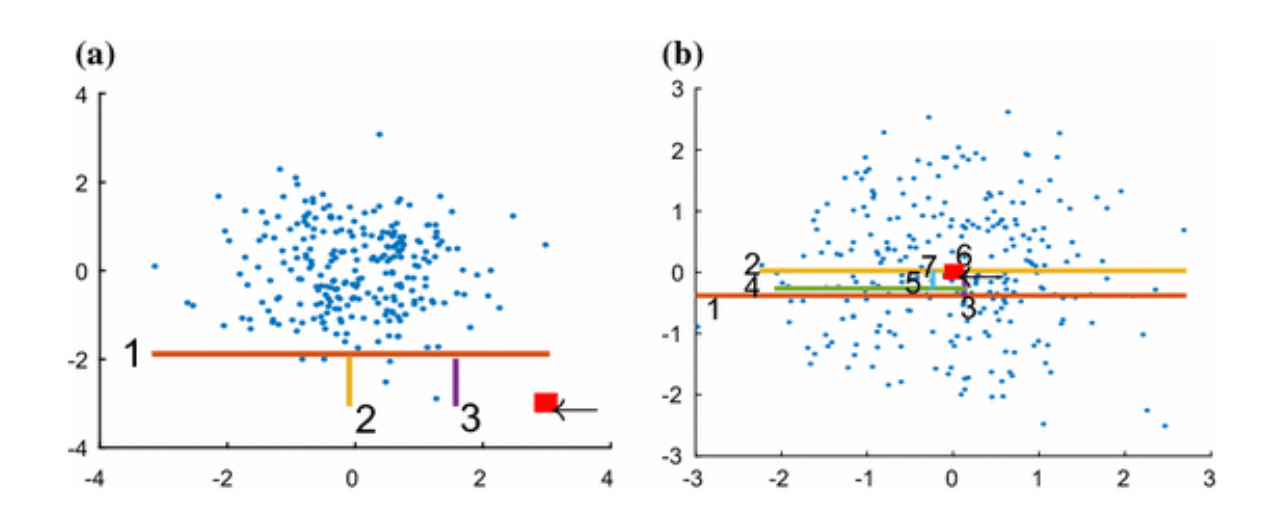
The iPath (isolation Path) arises from the study published by Vinh et al. (2016). The authors found that using the iForest anomaly detection approach (isolation Forest), it is possible to establish a dimensionally unbiased metric. The idea behind scoring the iPath is that, in the most discrepant subspace, an anomalous object is easier to isolate than the others.
The iPath process consists of making cuts in space, isolating objects from the rest of the dough. In this scenario, if the object is surrounded by several others, you will need to more cuts to separate it from the rest, while if the object is an outlier, it will take less cuts. This behavior can be observed in Figure 1, where (a) represents the procedure of an outlier that was isolated with only three cuts, while (b), a value not considered an outlier, it needed 7 cuts to be isolated from the rest of the data.
Search Functions
Simple Combination
Simple Combinations consists of making all possible combinations of spaces between a minimum and maximum size. This means that, for example, for a dataset of n dimensions and a minimum and maximum size value equal to i and j respectively, the Simple Combination will create all possible combinations without repetition.
Let's say you have a dataset with the followin dimensions
['datetime','ticker','open','close','high','low','volume']
if your maximum value is one the Simple Combination algorithm will return:
[['datetime'],['ticker'],['open'],['close'],['high'],['low'],['volume']]
if your maximum value is two the Simple Combination algorithm will return:
[['datetime', 'ticker'], ['datetime', 'open'], ['datetime', 'close'], ['datetime', 'high'], ...]
This technique allows the user to analyze a large number of dimensions controlling the combinatorial explosion caused by an all-to-all combination with no size limit.
Architecture
- Preprocess: contains a normalization function that allows the user to assign weights for chosen dimensions;
- Score: contains the iPath class and will contain other score classes in the future;
- Search: contains the SimpleCombination class and will contain other search classes in the future;
- Visualization: contains some functions to assist in the before and after visualization application of OAM techniques
Although the implementation separates them into different modules, Score and Search function as a set. As the scoring algorithm chosen, for the creation of an instance of iPath requires only two parameters, the size of the generated subsamples and the number of trees to be generated.
ipath = IsolationPath(
    subsample_size=256,
    number_of_paths=50
)
Then SimpleCombination, implemented as a search method, receives the instance of the chosen scoring method, the parameters that define the size of the generated subspaces and which dimensions will be used.
search = SimpleCombination(
    ipath,
    min_items_per_subspace=2,
    max_items_per_subspace=4,
    dimensions=[
        "variation_mean", "variation_std", "up_count", "down_count",
    ]
)
The decision to decouple the Score from the Search, and then reference them in the moment instance of classes, is linked to the possibility of combining them in different ways. If a new scoring algorithm is implemented, it will only need to contain one method called score, returning a number, to integrate with SimpleCombination. Likewise, if a new search method is implemented, it will only need to evaluate the dimension through the score method of the class received as a parameter to integrate with the rest.
You can check a few examples of the lib in use in the oam/analysisfolder
and in the test/sample_search.py as well. Also, the tests should serve you
with some guidance on how to use specific functions - the coverage is pretty good
at the moment.
Tests
We recognize our testing strategy is quite simple, many times we just look for exceptions in the happy path - we'll be glad to accept some help improving this area.
You can run them on your own through
make test.


Download files
Download the file for your platform. If you're not sure which to choose, learn more about installing packages.
Source Distribution
Built Distribution
Filter files by name, interpreter, ABI, and platform.
If you're not sure about the file name format, learn more about wheel file names.
Copy a direct link to the current filters
File details
Details for the file python-oam-0.7.tar.gz.
File metadata
- Download URL: python-oam-0.7.tar.gz
- Upload date:
- Size: 18.3 kB
- Tags: Source
- Uploaded using Trusted Publishing? No
- Uploaded via: twine/3.8.0 pkginfo/1.8.2 readme-renderer/34.0 requests/2.28.1 requests-toolbelt/0.9.1 urllib3/1.26.12 tqdm/4.62.0 importlib-metadata/4.11.3 keyring/21.8.0 rfc3986/1.5.0 colorama/0.4.4 CPython/3.9.6
File hashes
| Algorithm | Hash digest | |
|---|---|---|
| SHA256 |
33f95f319b4f3a3f9f3c47875f20904fa3f26dd2c9f1102d3991c730499f2250
|
|
| MD5 |
2296df4136e187f5fe1cdd7ccca7c18d
|
|
| BLAKE2b-256 |
408cd3be1996e9efa9682c0d9a5ec57a61464a2907472fd615884f352f5520e2
|
File details
Details for the file python_oam-0.7-py3-none-any.whl.
File metadata
- Download URL: python_oam-0.7-py3-none-any.whl
- Upload date:
- Size: 14.8 kB
- Tags: Python 3
- Uploaded using Trusted Publishing? No
- Uploaded via: twine/3.8.0 pkginfo/1.8.2 readme-renderer/34.0 requests/2.28.1 requests-toolbelt/0.9.1 urllib3/1.26.12 tqdm/4.62.0 importlib-metadata/4.11.3 keyring/21.8.0 rfc3986/1.5.0 colorama/0.4.4 CPython/3.9.6
File hashes
| Algorithm | Hash digest | |
|---|---|---|
| SHA256 |
16448a0b07662549ed2afae6a1a29cf5fd3046de0aec87d6c718871726899492
|
|
| MD5 |
8882803f7c95451548529aa52ce94e59
|
|
| BLAKE2b-256 |
11025f6d6c9d38ffef92831cae9b4fb3b8b85b5fa0a69d52c34901b5f5458174
|






