




PythonPerlin
Perlin noise in python -- procedural generative art tool to seamlessly tile texture patterns in any dimensions
In 1997 professor Ken Perlin won an Oscar for Technical Achievement from the Academy of Motion Picture Arts and Sciences for his invention of Perlin noise for the Tron 1982 movie.
Installation
pip install pythonperlin
More examples and animations can be found at:
https://github.com/timpyrkov/procedural-art/
https://www.instagram.com/timpyrkov/
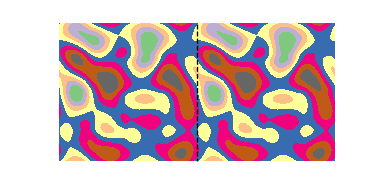
Generate Perlin noise
import pylab as plt
from pythonperlin import perlin

# Set grid shape for randomly seeded gradients
shape = (4,4)

# Set density - output shape will be dens * shape = (128,128)
dens = 32

# Generate noise
x = perlin(shape, dens=dens, seed=0)

# Test that noise tiles seamlessly
x = np.concatenate([x] * 2, axis=1)

plt.figure(figsize=(12,6))
plt.imshow(x, cmap=plt.get_cmap('Accent_r'))
plt.axis('off')
plt.show()
Generate domain warping
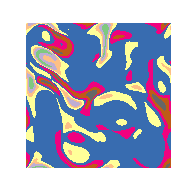
Add noise to grid coordinates and generate noise again
dens = 32
shape = (4,4)
x = perlin(shape, dens=dens, seed=0, warp=2)

plt.figure(figsize=(6,6))
plt.imshow(x, cmap=plt.get_cmap('Accent_r'))
plt.axis('off')
plt.show()
Generate octaves
import pylab as plt
from pythonperlin import perlin

# Set grid shape for randomly seeded gradients
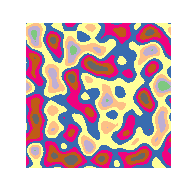
shape = (8,8)

# Set density - output shape will be shape * dens = (256,256)
dens = 32

# Generate noise
x = perlin(shape, dens=dens, seed=0)

plt.figure(figsize=(6,6))
plt.imshow(x, cmap=plt.get_cmap('Accent_r'))
plt.axis('off')
plt.show()

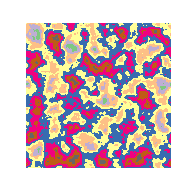
# Generate noise array with 4 additional octaves
x = perlin(shape, dens=dens, seed=0, octaves=4)

plt.figure(figsize=(6,6))
plt.imshow(x, cmap=plt.get_cmap('Accent_r'))
plt.axis('off')
plt.show()
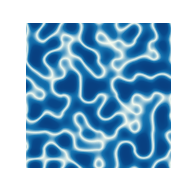
Generate water caustics
Take absolute value of Perlin noise and apply log-scaled color gradient
import numpy as np
from matplotlib.colors import LinearSegmentedColormap

dens = 32
shape = (8,8)
x = perlin(shape, dens=dens)

# Take absolute values of Perlin noise
x = np.abs(x)

# Log-scale colormap
logscale = np.logspace(0,-3,5)
colors = plt.cm.get_cmap('GnBu_r')(logscale)
cmap = LinearSegmentedColormap.from_list('caustics', colors)

plt.figure(figsize=(6,6))
plt.imshow(x, cmap=cmap)
plt.axis('off')
plt.show()
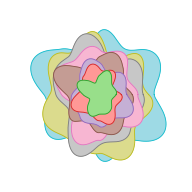
Generate flower petals
Take 1D Perlin noise as the varying radius along a circle
dens = 32
shape = (8,8)
x = perlin(shape, dens=dens)

n = 8
delta = dens
color = plt.get_cmap('tab20').colors[::-1]
plt.figure(figsize=(6,6))
for i in range(n):
    r = x[delta * i] + 1
    r = np.concatenate([r, (r[0],)])
    phi = 2 * np.pi * np.linspace(0, 1, len(r))
    scale = 1 - i / (n + 2)
    z = scale * r * np.exp(1j * phi)
    ax = plt.gca()
    zorder = max([ch.zorder for ch in ax.get_children()])
    plt.fill(z.real, z.imag, c=color[2*i], zorder=zorder+1)
    plt.plot(z.real, z.imag, c=color[2*i+1], lw=2, zorder=zorder+2)
plt.axis('off')
plt.show()
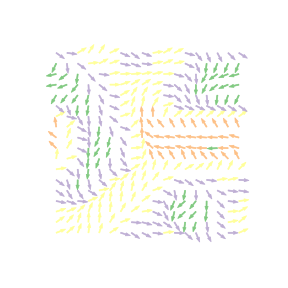
Generate vector field
Take Perlin noise as the vector angle at each point of a grid
dens = 6
shape = (3,3)
x = perlin(shape, dens=dens)
z = np.exp(2j * np.pi * x)

shape = z.shape
colors = plt.get_cmap('Accent').colors
plt.figure(figsize=(6,6))
for i in range(shape[0]):
    for j in range(shape[1]):
        di = 0.5 * z[i,j].real
        dj = 0.5 * z[i,j].imag
        color = colors[(di > 0) + 2 * (dj > 0)]
        plt.arrow(i, j, di, dj, color=color, width=0.1)
plt.axis('off')
plt.show()
Sound of Perlin noise
Perlin noise sounds nice and less buzzing than white noise
import sounddevice as sd

dens = 32
shape = (1024,)
x = perlin(shape, dens=dens)

sd.play(x, 22050)
Alternatively, save and play perlin.wav audio
import IPython
import soundfile as sf

sf.write('perlin.wav', x, 22050)
IPython.display.Audio('perlin.wav')

Documentation
1 maintainer

Metadata
1 maintainer
Release files for pythonperlin 0.0.8
For a detailed explanation of source distributions (sdists) and built distributions (wheels), please see the package formats documentation.
Source distribution (sdist)
| File | Size | Uploaded | Provenance | Actions |
|---|---|---|---|---|
| pythonperlin-0.0.8.tar.gz | 6.1 kB | Without provenance | Details for pythonperlin-0.0.8.tar.gz |
Release files / pythonperlin-0.0.8.tar.gz
| Download URL | pythonperlin-0.0.8.tar.gz |
|---|---|
| Size | 6.1 kB |
| Tags | Source |
|
SHA-256 checksum How to use checksums |
36fd55cc18394ba8dc87f8331617c0e3bee4ba05639d7b31959c65522d73eaa1
|
|
BLAKE2b-256 checksum How to use checksums |
973c67eb428deafb37572f1851e7fe7aa917e36884cc42b90215f6bb440eeaab
|
| Upload date | |
|
Uploaded using Trusted Publishing? What is trusted publishing? |
No |
| Uploaded via |
twine/3.8.0 pkginfo/1.8.2 readme-renderer/34.0 requests/2.27.1 requests-toolbelt/0.9.1 urllib3/1.26.9 tqdm/4.63.0 importlib-metadata/4.11.3 keyring/23.5.0 rfc3986/2.0.0 colorama/0.4.4 CPython/3.9.17
|
Security for pythonperlin 0.0.8
Provenance
Provenance describes where a file came from. On PyPI, provenance is shared via attestations, which provide a verifiable record of the build or publishing details. View details, limitations and caveats.
No provenance found
None of the files in this release were uploaded with provenance metadata.
A note on package security
PyPI is a repository for distributing packages, not a service for auditing them. While third-party security researchers and our staff do their best to detect and remove malicious packages, PyPI cannot guarantee the quality, security or suitability of any given package.
To learn more about protecting yourself from malicious actors, visit our package security documentation.














