




Pythonworley
Worley noise in python -- procedural generative art tool to seamlessly tile texture patterns in any dimensions
Worley noise is a noise function introduced by Steven Worley in 1996. Worley noise is an extension of the Voronoi tessellation.
Installation
pip install pythonworley
More examples and animations can be found at:
https://github.com/timpyrkov/procedural-art/
https://www.instagram.com/timpyrkov/
## Generate Worley noise centers and Voronoi tesselation
Worley noise and Voronoi tesselation work on any random centers. However, random centers placed at regular grid give us an easy way to make a pattern that can be seamlessly tiled in any direction.
import pylab as plt
from scipy import spatial
from pythonworley import noisecoords, worley

# Set grid shape for randomly seeded gradients
shape = (8,4)

# Generate grid noise and set flag boundary=True
# to pad it with periodic boundary points
noise = noisecoords(*shape, boundary=True, seed=0)

# Fltten X, Y coordinates and generate Voronoi tesselation
coords = noise.reshape(2,-1).T
vor = spatial.Voronoi(coords)
vert = vor.vertices
edge = vor.ridge_vertices
face = vor.regions


plt.figure(figsize=(12,6), facecolor="grey")

# Fill faces with random colors
rand = np.random.uniform(0.2, 0.8, len(face))
color = plt.get_cmap("Greys")(rand)
for i, f in enumerate(face):
    if len(f) and min(f) > 0:
        v = vert[f]
        plt.fill(v[:,0], v[:,1], c=color[i])

# Draw edges
for e in edge:
    if min(e) > 0:
        v = vert[e]
        plt.plot(v[:,0], v[:,1], c="black", lw=12)

# Plot centers
plt.scatter(*noise, c="black", s=200)

# Set xlim and ylim to hide periodic boundary padding points
plt.xlim(0, shape[0])
plt.ylim(0, shape[1])
plt.axis('off')
plt.show()
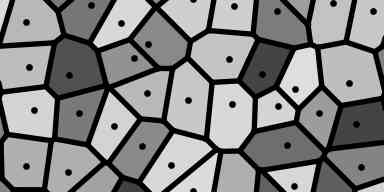
Generate cellular noise
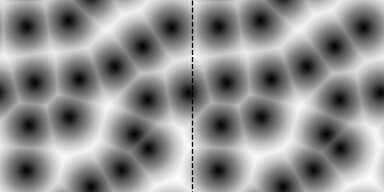
Worley noise produces cellular noise pattern when colored dark to light as the distance to noise centers increases.
import pylab as plt
from pythonworley import worley

# Set grid shape for randomly seeded gradients
shape = (4,4)

# Set density - output shape will be dens * shape = (128,128)
dens = 64

# Generate noise and centers
w, c = worley(shape, dens=dens, seed=0)

# Worley noise is an array of distances to the Nth closests neighbour center.
# Select the first (the smallest). Then transpose, because plt.imshow treats axis 0 as the "Y".
w = w[0].T

# Test that noise tiles seamlessly
w = np.concatenate([w] * 2, axis=1)

plt.figure(figsize=(12,6))
plt.imshow(w, cmap=plt.get_cmap('Greys_r'))
plt.plot([256,256], [0,256], '--k', lw=3)
# plt.scatter(*c, c= "r")
plt.axis('off')
plt.show()
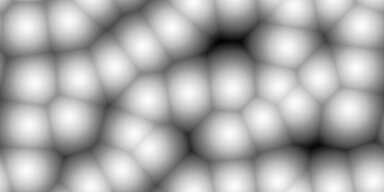
Generate bubble pettern
Worley noise produces bubble pattern when colored light to dark as the distance to noise centers increases.
dens = 64
shape = (8,4)
w, c = worley(shape, dens=dens, seed=0)
w = w[0].T

plt.figure(figsize=(12,6))
plt.imshow(w, cmap=plt.get_cmap('Greys'))
# plt.scatter(*c, c= "r")
plt.axis('off')
plt.show()
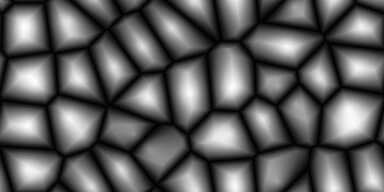
Generate cobblestone pattern
Worley noise produces ccobblestone pavement pattern when taking the difference between the smallest and the second smallest distances from the Worley noise array.
dens = 64
shape = (8,4)
w, c = worley(shape, dens=dens, seed=0)
w = w[1].T - w[0].T

plt.figure(figsize=(12,6))
plt.imshow(w, cmap=plt.get_cmap('Greys_r'))
# plt.scatter(*c, c= "r")
plt.axis('off')
plt.show()
Procedural star field
-
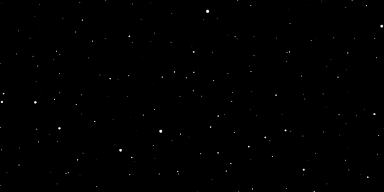
When generating a random star field, a problem is how keep stars apart. Unfortunately random placememts tends to put some stars extremely close to each other.
-
An elegant solution is to place stars based on the grid noise. Though we do not use Worley noise in this example, the grid noise is similar to that we used to generate Worley noise centers above.
shape = (20,10)

# Make rectangular grid
x, y = np.arange(shape[0]), np.arange(shape[1])
x, y = np.meshgrid(x, y, indexing="ij")

# Generate noise: random displacements r at random angles phi
np.random.seed(0)
phi = np.random.uniform(0, 2 * np.pi, x.shape)
r = np.random.uniform(0, 0.5, x.shape)

# Shrink star size to keep it inside its cell.
# Alse, we want more small stars - for the background effect.
# To do that we rescale displacements: r -> 1/2 - 0.001 / r.
r = np.clip(0.5 - 1e-3 / r, 0, None)
size = 200 * (0.5 - r) - 0.4

# Convert r and phi to cartesian coordinates using Euler formula.
z = r * np.exp(1j * phi)
dx, dy = z.real, z.imag
x, y = x + dx, y + dy

plt.figure(figsize=(12,6), facecolor="black")
plt.scatter(x, y, c="white", s=size)
plt.axis('off')
plt.show()
Procedural cityline
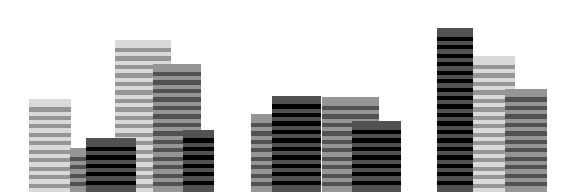
Again we do not use Worley noise itself in this example. Instead we generate a random cityline based on the grid noise which is similar to that we used to generate Worley noise centers above.
# Function to plot a building based its randomly generated center, width, and height
def plot_building(center, width, height, floor_color, window_color, floor=3, basement=0):
    nfloor = int(height)
    if nfloor > floor:
        colors = [[window_color, floor_color] for i in range(nfloor - 1)]
        colors = [floor_color] * 2 + list(itertools.chain(*colors))
        heights = floor * np.arange(1, 1 + 2 * nfloor)[::-1] + basement
        centers = np.ones((2 * nfloor)) * center
        plt.bar(centers, heights, width=width, color=colors)


nblock = 6 # Number of blocks per line
nline = 3 # Number of lines
w = 20 # Average block width

# Generate grid noise
np.random.seed(0)
rand = np.random.uniform(0, w, (nline, 3, nblock))

# Plot blocks line by line
plt.figure(figsize=(18,6), facecolor="w")
for i in range(nline):
    darkness = (i + np.arange(2) + 1) / (nline + 1)
    floor_color, window_color = plt.get_cmap("Greys")(darkness)
    center, width, height = rand[i]
    center += 3 * w * np.arange(nblock) + w * i
    width += w
    for j in range(nblock):
        plot_building(center[j], width[j], height[j],
                      floor_color, window_color, basement=i)
plt.axis('off')
plt.show()
Documentation
1 maintainer

Metadata
1 maintainer
Release files for pythonworley 0.0.1
For a detailed explanation of source distributions (sdists) and built distributions (wheels), please see the package formats documentation.
Source distribution (sdist)
| File | Size | Uploaded | |
|---|---|---|---|
| pythonworley-0.0.1.tar.gz | 6.0 kB | Details |
Release files / pythonworley-0.0.1.tar.gz
| Download URL | pythonworley-0.0.1.tar.gz |
|---|---|
| Size | 6.0 kB |
| Tags | Source |
|
SHA-256 checksum How to use checksums |
6d3838a052711fef1fa586d6647936bea1e84a7f324765721af2ee6c4a0bac22
|
|
BLAKE2b-256 checksum How to use checksums |
d82866d103b405c9e020506d644464e958a66278b11a1ead35e4164b87c05314
|
| Upload date | |
|
Uploaded using Trusted Publishing? What is trusted publishing? |
No |
| Uploaded via |
twine/3.8.0 pkginfo/1.8.2 readme-renderer/34.0 requests/2.27.1 requests-toolbelt/0.9.1 urllib3/1.26.9 tqdm/4.63.0 importlib-metadata/4.11.3 keyring/23.5.0 rfc3986/2.0.0 colorama/0.4.4 CPython/3.9.17
|













