
This release is a pre-release and may not be stable for production use.
















TL;DR
Ignite is a high-level library to help with training neural networks in PyTorch.
- ignite helps you write compact but full-featured training loops in a few lines of code
- you get a training loop with metrics, early-stopping, model checkpointing and other features without the boilerplate
Below we show a side-by-side comparison of using pure pytorch and using ignite to create a training loop to train and validate your model with occasional checkpointing:
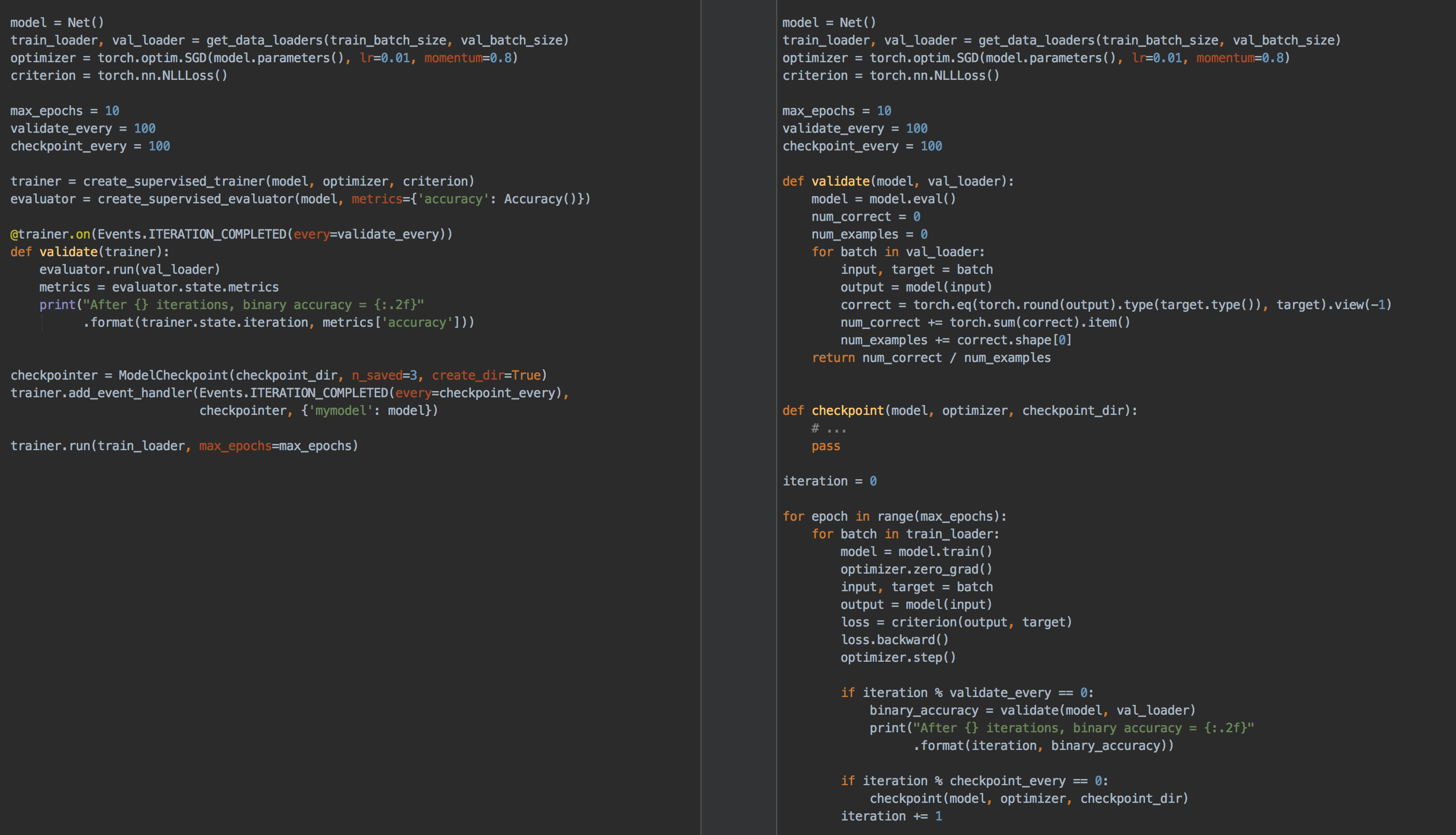
As you can see, the code is more concise and readable with ignite. Furthermore, adding additional metrics, or things like early stopping is a breeze in ignite, but can start to rapidly increase the complexity of your code when "rolling your own" training loop.
Table of Contents
- Installation
- Why Ignite?
- Documentation
- Structure
- Examples
- Communication
- Contributing
- Projects using Ignite
- User feedback
Installation
From pip:
pip install pytorch-ignite
From conda:
conda install ignite -c pytorch
From source:
pip install git+https://github.com/pytorch/ignite
Nightly releases
From pip:
pip install --pre pytorch-ignite
From conda (this suggests to install pytorch nightly release instead of stable version as dependency):
conda install ignite -c pytorch-nightly
Why Ignite?
Ignite's high level of abstraction assumes less about the type of network (or networks) that you are training, and we require the user to define the closure to be run in the training and validation loop. This level of abstraction allows for a great deal more of flexibility, such as co-training multiple models (i.e. GANs) and computing/tracking multiple losses and metrics in your training loop.
Power of Events & Handlers
The cool thing with handlers is that they offer unparalleled flexibility (compared to say, callbacks). Handlers can be any function (e.g. lambda, simple function, class method etc.) with the correct signature, we only require that the first argument be engine. Thus, we do not require to inherit from an interface and override its abstract methods which could unnecessarily bulk up your code and its complexity.
Execute any number of functions whenever you wish
Examples
trainer.add_event_handler(Events.STARTED, lambda engine: print("Start training"))

# attach handler with args, kwargs
mydata = [1, 2, 3, 4]
logger = ...

def on_training_ended(engine, data):
    print("Training is ended. mydata={}".format(data))
    # User can use variables from another scope
    logger.info("Training is ended")


trainer.add_event_handler(Events.COMPLETED, on_training_ended, mydata)
# call any number of functions on a single event
trainer.add_event_handler(Events.COMPLETED, lambda engine: print("OK"))

@trainer.on(Events.ITERATION_COMPLETED)
def log_something(engine):
    print(engine.state.output)
Built-in events filtering
Examples
# run the validation every 5 epochs
@trainer.on(Events.EPOCH_COMPLETED(every=5))
def run_validation(_):
    # run validation

# change some training variable once on 20th epoch
@trainer.on(Events.EPOCH_STARTED(once=20))
def change_training_variable(_):
    # ...

# Trigger handler with customly defined frequency
@trainer.on(Events.ITERATION_COMPLETED(event_filter=first_x_iters))
def log_gradients(_):
    # ...
Stack events to share some actions
Examples
Events can be stacked together to enable multiple calls:
@trainer.on(Events.COMPLETED | Events.EPOCH_COMPLETED(every=10))
def do_some_validation(engine):
    # ...
Custom events to go beyond standard events
Examples
Custom events related to backward and optimizer step calls:
class BackpropEvents(Enum):
    BACKWARD_STARTED = 'backward_started'
    BACKWARD_COMPLETED = 'backward_completed'
    OPTIM_STEP_COMPLETED = 'optim_step_completed'

def update(engine, batch):
    # ...
    loss = criterion(y_pred, y)
    engine.fire_event(BackpropEvents.BACKWARD_STARTED)
    loss.backward()
    engine.fire_event(BackpropEvents.BACKWARD_COMPLETED)
    optimizer.step()
    engine.fire_event(BackpropEvents.OPTIM_STEP_COMPLETED)
    # ...

trainer = Engine(update)
trainer.register_events(*BackpropEvents)

@trainer.on(BackpropEvents.BACKWARD_STARTED)
def function_before_backprop(engine):
    # ...
- Complete snippet can be found here.
- Another use-case of custom events: trainer for Truncated Backprop Through Time.
Out-of-the-box metrics
-
Metrics for various tasks: Precision, Recall, Accuracy, Confusion Matrix, IoU etc, ~20 regression metrics.
-
Users can also compose their own metrics with ease from existing ones using arithmetic operations or torch methods:
precision = Precision(average=False)
recall = Recall(average=False)
F1_per_class = (precision * recall * 2 / (precision + recall))
F1_mean = F1_per_class.mean()  # torch mean method
F1_mean.attach(engine, "F1")
Documentation
API documentation and an overview of the library can be found here.
Additional Materials
- 8 Creators and Core Contributors Talk About Their Model Training Libraries From PyTorch Ecosystem
- Ignite Posters from Pytorch Developer Conferences:
Structure
- ignite: Core of the library, contains an engine for training and evaluating, all of the classic machine learning metrics and a variety of handlers to ease the pain of training and validation of neural networks!
- ignite.contrib: The Contrib directory contains additional modules contributed by Ignite users. Modules vary from TBPTT engine, various optimisation parameter schedulers, logging handlers and a metrics module containing many regression metrics (ignite.contrib.metrics.regression)!
The code in ignite.contrib is not as fully maintained as the core part of the library. It may change or be removed at any time without notice.
Examples
We provide several examples ported from
pytorch/examples using ignite to display how it helps to write compact and
full-featured training loops in a few lines of code:
MNIST Example
Basic neural network training on MNIST dataset with/without ignite.contrib module:
- MNIST with ignite.contrib TQDM/Tensorboard/Visdom loggers
- MNIST with native TQDM/Tensorboard/Visdom logging
Tutorials
Text Classification using Convolutional Neural Networks
Distributed CIFAR10 Example
Training a small variant of ResNet on CIFAR10 in various configurations: 1) single gpu, 2) single node multiple gpus, 3) multiple nodes and multilple gpus.
Other Examples
Reproducible Training Examples
Inspired by torchvision/references, we provide several reproducible baselines for vision tasks:
Features:
- Distributed training with mixed precision by nvidia/apex
- Experiments tracking with MLflow or Polyaxon
Communication
-
GitHub issues: questions, bug reports, feature requests, etc.
-
Discuss.PyTorch, category "Ignite".
-
PyTorch Slack at #pytorch-ignite channel. Request access.
User feedback
We have created a form for "user feedback". We appreciate any type of feedback and this is how we would like to see our community:
- If you like the project and want to say thanks, this the right place.
- If you do not like something, please, share it with us and we can see how to improve it.
Thank you !
Contributing
We appreciate all contributions. If you are planning to contribute back bug-fixes, please do so without any further discussion. If you plan to contribute new features, utility functions or extensions, please first open an issue and discuss the feature with us.
Please see the contribution guidelines for more information.
As always, PRs are welcome :)
Projects using Ignite
- State-of-the-Art Conversational AI with Transfer Learning
- Tutorial on Transfer Learning in NLP held at NAACL 2019
- Implementation of "Attention is All You Need" paper
- Implementation of DropBlock: A regularization method for convolutional networks in PyTorch
- Deep-Reinforcement-Learning-Hands-On-Second-Edition, published by Packt
- Kaggle Kuzushiji Recognition: 2nd place solution
- Unsupervised Data Augmentation experiments in PyTorch
- Hyperparameters tuning with Optuna
- Project MONAI - AI Toolkit for Healthcare Imaging
- DeepSeismic - Deep Learning for Seismic Imaging and Interpretation
See other projects at "Used by"
If your project implements a paper, represents other use-cases not covered in our official tutorials, Kaggle competition's code or just your code presents interesting results and uses Ignite. We would like to add your project in this list, so please send a PR with brief description of the project.


Release files for pytorch-ignite 0.4.0.dev20200409
For a detailed explanation of source distributions (sdists) and built distributions (wheels), please see the package formats documentation.
Source distribution (sdist)
| File | Size | Uploaded | |
|---|---|---|---|
| pytorch-ignite-0.4.0.dev20200409.tar.gz | 90.5 kB | Details |
Built distribution (wheel)
| File | Interpreter | ABI | Platform | Reset |
|---|---|---|---|---|
| pytorch_ignite-0.4.0.dev20200409-py2.py3-none-any.whl | Python 3, Python 2 | none | any | Details |
Total release size: 217.7 kB
Release files / pytorch-ignite-0.4.0.dev20200409.tar.gz
| Download URL | pytorch-ignite-0.4.0.dev20200409.tar.gz |
|---|---|
| Size | 90.5 kB |
| Tags | Source |
|
SHA-256 checksum How to use checksums |
8bb0f43c918224636d920f970ae5a3b0832d6f6a5c107ae2ff8dde4e11c17bf2
|
|
BLAKE2b-256 checksum How to use checksums |
5537fcdfc257eb2a6a10f5ed5e472101b525cef11082987d01efcef6a7f8438b
|
| Upload date | |
|
Uploaded using Trusted Publishing? What is trusted publishing? |
No |
| Uploaded via |
twine/3.1.1 pkginfo/1.5.0.1 requests/2.23.0 setuptools/46.1.3.post20200330 requests-toolbelt/0.9.1 tqdm/4.45.0 CPython/3.7.7
|
Release files / pytorch_ignite-0.4.0.dev20200409-py2.py3-none-any.whl
| Download URL | pytorch_ignite-0.4.0.dev20200409-py2.py3-none-any.whl |
|---|---|
| Size | 127.2 kB |
| Tags | Python 2 Python 3 |
|
SHA-256 checksum How to use checksums |
0f15e3d4eff4e14751fc596b4161fd616678566a17dd548004a21a0ce9885fd0
|
|
BLAKE2b-256 checksum How to use checksums |
765e4e16eacdc614a1d19227944719e9162579ff493418b2b3e0b06774dd7180
|
| Upload date | |
|
Uploaded using Trusted Publishing? What is trusted publishing? |
No |
| Uploaded via |
twine/3.1.1 pkginfo/1.5.0.1 requests/2.23.0 setuptools/46.1.3.post20200330 requests-toolbelt/0.9.1 tqdm/4.45.0 CPython/3.7.7
|














