
This release is a pre-release and may not be stable for production use.

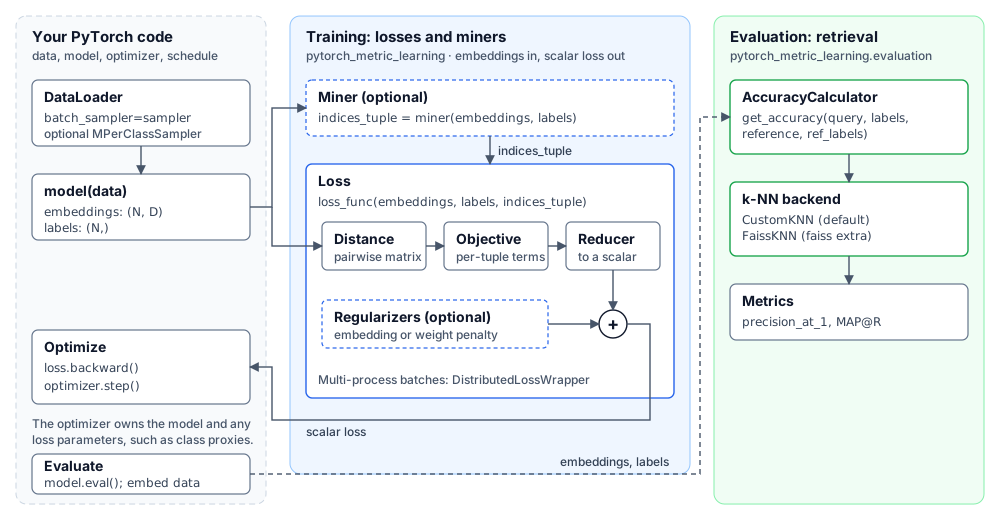
Train embedding models with composable PyTorch losses, hard-example miners, distances, reducers, and regularizers. Use them in your own training loop for retrieval, clustering, recognition, or learning from pairs and triplets.
Docs for humans · Documentation source
Install
Install the version 3 release candidate from PyPI with uv or pip:
uv pip install "pytorch-metric-learning==3.0.0rc3"
pip install "pytorch-metric-learning==3.0.0rc3"
The core package needs only PyTorch and NumPy. Optional extras add the Faiss
retrieval backend, pytorch-metric-learning[faiss], and scikit-learn for the
NMI/AMI clustering metrics, pytorch-metric-learning[clustering].
Version 3 requires Python 3.12 or newer, PyTorch 2.14.0 or newer, and NumPy 2.5.3 or newer. Upgrading from version 2? Read the release notes and look up old names in the migration guide. The version 2 documentation source remains available.
A minimal training step
Your model produces one embedding per input. Equal labels identify positive pairs; different labels identify negatives. Here a contrastive loss pulls positive pairs together and pushes negatives apart:
import torch
from pytorch_metric_learning import losses

torch.manual_seed(17)
model = torch.nn.Linear(8, 4)
optimizer = torch.optim.SGD(model.parameters(), lr=0.1)
data = torch.randn(12, 8)
labels = torch.arange(4).repeat_interleave(3)
loss_func = losses.ContrastiveLoss(neg_margin=1.4)

optimizer.zero_grad(set_to_none=True)
loss = loss_func(model(data), labels)
loss.backward()
optimizer.step()
The model returns embeddings shaped (12, 4) and labels have shape (12,).
This loss L2-normalizes embeddings by default. It averages active positive and
negative pair penalties separately, then adds them. See the
contrastive-loss contract for distances,
margins, and reduction options.
Learn more
The Markdown documentation starts with a task index and a concepts overview of embeddings, tuples, distances, loss terms, and reducers. Every component page states its signature, defaults, tensor contract, and paper, and the recipes show complete training and evaluation code.
Contributing
See CONTRIBUTING.md. Thanks to all contributors, upstream projects, and supporters.
Citing this library
If you use this library in your research, please cite the PyTorch Metric Learning paper:
@article{Musgrave2020PyTorchML,
  title={PyTorch Metric Learning},
  author={Kevin Musgrave and Serge J. Belongie and Ser-Nam Lim},
  journal={ArXiv},
  year={2020},
  volume={abs/2008.09164}
}
1 maintainer

Metadata
1 maintainer
Release files for pytorch-metric-learning 3.0.0rc5
For a detailed explanation of source distributions (sdists) and built distributions (wheels), please see the package formats documentation.
Source distribution (sdist)
| File | Size | Uploaded | Provenance | Actions |
|---|---|---|---|---|
| pytorch_metric_learning-3.0.0rc5.tar.gz | 67.8 kB | Without provenance | Details for pytorch_metric_learning-3.0.0rc5.tar.gz |
Built distribution (wheel)
| File | Interpreter | ABI | Platform | Actions Reset |
|---|---|---|---|---|
| pytorch_metric_learning-3.0.0rc5-py3-none-any.whl | Python 3 | none | any | Details for pytorch_metric_learning-3.0.0rc5-py3-none-any.whl |
Total release size: 183.2 kB
Release files / pytorch_metric_learning-3.0.0rc5.tar.gz
| Download URL | pytorch_metric_learning-3.0.0rc5.tar.gz |
|---|---|
| Size | 67.8 kB |
| Tags | Source |
|
SHA-256 checksum How to use checksums |
c92597248f5db27994aa0140183def039883094680fa91e6e1d3f519c3ae9cf0
|
|
BLAKE2b-256 checksum How to use checksums |
ff9c4d550e8f675f5c0be237d63cac454b02f750556adb2127e152b53c606734
|
| Upload date | |
|
Uploaded using Trusted Publishing? What is trusted publishing? |
Yes |
| Uploaded via |
uv/0.13.4 {"installer":{"name":"uv","version":"0.13.4","subcommand":["publish"]},"python":null,"implementation":{"name":null,"version":null},"distro":{"name":"Ubuntu","version":"24.04","id":"noble","libc":null},"system":{"name":null,"release":null},"cpu":null,"openssl_version":null,"setuptools_version":null,"rustc_version":null,"ci":true}
|
Release files / pytorch_metric_learning-3.0.0rc5-py3-none-any.whl
| Download URL | pytorch_metric_learning-3.0.0rc5-py3-none-any.whl |
|---|---|
| Size | 115.4 kB |
| Tags | Python 3 |
|
SHA-256 checksum How to use checksums |
b1aed3712e95d57c69d0ec4df14df7bef54a4f300f240f822b8799e377f1d5e7
|
|
BLAKE2b-256 checksum How to use checksums |
3545f186653834bbe6dfa095f8b474b2d5945694157b347e62c681045b6fa4ab
|
| Upload date | |
|
Uploaded using Trusted Publishing? What is trusted publishing? |
Yes |
| Uploaded via |
uv/0.13.4 {"installer":{"name":"uv","version":"0.13.4","subcommand":["publish"]},"python":null,"implementation":{"name":null,"version":null},"distro":{"name":"Ubuntu","version":"24.04","id":"noble","libc":null},"system":{"name":null,"release":null},"cpu":null,"openssl_version":null,"setuptools_version":null,"rustc_version":null,"ci":true}
|
Security for pytorch-metric-learning 3.0.0rc5
Provenance
Provenance describes where a file came from. On PyPI, provenance is shared via attestations, which provide a verifiable record of the build or publishing details. View details, limitations and caveats.
No provenance found
None of the files in this release were uploaded with provenance metadata.
A note on package security
PyPI is a repository for distributing packages, not a service for auditing them. While third-party security researchers and our staff do their best to detect and remove malicious packages, PyPI cannot guarantee the quality, security or suitability of any given package.
To learn more about protecting yourself from malicious actors, visit our package security documentation.














