
pytorch2ltspice


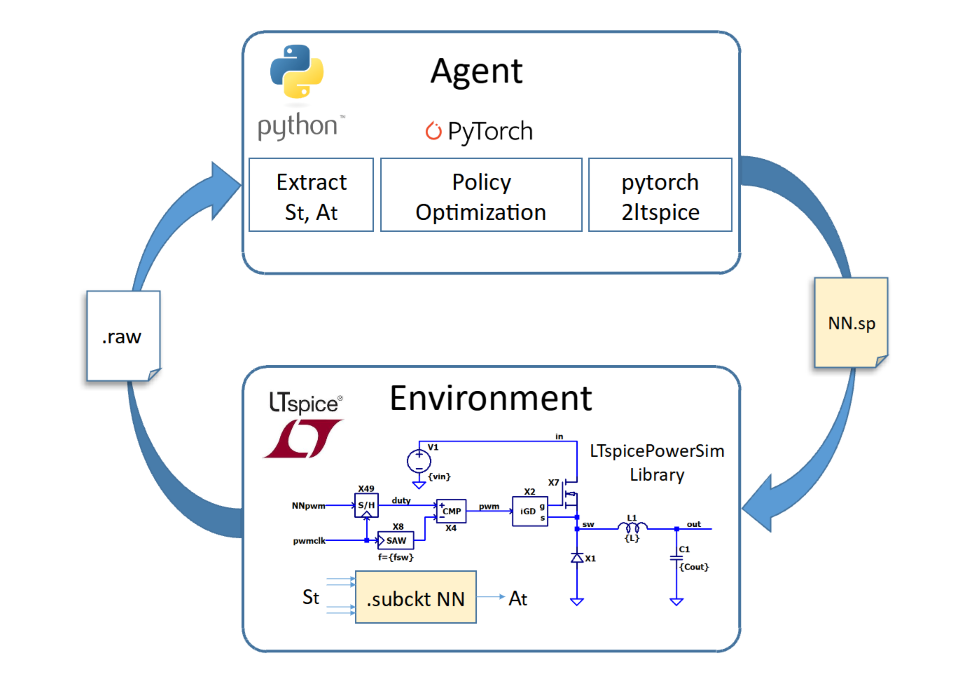
pytorch2ltspice converts PyTorch nn.Sequential models into LTspice-compatible subcircuits (.subckt).
It is intended for workflows where a controller is trained in PyTorch and then embedded directly into LTspice simulations for power electronics, control, and reinforcement learning experiments.
By combining it with LTspicePowerSim, you can evaluate neural-network controllers inside converter, inverter, and motor-drive simulations.
Features
- Export PyTorch
nn.Sequentialmodels as LTspice.subcktnetlists. - Support
nn.Linear,nn.ReLU,nn.Sigmoid,nn.Tanh,nn.RNNCell,nn.GRUCell, andnn.LSTMCell. - Generate behavioral-source (
B) based netlists for feed-forward layers. - Generate recurrent-cell implementations using LTspice
.machineblocks with an auto-addedCLKpin. - Support final-output postprocessing via
output_activationand selective output exposure viaoutput_mask. - Include helper utilities under
pytorch2ltspice.utilsfor signal generation, model scaffolding, and sampling. - Provide end-to-end example projects for buck-converter control with imitation learning and PPO.
Installation
Install from PyPI:
pip install pytorch2ltspice
Install from source:
git clone https://github.com/kosokno/pytorch2ltspice.git
cd pytorch2ltspice
pip install -e .
Quick Start
Define a model in PyTorch:
import torch.nn as nn

model = nn.Sequential(
    nn.Linear(20, 32),
    nn.ReLU(),
    nn.Linear(32, 16),
    nn.ReLU(),
    nn.Linear(16, 1),
)
model.eval()
Export it as an LTspice subcircuit:
from pytorch2ltspice import export_model_to_ltspice

export_model_to_ltspice(
    model,
    filename="TEST_MODEL_SUBCKT.SP",
    subckt_name="TESTACTORSUBCKT",
    output_activation=["tanh"],
)
Include the generated file in LTspice:
- Add
.include TEST_MODEL_SUBCKT.SPto your schematic. - Drive the
NNIN*pins from your circuit. - Read the inference result from
NNOUT*.
Utilities
Helper utilities are available under pytorch2ltspice.utils:
siggen: generate LTspice signal-source schematics and symbols.modelgen: generate a PyTorch module class fromnn.Sequential.sampling: sample signals on a clock for analysis and data preparation.
Examples
Example projects are available under examples/:
BUCK_VM_BI: behavior-imitation controller for a voltage-mode buck converter.BUCK_VM_PPO: PPO-based controller for a voltage-mode buck converter.BUCK_VM_GRU8x1: recurrent controller examples usingGRUCell.
Related Projects
License
MIT
1 maintainer

Metadata
1 maintainer
Release files for pytorch2ltspice 0.1.4
For a detailed explanation of source distributions (sdists) and built distributions (wheels), please see the package formats documentation.
Built distribution (wheel)
| File | Interpreter | ABI | Platform | Reset |
|---|---|---|---|---|
| pytorch2ltspice-0.1.4-py3-none-any.whl | Python 3 | none | any | Details |
Release files / pytorch2ltspice-0.1.4-py3-none-any.whl
| Download URL | pytorch2ltspice-0.1.4-py3-none-any.whl |
|---|---|
| Size | 20.2 kB |
| Tags | Python 3 |
|
SHA-256 checksum How to use checksums |
79d35e7f6c87809fa28f6b4f15798b1de77faf139acc7772ac4b3fcf2b74e9bb
|
|
BLAKE2b-256 checksum How to use checksums |
5ec3915d554c5e16466f8e211f5b53b326f2b4b83703b4c936f50c2eb17ad9e7
|
| Upload date | |
|
Uploaded using Trusted Publishing? What is trusted publishing? |
No |
| Uploaded via |
twine/6.2.0 CPython/3.12.10
|














