










A python package for the truncation of scattering phase functions in radiative transfer applications
Mustapha Moulana
HYGEOS website
Documentation
Features
- Analytic scattering phase functions: Henyey-Greenstein, two-term Henyey-Greenstein and Fournier-Forand
- Phase function Legendre moments, computed numerically for an arbitrary phase function or analytically for the Henyey-Greenstein family
- Truncation of the forward peak with the delta-m method of Wiscombe (1977) and the geometrical truncation (GT) method of Iwabuchi and Suzuki (2009)
- Truncation results returned as xarray datasets, gathering the approximated and truncated phase functions, the truncation factor, the truncation angle and the exact and truncated moments
- Numerical utilities: Legendre polynomials and their derivatives, Bessel functions of the first kind, and a Lobatto quadrature with cached abscissas and weights, for accurate integration of strongly peaked phase functions on a limited number of angles
Installation
The installation can be performed using one of the following commands:
$ conda install -c conda-forge pytrunc
$ pip install pytrunc
$ pip install git+https://github.com/hygeos/pytrunc.git
Quickstart
Truncate a Henyey-Greenstein phase function with the delta-m method and get the result as an xarray dataset:
>>> import numpy as np
>>> from pytrunc.phase import henyey_greenstein
>>> from pytrunc.truncation import delta_m_phase_approx
>>> theta = np.linspace(0., 180., 1801)  # scattering angles in degrees
>>> phase = henyey_greenstein(theta, g=0.85, normalize=2)
>>> ds = delta_m_phase_approx(phase, theta, m_max=20)
>>> ds['f'].values
array(0.03874944)
The same phase function truncated with the GT method, using the last moment as the truncation fraction:
>>> from pytrunc.phase import calc_moments
>>> from pytrunc.truncation import gt_phase_approx
>>> chi = calc_moments(phase, theta, m_max=20, normalize=True)
>>> ds = gt_phase_approx(phase, theta, trunc_frac=chi[20])
>>> ds['f'].values, ds['theta_f'].values
(array(0.03874944), array(7.1))
Examples
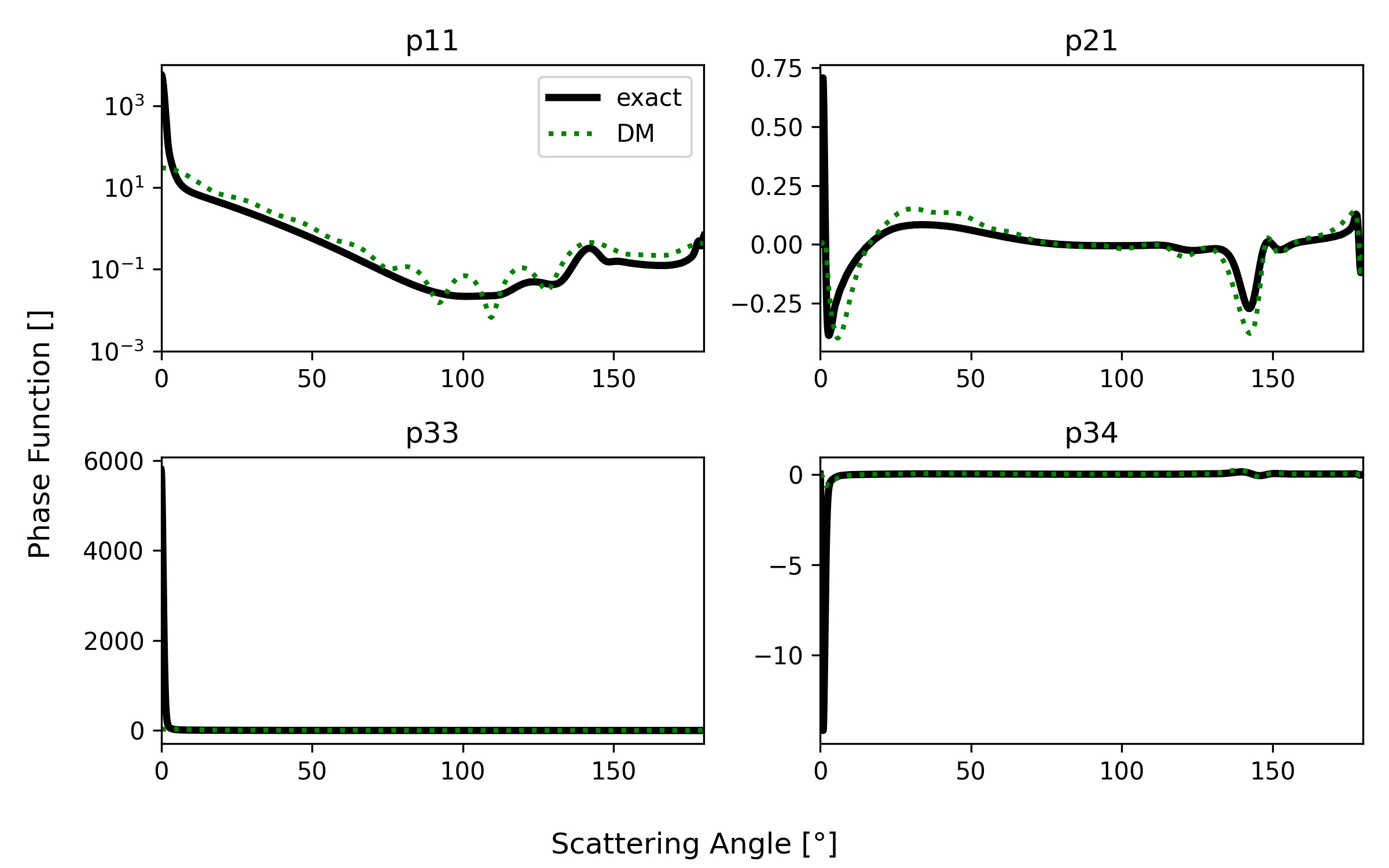
Truncation of a realistic water cloud phase function (Mie calculation at 500 nm, effective radius of 8 µm) with the delta-m method:
Show figure
>>> ...
>>> from pytrunc.truncation import delta_m_phase_approx
>>> m_max = 20  # stream / term number
>>> # phase_exact -> P11 of a liquid cloud at 500nm, effective radius of 8 micrometers
>>> # theta -> the phase angles in degrees
>>> ds = delta_m_phase_approx(phase_exact, theta, m_max)  # return an xarray dataset
>>> ...
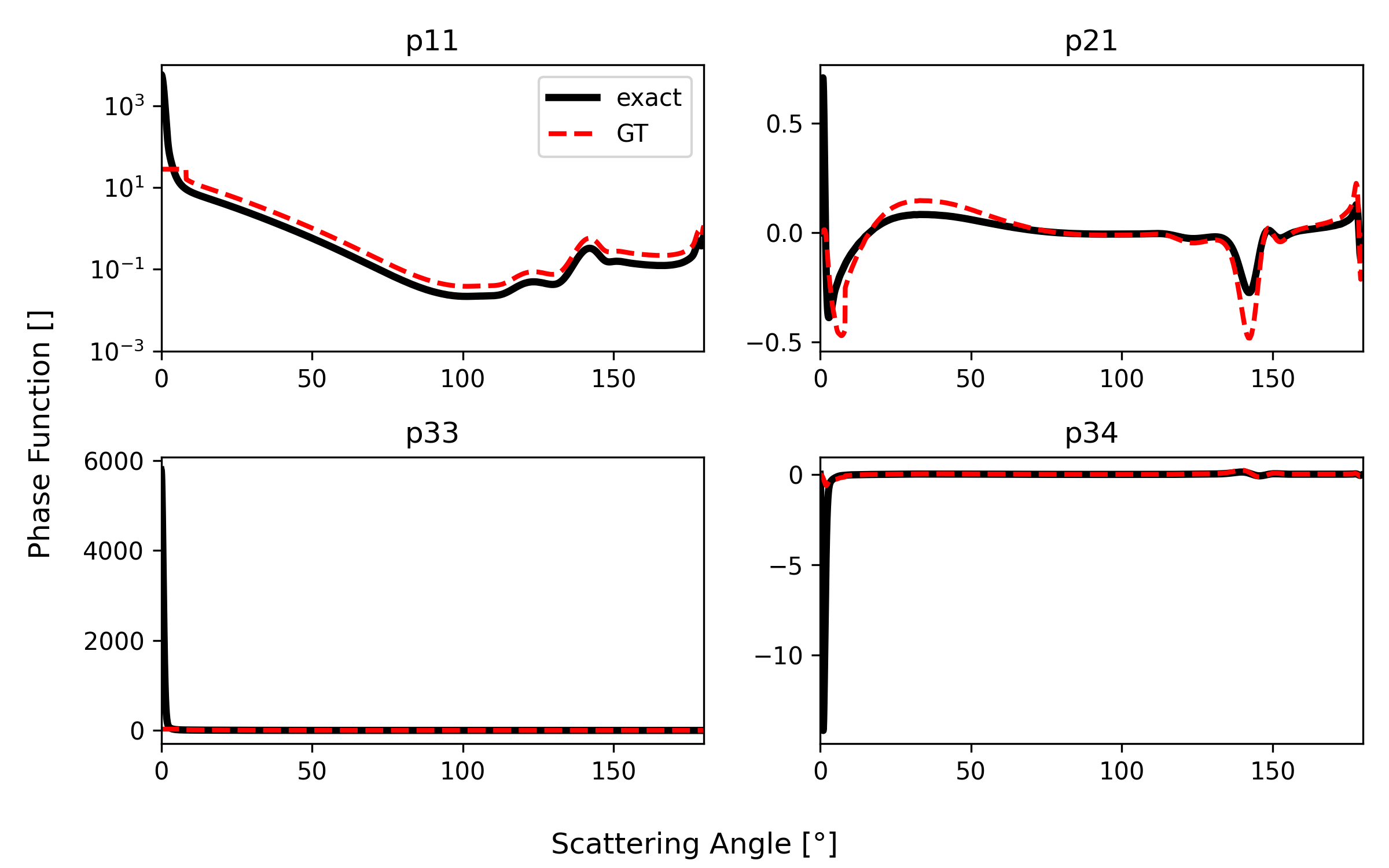
The same phase function truncated with the geometrical truncation (GT) method:
Show figure
>>> ...
>>> from pytrunc.truncation import gt_phase_approx
>>> from pytrunc.phase import calc_moments
>>> m_max = 20  # stream / term number
>>> # phase_exact -> P11 of a liquid cloud at 500nm, effective radius of 8 micrometers
>>> # theta -> the phase angles in degrees
>>> chi = calc_moments(phase_exact, theta, m_max=m_max, normalize=True)  # the phase moments
>>> f = chi[m_max]  # the truncation factor
>>> ds = gt_phase_approx(phase_exact, theta, f)  # return an xarray dataset
>>> ...
Documentation
The complete documentation is available at
hygeos.github.io/pytrunc. It
includes example notebooks (truncation of a realistic water cloud phase
function, Lobatto quadrature, and the validation against Iwabuchi and
Suzuki (2009)) and the full API reference. The docstrings are also
available from the built-in help function, e.g.
help(delta_m_phase_approx).
License
Pytrunc is licensed under the Apache License 2.0, see LICENSE.txt.
1 maintainer

Metadata
1 maintainer
Release files for pytrunc 2.1.0
For a detailed explanation of source distributions (sdists) and built distributions (wheels), please see the package formats documentation.
Source distribution (sdist)
| File | Size | Uploaded | |
|---|---|---|---|
| pytrunc-2.1.0.tar.gz | 374.4 kB | Details |
Built distribution (wheel)
| File | Interpreter | ABI | Platform | Reset |
|---|---|---|---|---|
| pytrunc-2.1.0-py3-none-any.whl | Python 3 | none | any | Details |
Total release size: 743.3 kB
Release files / pytrunc-2.1.0.tar.gz
| Download URL | pytrunc-2.1.0.tar.gz |
|---|---|
| Size | 374.4 kB |
| Tags | Source |
|
SHA-256 checksum How to use checksums |
64a95c7d9d5691f65d1d9becdac75f5c77357a2dd0655d2703f7f8e31ffea945
|
|
BLAKE2b-256 checksum How to use checksums |
fc06041115d1577ddf08d0e5ab2a97cb928f3194dc7f824ce5f1c1ff5833f5b2
|
| Upload date | |
|
Uploaded using Trusted Publishing? What is trusted publishing? |
Yes |
| Uploaded via |
twine/7.0.0 CPython/3.13.14
|
Provenance
Provenance describes where a file came from. On PyPI, provenance is shared via attestations, which provide a verifiable record of the build or publishing details. View details, limitations and caveats.


PyPI Publish Attestation
PyPI verified that this artifact, at this checksum, originated from the publisher listed below.
Signed by GitHub Actions, verified by PyPI on Sep 30, 2026.
Transparency logRelease files / pytrunc-2.1.0-py3-none-any.whl
| Download URL | pytrunc-2.1.0-py3-none-any.whl |
|---|---|
| Size | 368.9 kB |
| Tags | Python 3 |
|
SHA-256 checksum How to use checksums |
402aa6d28a05cb7ee4938741146f41b35cc1ef117d0deef59ebe69b41db8254b
|
|
BLAKE2b-256 checksum How to use checksums |
92523d67c9f0736152542ea753dfea0e493dc6edd1f8ac2c6214f4abb67cec21
|
| Upload date | |
|
Uploaded using Trusted Publishing? What is trusted publishing? |
Yes |
| Uploaded via |
twine/7.0.0 CPython/3.13.14
|
Provenance
Provenance describes where a file came from. On PyPI, provenance is shared via attestations, which provide a verifiable record of the build or publishing details. View details, limitations and caveats.
PyPI Publish Attestation
PyPI verified that this artifact, at this checksum, originated from the publisher listed below.
Signed by GitHub Actions, verified by PyPI on Sep 30, 2026.
Transparency log













