
pyvista-modflow
Read MODFLOW-USG unstructured grids into PyVista as exact, flat-layered volumes.


Built and maintained by CoDimensional PBC.
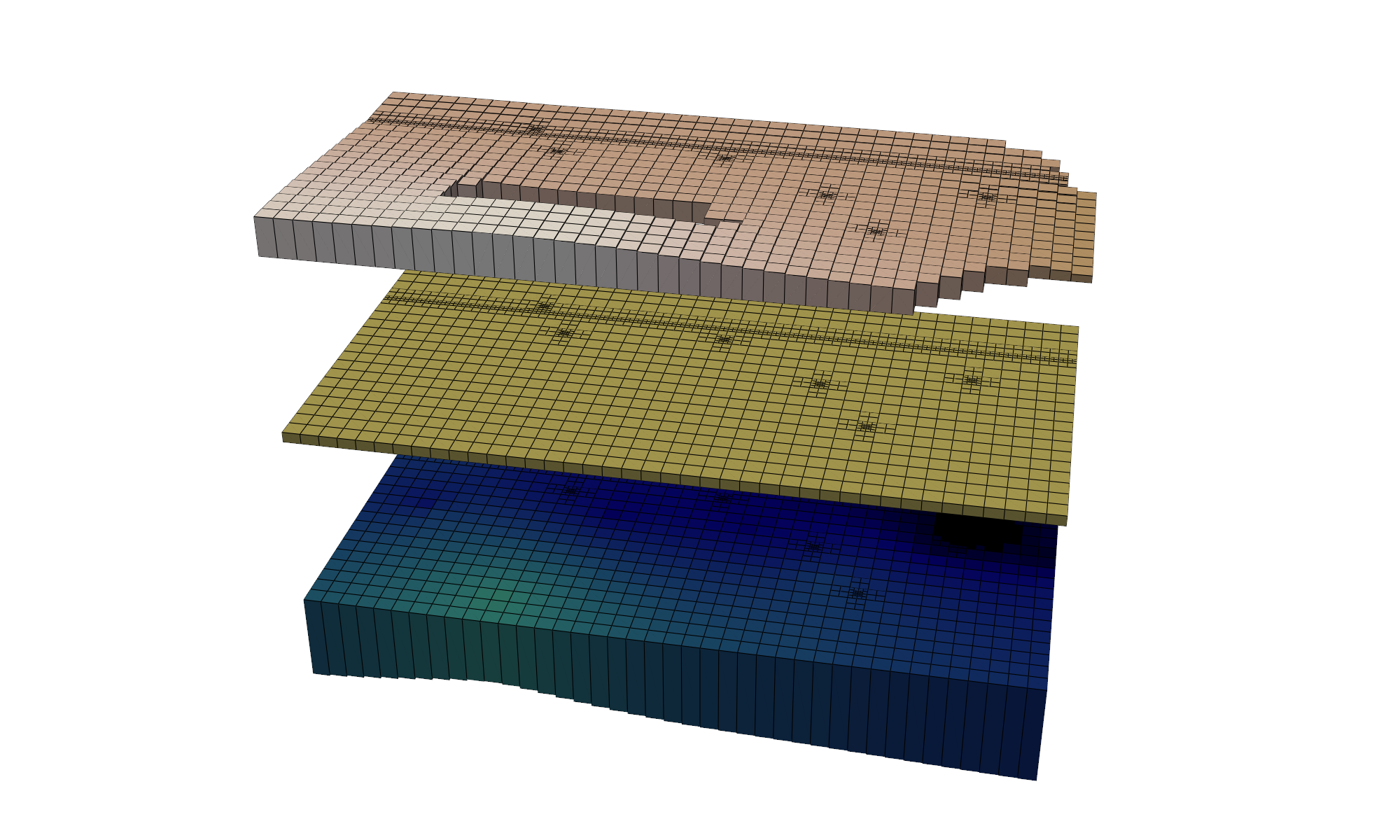
FloPy's Freyberg MODFLOW-USG model, layers pulled apart, 60× vertical exaggeration (scripts/render_readme.py).
Install
pip install pyvista-modflow
It depends only on NumPy and PyVista (0.49 or later, with VTK 9.4 or later), and it registers itself as the PyVista reader for .dis and .disu files.
Quickstart
import pyvista as pv

grid = pv.read('model.disu')  # finds model.gsf or model.shp beside it
grid = pv.read('model.disu', footprints='cells.shp')  # or name the outlines
grid.plot(show_edges=True)  # colored by layer
pyvista_modflow.read(...) takes the same arguments. The grid carries two cell arrays: layer, and node, the 1-based MODFLOW node number. Use node to attach heads or any other per-node result:
import numpy as np

heads = np.loadtxt('heads.txt')  # one value per MODFLOW node, from any post-processor
grid.cell_data['head'] = heads[grid.cell_data['node'] - 1]
Command line
Installing the package also lets the pyvista command read DISU files. The footprint file must sit beside the DISU with the same name (model.gsf or model.shp).
pyvista convert model.disu model.vtu  # one model
pyvista convert "*.disu" .vtu         # every model in the folder
pyvista plot model.disu
Recipes
Aquifers are thin, so exaggerate z before looking at them:
grid.scale([1, 1, 20]).plot(scalars='head', show_edges=True)
One layer, a cross-section, or a cutaway of whole cells:
layer2 = grid.threshold([2, 2], scalars='layer')
section = grid.slice(normal='y')
cutaway = grid.clip(normal='x', crinkle=True)
Save it for ParaView or any other VTK reader:
grid.save('model.vtu')
Background
A MODFLOW-USG DISU file holds each cell's top, bottom and area, but no x or y coordinates. The cell outlines come from a sidecar file, and the usual conversions build the cells from that sidecar's vertices. Those vertices are shared between neighboring cells and carry a single z, so every cell is bent to follow an interpolated surface instead of its own flat top and bottom.
This reader takes each cell's outline from the sidecar and its elevations from the DISU, so every cell is a flat-topped prism. Neighboring columns break at different elevations, so the reader splits every side wall wherever a neighbor's top or bottom meets it, and inserts the extra corner a refined (quadtree or nested) neighbor puts part way along a coarse cell's edge. A wall shared by two cells is the same face in both, so the surface PyVista extracts has no interior walls. Tops and bottoms are not split the same way: where a layer is refined differently from the one above it, the coarse cell's top and the fine cells' bottoms touch without sharing faces.
Inputs
| File | Holds |
|---|---|
DISU (.dis, .disu) |
Nodes per layer and every node's TOP, BOT and AREA. INTERNAL, CONSTANT, OPEN/CLOSE, free and fixed-width Fortran formats are read. |
GSF (.gsf) |
One outline per node. Vertex z is ignored. |
Polygon shapefile (.shp with .shx, .dbf, optional .prj) |
One layer's outlines, numbered 1 .. n by a whole-number ID field (id_field=), reused by every layer of a layered (IVSD = -1) DISU. The .prj is kept as crs_wkt field data. |
Each outline's area is checked against the DISU AREA, which catches outlines matched to the wrong nodes; area_rtol=None skips it. A node whose TOP is not above its BOT has no volume and is skipped with a warning, and the node cell array maps every cell back to its MODFLOW node.
MODFLOW 6 (DISV, DISU, binary grid files) and structured DIS files are not read yet.
Development
just sync   # uv sync with the dev group
just test   # pytest
just lint   # pre-commit on every file
just figure # re-render the figure above
The test models in tests/data/ come from FloPy (public domain, CC0); see tests/data/README.md.
Metadata
Release files for pyvista-modflow 0.1.0
For a detailed explanation of source distributions (sdists) and built distributions (wheels), please see the package formats documentation.
Source distribution (sdist)
| File | Size | Uploaded | Provenance | Actions |
|---|---|---|---|---|
| pyvista_modflow-0.1.0.tar.gz | 1.0 MB | With provenance | Details for pyvista_modflow-0.1.0.tar.gz |
Built distribution (wheel)
| File | Interpreter | ABI | Platform | Actions Reset |
|---|---|---|---|---|
| pyvista_modflow-0.1.0-py3-none-any.whl | Python 3 | none | any | Details for pyvista_modflow-0.1.0-py3-none-any.whl |
Total release size: 1.1 MB
Release files / pyvista_modflow-0.1.0.tar.gz
| Download URL | pyvista_modflow-0.1.0.tar.gz |
|---|---|
| Size | 1.0 MB |
| Tags | Source |
|
SHA-256 checksum How to use checksums |
fc4cbf30442853884ace7379790f8f9563091d2544bbca5d33b1f496f10b40ab
|
|
BLAKE2b-256 checksum How to use checksums |
95be22297cfc0ce914a4d96e658e0432047d12d3322e5548a1efed47c6489eaf
|
| Upload date | |
|
Uploaded using Trusted Publishing? What is trusted publishing? |
Yes |
| Uploaded via |
twine/7.0.0 CPython/3.13.16
|
Provenance
Provenance describes where a file came from. On PyPI, provenance is shared via attestations, which provide a verifiable record of the build or publishing details. View details, limitations and caveats.


PyPI Publish Attestation
PyPI verified that this artifact, at this checksum, originated from the publisher listed below.
Signed by GitHub Actions, verified by PyPI on Oct 29, 2026.
Transparency logRelease files / pyvista_modflow-0.1.0-py3-none-any.whl
| Download URL | pyvista_modflow-0.1.0-py3-none-any.whl |
|---|---|
| Size | 20.8 kB |
| Tags | Python 3 |
|
SHA-256 checksum How to use checksums |
9bea28ad7d19c91220e80fa7fc669a74adbcfd2b4c775677e1923afc9674cf9a
|
|
BLAKE2b-256 checksum How to use checksums |
b04b603f63d807ec5c3d802203a7edcd3496970bd6ead5fdb3af6ead93d3630b
|
| Upload date | |
|
Uploaded using Trusted Publishing? What is trusted publishing? |
Yes |
| Uploaded via |
twine/7.0.0 CPython/3.13.16
|
Provenance
Provenance describes where a file came from. On PyPI, provenance is shared via attestations, which provide a verifiable record of the build or publishing details. View details, limitations and caveats.
PyPI Publish Attestation
PyPI verified that this artifact, at this checksum, originated from the publisher listed below.
Signed by GitHub Actions, verified by PyPI on Oct 29, 2026.
Transparency logSecurity for pyvista-modflow 0.1.0
Provenance
Provenance describes where a file came from. On PyPI, provenance is shared via attestations, which provide a verifiable record of the build or publishing details. View details, limitations and caveats.
Full provenance
All 2 files in this release have been uploaded with provenance metadata.
Attestation for pyvista_modflow-0.1.0.tar.gz
PyPI Publish Attestation
PyPI verified that this artifact, at this checksum, originated from the publisher listed below.
Signed by GitHub Actions, verified by PyPI on Oct 29, 2026.
Transparency logA note on package security
PyPI is a repository for distributing packages, not a service for auditing them. While third-party security researchers and our staff do their best to detect and remove malicious packages, PyPI cannot guarantee the quality, security or suitability of any given package.
To learn more about protecting yourself from malicious actors, visit our package security documentation.













