
Exact mesh booleans, intersection curves, self-intersection repair,
isocontours and isobands, and N-ary CSG on PyVista
meshes. PyVista in, PyVista out, through one .trueform accessor on
pyvista.PolyData.
Getting Started
pip install pyvista-trueform
The accessor registers itself on import and answers through
.trueform on any pyvista.PolyData:
import pyvista as pv
import pyvista_trueform  # registers the accessor

pv.Cube().trueform.volume()
The cache is whole-value, keyed by the dataset's VTK modification time — the held instance is what lets trueform's spatial tree, face membership, and edge link build lazily once:
import numpy as np

a = pv.Cube()
mesh = a.trueform.to_mesh()
assert a.trueform.to_mesh() is mesh  # same cached instance, MTime unchanged

np.asarray(a.points)[0] += 1.0       # raw mutation: MTime NOT bumped
a.Modified()                         # tell VTK, so the cache rebuilds
assert a.trueform.to_mesh() is not mesh
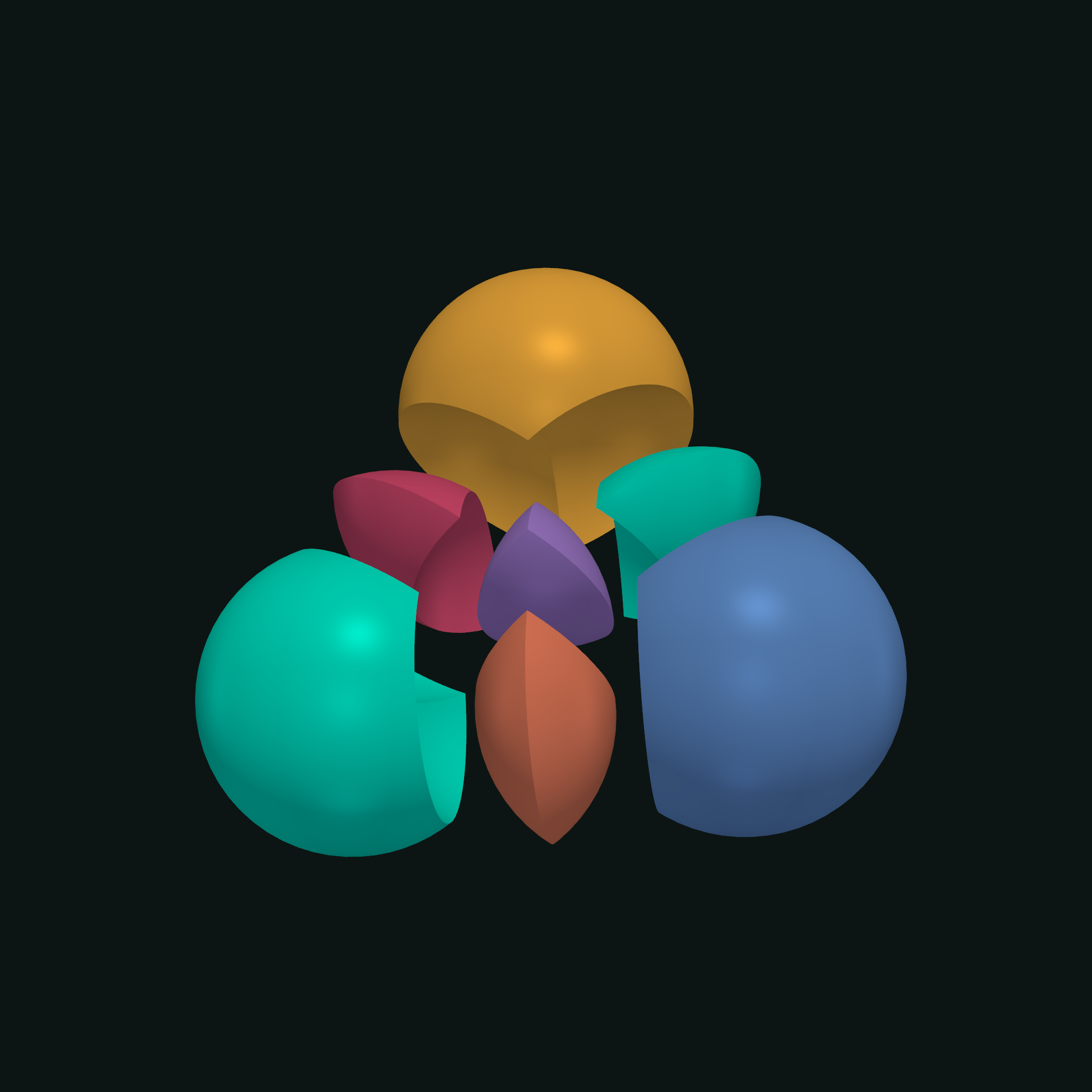
A worked example — a boolean carves the shape, domains reads the
pieces the arrangement made, and pick names the one a ray struck:
import numpy as np
import pyvista as pv
import pyvista_trueform as tfpv
import trueform as tf

a = pv.Cube()
b = pv.Cube(center=(0.5, 0.5, 0.5))

carved = a.trueform.difference(b)
carved.cell_data["trueform_labels"]  # per-face source: 0 (a) or 1 (b)
blocks = tfpv.domains([a, b])        # every overlap pocket, its own block
ray = tf.Ray(origin=np.array([-2, 0, 0], dtype=np.float32),
            direction=np.array([1, 0, 0], dtype=np.float32))
hit = tfpv.pick(blocks, ray)
hit.block_index                      # which block the ray struck
The contract the package holds itself to — dialect laws, the full surface, the gotchas — is one call away:
print(tfpv.agents()) # the package contract, for agents and humans alike
The sections below cover the rest of the surface these three lean on.
N-ary CSG
Build one arrangement of N operands and answer arbitrarily many boolean expressions against it:
from pyvista_trueform import csg_graph

c = pv.Cube(center=(0.25, 0.5, 0.0))  # quads, mixed ngons: normalized losslessly
graph = csg_graph([a, b, c])
graph.mesh(tf.op(0) - (tf.op(1) | tf.op(2)))

graph.domains()                       # every watertight piece, as a MultiBlock
graph.intersection_curves()           # the seams, as line PolyData
graph.outer_shell()                   # boundary of everything the operands enclose
graph.native                          # escape hatch: the raw trueform.CsgGraph

csg_graph([a])                        # one operand is legal: its own self arrangement
Conversions
to_trueform and to_pyvista cross the boundary; only to_trueform
copies:
from pyvista_trueform import to_trueform, to_pyvista, curves_to_pyvista

mesh = to_trueform(a)                        # detached trueform.Mesh, copies the geometry
to_pyvista(mesh)                             # zero-copy: shares mesh's own NumPy buffers
curves_to_pyvista(tf.boundary_curves(mesh))  # any (paths, points) pair, zero-copy
IO
from pyvista_trueform import read, write

write("cube.obj", a)                          # dispatched on suffix; .obj keeps a's own quad faces
read("cube.obj")                              # zero-copy conversion back to PolyData

write("cube.stl", a.trueform.triangulated())  # STL: triangles only
read("cube.stl")                              # STL welds duplicate vertices on the way in
Domains and N-ary arrangements
from pyvista_trueform import domains, mesh_arrangements, split_into_domains

domains([a, b, c])            # every watertight domain, named by id, as a MultiBlock
mesh_arrangements([a, b, c])  # the whole arrangement instead, as one labeled PolyData
a.trueform.domains()          # one mesh's own overlap pockets, from its self arrangement

arranged = mesh_arrangements([a, b, c])
split_into_domains(arranged, exclude_outer_shell=True)  # already cut: labeled and
                                                        # split, no second arrangement
Picking
pick and closest answer over any MultiBlock (nested ones flatten; a
plain PolyData works too, as block 0):
from pyvista_trueform import pick, closest

blocks = domains(csg_graph([a, b]))
ray = tf.Ray(origin=np.array([-2, 0, 0], dtype=np.float32),
            direction=np.array([1, 0, 0], dtype=np.float32))
pick(blocks, ray)                 # hit.block_index, hit.point: first block struck
closest(blocks, [0.0, 0.0, 0.0])  # same shape, by proximity instead of a ray
Remesh
tri = a.trueform.triangulated()

tri.trueform.remeshed(0.1)             # isotropic, target edge length
tri.trueform.decimated(0.5)            # quadric-error, target face proportion
tri.trueform.simplified()              # quadric-error, to an error budget instead

labels = np.zeros(tri.n_cells, dtype=np.int32)
remeshed = tri.trueform.remeshed(0.1, preserve_regions=labels)
remeshed.cell_data["trueform_labels"]  # preserve_regions rides back as cell data
Queries
a.trueform.volume()                  # .area(), .signed_volume(), .mean_edge_length() too
a.trueform.is_closed()               # .is_open(), .is_manifold(), .is_non_manifold(),
                                     # .euler_characteristic() too
a.trueform.distance(b)               # euclidean; .intersects(b) too
a.trueform.signed_distance(b)        # negative inside b; batched over a's own points
a.plot(scalars=a.trueform.signed_distance(b), cmap="polydera_div")  # packaged map, registered on import
a.trueform.closest_point([0, 0, 0])  # (face_id, distance, point)
a.trueform.closest_points([2, 0, 0], k=3)  # the k nearest, closest first
a.trueform.closest_point_pair(b)     # witness pair between a and b
a.trueform.principal_curvatures()    # (k0, k1); .shape_index() too

seg = tf.Segment(np.array([[2, 0, 0], [3, 0, 0]], dtype=np.float32))
a.trueform.distance(seg)             # queries take trueform primitives; .closest_point(seg) too

n, labels = a.trueform.connected_components()  # (n, per-face component labels)
a.trueform.split_components()        # one block per component, as a MultiBlock
a.trueform.boundary_curves()         # open edges, as line PolyData
a.trueform.boundary_edges()          # the dataset's own point ids instead; .boundary_paths(),
                                     # .non_manifold_edges(), .non_manifold_paths() too

ray = tf.Ray(origin=np.array([-2, 0, 0], dtype=np.float32),
            direction=np.array([1, 0, 0], dtype=np.float32))
a.trueform.ray_cast(ray)             # (face_id, t); config=(min_t, max_t) bounds it
All of these answer against the cached mesh, so the spatial tree amortizes across calls.
Registration
from pyvista_trueform import (align_rigid, align_similarity, align_icp,
                             align_obb, align_knn, chamfer_distance)

align_rigid(a, b)       # Kabsch: rotation + translation, correspondence required
align_similarity(a, b)  # + uniform scale, same correspondence requirement
align_icp(a, b)         # iterative closest point, no correspondence needed
align_obb(a, b)         # oriented-bounding-box alignment, no correspondence
align_knn(a, b)         # one soft-correspondence step
chamfer_distance(a, b)  # one-way chamfer measure

matrix = align_rigid(a, b)                    # 4x4 delta: maps a's current points onto b
aligned = a.transform(matrix, inplace=False)  # apply to a itself to align it with b
Lines and tubes
from pyvista_trueform import connect_lines, tube

line = pv.Line((0, 0, 0), (1, 0, 0))
tube(line, radius=0.1)  # triangle tube; unordered 2-point segments connect first
connect_lines(line)     # just the assembly: segments in, polylines out, same point ids
Generators
tfpv.box(2.0, 1.0, 3.0)                                   # ticks subdivide each axis
tfpv.sphere(1.0, stacks=20, segments=20)
tfpv.cylinder(1.0, 2.0, segments=20)
tfpv.plane(10.0, 5.0)                                     # ticks subdivide each axis
tfpv.sphere(1.0, dtype=np.float64, index_dtype=np.int64)  # trueform's defaults apply when omitted
Examples
Seven standalone scripts in examples/, each with an importable
compute() and a plotting main() (python examples/<name>.py); the
gallery ships in the Polydera color scheme through the shared
examples/_theme.py:
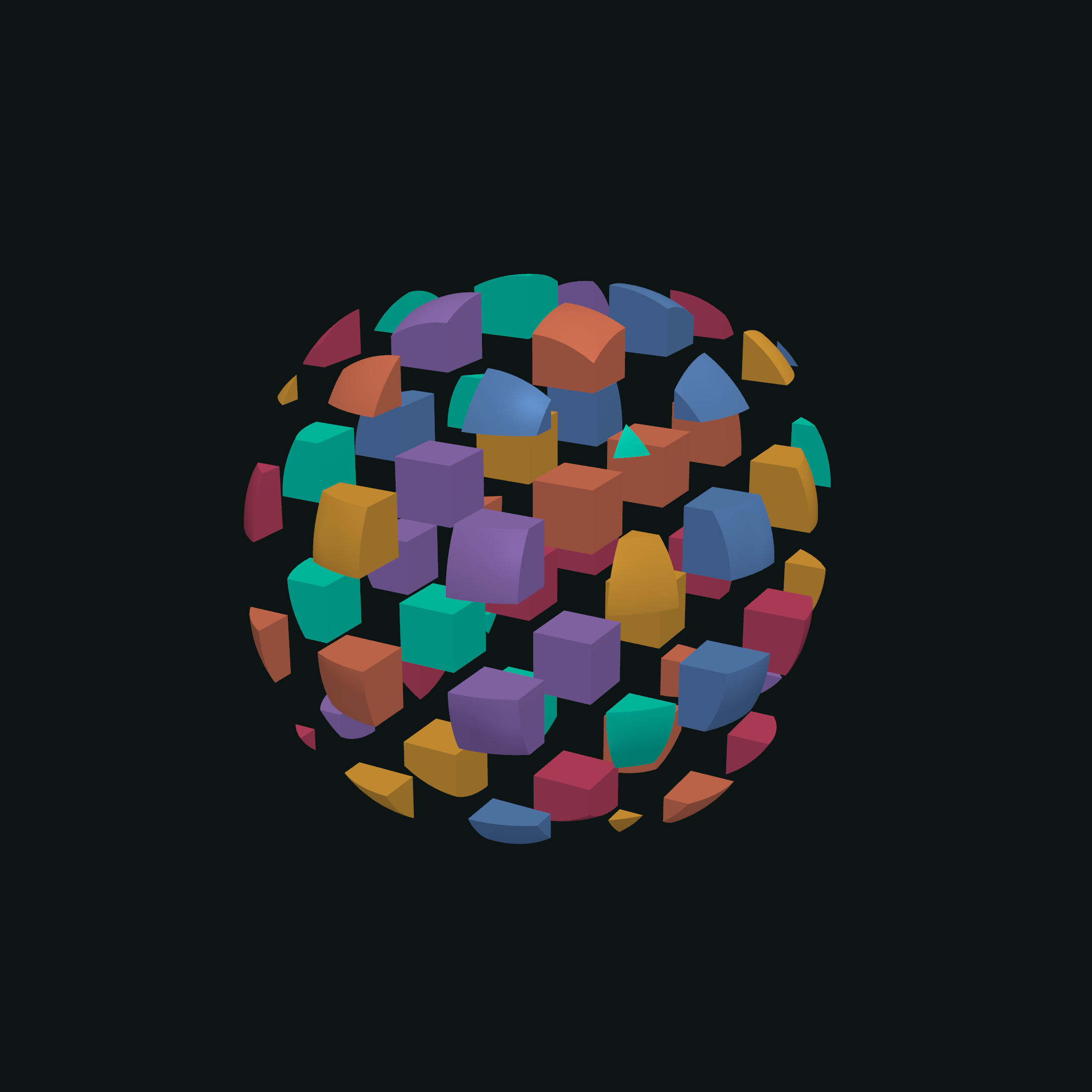
boolean.py— a boolean difference recut live under a dragged sphere widget, the result labeled by source.csg_fracture.py— a sphere minus a grid of cutters through one csg_graph expression, read back as volumetric chunks; clicking a chunk names it throughclosest.isobands.py— height isobands and isocontours overlaid on a surface, recut live from a band-count slider.signed_distance.py— a hills surface recolored live by signed distance to a dragged torus probe, diverging about the zero seam.curvature.py— Gaussian curvature across a torus and mean curvature across a hills surface, from oneprincipal_curvaturescall each.remesh_and_simplify.py— remeshed, decimated, and simplified side by side.raycast_depth.py— an orthographic depth image from one batchedtf.Raycast.
Coming with trueform 0.11
Orientation verdicts (orient_faces_consistently,
ensure_positive_orientation) — the Python binding still returns only the
repaired faces array, no verdict yet.
License
Dual-licensed:
- Noncommercial: PolyForm Noncommercial License 1.0.0
- Commercial: Contact info@polydera.com
1 maintainer

Download files
Download the file for your platform. If you're not sure which to choose, learn more about installing packages.
Source Distribution
Built Distribution
Filter files by name, interpreter, ABI, and platform.
If you're not sure about the file name format, learn more about wheel file names.
Copy a direct link to the current filters
File details
Details for the file pyvista_trueform-0.2.0.tar.gz.
File metadata
- Download URL: pyvista_trueform-0.2.0.tar.gz
- Upload date:
- Size: 52.1 kB
- Tags: Source
- Uploaded using Trusted Publishing? No
- Uploaded via:
twine/7.0.0 CPython/3.13.14
File hashes
| Algorithm | Hash digest | |
|---|---|---|
| SHA256 |
34df0219f8fa671073e5fe673bf7b25f3f6354deb0b80a038441cae3f340b58e
|
|
| MD5 |
0fc65d9ab62486d736c9b81a7358788f
|
|
| BLAKE2b-256 |
470e4c6e92d905d7d2c5c14b7e50bca87b5276813bbf533e44d0640f6dbe7479
|
File details
Details for the file pyvista_trueform-0.2.0-py3-none-any.whl.
File metadata
- Download URL: pyvista_trueform-0.2.0-py3-none-any.whl
- Upload date:
- Size: 48.9 kB
- Tags: Python 3
- Uploaded using Trusted Publishing? No
- Uploaded via:
twine/7.0.0 CPython/3.13.14
File hashes
| Algorithm | Hash digest | |
|---|---|---|
| SHA256 |
2c1c10e3d30c1fa09682a06ef0244cea9ea3a0a3f189ccdc64d1446a2d8530e0
|
|
| MD5 |
016fa17b58f018b8eb1c3e7b4deb346d
|
|
| BLAKE2b-256 |
3867fb1791f277f8c49630629f55dcb6569721a2bdcd2ce83fa30eb4c6d6ec65
|













