
pyxel
python library for experimental mechanics using finite elements
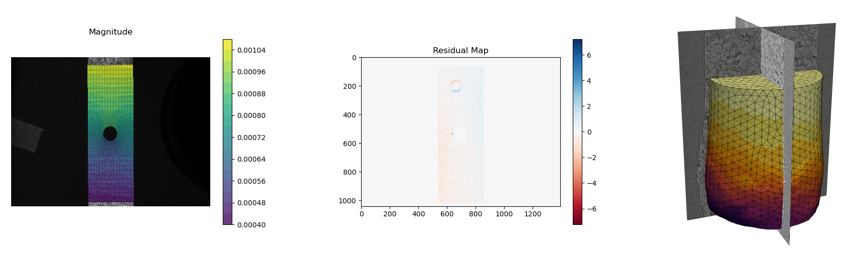
pyxel is an open-source Finite Element (FE) Digital Image/Volume Correlation (DIC/DVC) library for experimental mechanics applications. It is freely available for research and teaching.

In its present form, it is restricted to 2D-DIC and 3D-DVC. Stereo-DIC (SDIC) will be added later.
The gray level conservation problem is written in the physical space. It relies on camera models (which must be calibrated) and on a dedicated quadrature rule in the FE mesh space. For front-parallel camera settings, the implemented camera model is a simplified pinhole model, with 4 parameters in 2D (2 translations, 1 rotation and the focal length) and 7 parameters in 3D (focal length, 3 rotations and 3 translations). More complex camera models (including distortions) could easily be implemented within this framework (next update?).
The library natively includes linear and quadratic triangles, quadrilaterals, tetrahedra and hexahedra. Results can be exported in different formats, so that the measurements can be post-processed either with Matplotlib or with Paraview.
0. Installation
-
Install it from PyPI. The package is named
pyxel-dic, but it is imported aspyxel:pip install pyxel-dic
import pyxel as px
-
Alternatively, clone the git repository and install it in editable mode:
git clone https://github.com/jcpassieux/pyxel.git
cd pyxel
pip install -e .
-
Dependencies (
numpy,scipy,matplotlib,opencv-python,scikit-image,meshio,gmsh) are installed automatically bypip. Python 3 is required.
1. Script files
- pyxel is a library: for each test case, a script file must be written.
- A set of tutorials is provided in the
./testsfolder to illustrate the main functionalities of the library.
2. About meshes
A Finite Element mesh is required for the displacement measurement. In pyxel, a mesh is entirely defined by two variables:
-
A Python dictionary for the elements. The key is the element type label (gmsh numbering) and the value is a numpy array of size
NE * NN, whereNNis the number of nodes of this element type andNEthe number of elements. Example:e = dict() e[3] = np.array([[n0, n1, n2, n3]])
-
A numpy array
nfor the node coordinates. Example:n = np.array([[x0, y0], [x1, y1], ...])
Notes:
pyxelis able to read and write all the mesh types supported bymeshio.
3. Minimal sample code
To run a simple 2D-DIC analysis:
import numpy as np
import pyxel as px

f = px.Image('img-0.tif').Load()
g = px.Image('img-1.tif').Load()
roi = np.array([[100, 100], [500, 500]])
m, cam = px.MeshFromROI(roi, 50, typel=3)
U, res = px.Correlate(f, g, m, cam)
4. Output files
Results can be post-processed directly with Matplotlib:
m.PlotContourDispl(U, s=30)
A more convenient way (especially in DVC) is to use Paraview:
m.VTKSol('vtufile', U)
5. Terms of use
This program is free software: you can redistribute it and/or modify it. It is distributed in the hope that it will be useful, but WITHOUT ANY WARRANTY.
pyxel is distributed under the terms of the CeCILL license, a French free software license agreement in the spirit of the GNU GPL.
6. Dependencies
numpy, scipy, matplotlib, opencv-python, scikit-image, meshio, gmsh
References
Jean-Charles Passieux, Robin Bouclier. Classic and Inverse Compositional Gauss-Newton in Global DIC. International Journal for Numerical Methods in Engineering, 119(6), p. 453-468, 2019.
Jean-Charles Passieux. pyxel, an open-source FE-DIC library. Zenodo. doi:10.5281/zenodo.4654018
How to cite
@article{passieux2019classic,
  author  = {Passieux, Jean-Charles and Bouclier, Robin},
  title   = {Classic and Inverse Compositional Gauss-Newton in Global DIC},
  journal = {International Journal for Numerical Methods in Engineering},
  volume  = {119},
  number  = {6},
  pages   = {453--468},
  year    = {2019}
}

@software{passieux_pyxel,
  author = {Passieux, Jean-Charles},
  title  = {pyxel, an open-source FE-DIC library},
  doi    = {10.5281/zenodo.4654018},
  publisher = {Zenodo}
}
1 maintainer

Metadata
1 maintainer
Release files for pyxel-dic 2026.10.8
For a detailed explanation of source distributions (sdists) and built distributions (wheels), please see the package formats documentation.
Source distribution (sdist)
| File | Size | Uploaded | Provenance | |
|---|---|---|---|---|
| pyxel_dic-2026.10.8.tar.gz | 111.2 kB | Without provenance | Details |
Release files / pyxel_dic-2026.10.8.tar.gz
| Download URL | pyxel_dic-2026.10.8.tar.gz |
|---|---|
| Size | 111.2 kB |
| Tags | Source |
|
SHA-256 checksum How to use checksums |
2d2ddd8b6fa1a780452814115f5dd9a6ad17e8bb0a280ed9abaa0294274c2c09
|
|
BLAKE2b-256 checksum How to use checksums |
dfa472b3a8b39d36e9baabe190489fe01700e578f50de09917a79cd53120d0ac
|
| Upload date | |
|
Uploaded using Trusted Publishing? What is trusted publishing? |
No |
| Uploaded via |
twine/6.1.0 CPython/3.12.7
|
Security for pyxel-dic 2026.10.8
Provenance
Provenance describes where a file came from. On PyPI, provenance is shared via attestations, which provide a verifiable record of the build or publishing details. View details, limitations and caveats.
No provenance found
None of the files in this release were uploaded with provenance metadata.
A note on package security
PyPI is a repository for distributing packages, not a service for auditing them. While third-party security researchers and our staff do their best to detect and remove malicious packages, PyPI cannot guarantee the quality, security or suitability of any given package.
To learn more about protecting yourself from malicious actors, visit our package security documentation.














