

qai-consultant-mcp



Listed on the official MCP registry (io.github.gvasile29/qai-consultant-mcp), Glama, and Awesome MCP Servers.
A local, fully keyless MCP server: standards-grounded QA knowledge retrieval (OWASP, IEEE, ISO, A-SPICE, EU AI Act, plus testing methodologies and audit frameworks), deterministic QA effort estimation, QA document quality review, test-results health analysis, and QA process maturity assessment — callable from Claude Code, Claude Desktop, or any other MCP client that runs local stdio servers.
No API keys, no Pinecone, no cloud LLM calls. It runs a local embedding index over a self-authored QA knowledge base (Markdown only — the ISTQB syllabus and OWASP guide PDFs used by the web app are not bundled, for licensing reasons) and does the estimation math itself; the client LLM writes the narrative, this server just supplies grounding and numbers.
This package is the MCP companion to QAI Consultant, an AI QA Architect web app / CLI. If you're looking for the full app (Risk Register / Effort Estimation / Test Strategy / Test Plan generation with a browser UI), see the main project instead — this package is just the MCP server piece of it.
Install
Requires uv (for uvx).
uvx qai-consultant-mcp
Claude Code:
claude mcp add qai-consultant -- uvx qai-consultant-mcp
Claude Desktop (claude_desktop_config.json):
{
  "mcpServers": {
    "qai-consultant": {
      "command": "uvx",
      "args": ["qai-consultant-mcp"]
    }
  }
}
First run downloads the embedding model (sentence-transformers/all-MiniLM-L6-v2, served via fastembed's ONNX Runtime) and builds a local index — a few seconds to a minute the first time, then it's cached.
Optional agent skill (Claude Code): copy the skills/qai-consultant/ folder into ~/.claude/skills/ (or your project's .claude/skills/). It tells the agent which tool fits a request and how to read the results, for example that an empty flaky-test list after only 1-2 runs means "not enough data", not "no flaky tests". Other agents that read SKILL.md files can use the same folder.
Tools
| Tool | What it does |
|---|---|
retrieve_qa_knowledge |
Grounding chunks from the knowledge base (standards summaries — OWASP Top 10, IEEE 829, ISO/IEC 25010, ISO 26262, A-SPICE, EU AI Act; testing methodologies; audit/evaluation frameworks; AI SDLC case studies), filterable by category; min_score, low_relevance and a per-chunk match (strong/moderate/weak) tell you when the Markdown-only index has no real match |
list_kb_sources |
Every document in the knowledge base, grouped by category |
estimate_qa_effort |
Deterministic PERT-based effort estimate (baseline + complexity multipliers + team capacity + confidence score) — no LLM narrative, you write your own from the numbers; warnings lists any input that was assumed or ignored |
review_qa_document |
Deterministic 0–100 quality score for an existing Test Plan/Strategy/test case list across six ISTQB/IEEE-829-grounded dimensions, with findings and resolved KB citations — no LLM scoring, you write the narrative from the findings |
analyze_test_results |
Deterministic health metrics from JUnit XML or CSV test execution data — flaky tests, ever-failing tests, slowest tests, and failure clustering — no LLM anywhere in this tool |
assess_qa_maturity |
Deterministic indicative TMMi process-maturity level (1-3, never a certified 4-5) from a free-text description or pasted document, plus a conditional 7-check EU AI Act Articles 9-15 readiness score when the input signals an AI/ML system — no LLM anywhere in this tool |
Try It — Example Prompts
Type these directly in Claude Code or Claude Desktop once the server is attached:
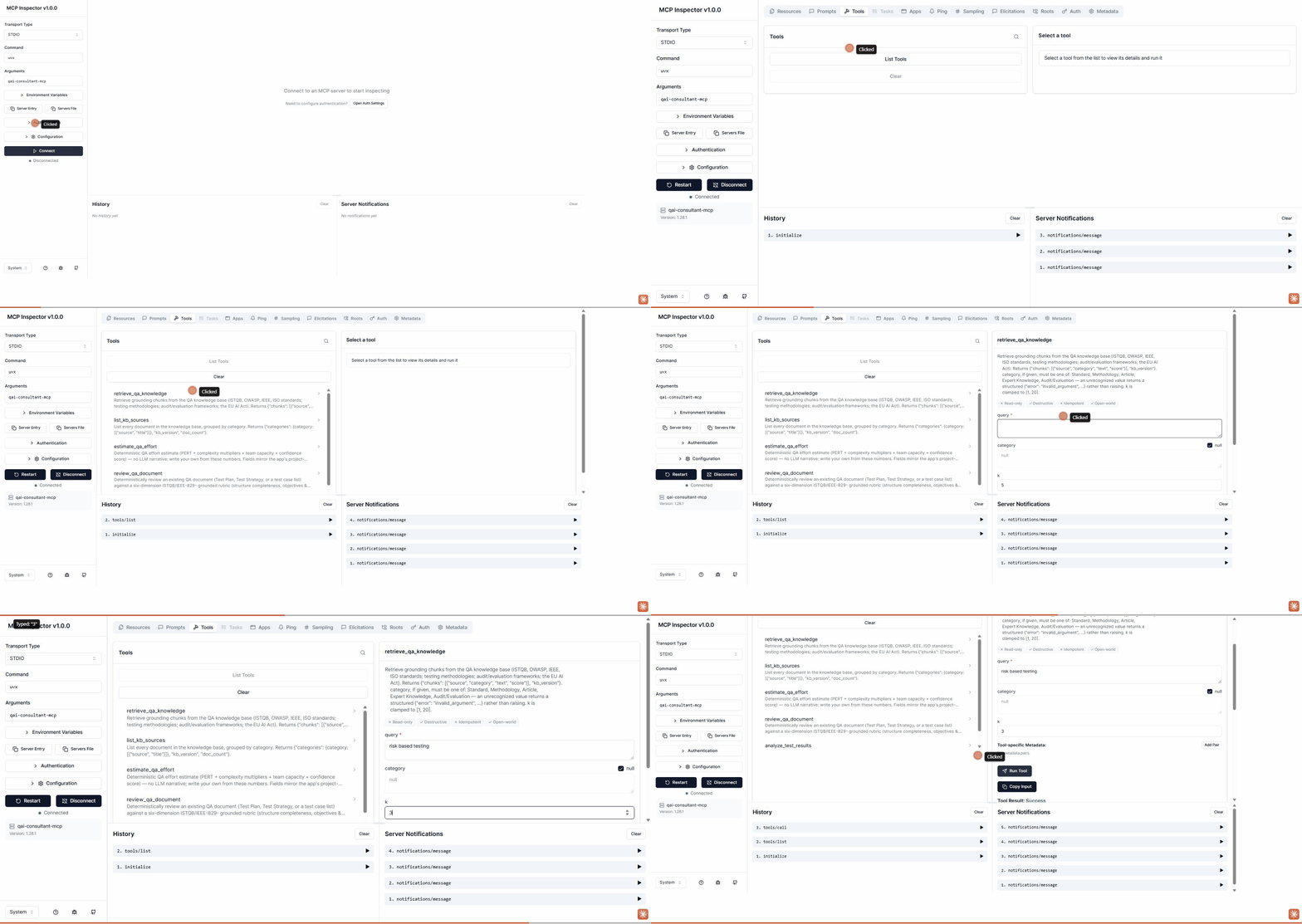
- "Using qai-consultant, what does the knowledge base say about risk-based testing?" →
retrieve_qa_knowledge - "List every document in the qai-consultant knowledge base, grouped by category." →
list_kb_sources - "Using qai-consultant's estimate_qa_effort, estimate the effort for a B2B SaaS project called 'Test Migration', React + Node.js + PostgreSQL, 2 QA / 5 dev engineers, 3-month timeline, Agile/Scrum, no notable known risks, minimal existing test automation, no special compliance requirements." →
estimate_qa_effort - "Here's a Test Plan [paste it] — use qai-consultant to review it with review_qa_document and give me the score and findings." →
review_qa_document - "Here's a JUnit XML report from my last 3 CI runs [paste them] — use qai-consultant's analyze_test_results to find flaky tests." →
analyze_test_results - "Here's how our team tests today [describe it] — use qai-consultant's assess_qa_maturity to estimate our TMMi level and the gaps to close." →
assess_qa_maturity
The first one (retrieve_qa_knowledge) is the fastest way to confirm the server actually attached.
Prompts
qa_project_interview— the project-intake interview (11 questions covering scope, tech stack, team, timeline, risks, compliance)risk_register_structure— Risk Register document structure + grounding instructionstest_strategy_structure— Test Strategy document structure + grounding instructionstest_plan_structure— IEEE 829-aligned Test Plan structure + grounding instructions
Each *_structure prompt instructs the client to ground its generation in retrieve_qa_knowledge results with [Source N] citations, and to label the output as AI-generated.
Privacy
Anonymous usage telemetry is on by default (since v3.7.0). Turn it off with QAI_TELEMETRY=0 or DO_NOT_TRACK=1; the server prints a one-line notice to stderr at startup whenever it's on. Only the tool name, a success flag, duration, retrieval k and category (only when it is one of the five known categories), package/Python version and OS family are sent, under a random ID that is new for every server run and never written to disk — never your query text, project details, or knowledge-base content.
Source
github.com/gvasile29/qai-consultant — Apache 2.0 licensed.
1 maintainer

Metadata
1 maintainer
Release files for qai-consultant-mcp 3.9.1
For a detailed explanation of source distributions (sdists) and built distributions (wheels), please see the package formats documentation.
Source distribution (sdist)
| File | Size | Uploaded | Provenance | Actions |
|---|---|---|---|---|
| qai_consultant_mcp-3.9.1.tar.gz | 260.4 kB | Without provenance | Details for qai_consultant_mcp-3.9.1.tar.gz |
Built distribution (wheel)
| File | Interpreter | ABI | Platform | Actions Reset |
|---|---|---|---|---|
| qai_consultant_mcp-3.9.1-py3-none-any.whl | Python 3 | none | any | Details for qai_consultant_mcp-3.9.1-py3-none-any.whl |
Total release size: 546.7 kB
Release files / qai_consultant_mcp-3.9.1.tar.gz
| Download URL | qai_consultant_mcp-3.9.1.tar.gz |
|---|---|
| Size | 260.4 kB |
| Tags | Source |
|
SHA-256 checksum How to use checksums |
8963e07b944077fe67f743d4172a1b84190a6acc83e7e34d5635f82b18f0f026
|
|
BLAKE2b-256 checksum How to use checksums |
6c6eadb795b537afd04b664b8c1c3fd4572bd46b29461d4d618e38fb3e18f5bb
|
| Upload date | |
|
Uploaded using Trusted Publishing? What is trusted publishing? |
No |
| Uploaded via |
twine/6.2.0 CPython/3.11.3
|
Release files / qai_consultant_mcp-3.9.1-py3-none-any.whl
| Download URL | qai_consultant_mcp-3.9.1-py3-none-any.whl |
|---|---|
| Size | 286.3 kB |
| Tags | Python 3 |
|
SHA-256 checksum How to use checksums |
1d90fa463224084066e42c61b230893e945c184635c27b29eea244450f54ee46
|
|
BLAKE2b-256 checksum How to use checksums |
85d7ad6c0221627d27b072069afb2ac521b671e6d39879b687ba27ca4c0af303
|
| Upload date | |
|
Uploaded using Trusted Publishing? What is trusted publishing? |
No |
| Uploaded via |
twine/6.2.0 CPython/3.11.3
|
Security for qai-consultant-mcp 3.9.1
Provenance
Provenance describes where a file came from. On PyPI, provenance is shared via attestations, which provide a verifiable record of the build or publishing details. View details, limitations and caveats.
No provenance found
None of the files in this release were uploaded with provenance metadata.
A note on package security
PyPI is a repository for distributing packages, not a service for auditing them. While third-party security researchers and our staff do their best to detect and remove malicious packages, PyPI cannot guarantee the quality, security or suitability of any given package.
To learn more about protecting yourself from malicious actors, visit our package security documentation.














