
This release is a pre-release and may not be stable for production use.
QaNN
QaNN (Quantized Nearest Neighbors) is a Python library for fast nearest-neighbor search, written in multithreaded, SIMD-accelerated C++ and driven from NumPy and SciPy.
- Dense vectors: exact search, IVF and HNSW graph search, product and scalar quantization, exact re-ranking.
- Sparse vectors (BM25, SPLADE): exact and approximate inverted-index search.
- Every index: custom ids, deletion, metadata filters, saving and loading.
Alpha: under active development. The API may change between releases.
Performance
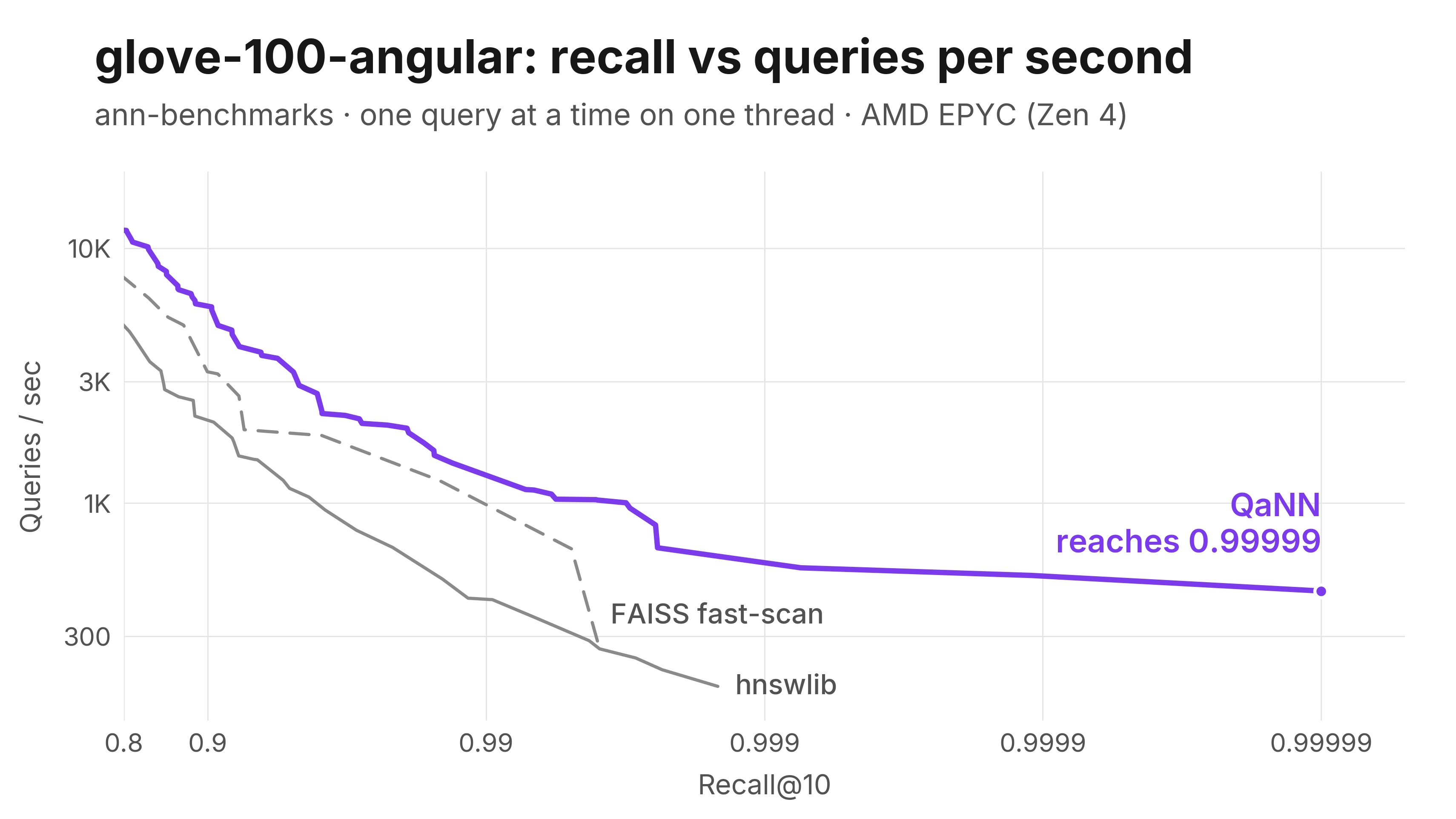
GloVe-100 (1.2M word vectors, angular) on ann-benchmarks: recall@10 against queries per second, one query at a time on one thread of an AMD EPYC 9J14 (Zen 4) VM; up and to the right is better. qann 0.1.0a27, hnswlib 0.8.0, faiss-cpu 1.14.3. Each line is that library's fastest index on this dataset: qann's IVF fast-scan with re-ranking (qann-ivf-fastscan), hnswlib's HNSW and FAISS's IVF-PQ fast-scan. qann's own HNSW, left out for readability, ran just ahead of hnswlib. The harness and configs are on the external-benchmarks branch.
Install
pip install qann
pip install scipy   # only for the sparse indexes
- Wheels: Linux (x86_64, aarch64) and macOS (Apple Silicon, Intel), Python 3.10 to 3.14. x86_64 needs AVX2 and FMA, and uses AVX-512 kernels at run time on CPUs that have it; set
QANN_DISABLE_AVX512=1to keep the AVX2 ones. - From source:
pip install .in a checkout. Needs CMake 3.20+, a C++20 compiler and, on Linux, optionally OpenBLAS (much faster training).
Quick start
import numpy as np, qann

x = np.random.rand(100_000, 128).astype(np.float32)

ivf = qann.IVFIndex(128, nlist=1024, nprobe=16)
ivf.enable_pq(16)                           # store each vector in 16 bytes
ivf.train(x, seed=1)
index = qann.RefineIndex(ivf, k_factor=10)  # re-rank PQ candidates exactly
index.add(x)

ids, dists = index.batch_query(x[:5], 10)   # both shaped (5, 10)
Conventions
- Vectors are 2D NumPy arrays of shape
(n, dim); single vectors (query) are(dim,). float32 C-contiguous arrays are used without copying; anything else is converted first. - Ids count up from 0 in insertion order, unless the index uses custom ids.
- Distances are smallest first: squared L2 by default, or cosine distance / negative inner product with another metric.
- Results from
batch_queryare anint64id array and afloat32distance array, both(num_queries, k). Missing hits are padded with id-1and distanceinf.
Indexes
Indexes come in two families, with one class per search algorithm:
Dense vectors (qann.DenseIndex) |
Sparse vectors (qann.SparseIndex) |
|
|---|---|---|
| Exact | FlatIndex |
InvertedIndex |
| Approximate | IVFIndex, HNSWIndex, RefineIndex (exact re-ranking of either) |
SparseApproxIndex |
- The algorithm is fixed when an index is created. Search settings such as
nprobeoref_searchare properties you can change at any time. To switch type, rebuild:new.add(old.get_vectors(old.ids()), ids=old.ids())(ids only ifnewuses custom ids). - Ids, deletion, metadata, filters and saving work the same in both families (
qann.IndexBase). qann.Indexis the old name ofqann.DenseIndexand still works.HybridIndexcombines a dense and a sparse index over the same documents; see Hybrid search.
Methods every dense index has (sparse indexes take scipy.sparse matrices instead and have no dim):
| Method | Description |
|---|---|
add(data, ids=None, *, metadata=None) |
Add an (n, dim) array, plus ids if the index uses custom ids and optional metadata. Returns the ids. |
batch_query(queries, k, *, allowed=None, where=None) |
k nearest neighbors per row, in parallel. Returns (ids, dists). See Filtered search for allowed and where. |
query(query, k, *, allowed=None, where=None) |
k nearest neighbors of one (dim,) vector. Returns 1D (ids, dists). |
remove(ids) |
Delete vectors by id. Returns how many were deleted. |
compact() |
Free the memory of deleted vectors. Returns how many were freed. |
size(), dim() |
Number of (non-deleted) vectors; vector dimension. |
ids(*, where=None) |
Every live id, ascending (sparse indexes too); with where, only those whose metadata matches, with no vector search. |
get_vectors(ids) |
Copies of the stored vectors, (n, dim), in the order given. Not on PQ or SQ indexes, which keep only codes (stores_vectors is False); a RefineIndex over them works. With Cosine they come back unit-length. |
save(path) |
Save to a file; see Saving and loading. |
metadata_schema, get_metadata, update_metadata, add_metadata_column, drop_metadata_column |
See Metadata. |
Which to pick: FlatIndex up to a few hundred thousand vectors; IVF + fast-scan + RefineIndex when you can train on representative data and build time matters; HNSW when you can't train up front or new kinds of vectors keep arriving. Benchmark on your own data; measurements.
FlatIndex(dim, *, custom_ids=False)
Exact brute-force search: no training, 100% recall, cost linear in the number of vectors. Also useful as ground truth when measuring recall.
index = qann.FlatIndex(128)
index.add(x)
ids, dists = index.batch_query(x[:10], 10)
IVFIndex(dim, nlist, nprobe=10, *, custom_ids=False)
Clusters vectors into nlist lists with k-means, and scans only the nprobe lists nearest each query.
| Member | Description |
|---|---|
train(data, max_iters=10, seed=None, *, clustering=Clustering.EMeans, passes=2) |
Learn the centroids from at least nlist vectors. Call once, before add. The default is e-means (mini-batch k-means) in passes passes over the sample; clustering=qann.Clustering.Lloyd runs Lloyd's k-means for max_iters iterations instead. A PQ codebook always runs 25 Lloyd iterations. |
enable_pq(num_subspaces, centroids_per_subspace=None, *, fast_scan=False, rotate=False) |
Compress vectors with product quantization. Call before train. |
enable_sq(bits=8) |
Store 8 or 4 bits per dimension instead of floats (SQ). Call before train; not with PQ. |
nprobe |
Lists scanned per query: higher is slower and more accurate. |
pq_distance |
qann.PQDistance.ADC (default, more accurate) or SDC. |
precomputed_tables |
Lookup tables built at train time that speed up L2 PQ queries, and cosine ones scored with L2 tables (cosine_inner_product False). On by default; False frees them. Inner product doesn't need them. |
cosine_inner_product |
How Metric.Cosine PQ queries score codes: by inner product with one table per query (True), or with each list's L2 table (False). train() tries both on part of its sample and keeps the one that ranks it better; set it to override. |
fast_scan, sq_bits |
Read-only: the compression in use. |
nlistmust be 100 to 65535. Start withnlistaroundsqrt(n)to4 * sqrt(n), andnprobeat 1% to 5% ofnlist.- With PQ, each vector is split into
num_subspacesslices stored as one byte each: a 128-dim vector (512 bytes) with 16 subspaces takes 16 bytes.dimmust divide evenly. Distances become approximate; wrap the index in aRefineIndexto recover recall.
ivf = qann.IVFIndex(128, nlist=1024, nprobe=16)
ivf.enable_pq(16)
ivf.train(x, seed=1)
ivf.add(x)
ivf.nprobe = 32   # trade speed for recall
Fast-scan
enable_pq(num_subspaces, fast_scan=True) stores 4 bits per slice and scores 32 vectors per SIMD lookup, about 6x faster than regular PQ. Use twice the subspaces you would with regular PQ, and pair it with a RefineIndex:
ivf = qann.IVFIndex(128, nlist=1024, nprobe=16)
ivf.enable_pq(64, fast_scan=True)          # 64 x 4 bits = 32 bytes per vector
ivf.train(x, seed=1)
refine = qann.RefineIndex(ivf, k_factor=16)
refine.add(x)
num_subspacesmust be even and at most 1024.pq_distancemust stayADC.- Without a
RefineIndex, recall is lower and distances are approximate.
Rotation
enable_pq(..., rotate=True) also learns a rotation that spreads information evenly over the subspaces. It helps when dimensions are correlated (SIFT: noticeably higher recall before re-ranking) and does nothing when they aren't (GloVe). Results stay valid either way. Measure on your data.
SQ
enable_sq(8) stores one byte per dimension (a quarter of the floats' memory) and enable_sq(4) half a byte. 8 bits loses little recall and needs no RefineIndex; 4 bits should be wrapped in RefineIndex(k_factor=8).
ivf = qann.IVFIndex(128, nlist=1024, nprobe=16)
ivf.enable_sq(8)
ivf.train(x, seed=1)
ivf.add(x)
Fast-scan, rotation and SQ measurements.
HNSWIndex(dim, M=16, ef_construction=200, *, custom_ids=False, seed=None)
A graph index: each vector links to M near neighbors, and a query walks the graph toward its target. No training, exact distances, builds on all cores; it uses more memory per vector and adds more slowly than IVF.
| Member | Description |
|---|---|
ef_search |
Candidates kept while searching (default 64): higher is slower and more accurate. |
M, ef_construction |
Read-only: the build settings. Higher builds a better graph, more slowly. |
enable_sq(bits=8), train(x) |
Store 8- or 4-bit codes instead of floats. Call enable_sq, then train on a representative sample, before add. |
sq_bits |
Read-only: 8 or 4 with SQ, else 0. |
index = qann.HNSWIndex(128, M=16, ef_construction=200)
index.add(x)
index.ef_search = 128   # trade speed for recall
ids, dists = index.batch_query(q, 10)
M: 16 suits data like SIFT. For text embeddings useM=32to48withef_construction=300to400.- Deleting hides vectors from results.
compact()rebuilds the graph, so call it after many deletes, not each one. - Reproducible builds need
seedandqann.set_num_threads(1); parallel builds differ slightly run to run. - SQ: wrap in a
RefineIndex.k_factor=2is enough for 8 bits; 4 bits needs 4 to 8.
index = qann.HNSWIndex(128)
index.enable_sq(8)
index.train(x)
refine = qann.RefineIndex(index, k_factor=2)
refine.add(x)
RefineIndex(base, k_factor=10, *, custom_ids=False)
Fetches k * k_factor candidates from an approximate base, then re-ranks them by exact distance using full copies of the vectors. This is the usual way to get PQ or SQ speed with near-exact ranking.
basemust be trained, empty, without custom ids and never compacted. Give theRefineIndexits owncustom_idsinstead.- Add, remove and compact through the
RefineIndex. Doing it on the base raisesValueError. - Tune the base through the
baseproperty, e.g.refine.base.nprobe = 32.k_factorcan change at any time.
InvertedIndex(*, custom_ids=False)
Exact search over sparse vectors: BM25 weights or learned sparse vectors such as SPLADE, as scipy.sparse matrices (a column is a term id). Scores by dot product: distance is -(q . d), largest dot product first.
import scipy.sparse as sp

index = qann.InvertedIndex()
index.add(doc_matrix, metadata={"lang": langs})             # (n_docs, vocab) CSR
ids, dists = index.batch_query(query_matrix, 10, where="lang = 'en'")
ids, dists = index.query(query_matrix[[0]], 10)             # one row
- Input: any
scipy.sparsematrix or array; term ids below 2^32. Duplicate entries in a row are summed, zeros dropped. - Results: only documents sharing a term with the query come back, so a row can have fewer than
k. - Pruning (
pruning, on by default) skips work that can't change the topk. Results are identical either way; it helps most at smallk. - Size:
termsandpostingscount distinct terms and stored entries (8 bytes each).
SparseApproxIndex(*, custom_ids=False, query_terms=10, list_depth=10000, k_factor=10)
Approximate sparse search for queries with many terms, such as SPLADE's. Same input and features as InvertedIndex, about twice its memory.
index = qann.SparseApproxIndex()
index.add(doc_matrix)
ids, dists = index.batch_query(query_matrix, 10)
index.list_depth = 2000          # faster, lower recall
- A query uses its
query_termslargest values, reads thelist_depthheaviest entries of those terms, and re-scores the bestk * k_factorexactly.0means all. - Returned distances are exact; only which documents are found is approximate.
- The defaults reached 0.96 recall@10 at about 14x the speed of exact search on 1M SPLADE passages. Measurements.
BM25(k1=1.2, b=0.75)
Turns texts into BM25 sparse vectors for InvertedIndex or HybridIndex, and stays exact as documents come and go:
bm25 = qann.BM25()
index = qann.InvertedIndex(custom_ids=True)
index.add(bm25.encode_documents(texts), ids=doc_ids)
ids, dists = index.query(bm25.encode_query("rate limits on the api"), 10)

index.remove(old_ids)
bm25.remove(old_texts)                 # keep the counts in step with the index
- Scores: documents store saturated term frequencies and each query carries IDF from the current counts, so adds and removes keep scores the same as recomputing BM25 over the live documents, without re-encoding stored ones.
- Tokens: lowercase ASCII letters and digits, Lucene's English stopwords removed, no stemming. FiQA nDCG@10 0.238, matching BEIR's Lucene BM25.
- No vocabulary: a term's id is its 31-bit CRC-32 hash. The counts aren't saved with an index; after
qann.load, callbm25.rebuild(texts)with the stored texts (about 5 s for 1M FiQA-sized documents on an M3). encode_queries(texts)encodes a batch;num_documents,num_termsandtotal_lengthshow the counts.
make_index(type, dim, opts=IndexOptions())
Builds any index from a type and an options object:
opts = qann.IndexOptions()
opts.nlist, opts.nprobe, opts.pq_subspaces = 1024, 16, 16
ivf = qann.make_index(qann.IndexType.IVF, 128, opts)
IndexType is Flat, IVF, HNSW, Inverted or SparseApprox (sparse types ignore dim; pass 0). IndexOptions fields and defaults:
| For | Fields |
|---|---|
| all | custom_ids (False), metric (L2, dense only) |
| Flat | capacity (1024) |
| IVF | nlist (100), nprobe (10), pq_subspaces (0 = no PQ), pq_centroids (256), ivf_sq_bits (0) |
| HNSW | hnsw_m (16), ef_construction (200), ef_search (64), hnsw_sq_bits (0) |
| Inverted | pruning (True) |
| SparseApprox | query_terms (10), list_depth (10000), k_factor (10) |
Metrics
Dense indexes take metric=qann.Metric.L2 (default), Cosine or InnerProduct, fixed at construction, saved with the index and reported by index.metric. They work with every dense index and compression.
index = qann.HNSWIndex(384, metric=qann.Metric.Cosine)
index.add(embeddings)
ids, dists = index.batch_query(query_embeddings, 10)   # dists = 1 - cosine similarity
- Cosine suits most text and image embeddings. Distance is
1 - cosine similarity(0 to 2). Vectors are normalized for you; a zero vector raisesValueError.
Inner product
Use InnerProduct when vector length matters: recommendation factors, multi-vector retrieval (ColBERT, MUVERA), models trained with a dot-product loss.
index = qann.HNSWIndex(64, metric=qann.Metric.InnerProduct)
index.add(item_factors)
ids, dists = index.batch_query(user_factors, 10)   # dists = -(q . x)
- Distance is
-(q . x), so results stay smallest first. Nothing is normalized. - PQ must use
ADC, andprecomputed_tablesreadsFalse(not needed). - HNSW links its graph with a transform that makes inner product search work far better than linking by raw dot product. Measurements.
Custom ids and deleting
Create an index with custom_ids=True to use your own ids (database keys, document ids):
index = qann.FlatIndex(128, custom_ids=True)
index.add(vectors, ids=doc_ids)               # one int per row
ids, dists = index.batch_query(queries, 10)   # ids are your doc_ids
index.remove([doc_ids[0], doc_ids[1]])        # returns 2
- Ids can be any integer array, list or
range. They must be>= 0and unique; a bad batch adds nothing. Every add must pass them. removeskips unknown and already deleted ids. A deleted id can be added again.compact()frees deleted vectors' memory and keeps ids and results unchanged (HNSW rebuilds its graph, so its results can shift slightly). Call it after a large batch of deletes.- Default ids never repeat, even after deletes and
compact(). Keep the idsadd()returns, or use custom ids for data that changes.
Filtered search
To search only some vectors, pass the ids that may be returned as allowed, or filter on stored metadata with where:
in_stock = product_ids[stock > 0]
ids, dists = index.batch_query(queries, 10, allowed=in_stock)
- Filtering happens during the search, so a selective filter still returns
kresults when that many match. - Works on every index, with recall close to unfiltered search. Very narrow filters switch to scoring the allowed vectors directly, which is exact.
- Unknown and deleted ids in
allowedare ignored. One set applies to every row of abatch_query. - Tuning:
HNSWIndex.filter_ef_scalingandIVFIndex.filter_probe_scaling(both on, not saved) keep filtered recall near unfiltered. Turn them off for faster queries when filtered recall is already high on your data.
How each index filters, and measurements.
Metadata
Store attributes with each vector and filter on them:
index.add(vectors, metadata={"category": categories, "price": prices, "year": years})

f = qann.field
ids, dists = index.batch_query(queries, 10, where=(f("category") == "shoes") & (f("price") < 50))
ids, dists = index.batch_query(queries, 10, where=f("year").isin([2024, 2025]) | f("price").is_null())

# or as a SQL WHERE clause, with values passed separately
ids, dists = index.batch_query(queries, 10, where="category = 'shoes' AND price < 50")
ids, dists = index.batch_query(queries, 10, where=("user_id = ? AND year IN (?, ?)", [uid, 2024, 2025]))
- Columns hold ints, floats or strings, one value per vector.
Noneis a null, and so is any column an add leaves out. - Nulls fail every comparison. Use
f("price").is_null()to select them. SQL'sNOTexcludes nulls;~includes them. qann.fieldoperators:==,!=,<,<=,>,>=,.isin([...]),.between(lo, hi),.is_null(), combined with&,|,~.- Parenthesize comparisons:
(f("a") < 1) & (f("b") == 2). - Python's
and/or/notraiseTypeError. - For long chains use
qann.any_of(...)/qann.all_of(...).
- Parenthesize comparisons:
- SQL: comparisons,
[NOT] IN,IS [NOT] NULL,[NOT] BETWEEN,AND,OR,NOTand parentheses. Bad syntax raisesValueError. - Parameters: pass values as
(sql, [values])for?or(sql, {name: value})for:name, never pasted into the string.qann.where(sql, params)returns a reusable filter. - Combining: with both
whereandallowed, results must pass both. - Without a query:
index.ids(where=...)returns every live id matching the filter, ascending, e.g. to delete by filter:index.remove(index.ids(where="source = 'x'")).
Reading and changing metadata:
| Call | Does |
|---|---|
get_metadata(ids, columns=None) |
{name: values}, one value per id. Numbers come back as NumPy masked arrays (masked = null), strings as lists with None. |
update_metadata(ids, {"price": [10, None]}) |
Overwrites those columns for those vectors in place. |
add_metadata_column(name, type, *, default=None, ids=None, values=None) |
New column ('int', 'float' or 'str'): all default, or values for ids and null elsewhere. |
drop_metadata_column(name) |
Removes a column. |
metadata_schema |
Each column's name and type. |
Unknown, deleted or repeated ids raise ValueError. Metadata stays with its vector through remove, compact, save and load. Types, SQL limits and costs.
Hybrid search
Dense and sparse retrievers miss different things: embeddings find paraphrases, keyword weights (BM25, SPLADE) find exact rare terms. A HybridIndex holds both representations of every document, searches both and fuses the rankings:
dense = qann.HNSWIndex(384, metric=qann.Metric.Cosine)
sparse = qann.InvertedIndex()
hybrid = qann.HybridIndex(dense, sparse, custom_ids=True)

bm25 = qann.BM25()
hybrid.add(embeddings, bm25.encode_documents(texts), ids=doc_ids)   # row i of each is document doc_ids[i]
ids, scores = hybrid.batch_query(q_embeddings, bm25.encode_queries(q_texts), 10, where="lang = 'en'")   # highest score first
- One index, one set of ids. The
HybridIndexkeeps the ids and metadata, and both parts stay aligned because only it changes them.addchecks both representations first, so a bad row adds nothing anywhere.remove,compact,saveandqann.loadcover both parts. - Parts: any empty dense index (trained, if it needs it; a
RefineIndexworks too) and any empty sparse index, neither with custom ids. Tune them throughhybrid.denseandhybrid.sparse(e.g.hybrid.dense.ef_search = 128). Adding to them directly raisesValueError. - Fusion settings, saved with the index:
method:"linear"(default) or"rrf", as inqann.fusebelow.weights:(dense, sparse), default(1, 1).rrf_k: default 60.depth_factor: each side fetchesk * depth_factorresults before fusing, default 5.
- Results are
(ids, scores): fusion scores, higher is better, padded with-1/0.querytakes one(dim,)vector and a one-row sparse matrix. - Measured on BEIR, the default (linear, equal weights) beat RRF on every dataset and model tried, and beat the better single retriever in most; tuned weights added up to +0.05 nDCG@10. Results.
Tuning the weights. The best (dense, sparse) weights depend on your data and models: when one side is much weaker, give it less weight. With a few dozen queries whose relevant documents you know, tune_weights tries a range of weights and keeps the best:
relevant = [{12, 40}, {7: 2, 31: 1}, ...]     # per query: a set of relevant ids, or {id: grade}
scores = hybrid.tune_weights(q_dense[:50], q_sparse[:50], relevant[:50], k=10)   # sets hybrid.weights
ids, _ = hybrid.batch_query(q_dense[50:], q_sparse[50:], 10)
print(hybrid.weights, qann.ndcg(ids, relevant[50:]))         # check on queries not used for tuning
tune_weights(dense, sparse, relevant, k=10, *, metric="ndcg", grid=None)returns{(dense, sparse): score}and setsweightsto the best pair (the first on a tie). Each side is searched once and the hits re-fused for every pair, so it costs about onebatch_query.metricis"ndcg","recall"or"mrr", atk. The defaultgridruns from dense only(1, 0)to sparse only(0, 1), starting at(1, 1); only the ratio between the two matters. It uses the currentmethodanddepth_factor.- Ranking metrics for any index's results:
qann.ndcg(ids, relevant, k=None),qann.recall(...)andqann.mrr(...)takebatch_queryids (onerelevantentry per row) or one query's ids, and return the mean over queries. Grades above 0 count as relevant;kdefaults to the row width.benchmarks/hybrid_beir.pyuses them on BEIR.
Fusing results yourself: qann.fuse(results, *, method="rrf", k=60, weights=None, limit=10) merges any ranked lists, for example several dense models or results from another search engine:
d = dense_a.batch_query(q_a, 50)              # fetch several times what you need
s = dense_b.batch_query(q_b, 50)
ids, scores = qann.fuse([d, s], limit=10)
"rrf"(reciprocal rank fusion, the default): each id scoresweight / (k + rank)in every list that has it. Only ranks count, so scores on different scales never need comparing: the safe choice."linear": each list's distances are rescaled per query to 1 (nearest) down to 0 (farthest returned), then summed withweights. With weights tuned on a few labeled queries it usually beats"rrf".- Inputs are
queryorbatch_queryresults, all 1D or all 2D ("rrf"also takes plain id arrays). Ids must mean the same document in every list.
Saving and loading
index.save("vectors.qann")          # str or pathlib.Path
index = qann.load("vectors.qann")   # returns the saved class, e.g. IVFIndex or InvertedIndex
- Everything is restored: vectors, ids, deletions, training, graphs, metadata, the metric and settings. A loaded index gives identical results and keeps accepting adds.
- A
RefineIndexfile includes its base. Tune it throughloaded.base. - Larger than RAM:
qann.load(path, mmap=True)leaves aRefineIndex's raw vectors, anIVFIndex's float and SQ lists and a sparse index's posting lists in the file and reads only what queries touch, so memory holds just the centroids, any PQ codes, ids and metadata. Results are identical; keep the file in place while the index is open. Details. - Safe: an interrupted save never leaves a partial file, and a corrupt or foreign file raises
RuntimeError. - Versioned: newer releases load files from older ones. Details.
A standalone PQCodebook has its own file: pq.save(path) and qann.PQCodebook.load(path). qann.load is for indexes and refuses a codebook file (and the other way round).
Product quantization
PQCodebook(dim, num_subspaces, centroids_per_subspace=256) is the quantizer inside IVFIndex, for direct use:
| Method | Description |
|---|---|
train(data, max_iters=25, seed=None) |
k-means in each subspace over an (n, dim) array. |
encode(vec) |
A (dim,) vector to num_subspaces uint8 codes. |
compute_adc_table(query) |
Distances from a (dim,) query to every centroid, reusable across codes. |
distance_adc(table, code) |
Approximate squared L2 between the table's query and a code. |
distance_sdc(query_code, code) |
Approximate squared L2 between two codes. |
dim(), num_subspaces(), centroids_per_subspace() |
Shape of the codebook. |
save(path), PQCodebook.load(path) |
Save to and load from a file; see Saving and loading. |
pq = qann.PQCodebook(128, 16)
pq.train(x, seed=1)
codes = [pq.encode(v) for v in x[:1000]]
table = pq.compute_adc_table(x[0])
dists = [pq.distance_adc(table, c) for c in codes]
Utilities
| Function | Description |
|---|---|
l2_distance(a, b) |
Row-wise squared L2 between two (m, dim) arrays. |
cosine_distance(a, b) |
Row-wise cosine distance between two (m, dim) arrays. |
set_num_threads(n) |
Threads for batch queries, adds and training. 0 (default) uses every core. |
num_threads() |
Thread count in effect. |
fuse(results, *, method="rrf", k=60, weights=None, limit=10) |
Merge ranked results from several retrievers; see Hybrid search. |
ndcg(ids, relevant, k=None), recall(...), mrr(...) |
Ranking quality of results against known relevant ids; see Hybrid search. |
__version__ |
Installed version. |
Threads and type hints
- Thread-safe: queries, adds and training release the GIL, and several threads can query one index at once. Adds and setting changes wait for running queries, so no query sees a half-updated index.
- Typed: wheels include type stubs for editors and type checkers.
Choosing a configuration
Measured with benchmarks/rag_matrix.py on an AMD EPYC 9J14 VM (8 cores). There are two datasets:
- BEIR FiQA: 58k financial Q&A passages embedded with bge-small (384 dimensions), scored against human relevance labels.
- VIBE arxiv-nomic: 1.34M abstracts embedded with nomic (768 dimensions), scored against exact search.
Each index runs at its cheapest search setting within 0.005 nDCG@10 of exact search (FiQA) or reaching 0.95 recall@10 (arxiv). The full tables are in ARCHITECTURE.md.
| FiQA: µs / query | FiQA: RAM per vector | 1.34M: µs / query | 1.34M: RAM per vector | 1.34M, 1% filter: µs | |
|---|---|---|---|---|---|
FlatIndex (exact) |
2,704 | 1,546 B | 132,396 | 3,082 B | 4,261 |
HNSWIndex + SQ8 + RefineIndex(k_factor=2) |
178 | 532 B | 240 | 916 B | 2,282 |
IVFIndex + fast-scan PQ + RefineIndex(k_factor=4) |
121 | 125 B | 279 | 212 B | 802 |
RAM counts a RefineIndex loaded with qann.load(path, mmap=True), which leaves its full vectors on disk. Latency is one query at a time on one thread.
- Start with IVF + fast-scan PQ +
RefineIndex, loaded withmmap=True:base = qann.IVFIndex(dim, nlist, metric=qann.Metric.Cosine) base.enable_pq(dim // 2, fast_scan=True) base.train(vectors) index = qann.RefineIndex(base, k_factor=4)
On FiQA it came within 0.002 nDCG@10 of exact search, answered fastest on one thread, and kept 12 to 15x less in RAM than float vectors. It also stays fast under metadata filters. - For the most throughput on a large unfiltered corpus, use HNSW + SQ8 +
RefineIndex(k_factor=2). It needs RAM for SQ8 codes and the graph (916 B per vector at 768 dimensions). It answered 21.6k queries per second on 8 cores against 8.0k for IVF + PQ, and built faster at this scale (272 s against 724 s; the benchmark trained IVF on every vector, and a sample would be faster). - Re-rank PQ. Without
RefineIndex, fast-scan PQ found 80-85% of exact search's top 10, and 80-84% under filters. Its nDCG@10 on FiQA dropped only 0.004, since labels are less strict than exact neighbors. SQ8 alone kept 98-99% on FiQA. - Under ~10k vectors, use
FlatIndex. It is exact and fast enough: 130 µs on SciFact's 5k documents. - Selective filters favor IVF at scale. With 1% of 1.34M vectors allowed, HNSW switches to scoring the allowed vectors directly: exact, but 2.3-3.8 ms at 768 dimensions, against 0.35-0.8 ms for IVF.
- Tune hybrid weights when BM25 is weak. On FiQA, linear fusion at the default (1, 1) scored below dense search alone (0.373 against 0.385 nDCG@10);
tune_weightson half the queries reached 0.391 on the other half. On SciFact, where BM25 is strong, the default already gave the best result (0.738 against 0.720 for dense alone).
LangChain
langchain-qann is a LangChain VectorStore on a qann index. It supports the presets "hnsw", "ivf-pq" and "flat" or any qann index you build, metadata filters as dicts, SQL or qann.Expr, hybrid search with BM25 or a SPLADE encoder (sparse="bm25"), and saving to one file:
from langchain_qann import QANNVectorStore

store = QANNVectorStore.from_texts(texts, embeddings, metadatas=metadatas, index="ivf-pq")
docs = store.similarity_search("query", k=10, filter="year >= 2020")
LlamaIndex
llama-index-vector-stores-qann is a LlamaIndex vector store on a qann index. It offers the same presets and your own qann index, translates MetadataFilters into qann filters, supports delete_ref_doc and hybrid query modes (sparse="bm25"), and persists to one file:
from llama_index.vector_stores.qann import QANNVectorStore

store = QANNVectorStore(index="ivf-pq", sparse="bm25")
index = VectorStoreIndex.from_documents(documents, storage_context=StorageContext.from_defaults(vector_store=store))
nodes = index.as_retriever(vector_store_query_mode="hybrid", alpha=0.6).retrieve("query")
More
ARCHITECTURE.md has the design, a file-by-file reference, the measurements behind this README and the benchmarks.
1 maintainer

Metadata
1 maintainer
Release files for qann 0.1.0a32
For a detailed explanation of source distributions (sdists) and built distributions (wheels), please see the package formats documentation.
Source distribution (sdist)
| File | Size | Uploaded | Provenance | Actions |
|---|---|---|---|---|
| qann-0.1.0a32.tar.gz | 4.1 MB | With provenance | Details for qann-0.1.0a32.tar.gz |
Built distributions (wheels)
Total release size: 103.4 MB
Release files / qann-0.1.0a32.tar.gz
| Download URL | qann-0.1.0a32.tar.gz |
|---|---|
| Size | 4.1 MB |
| Tags | Source |
|
SHA-256 checksum How to use checksums |
a79c3ab7c35c318e8de54f0c8931a92b2358f879aa98907b8dc974a7d56c797f
|
|
BLAKE2b-256 checksum How to use checksums |
650a6a5a1026c9ff14477241dd099a6a8e57695c156a947560abaed4c95b0fea
|
| Upload date | |
|
Uploaded using Trusted Publishing? What is trusted publishing? |
Yes |
| Uploaded via |
twine/7.0.0 CPython/3.13.16
|
Provenance
Provenance describes where a file came from. On PyPI, provenance is shared via attestations, which provide a verifiable record of the build or publishing details. View details, limitations and caveats.


PyPI Publish Attestation
PyPI verified that this artifact, at this checksum, originated from the publisher listed below.
Signed by GitHub Actions, verified by PyPI on Nov 18, 2026.
Transparency logRelease files / qann-0.1.0a32-cp314-cp314-manylinux_2_27_x86_64.manylinux_2_28_x86_64.whl
| Download URL | qann-0.1.0a32-cp314-cp314-manylinux_2_27_x86_64.manylinux_2_28_x86_64.whl |
|---|---|
| Size | 13.0 MB |
| Tags | CPython 3.14 Linux glibc 2.27+ x86-64 Linux glibc 2.28+ x86-64 |
|
SHA-256 checksum How to use checksums |
714e73da577f990cc5ed9ae1cd1c66149b4f90158d833d5cd14230d0830e8d2e
|
|
BLAKE2b-256 checksum How to use checksums |
8ab1544e2fb5cd07b48c7eaf260e4cfe2b296e61471d438b7c70e085efbf088e
|
| Upload date | |
|
Uploaded using Trusted Publishing? What is trusted publishing? |
Yes |
| Uploaded via |
twine/7.0.0 CPython/3.13.16
|
Provenance
Provenance describes where a file came from. On PyPI, provenance is shared via attestations, which provide a verifiable record of the build or publishing details. View details, limitations and caveats.
PyPI Publish Attestation
PyPI verified that this artifact, at this checksum, originated from the publisher listed below.
Signed by GitHub Actions, verified by PyPI on Nov 18, 2026.
Transparency logRelease files / qann-0.1.0a32-cp314-cp314-manylinux_2_27_aarch64.manylinux_2_28_aarch64.whl
| Download URL | qann-0.1.0a32-cp314-cp314-manylinux_2_27_aarch64.manylinux_2_28_aarch64.whl |
|---|---|
| Size | 5.8 MB |
| Tags | CPython 3.14 Linux glibc 2.27+ ARM64 Linux glibc 2.28+ ARM64 |
|
SHA-256 checksum How to use checksums |
577dfce2fbcd687b649cb196c76b537786f3930aa7f421e555801e1c489ec7fb
|
|
BLAKE2b-256 checksum How to use checksums |
6c54d1c32e00b5f68b03bc12b6b609122ac87cfb5cf00b91ee4b137f42091106
|
| Upload date | |
|
Uploaded using Trusted Publishing? What is trusted publishing? |
Yes |
| Uploaded via |
twine/7.0.0 CPython/3.13.16
|
Provenance
Provenance describes where a file came from. On PyPI, provenance is shared via attestations, which provide a verifiable record of the build or publishing details. View details, limitations and caveats.
PyPI Publish Attestation
PyPI verified that this artifact, at this checksum, originated from the publisher listed below.
Signed by GitHub Actions, verified by PyPI on Nov 18, 2026.
Transparency logRelease files / qann-0.1.0a32-cp314-cp314-macosx_11_0_x86_64.whl
| Download URL | qann-0.1.0a32-cp314-cp314-macosx_11_0_x86_64.whl |
|---|---|
| Size | 554.9 kB |
| Tags | CPython 3.14 macOS 11.0+ x86-64 |
|
SHA-256 checksum How to use checksums |
21baf879b93180925209e329d4d7773730e28ace8cfa6653cd53d8dfcb3bb2e0
|
|
BLAKE2b-256 checksum How to use checksums |
b2f1e56a49f09af9b321b882a1987cc30f5e1ec2ef345b1bedd23960bfef664b
|
| Upload date | |
|
Uploaded using Trusted Publishing? What is trusted publishing? |
Yes |
| Uploaded via |
twine/7.0.0 CPython/3.13.16
|
Provenance
Provenance describes where a file came from. On PyPI, provenance is shared via attestations, which provide a verifiable record of the build or publishing details. View details, limitations and caveats.
PyPI Publish Attestation
PyPI verified that this artifact, at this checksum, originated from the publisher listed below.
Signed by GitHub Actions, verified by PyPI on Nov 18, 2026.
Transparency logRelease files / qann-0.1.0a32-cp314-cp314-macosx_11_0_arm64.whl
| Download URL | qann-0.1.0a32-cp314-cp314-macosx_11_0_arm64.whl |
|---|---|
| Size | 464.4 kB |
| Tags | CPython 3.14 macOS 11.0+ ARM64 |
|
SHA-256 checksum How to use checksums |
5a7e3d111a373fdc2ef1c0a33c18df3fdc5b0f4fa0d017566f9e2144beb98abb
|
|
BLAKE2b-256 checksum How to use checksums |
89ff8096282fe27b70676fb23d9df0d25b9308d5cc391284a71e049a9685ba95
|
| Upload date | |
|
Uploaded using Trusted Publishing? What is trusted publishing? |
Yes |
| Uploaded via |
twine/7.0.0 CPython/3.13.16
|
Provenance
Provenance describes where a file came from. On PyPI, provenance is shared via attestations, which provide a verifiable record of the build or publishing details. View details, limitations and caveats.
PyPI Publish Attestation
PyPI verified that this artifact, at this checksum, originated from the publisher listed below.
Signed by GitHub Actions, verified by PyPI on Nov 18, 2026.
Transparency logRelease files / qann-0.1.0a32-cp313-cp313-manylinux_2_27_x86_64.manylinux_2_28_x86_64.whl
| Download URL | qann-0.1.0a32-cp313-cp313-manylinux_2_27_x86_64.manylinux_2_28_x86_64.whl |
|---|---|
| Size | 13.0 MB |
| Tags | CPython 3.13 Linux glibc 2.27+ x86-64 Linux glibc 2.28+ x86-64 |
|
SHA-256 checksum How to use checksums |
f9f482d99c38202b0585c1a570d0bb26b6cf0f1515da1b3a38ab403c6455474a
|
|
BLAKE2b-256 checksum How to use checksums |
8e01e78f37094d4c3c547d5be4512d4a12b07dabcb1f98bd2c4ada19af84f786
|
| Upload date | |
|
Uploaded using Trusted Publishing? What is trusted publishing? |
Yes |
| Uploaded via |
twine/7.0.0 CPython/3.13.16
|
Provenance
Provenance describes where a file came from. On PyPI, provenance is shared via attestations, which provide a verifiable record of the build or publishing details. View details, limitations and caveats.
PyPI Publish Attestation
PyPI verified that this artifact, at this checksum, originated from the publisher listed below.
Signed by GitHub Actions, verified by PyPI on Nov 18, 2026.
Transparency logRelease files / qann-0.1.0a32-cp313-cp313-manylinux_2_27_aarch64.manylinux_2_28_aarch64.whl
| Download URL | qann-0.1.0a32-cp313-cp313-manylinux_2_27_aarch64.manylinux_2_28_aarch64.whl |
|---|---|
| Size | 5.8 MB |
| Tags | CPython 3.13 Linux glibc 2.27+ ARM64 Linux glibc 2.28+ ARM64 |
|
SHA-256 checksum How to use checksums |
4d11c49168b43e12b97551cabd23a36d095174c50f84d6cd8471600ebfc5d59a
|
|
BLAKE2b-256 checksum How to use checksums |
add621f66fb9cf8569ef44b8205096b1fd56410ce1d96ff507524554507d4519
|
| Upload date | |
|
Uploaded using Trusted Publishing? What is trusted publishing? |
Yes |
| Uploaded via |
twine/7.0.0 CPython/3.13.16
|
Provenance
Provenance describes where a file came from. On PyPI, provenance is shared via attestations, which provide a verifiable record of the build or publishing details. View details, limitations and caveats.
PyPI Publish Attestation
PyPI verified that this artifact, at this checksum, originated from the publisher listed below.
Signed by GitHub Actions, verified by PyPI on Nov 18, 2026.
Transparency logRelease files / qann-0.1.0a32-cp313-cp313-macosx_11_0_x86_64.whl
| Download URL | qann-0.1.0a32-cp313-cp313-macosx_11_0_x86_64.whl |
|---|---|
| Size | 554.9 kB |
| Tags | CPython 3.13 macOS 11.0+ x86-64 |
|
SHA-256 checksum How to use checksums |
d91ef9b81744bfab0f6097166555f41acd3446a41dbed4a6c28a4a6cd436c5a6
|
|
BLAKE2b-256 checksum How to use checksums |
096beace6714e52e2873572fb5560044067db531ac62772572359523ad1c5684
|
| Upload date | |
|
Uploaded using Trusted Publishing? What is trusted publishing? |
Yes |
| Uploaded via |
twine/7.0.0 CPython/3.13.16
|
Provenance
Provenance describes where a file came from. On PyPI, provenance is shared via attestations, which provide a verifiable record of the build or publishing details. View details, limitations and caveats.
PyPI Publish Attestation
PyPI verified that this artifact, at this checksum, originated from the publisher listed below.
Signed by GitHub Actions, verified by PyPI on Nov 18, 2026.
Transparency logRelease files / qann-0.1.0a32-cp313-cp313-macosx_11_0_arm64.whl
| Download URL | qann-0.1.0a32-cp313-cp313-macosx_11_0_arm64.whl |
|---|---|
| Size | 464.1 kB |
| Tags | CPython 3.13 macOS 11.0+ ARM64 |
|
SHA-256 checksum How to use checksums |
b5bb5235635a48a86e6aa34d15a8a856e86986009e3ec0e2a6ffa1dd8a2ed2cd
|
|
BLAKE2b-256 checksum How to use checksums |
f4c10f5334a44417671e15d5f133bcf73906df3422a3251cedd66a389c5a3f97
|
| Upload date | |
|
Uploaded using Trusted Publishing? What is trusted publishing? |
Yes |
| Uploaded via |
twine/7.0.0 CPython/3.13.16
|
Provenance
Provenance describes where a file came from. On PyPI, provenance is shared via attestations, which provide a verifiable record of the build or publishing details. View details, limitations and caveats.
PyPI Publish Attestation
PyPI verified that this artifact, at this checksum, originated from the publisher listed below.
Signed by GitHub Actions, verified by PyPI on Nov 18, 2026.
Transparency logRelease files / qann-0.1.0a32-cp312-cp312-manylinux_2_27_x86_64.manylinux_2_28_x86_64.whl
| Download URL | qann-0.1.0a32-cp312-cp312-manylinux_2_27_x86_64.manylinux_2_28_x86_64.whl |
|---|---|
| Size | 13.0 MB |
| Tags | CPython 3.12 Linux glibc 2.27+ x86-64 Linux glibc 2.28+ x86-64 |
|
SHA-256 checksum How to use checksums |
07174a55df78e7dbe7f5b8c85924f5774aa1388bcf87c29696c3f47f0bb66b1f
|
|
BLAKE2b-256 checksum How to use checksums |
73ea35a82dec5f4eef60f6757f900bd2fe222f049a5ba22e96949ef1dc0d7b26
|
| Upload date | |
|
Uploaded using Trusted Publishing? What is trusted publishing? |
Yes |
| Uploaded via |
twine/7.0.0 CPython/3.13.16
|
Provenance
Provenance describes where a file came from. On PyPI, provenance is shared via attestations, which provide a verifiable record of the build or publishing details. View details, limitations and caveats.
PyPI Publish Attestation
PyPI verified that this artifact, at this checksum, originated from the publisher listed below.
Signed by GitHub Actions, verified by PyPI on Nov 18, 2026.
Transparency logRelease files / qann-0.1.0a32-cp312-cp312-manylinux_2_27_aarch64.manylinux_2_28_aarch64.whl
| Download URL | qann-0.1.0a32-cp312-cp312-manylinux_2_27_aarch64.manylinux_2_28_aarch64.whl |
|---|---|
| Size | 5.8 MB |
| Tags | CPython 3.12 Linux glibc 2.27+ ARM64 Linux glibc 2.28+ ARM64 |
|
SHA-256 checksum How to use checksums |
43326e044fe0b59fc2dd7315d4284d7629864a3018465816d3d23cb402fe2780
|
|
BLAKE2b-256 checksum How to use checksums |
e43fe55667df7c5d7a92a89460e85b503c05845a2ac522ae24699927c7c9b8df
|
| Upload date | |
|
Uploaded using Trusted Publishing? What is trusted publishing? |
Yes |
| Uploaded via |
twine/7.0.0 CPython/3.13.16
|
Provenance
Provenance describes where a file came from. On PyPI, provenance is shared via attestations, which provide a verifiable record of the build or publishing details. View details, limitations and caveats.
PyPI Publish Attestation
PyPI verified that this artifact, at this checksum, originated from the publisher listed below.
Signed by GitHub Actions, verified by PyPI on Nov 18, 2026.
Transparency logRelease files / qann-0.1.0a32-cp312-cp312-macosx_11_0_x86_64.whl
| Download URL | qann-0.1.0a32-cp312-cp312-macosx_11_0_x86_64.whl |
|---|---|
| Size | 554.9 kB |
| Tags | CPython 3.12 macOS 11.0+ x86-64 |
|
SHA-256 checksum How to use checksums |
8b5d9502ed94bd2e08afe18ec3ad7049905863b1f4df075e0a9895a1ebfce99d
|
|
BLAKE2b-256 checksum How to use checksums |
3b042be97111b74872e17d2563d410ecf5b69a9b16ce8c91093ab088a4fe1252
|
| Upload date | |
|
Uploaded using Trusted Publishing? What is trusted publishing? |
Yes |
| Uploaded via |
twine/7.0.0 CPython/3.13.16
|
Provenance
Provenance describes where a file came from. On PyPI, provenance is shared via attestations, which provide a verifiable record of the build or publishing details. View details, limitations and caveats.
PyPI Publish Attestation
PyPI verified that this artifact, at this checksum, originated from the publisher listed below.
Signed by GitHub Actions, verified by PyPI on Nov 18, 2026.
Transparency logRelease files / qann-0.1.0a32-cp312-cp312-macosx_11_0_arm64.whl
| Download URL | qann-0.1.0a32-cp312-cp312-macosx_11_0_arm64.whl |
|---|---|
| Size | 464.1 kB |
| Tags | CPython 3.12 macOS 11.0+ ARM64 |
|
SHA-256 checksum How to use checksums |
8d0e0270cd310b359f2f1e4c5d5d64aeda7ae57912d38693e05298816ddcfc58
|
|
BLAKE2b-256 checksum How to use checksums |
8decbd8d440433720a0570fe0bb236b555f78dccfc365d977383ff745b1df7e0
|
| Upload date | |
|
Uploaded using Trusted Publishing? What is trusted publishing? |
Yes |
| Uploaded via |
twine/7.0.0 CPython/3.13.16
|
Provenance
Provenance describes where a file came from. On PyPI, provenance is shared via attestations, which provide a verifiable record of the build or publishing details. View details, limitations and caveats.
PyPI Publish Attestation
PyPI verified that this artifact, at this checksum, originated from the publisher listed below.
Signed by GitHub Actions, verified by PyPI on Nov 18, 2026.
Transparency logRelease files / qann-0.1.0a32-cp311-cp311-manylinux_2_27_x86_64.manylinux_2_28_x86_64.whl
| Download URL | qann-0.1.0a32-cp311-cp311-manylinux_2_27_x86_64.manylinux_2_28_x86_64.whl |
|---|---|
| Size | 13.0 MB |
| Tags | CPython 3.11 Linux glibc 2.27+ x86-64 Linux glibc 2.28+ x86-64 |
|
SHA-256 checksum How to use checksums |
e1cfc2de5935d92e5a8647c97c0340c4c6fb0c8b5cc92a49a304a2123bbf3d04
|
|
BLAKE2b-256 checksum How to use checksums |
4ccccd2deca4d6c73e6f1c8a06d46fedde800def54334d722f7484e1095ab988
|
| Upload date | |
|
Uploaded using Trusted Publishing? What is trusted publishing? |
Yes |
| Uploaded via |
twine/7.0.0 CPython/3.13.16
|
Provenance
Provenance describes where a file came from. On PyPI, provenance is shared via attestations, which provide a verifiable record of the build or publishing details. View details, limitations and caveats.
PyPI Publish Attestation
PyPI verified that this artifact, at this checksum, originated from the publisher listed below.
Signed by GitHub Actions, verified by PyPI on Nov 18, 2026.
Transparency logRelease files / qann-0.1.0a32-cp311-cp311-manylinux_2_27_aarch64.manylinux_2_28_aarch64.whl
| Download URL | qann-0.1.0a32-cp311-cp311-manylinux_2_27_aarch64.manylinux_2_28_aarch64.whl |
|---|---|
| Size | 5.8 MB |
| Tags | CPython 3.11 Linux glibc 2.27+ ARM64 Linux glibc 2.28+ ARM64 |
|
SHA-256 checksum How to use checksums |
f7a50c78ec796dd00b178bd03887e26770afbdda3e8dfe27dd51392eeb2184bb
|
|
BLAKE2b-256 checksum How to use checksums |
870a213dbbe2db99cc3882b3b645d1738848276c802539607e5c99865702e141
|
| Upload date | |
|
Uploaded using Trusted Publishing? What is trusted publishing? |
Yes |
| Uploaded via |
twine/7.0.0 CPython/3.13.16
|
Provenance
Provenance describes where a file came from. On PyPI, provenance is shared via attestations, which provide a verifiable record of the build or publishing details. View details, limitations and caveats.
PyPI Publish Attestation
PyPI verified that this artifact, at this checksum, originated from the publisher listed below.
Signed by GitHub Actions, verified by PyPI on Nov 18, 2026.
Transparency logRelease files / qann-0.1.0a32-cp311-cp311-macosx_11_0_x86_64.whl
| Download URL | qann-0.1.0a32-cp311-cp311-macosx_11_0_x86_64.whl |
|---|---|
| Size | 555.0 kB |
| Tags | CPython 3.11 macOS 11.0+ x86-64 |
|
SHA-256 checksum How to use checksums |
6ee9806cc9404cc06da3fbab6517f566778d5d0a30049fd5e18091936df59827
|
|
BLAKE2b-256 checksum How to use checksums |
b45f39027f4dc3610039daa9f8e9ed1b7a95b40a48abbf9b59981b73536c4982
|
| Upload date | |
|
Uploaded using Trusted Publishing? What is trusted publishing? |
Yes |
| Uploaded via |
twine/7.0.0 CPython/3.13.16
|
Provenance
Provenance describes where a file came from. On PyPI, provenance is shared via attestations, which provide a verifiable record of the build or publishing details. View details, limitations and caveats.
PyPI Publish Attestation
PyPI verified that this artifact, at this checksum, originated from the publisher listed below.
Signed by GitHub Actions, verified by PyPI on Nov 18, 2026.
Transparency logRelease files / qann-0.1.0a32-cp311-cp311-macosx_11_0_arm64.whl
| Download URL | qann-0.1.0a32-cp311-cp311-macosx_11_0_arm64.whl |
|---|---|
| Size | 464.9 kB |
| Tags | CPython 3.11 macOS 11.0+ ARM64 |
|
SHA-256 checksum How to use checksums |
7daac7e3d93360485b4d059ad49b034556dbb85601ef2dcbc3ee6c21ae994b05
|
|
BLAKE2b-256 checksum How to use checksums |
d710cc5b2456fed66ab7c19b79e097b49ced2b5168d76c50521281c8a8c30aaf
|
| Upload date | |
|
Uploaded using Trusted Publishing? What is trusted publishing? |
Yes |
| Uploaded via |
twine/7.0.0 CPython/3.13.16
|
Provenance
Provenance describes where a file came from. On PyPI, provenance is shared via attestations, which provide a verifiable record of the build or publishing details. View details, limitations and caveats.
PyPI Publish Attestation
PyPI verified that this artifact, at this checksum, originated from the publisher listed below.
Signed by GitHub Actions, verified by PyPI on Nov 18, 2026.
Transparency logRelease files / qann-0.1.0a32-cp310-cp310-manylinux_2_27_x86_64.manylinux_2_28_x86_64.whl
| Download URL | qann-0.1.0a32-cp310-cp310-manylinux_2_27_x86_64.manylinux_2_28_x86_64.whl |
|---|---|
| Size | 13.0 MB |
| Tags | CPython 3.10 Linux glibc 2.27+ x86-64 Linux glibc 2.28+ x86-64 |
|
SHA-256 checksum How to use checksums |
c8cd17932814bf68a608e98c0f40db7b345bbe780cba1e65642422415a0f3df3
|
|
BLAKE2b-256 checksum How to use checksums |
ef36d7c96b284daa78d62ea5df7fadd008de26feb6880e87cd2e2e75c96a9256
|
| Upload date | |
|
Uploaded using Trusted Publishing? What is trusted publishing? |
Yes |
| Uploaded via |
twine/7.0.0 CPython/3.13.16
|
Provenance
Provenance describes where a file came from. On PyPI, provenance is shared via attestations, which provide a verifiable record of the build or publishing details. View details, limitations and caveats.
PyPI Publish Attestation
PyPI verified that this artifact, at this checksum, originated from the publisher listed below.
Signed by GitHub Actions, verified by PyPI on Nov 18, 2026.
Transparency logRelease files / qann-0.1.0a32-cp310-cp310-manylinux_2_27_aarch64.manylinux_2_28_aarch64.whl
| Download URL | qann-0.1.0a32-cp310-cp310-manylinux_2_27_aarch64.manylinux_2_28_aarch64.whl |
|---|---|
| Size | 5.8 MB |
| Tags | CPython 3.10 Linux glibc 2.27+ ARM64 Linux glibc 2.28+ ARM64 |
|
SHA-256 checksum How to use checksums |
9f83a51d7f255fee0cc58ff9b9e8c15fcdbb5ef8d0a4bc79a938600abcd09d66
|
|
BLAKE2b-256 checksum How to use checksums |
e2ce6d9f17eef42d585f5655a5ea1cee05e487bae37793c7daab94d82e18f3b8
|
| Upload date | |
|
Uploaded using Trusted Publishing? What is trusted publishing? |
Yes |
| Uploaded via |
twine/7.0.0 CPython/3.13.16
|
Provenance
Provenance describes where a file came from. On PyPI, provenance is shared via attestations, which provide a verifiable record of the build or publishing details. View details, limitations and caveats.
PyPI Publish Attestation
PyPI verified that this artifact, at this checksum, originated from the publisher listed below.
Signed by GitHub Actions, verified by PyPI on Nov 18, 2026.
Transparency logRelease files / qann-0.1.0a32-cp310-cp310-macosx_11_0_x86_64.whl
| Download URL | qann-0.1.0a32-cp310-cp310-macosx_11_0_x86_64.whl |
|---|---|
| Size | 554.9 kB |
| Tags | CPython 3.10 macOS 11.0+ x86-64 |
|
SHA-256 checksum How to use checksums |
56c626d6b0bba1edc7fb1a1335d5f65a4ca225105cc46cfd1afba1ae4630b9e8
|
|
BLAKE2b-256 checksum How to use checksums |
9b6cae60d808746de130254c60bd0467c861a368d9cfda86607f7756d3d88df5
|
| Upload date | |
|
Uploaded using Trusted Publishing? What is trusted publishing? |
Yes |
| Uploaded via |
twine/7.0.0 CPython/3.13.16
|
Provenance
Provenance describes where a file came from. On PyPI, provenance is shared via attestations, which provide a verifiable record of the build or publishing details. View details, limitations and caveats.
PyPI Publish Attestation
PyPI verified that this artifact, at this checksum, originated from the publisher listed below.
Signed by GitHub Actions, verified by PyPI on Nov 18, 2026.
Transparency logRelease files / qann-0.1.0a32-cp310-cp310-macosx_11_0_arm64.whl
| Download URL | qann-0.1.0a32-cp310-cp310-macosx_11_0_arm64.whl |
|---|---|
| Size | 464.7 kB |
| Tags | CPython 3.10 macOS 11.0+ ARM64 |
|
SHA-256 checksum How to use checksums |
039b7f96940dbd9ef01aa960ecf8174381b5185204beb961144691867a7ba239
|
|
BLAKE2b-256 checksum How to use checksums |
c8d7f0d2391344c32e718aed6ea8ff1546556412c073a7fc41140c86381754e0
|
| Upload date | |
|
Uploaded using Trusted Publishing? What is trusted publishing? |
Yes |
| Uploaded via |
twine/7.0.0 CPython/3.13.16
|
Provenance
Provenance describes where a file came from. On PyPI, provenance is shared via attestations, which provide a verifiable record of the build or publishing details. View details, limitations and caveats.
PyPI Publish Attestation
PyPI verified that this artifact, at this checksum, originated from the publisher listed below.
Signed by GitHub Actions, verified by PyPI on Nov 18, 2026.
Transparency logSecurity for qann 0.1.0a32
Provenance
Provenance describes where a file came from. On PyPI, provenance is shared via attestations, which provide a verifiable record of the build or publishing details. View details, limitations and caveats.
Full provenance
All 21 files in this release have been uploaded with provenance metadata.
Attestation for qann-0.1.0a32.tar.gz
PyPI Publish Attestation
PyPI verified that this artifact, at this checksum, originated from the publisher listed below.
Signed by GitHub Actions, verified by PyPI on Nov 18, 2026.
Transparency logA note on package security
PyPI is a repository for distributing packages, not a service for auditing them. While third-party security researchers and our staff do their best to detect and remove malicious packages, PyPI cannot guarantee the quality, security or suitability of any given package.
To learn more about protecting yourself from malicious actors, visit our package security documentation.














